
 Worksheets
Waves Benchmark Review
Total questions: 100
Worksheet time: 2hrs 48mins
Which statement correctly describes how a sound wave travels through air?
The wave carries molecules of air away from the source of the sound.
The wave carries energy that causes molecules to move back and forth.
The wave carries a molecule in one direction until it collides with another molecule.
The wave moves through the air and gains energy from the moving molecules that it touches.
What do waves carry through objects?
sound
light
energy
water
A substance that carries sound waves is called
a fulcrum.
a medium.
a spectrum.
an equilibrium.
Campers shouted toward a canyon wall. What characteristic of sound best explains why the campers heard an echo?
Sound waves traveled slowly down the canyon.
Sound waves were absorbed by the canyon wall.
Sound waves reflected off the canyon wall.
Sound waves were refracted around the canyon.
What kind of wave requires the particles of a medium to vibrate and transfer energy
infrared light wave
radio wave
seismic wave
visible light wave
What part of the wave needs to be changed to change frequency?
amplitude
wavelength
crest
trough
A student tied a rope to a tree and created a periodic wave traveling through the rope by making it vibrate up and down.
As the wave travels what is transferred through the wave in the rope between the student and the tree?
mass only
energy only
both mass and energy
neither mass nor energy

Which property of light is demonstrated?
absorption
reflection
refraction
scattering
During a field trip, Tabreia visits a hillside and sees the clear image of a small mountain on the smooth surface of the nearby lake. What behavior of light can explain the appearance of the small mountain on the water's surface?
absorption
reflection
refraction
transmission
Carpet, draperies, and special ceiling materials can hold the energy transported by sound waves which reduces the loudness of sounds. Which term describes what is happening to the sound waves?
absorption
compression
reflection
refraction

What type of wave is this?
Electromagnetic
Mechanical
Both Electromagnetic and Mechanical
What shape are electromagnetic waves?
transverse only
compressional only
both transverse and compressional
What is an example of a vacuum?
light
an empty room
air
outer space
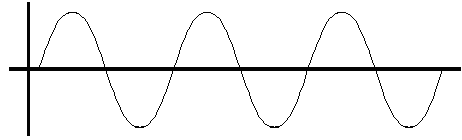



Between waves B and D, which is has a higher amplitude?
Wave B
Wave D
What controls the volume of a sound wave?
amplitude
wavelength
frequency

What do you call the the bending of waves caused by a change in their speed as they pass from one medium to another. The bending of light as it moves from one material to another is ---
refraction
reflection
translucent
absorbed


absorption
diffraction
reflection
refraction
transmission

Which of the following has the shortest wavelength?
microwaves
UV rays
Infrared
the color blue

Which of the following has the most energy?
X-rays
The color green
Microwaves
ultraviolet

Which of the following has the least amount of energy?
UV rays
The color yellow
infrared
Gamma rays

Which of the following has the shortest wavelength?
Gamma rays
The color blue
AM radio
Infrared
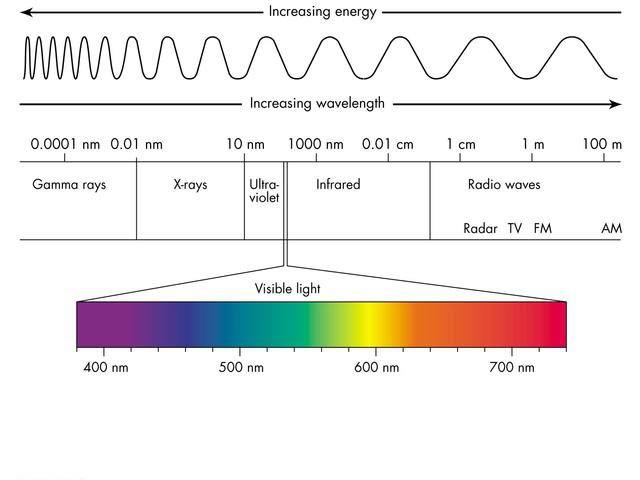
What is the correct order of the visible light spectrum starting with the longer wavelength?
Red, yellow, orange, blue, violet, indigo
Violet, indigo, blue, green, yellow, orange, red
Green, yellow, blue, indigo, red, orange
Red, orange, yellow, green, blue, indigo, violet
Light travels fastest through a ______ because ______
air; the particles are spread farthest apart
glass; the particles are closest together
vacuum; there are no particles
water; the particles are fluid


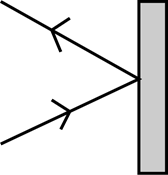
In the illustration, the light ray striking the object is-

What property of a sound wave is a sound's volume related to?
Period
Frequency
Amplitude
Wavelength
What is a mechanical wave?
A wave that requires a medium to travel.
A wave that can travel through a vacuum
Transverse waves but NOT longitudinal waves
Longitudinal waves by NOT transverse waves.
When a mechanical wave encounters and enters a new medium
Absorption
Transmission
Reflection
Mechanical wave
What makes electromagnetic waves different from mechanical waves?
no medium required
medium needed
light -catalyzed
space exclusive
Which electromagnetic wave possesses the least energy?
microwave
radio wave
infrared
gamma ray
What we see after light has been bent through a prism:
The Color Spectrum
White Light
Shadows
Visible light is which type of wave?
seismic
mechanical
longitudinal
electromagnetic
What is transferred by a wave?
Particles
Mass
Matter
Energy
Shaking a rope up and down produces which type of wave?
transverse
amplitude
longititudinal
period
What type of waves are usually found in space?
Mechanical
Electromagnetic

Which image represents a longitudinal wave?
A
B
when the crests of one wave and the troughs of another wave overlap
destructive interference
diffraction
resonance
constructive interference
when the crests and troughs of one wave overlap the crests of another wave or waves
resonance
constructive interference
destructive interference
reflection

A wave travels through a material. (Example: light passes through a window.)
Reflection
Refraction
Absorption
Transmission

Transfer of energy carried by electromagnetic waves to particles of matter.
Reflection
Refraction
Absorption
Transmission
Describe how light interacts with a translucent object.
No light passes through the object.
All light passes through the object.
Some light passes through the object.
How does light interact with a transparent object?
All of the light will pass through the object.
No light passes through the object.
Some light passes through the object, but the light is scattered.
How does light interact with an opaque object?
All light is able to pass through the object.
No light passes through the object.
Some light passes through but is scattered.

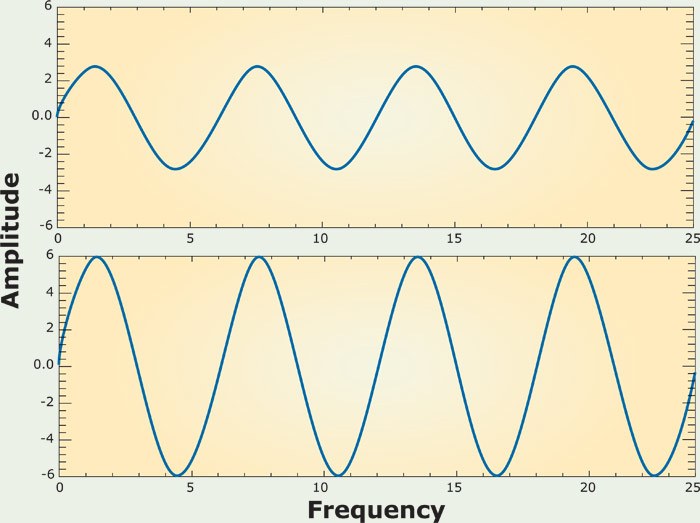
How are these waves different?
The top wave has more energy because it has a higher amplitude.
The top wave has more energy because it has a higher frequency.
The bottom wave has more energy because it has a higher amplitude.
The bottom wave has more energy because it has a higher frequency.
The waves are the same.

When white light is shining through a blue filter onto a red object, what color with the object appear?
Blue because the blue light is the only light hitting the object.
Purple because the red light will mix with the red object.
Black because the red object will absorb the blue light and no light will be reflected.
Black because the red object will reflect the blue light.
If Garrett counts the number of waves that reach the shore over a 10‑second period, what property of the waves is he measuring?
wavelength
speed
frequency
amplitude


Electromagnetic waves vary in
the speed they travel in a vacuum
wavelength and frequency
the way they reflect
the orientation of their electric and magnetic fields
The full range of frequencies of electromagnetic radiation is called
visible light
the electromagnetic spectrum
radio waves
invisible radiation
How is an electromagnetic wave different from a mechanical wave?
An electromagnetic wave travels slower than a mechanical wave.
An electromagnetic wave has a larger amplitude than a mechanical wave.
An electromagnetic wave can travel through a vacuum, but a mechanical wave cannot.
An electromagnetic wave has no wavelength, but a mechanical wave has a wavelength.
The colorful part of the eye, controls light going into the pupil
lens
iris
sclera
retina
carries messages from the eye to the brain
lens
vitreous humor
retina
optic nerve
black circle, allows light to enter the eye
iris
pupil
optic nerve
retina

The material through which a wave travels
Mechanical Wave
Medium
Crest
Trough

