Wayground logo

Free Printable Worksheets

Font size

S
M
L
XL
Worksheets

Gen Bio exam #3

Total questions: 89

Worksheet time: 2hrs 34mins
Name
Class
Date
1.
Which of the following best describes a DNA molecule?
a)
double helix
b)
contains ribose
c)
made of amino acids
d)
contains Uracil
2.
Nitrogenous bases are joined by which type of bond?
a)
polar bonds
b)
ionic bonds
c)
covalent bonds
d)
hydrogen bonds
3.
Cytosine always pairs with
a)
Adenine
b)
Thymine
c)
Uracil
d)
Guanine
4.
Guanine bonds with ______________.
a)
Adenine
b)
Guanine
c)
Cytosine
d)
Thymine
5.
What is the complement to the DNA strand below:
5'-ATGCCAT-3'
a)
5'-TACGGTA-3'
b)
3'-TACGGTA-5'
c)
3'-ATGGCAT-5'
d)
5'-ATGGCAT-3'
6.
Why is DNA important?
a)
it is very small and very complicated
b)
it's in everything
c)
it serves as the blueprint for traits of all living things
d)
because we eat it every day for energy
7.
Which organelle is DNA usually found in?
a)
cell membrane
b)
vacuole
c)
chloroplast
d)
nucleus
8.

What is a section of DNA that codes for a specific protein called?

a)

RNA

b)

replication

c)

gene

d)

protein

9.

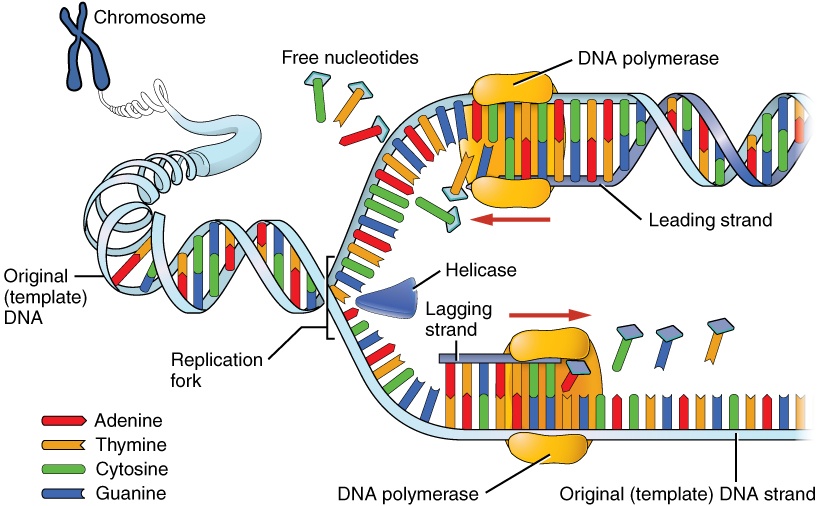
The picture below shows an enzyme unwinding and unzipping DNA.

​

​What is the name of this enzyme?

a)

DNA Helicase

b)

DNA Ligase

c)

DNA polyermase

d)

RNA Polymerase

10.

Which of the following DNA nucleotides are paired with the correct corresponding DNA nucleotide? (mark all that apply)

a)

Adenine with Thymine

b)

Guanine with Cytosine

c)

Thymine with Cytosine

d)

Adenine with Uracil.

e)

Uracil with Thymine

11.

You are given the DNA strand 5'ATGCTCAGCTGA3'. What is the corresponding DNA strand?

a)

5'UACGAGUCGACU3'

b)

5'TACGAGTCGACT3'

c)

3'UACGAGUCGACU5'

d)

3'TACGAGTCGACT5'

12.

Many enzymes are involved in DNA replication. Which is the correct order of enzymes involved in DNA replication from beginning to end?

a)

Helicase, DNA primase, DNA polymerase, Ligase

b)

RNA primase, Helicase, DNA polymerase, Ligase

c)

Helicase, RNA primase, DNA polymerase, Ligase

d)

DNA primase, Helicase, RNA polymerase, Ligase

13.

Which is the role of DNA polymerase?

a)

Unwinds the original DNA strand

b)

Lays down RNA primer for new nucleotide bases.

c)

Builds new strands by bringing in new nucleotide bases.

d)

Remove Okazaki fragments for new nucleotides.

14.

Which is the last step of DNA replication?

a)

RNA Helicase unwinds original DNA strand

b)

DNA Primase lays down RNA primer for new nucleotide bases.

c)

RNA polymerase builds new strands by bring in new nucleotide bases.

d)

Ligase knits together fragments on lagging strand

15.

Which letter in the given picture depicts the okazaki fragments?

a)

A - lagging strand

b)

C - leading strand

c)

B - lagging strand

d)

C - replication fork

16.
The process of DNA replication is called semi conservative because it results in
a)
none of these
b)
Two DNA molecules.  One original molecule and one with two new strands
c)
two exact copies with new strands
d)
two identical molecules, each with 1 original strand and one new.
17.
What strand is copied faster?
a)
Leading
b)
Lagging
18.
Who's work concluded that the %A=%T  and %G=%C
a)
Chargaff
b)
Meischer
c)
Levene
d)
Hammerling
19.

The proteins associated with DNA are called (a)   .

20.
How does RNA differ from DNA?
a)
RNA contains uracil and deoxyribose
b)
RNA contains ribose and thymine
c)
RNA contains uracil and ribose
d)
RNA contains adenine and ribose
21.
How would the DNA sequence GCTATA be transcribed to mRNA?
a)
GCUAUA
b)
CGATAT
c)
CGAUAU
d)
GCUTUT
22.
The process by which the genetic code of DNA is copied into a strand of RNA is called
a)
translation
b)
transcription
c)
transformation
d)
replication
23.

RNA has what base that is instead of thymine?

a)

guanine

b)

adenine

c)

thymine

d)

uracil

24.

Which RNA carries the message?

a)

mRNA

b)

rRNA

c)

tRNA

25.
If one strand of DNA has the sequence TTACCG, the sequence of the other strand of the same molecule will be
a)
AATGGC
b)
TTACCG
c)
AACGGC
d)
AATGGG
26.
True or false:  RNA is double-stranded.
a)
true
b)
false
c)
it depends on the type
27.

Name the enzyme that facilitates opening of DNA helix during transcription.

a)

DNA polymerase

b)

RNA polymerase

c)

DNA ligase

d)

DNA helicase

28.

Code in RNA corresponding to ATGC in DNA

a)

TACG

b)

TACA

c)

AGUC

d)

UACG

29.
Translation takes place in the 
a)
ribosome
b)
chloroplast
c)
nucleus
d)
mitochondria
30.
Brings the amino acids to the ribosome
a)
mRNA
b)
tRNA
c)
rRNA
d)
DNA
31.
What would be the tRNA anticodon for the mRNA codon CAG?
a)
GTC
b)
GUC
c)
CUG
d)
CAG
32.
What is the term for a three-nucleotide sequence that codes for an amino acid?
a)
base
b)
codon
c)
amine
d)
serine
33.

Which phrase best describes translation?

a)

converts mRNA into a polypeptide/protein

b)

catalyzes bonds between amino acids

c)

produces RNA from DNA molecules

d)

recycles tRNA molecules for reuse

34.
What type of bonds are forming during translation?
a)
Peptide bonds
b)
Hydrogen bonds
c)
Acid bonds
35.
How many amino acids are coded for by this sequence of nucleotides:
ATG GGA ACT CCA
a)
4
b)
2
c)
6
d)
12
36.
Amino acids are the building blocks of...
a)
atoms
b)
DNA
c)
proteins
d)
a loving relationship
37.
Which process is used to make mRNA from the DNA in the nucleus?
a)
transcription
b)
translation
c)
replication 
38.
Which is the organelle that makes proteins?
a)
Nucleus
b)
Ribosomes
c)
Rough ER
d)
Golgi Apparatus
39.

This type of mutation occurs when a nitrogen base is added into a sequence and drastically changes the resulting protein.

a)

Point mutation

b)

Frameshift mutation

c)

Chromosomal mutation

d)

Substitution

40.
Any change in the sequence of DNA is...
a)
transgenic shift
b)
Single Genotype
c)
Monohybrid Trait
d)
Mutation
41.
What type of gene mutation has occurred here? Normal-
AGA-TTC-ATA-GCG
Mutant-
AGA-TTC-AAT-AGC-G
a)
deletion frameshift
b)
insertion frameshift
c)
substitution
d)
nonsense
42.
Mutations that occur at a single point in the DNA sequence are:
a)
frameshift
b)
point
c)
deletion
43.
Why are insertion and deletion (frameshift) mutations so harmful?
a)
They change all of the codons from the mutation on down the line, which changes the amino acid sequence
b)
They insert things that an organism doesn't need.
c)
They often delete things that organisms need.
d)
Insertion and deletions are not any more harmful than substitution mutations.
44.
What are things that cause changes in the DNA sequence called?
a)
dangerous
b)
unfortunate
c)
interferon
d)
mutagens
45.

What mutation has occurred here?

T-G-A-C-C-A

T-G-A-G-C-A

a)

Point

b)

Deletion

c)

Insertion

d)

Frameshift

46.
What phase of mitosis is occuring in the picture?
a)
Prophase
b)
Metaphase
c)
Cytokinesis
d)
Telophase
47.
In which phase does the cell spend most of it's life?
a)
Interphase
b)
Nuclear Division
c)
Telophase
d)
Mitosis
48.
What phase of mitosis is pictured?
a)
Metaphase
b)
Telophase
c)
Prophase
d)
Anaphase
49.
Before cells can divide, what must be copied?
a)
mitochondria
b)
cytoplasm
c)
DNA
d)
Cell Wall
50.

in the cell cycle, what is the next stage after TELOPHASE (most of the time)?

a)

Metaphase

b)

anaphase

c)

cytokinesis

d)

interphase

51.

In what stage do the chromosomes line up along the equator of the cell?

a)

interphase

b)

prophase

c)

metaphase

d)

anaphae

52.
The stages of mitosis in order
a)
Metaphase, Anaphase, Prophase, Telophase
b)
Prophase, Anaphase, Metaphase, Telophase
c)
Prophase, Metaphase, Anaphase, Telophase
d)
Anaphase, Prophase, Telophase, Metaphase
53.
In mitosis, the two resulting cells are
a)
different from the starting cell and identical to each other.
b)
different from the starting cell and different from each other.
c)
identical to the starting cell and different from each other.
d)
identical to the starting cell and identical to each other.
54.
A chromatid is attached to a spindle fiber by the
a)
nucleolus
b)
deep furrow
c)
centromere
d)
centriole
55.
The structures that hold together sister chromatids
a)
tissues
b)
chromosomes
c)
spindle
d)
centromeres
56.
What is the name of the structure labeled X?
a)
Centriole
b)
Centrosome
c)
Chromatid
d)
Chromosome 
57.

Nuclear membranes form, cell begins to pinch to begin splitting describes:

a)

Prophase

b)

Anaphase

c)

Telophase

d)

Metaphase

58.

If there are 20 chromosomes in the nucleus before mitosis how many will there be in each new daughter cell after cytokinesis?

a)

20

b)

10

c)

40

d)

200

59.

In which phase does crossing-over happen?

a)

Prophase I

b)

Prophase II

c)

Metaphase I

d)

Anaphase II

60.

 Cells created at the end of meiosis are best known as

a)
somatic cells
b)
gamete cells
c)
skin cells
d)
diploid cells
61.

Unlike mitosis, meiosis results in the formation of

a)

Two genetically identical cells.

b)

Four genetically different cells.

c)

Four genetically identical cells

d)

Two genetically different cells

62.

If an organism has a haploid number of 23, what would be the diploid number?

a)

3

b)

23

c)

46

d)

92

63.

If an organism's lung cells contain 28 chromosomes, its gametes have ____ chromosomes.

a)

28

b)

14

c)

56

d)

7

64.

Sex cells divide using a process called meiosis

a)

True

b)

False

65.

Muscle cells, brain cells, and liver cells are all examples of

a)

Somatic cells

b)

Gametes

c)

Sex cells

d)

Reproductive cells

66.

Mitosis is involved in _____ and _____.

a)

Formation of Gametes.

b)

Formation of Eggs and Sperm cells.

c)

Eggs but not Sperm cells.

d)

Growth and Repair.

67.

With Meiosis, the daughter cells are genetically _____.             

a)

Damaged.

b)

Identical.

c)

Not identical.

d)

Diploid.

68.

Meiosis occurs only in _____.

a)

Reproductive cells.

b)

Injuries and other wounds.

c)

Body cells.

d)

Infants and Children.

69.
Meiosis makes sperm and egg cells. In humans, sperm and egg cells each have _____ chromosomes. Therefore a fertilized human egg cell (sperm and egg cell combined) would create a cell with _____ chromosomes.
a)
23, 46
b)
46, 23
c)
2, 4
d)
50, 100
70.
Unlike mitosis, meiosis in male mammals results in the formation of
a)
one haploid gamete
b)
three diploid gametes
c)
four diploid gametes
d)
four haploid gametes
71.
The following picture represents what pattern of inheritance?
a)
Complete dominance
b)
Incomplete dominance
c)
Co-dominance
d)
Sex-linked inheritance
72.
The following picture represents what pattern of inheritance?
a)
Complete dominance
b)
Incomplete dominance
c)
Co-dominance
d)
Multiple Alleles
73.

Type of inheritance where two alleles both are expressed at the same time in the heterozygote:

a)

Incomplete dominance

b)

Polygenic

c)

Sex-linked

d)

Codominance

74.

Genes are ...

a)

That is hidden whenever the dominant allele is present

b)

Segment of DNA on chromosome that control a trait or characteristic

c)

A number of how an event occur

d)

An organism that has two different alleles for a trait

75.

Dominant alleles are alleles whose trait ......... shows up when the alleles is present.

a)

always

b)

never

c)

sometimes

d)

usually

76.

Different forms of a gene

a)

Punnett square

b)

Gene

c)

Allele

d)

Homozygous

77.

Alleles that are hidden whenever the dominant allele is present

a)

Dominant alleles

b)

Recessive alleles

c)

Homozygous

d)

Heterozygous

78.

What is HOMOZYGOUS?

a)

AA or aa

b)

Aa

c)

Organism that has identical alleles for a trait

d)

Organism that has two different alleles for a trait

79.

What is HETEROZYGOUS?

a)

AA or aa

b)

Aa

c)

Organism that has identical alleles for a trait

d)

Organism that has two different alleles for a trait

80.

An organism's physical appearance or visible trait.

a)

Genotype

b)

Phenotype

81.

An organism's genetic makeup or alleles.

a)

Genotype

b)

Phenotype

82.
A plant shows incomplete dominance in size. A tall plant (TT) is crossed with a medium plant (TS). What fraction of plants will also be tall?
a)
100 %
b)
75%
c)
50%
d)
25%
83.
Which of the following is a hybrid?
a)
BB
b)
bb
c)
Bb
84.

In pea plants, round seeds (R) are dominant to wrinkled seeds (r). Which of the following represents the genotype of a pea plant that is heterozygous?

a)

RR

b)

round

c)

Rr

d)

wrinkled

e)

rr

85.

In mice, black fur (B) is dominant to white fur (b). According to the Punnett square shown, the offspring in box 4 would:

a)

be white.

b)

be heterozygous.

c)

be gray.

d)

be homozygous.

86.

In humans, having freckles (F) is dominant to not having freckles (f).


Two people with freckles get married and give birth to three children. Two of the kids have freckles and one does not.


Both parents must have which genotype?

a)

FF

b)

Ff

c)

ff

87.

If black fur is dominant and white fur is recessive, what genotype would an organism with white fur have?

a)

FF

b)

Ff

c)

ff

88.
Which of the following is homozygous dominant?
a)
Yy
b)
Y
c)
yy
d)
YY
89.
What allele combination should go in the missing box?
a)
AA
b)
Aa
c)
aa
d)
none of these