wayground logo

Free Printable Worksheets

Font size

S
M
L
XL
Worksheets

Kinetics and Gas Laws

Total questions: 104

Worksheet time: 3hrs 15mins

Name
Class
Date
1.
What are the two factors to look for when determining if the reaction is at equilibrium?
a)
Forward reaction rate is faster than the reverse and concentrations are equal
b)
Forward and reverse reaction rates are equal and concentration is conctant
c)
Forward and revers reaction rates are equal and concentration is equal
d)
Forward reaction rate is faster than the reverse and concentration is equal
2.

Identify the incorrect statement about achieving equilibrium.

a)

achieved when product and reactant concentrations are equal

b)

achieved when forward and reverse reaction rates are same

c)

achieved when concentration of reactants is stable/constant

d)

achieved when concentration ratio of reactants to products becomes stable, thus fixing the equilibrium constant (equilibrium position)

3.
This symbol indicates that a reaction is ____________
a)
reversible
b)
irreversible
4.
When the rate of the forward reaction is equal to the rate of backward reaction, the system is said to be in
a)
Chemical Equilibrium
b)
Chemical Balance
c)
Chemical Constant
d)
Chemical Reaction
5.
At what time the reaction reached equilibrium?
a)
t1
b)
t2
c)
t3
d)
t4
6.
It is a chemical reaction where the reactants form products that, in turn, react together to give the reactants back.
a)
reversible reaction
b)
irreversible reaction
c)
decomposition reaction
d)
synthesis
7.
Identify the labels (a) and (b) on the graph.
a)
a is concentration of reactants and b is the concentration of product
b)
a is concentration of product and b is the concentration of reactant
c)
a is the volume of reactants and b is the volume of product
d)
a the mass of reactants and b is the mass of product
8.
Define chemical equilibrium.
a)
A reaction is reversible.
b)
The concentration of the reactants is equal to the concentration of the products.
c)
The rate of a forward reaction is equal to the rate of the reverse reaction.
d)
The reaction stops and no further change in concentration occurs.
9.
At what time (in seconds) is equilibrium established?
a)
0 seconds
b)
1 second
c)
5 seconds
d)
10 seconds
10.
Which of the two graphs reaches equilibrium?
a)
The left one.
b)
The right one.
c)
Both of them.
d)
Neither.
11.
Which of the following is NOT true at equilibrium?
a)
The forward and reverse reactions proceed at the same rate.
b)
The concentrations of reactants and products do not change.
c)
The concentration of the reactants is equal to the concentration of the products.
d)
The forward and reverse reactions continue to occur.
12.
During equilibrium, the rates of the forward and the reverse reaction are ________
a)
the same 
b)
unequal
c)
unequal for exothermic reactions
d)
unequal for endothermic reactions
13.
If a reaction is reversible and has reached equilibrium, what can be said about the amounts of reactants and products?
a)
some reactant, some product
b)
no reactant, all product
c)
all reactant, no product
14.
How does a catalyst change during a reaction?
a)
It is part of the products
b)
It combines with the reactants
c)
It precipitates
d)
It remains unchanged
15.
How do catalysts increase the rate of reaction?
a)
The frequency of collisions is the increased
b)
the activation energy is lowered
c)
the energy of collisions is increased
d)
Both the frequency and energy of collisions is increased
16.
What is the activation energy?
a)
the quantity of heat absorbed in a reaction
b)
the minimum energy needed to begin a reaction
c)
the energy given off after reactants collide.
d)
both the energy and frequeny of collisions in increased
the energy difference between reactants and products
17.
The following factors affect the position of equilibrium EXCEPT
a)
Concentration
b)
Pressure
c)
Temperature
d)
States of matter
18.

2SO2(g)+O2(g)⇌2SO3(g)

Removing O2(g) will

a)

shift equilibrium right

b)

shift equilibrium left

c)

increase pressure

d)

have no change

19.
Changes in pressure will only affect substances that are in the __________ state.
a)
gaseous
b)
liquid
c)
solid
d)
plasma
20.
For the reaction...
SO2 + O2 <−>  SO3
If the equilibrium shifts to the right, the concentration of O2 will ___________.
a)
increase
b)
decrease
c)
remain the same
d)
double
21.

CoCI42- +6H2O →Co(H2O)62+ + 4CI-.


What would happen when H2O is added?

a)

Position of equilibrium will shift to left (and become more blue)

b)

Position of equilibrium will shift to right (and become more pink)

c)

Keq will increase as H2O is added

d)

Position of equilibrium will shift to left to reduce the added H2O

22.

1N2 + 3H2 →2NH3


When the pressure on the system is increased, the equilibrium position shifts to the right. Why?

a)

To increase the amount of products

b)

To reduce the pressure, as the right side has fewer molecules of gas

c)

Keq will increase when it is shifted to the right

d)

To increase the pressure, as the right side has more molecules of gas

23.
What two factors govern whether a collision between reacting particles will be effective?
a)
orientation and potential energy 
b)
kinetic energy and temperature 
c)
kinetic energy and orientation 
d)
potential energy and kinetic energy 
24.
Under the collision theory, the particles must collide with  ____ and ____ for a reaction to occur.
a)
sufficient rate and sufficient energy
b)
sufficient surface area and correct orientation
c)
sufficient catalyst and sufficient energy
d)
sufficent energy and correct orientation
25.
More collisions correspond to a: 
a)
Faster reaction rate  
b)
Slower reaction rate
c)
Constant reaction rate 
d)
None of the above
26.
Which of the following is NOT a factor affecting reaction rate?
a)
temperature
b)
catalysts
c)
particle size
d)
polarity
27.
Which of the following factors increases only the effectiveness of collisions?
a)
temperature
b)
catalysts
c)
concentration
d)
particle size
28.
Reaction rate means...
a)
amount of product formed
b)
speed of reaction
c)
concentration of reacting particles
d)
combining reactants with products
29.
Decreasing the particle size increases the reaction rate because
a)
It makes particles move faster
b)
It increases the likelihood of collisions with the correct geometry
c)
It decreases the surface area available to react
d)
It increases the number of collisions
30.
To slow down a chemical reaction you will do one of the following:
a)
Place the reactants in hot water
b)
Place the products in ice bath
c)
Place the reactants in a ice bath
d)
Keep stirring the reactants with a stirring rod
31.
Why does a higher temperature increase the rate of a reaction?
a)
it increases both the frequency and energy of particle collisions
b)
it only increases the frequency of particle collisions
c)
it only increases the energy of particle collisions
d)
it reduces the activation energy of the reaction
32.
Which of the following increase the reaction rate?
a)
less surface area
b)
lower temperature
c)
an inhibitor
d)
increased concentration
33.

Boyle's Law describes the relationship between ____________ and _____________

a)

temperature and volume

b)

pressure and temperature

c)

pressure and volume

d)

constant temperature and volume

34.
What is the formula for Boyle's Law?
a)
P1V1=P2V2
b)
P1V1/P2V2
c)
P1V2=P2V1
d)
P1/V1=P2/V2
35.

Which graph represents behavior of gas as stated by Boyle's Law

a)

b)

c)

36.

A gas in an environment has a volume of 16.8 L and a pressure of 3.2 atm. If the volume changes to 10.6 L, what will the new pressure be?

a)

5.07 atm

b)

2.02 Pa

c)

5.07 L

d)

2.02 atm

37.
Charles' Law States...
a)
As Pressure goes up volume goes down
b)
As Pressure goes up temperature goes up
c)
As Volume goes up temperature goes up 
d)
As Pressure goes down volume goes down 
38.
The relationship of which two variables are compared in Charles’s Law?
a)
pressure & volume
b)
volume & temperature
c)
temperature & pressure
d)
volume & moles (amount of gas)
39.
What is the formula Charles' Law?
a)
V = T
b)
VT = VT
c)
T1 + V1 = T2 + V2
d)
V1 / T1 = V2 / T2
40.
There are 65 liters of helium in a balloon at 35 K. If the temperature of the balloon is increased to 40 K, what will the new volume of the balloon be?
a)
40 L
b)
70 L
c)
74.3 L
d)
75.9 L
41.
When Volume increases then Pressure must...
a)
Increase
b)
Decrease
42.
What is the new volume of the gas if the pressure on 350 L of oxygen at 720 mm Hg is decreased to 600 mm Hg?
a)
420 L
b)
29.16 L
c)
4200.0 L
d)
291.6 L
43.
A gas occupies 4.98 L at 2.6 atm of pressure. What volume does it occupy at 1.8 atm pressure?
a)
12.9 L
b)
0.72 L
c)
7.2 L
d)
3.44 L
44.
A gas at a volume of 4 liters is at a pressure of 2 atm. The volume is changed to 16 Liters, what must the new pressure be?
a)
2 atm
b)
12 atm
c)
10 atm
d)
0.5 atm
45.
The pressure on a sample of gas is increased from 1.0 atm to 3.0 atm. If the new volume is 0.52 L, find the original volume.
a)
0.52 L
b)
1.56 L
c)
0.173 L
d)
1.00 L
46.
What type of relationship to pressure and volume have?
a)
direct
b)
inverse
c)
no relationship
d)
I don't know
47.
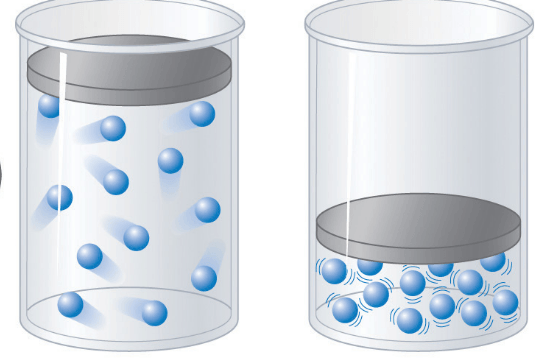
Which container will have a lower pressure?
a)
left
b)
right
c)
they both have the same pressure
d)
I don't know
48.
The relationship of which two variables are compared in Boyle's Law?
a)
pressure & volume
b)
volume & temperature
c)
temperature & pressure
d)
volume & moles (amount of gas)
49.
Which two variables must be held constant for Boyle’s Law to apply?
a)
pressure & volume
b)
volume & temperature
c)
temperature & moles (amount of gas)
d)
volume & moles (amount of gas)
50.
LeGarrette Blount decides to go scuba diving while on vacation in Mexico. As he swims deeper into the ocean, the pressure pushing on him increases. Based on the relationship in Boyle’s law, what would happen to the volume of a LeGarrette’s lungs with this increase in pressure?
a)
volume of the lungs would increase
b)
volume of the lungs would have no change
c)
volume of the lungs would double
d)
volume of the lungs would decrease
51.
True or False: Gases can be compressed. 
a)
True
b)
False
52.
What is the formula Charles' Law?
a)
V = T
b)
VT = VT
c)
T1 / V1 = T2 / V2
d)
V1 / T1 = V2 / T2
53.
What is 50 C in Kelvin?
a)
223
b)
323
c)
100
d)
50
54.

There are 40 liters of helium in a balloon at a temperature of 100 K. If the temperature of the balloon is increased to 200 K, what will be the new volume of the balloon?

a)

80 L

b)

45 L

c)

54 L

d)

45.33 L

55.

If a beach ball has a volume of 261 L at a temperature of 502 K, what will be the new temperature of the balloon if the volume decreases to 176 L?

a)

744 K

b)

0.0030 K

c)

339 K

d)

512 K

56.

The pressure remains constant over a sample of neon gas occupying a volume of 255 mL . The volume is now 323mL because the temperature has increased to 369 K. What is the original temperature of the gas?

a)

291 K

b)

223 K

c)

467 K

d)

76 K

57.

A sample of argon gas is at a temperature of 20 °C. The temperature is increased to 30°C so that the volume is now 373 mL. What was the original volume?

a)

338 mL

b)

411 mL

c)

254 mL

d)

249 mL

58.

The pressure remains constant over a sample of helium gas occupying a volume of 638 mL. The temperature is increased to 471 K and the volume is now 953 mL. What was the original temperature?

a)

315 K

b)

1291 K

c)

704 K

d)

133 K

59.

When the temperature of a gas decreases (with pressure and amount held constant), does the volume increase or decrease?

a)

Unaltered

b)

Remains constant

c)

Increase

d)

Decrease

60.

Charles' Law deals with what quantities?

a)

pressure/temperature

b)

pressure/volume

c)

volume/temperature

d)

volume/temperature/pressure

61.

If the Kelvin temperature of a gas is doubled, the volume of the gas will increase by ____.

a)

A factor of 2

b)

A factor of 1

c)

A factor of 3

d)

A factor of 0.5

62.
The gas in an aerosol can exerts a pressure of 3.00 atm at 25°C. Directions on the can warn the user not to keep the can in a place where the temperature exceeds 100°C. What would the gas pressure in the can be at 100°C?
a)
3.76 atm
b)
2.40 atm
c)
12 atm
d)
0.75 atm
63.

Which of the following is a pair of equivalent values ?

a)

-298 K and O o C

b)

298 K ans -273 o C

c)

319 K and 46 o C

d)

319 K and 592 o C

64.
When the temperature of matter increases the particles...
a)
speed up and move closer
b)
speed up and move farther apart
c)
slow down and move closer together
d)
slow down and move farther apart
65.

Gay–Lussac's Law is a direct relationship between temperature and pressure. Assuming a constant volume, when the temperature increases, then the pressure ________.

a)

Increases

b)

decreases

c)

stays the same

66.

Gay–Lussac's Law is a direct relationship between temperature and pressure.

Assuming a constant volume, if the pressure doubles, then the temperature ________

a)

doubles in Kelvin units

b)

doubles in Celsius units

c)

halves in Celsius units

d)

halves in Kelvin units

67.

A gas in a metal container at 5 atm (P1) has its temperature changed from 20 K (T1) to 90 K (T2). What is the final pressure in atmospheres (P2)?

a)

22.5 atm

b)

22.5 K

c)

225 atm

d)

225K

e)

correct answer is not given

68.

Hydrogen gas has a pressure of 14.2 psi at a temperature of 28 degrees Celsius. If the pressure is increased to 18.4 psi, what will be the new temperature?

a)

390.03 psi

b)

309.03 psi

c)

1,086.82 psi

d)

36.28 psi

e)

correct answer is not given

69.
Molar volume of any gas at STP
a)
22.4 L
b)
2.24 L
c)
6.02 x 10²³ L
d)
224 L
70.
If 3.25 mol of Ar occupies 100. L at a particular temp and pressure, what volume does 14.15 mol of Ar occupy under same condition?
a)
435 L
b)
225 L
c)
100 L
d)
522 L
71.
A 2.00 L sample of pure oxygen gas (O2) is measured at STP.  How many moles of oxygen is this?
a)
24.4 mol
b)
0.007 mol
c)
1.44 mol
d)
0.09 mol
72.
How many molecules are there in a 110 L sample of gas at STP?
a)
8 x 10²³ molecules
b)
8 x 1024  molecules
c)
3 x 1024 molecules
d)
3 x 10²³ molecules
73.
A sample of pure oxygen gas at STP measures out to be 2.00 L.  How many moles of oxygen is this?
a)
24.4 mol
b)
0.007 mol
c)
1.44 mol
d)
0.09 mol
74.
Gases of the same volume contain the same number of molecules.  This is the description of:
a)
Boyle's law
b)
Dalton's law
c)
Charles' law
d)
Avogadro's law
75.
A sample of carbon dioxide at STP is 0.50 L.  How many grams of carbon dioxide do we have?
a)
0.48 g
b)
0.49 g
c)
1.96 g
d)
0.98 g
76.

What is the value of STP?

a)

0 K and 1 atmosphere

b)

0 C and 1 atmosphere

c)

32 F and 1 atmosphere

d)

100 C and 1 atmosphere

77.

If I initially have 4.0 L of a gas at a pressure of 1.1 atm, what will the volume be if I increase the pressure to 3.4 atm?

a)

1.29 L

b)

12.36 L

c)

1.29 atm

d)

12.36 atm

78.

If I have 5.6 liters of gas in a piston at a pressure of 1.5 atm and compress the gas until its volume is 4.8 L, what will the new pressure inside the piston be?

a)

1.8 atm

b)

3.27 atm

c)

1.8 L

d)

3.27 atm

79.

I’ve got a car with an internal volume of 12,000 L. If I drive my car into the river and it implodes, what will be the volume of the gas when the pressure goes from 1.0 atm to 1.4 atm?

a)

8571.43 L

b)

3210.26 L

c)

8669.0 atm

d)

3905.33 atm

80.

A sample of nitrogen occupies a volume of 250 mL at 25oC. What volume will it occupy at 95oC?

a)

308.70 mL

b)

456.1 mL

c)

308.70oC

d)

456.1oC

81.

Oxygen gas is at a temperature of 40oC when it occupies a volume of 2.3 liters. To what temperature should it be raised to occupy a volume of 6.5 liters?

a)

611.84oC

b)

611.84 K

c)

880.33 K

d)

880.33oC

82.

Hydrogen gas was cooled from 150oC to 50oC. Its new volume is 75 mL. What was its original volume?

a)

98 mL

b)

98 K

c)

98oC

d)

98 L

83.

A rigid plastic container holds 1.00 L methane gas at 0.9 atm pressure when the temperature is 22.0°C. How much more pressure will the gas exert if the temperature is raised to 44.6°C?

a)

0.97 atm

b)

1.82 atm

c)

0.97oC

d)

1.82oC

84.

If a gas sample has a pressure of 30.7 kPa at 0.00°C, by how much does the temperature have to decrease to lower the pressure to 28.4 kPa?

a)

33.89 oC

b)

-20.46 oC

c)

597 oC

d)

-4.25 oC

85.

Which of the following is NOT a factor in the ideal gas law?

a)

pressure

b)

temperature in Kelvins

c)

amount of a substance in moles

d)

type of container

86.
Which law helps us find the moles of gas in a sample?
a)
Charles Law
b)
Boyle's Law
c)
Combined Gas Law
d)
Ideal Gas Law
87.

What does R stand for

a)

Ideal gas constant

b)

Molar constant

c)

Temperature constant

d)

Ideal gas law

88.

What does the variable "n" represent in the ideal gas law?

a)

pressure

b)

volume

c)

moles

d)

the gas constant

e)

temperature

89.
In order to solve gas law calculations, temperature must be measured in:
a)
Fahrenheit
b)
Celsius
c)
Kelvin
d)
It doesn't matter 
90.

Which of the following variables is NOT correctly matched with its value for this problem:

What pressure is required to contain 0.023 moles of nitrogen gas in a 4.2 L container at a temperature of 20⁰C?

a)

V = 4.2 L

b)

R = 0.0821 L⋅atm∕mol⋅K

c)

n = 0.023 mol

d)

P = 20⁰C

91.

Choose the correct set of variables to solve the following problem: What is the volume of a balloon if it contains 3.2 moles of helium at a temperature of 20⁰C and 1.2 atm?

a)

P = x (unknown), V = 3.2 mol, n = 1.2 atm, T = 20⁰C K

b)

P = 1.2 atm, V = 3.2 mol, n = 20⁰C, T = x (unknown)

c)

P = 293 K, V = 3.2 mol, n = x (unknown), T = 1.2 atm

d)

P = 1.2 atm, V = x (unknown), n = 3.2 mol, T = 293 K

92.
Calculate the volume that a 0.323-mol sample of a gas will occupy at 265 K and a pressure of 0.900 atm.
a)
7.18 L 
b)
7.81 L
c)
4.63 L
d)
4.36 L
93.
What pressure, in atm, is exerted by 2.50 L of gas containing 1.35 mol at 320 K?
PV=nRT
a)
14.19 atm
b)
16.53 atm
c)
18.42 atm
d)
22.54 atm
94.
If the pressure exerted by a gas at 25 degrees C in a volume of 0.044 L is 3.81 atm, how many moles of gas are present?
a)
.002766 mole
b)
.0069 mol
c)
2.766 mol
d)
9.887 mol
95.
In order to convert to Kelvin, you add ______ to the Celsius measurement.
a)
372
b)
273
c)
237
d)
732
96.

Solve the following probem:

What pressure is required to contain 0.23 moles of nitrogen gas in a 4.2 L container at a temperature of 20⁰C?

a)

1.32 atm

b)

0.048 atm

c)

2.49 atm

d)

19.32 atm

97.
What is the pressure exerted by 5.00 moles of nitrogen gas contained in a 30.0 Liter container at 25.0 °C?
a)

3670 atm

b)

0.245 atm

c)

4.08 atm

d)

605 atm

98.
At 17 °C, a 0.80 mole sample of a gas exerts a pressure of 1.2 atmospheres. What is the volume of the container?
a)

22.9 Liters

b)

2355 Liters

c)

0.0630 Liters

d)

15.9 Liters

99.
How many moles of propane gas are in a 7.0 L tank at 20°C and 5.45atm of pressure?
a)
0.629 mol
b)
1.59 mol
c)
23.2 mol
d)
917 mol
100.

A 7.50 liter sealed jar at 18 °C contains 0.125 moles of oxygen and 0.125 moles of nitrogen gas for a total of 0.25 moles of gas. What is the pressure in the container?

a)

7.38 atm

b)

0.796 atm

c)

0.684 atm

d)

0.398 atm

101.
How many moles of oxygen must be placed in a 3.00 liter container in order to exert a pressure of 2.00 atmospheres at 25 °C?
a)

146.8 moles

b)

0.245 moles

c)

21778 moles

d)

4.08 moles

102.
At what temperature (in Kelvin) would 4.0 moles of hydrogen gas in a 100 liter container exert a pressure of 1.00 atmospheres?
a)

0.0305 K

b)

0.487 K

c)

32.8 K

d)

304.5 K

103.

Determine the Kelvin temperature required for 0.0470 mol of gas to fill a balloon to 1.20 L under 0.998 atm pressure. 

a)

0 K 

b)

107 K 

c)

207 K 

d)

310 K 

104.

Solve the following problem:

What is the volume of a balloon if it contains 3.2 moles of helium at a temperature of 20⁰C and 1.2 atm?

a)

106.55 K

b)

53.3 L

c)

293 K

d)

64.15 L