wayground logo

Free Printable Worksheets

Font size

S
M
L
XL
Worksheets

First Nine Weeks Practice

Total questions: 71

Worksheet time: 2hrs 37mins

Name
Class
Date
1.
The smallest unit of a pure substance that has the properties of that substance
a)
element
b)
atom
c)
neutron
d)
compound
2.
Atoms are made up of three basic parts, which are -
a)
Protons, neutrons, electrons
b)
neutrinos, protons, neutrons
c)
quarks, protons, electrons
d)
electrons, neutrons, and quarks
3.
The nucleus is made up of -
a)
neutrons and electrons
b)
protons and neutrons
c)
protons and electrons
d)
electrons and quarks
4.
Protons have this charge -
a)
positive
b)
negative
c)
neutral
d)
no charge
5.
Electrons have this charge - 
a)
positive
b)
negative
c)
neutral
d)
no charge
6.
Neutrons have this charge -
a)
positive
b)
negative
c)
neutral
d)
They don't exist
7.
What scientist is best known for his "Plum Pudding" model of the atom?
a)
J.J. Tomson
b)
Ernest Rutherford
c)
John Dalton
d)
Democritus
8.
An atom's overall charge is ________.
a)
positive 
b)
depends
c)
neutral 
d)
negative 
9.
J.J. Thomson provided evidence that an atom...
a)
is the smallest particle of matter
b)
contains negatively charged particles
c)
has an overall negative charge
d)
has an overall positive charge
10.
Rutherford's gold foil experiment provided evidence that...
a)
negative and positive charges are spread evenly throughout the atom.
b)
alpha particles have a positive charge.
c)
gold is not a dense as previously thought.
d)
there is a dense positively charged nucleus at the center of an atom.
11.
Ernst Rutherford discovered which part of the atom through the use of gold foil?
a)
Proton
b)
Neutron
c)
Electron
d)
Orbitals
12.
The particles that are found in the nucleus of an atom are
a)
neutrons and electrons
b)
electrons only
c)
protons and neutrons
d)
protons and electrons
13.

How many valence electrons does Hydrogen Have?

a)

1 Valence electron

b)

2 Valence electron

c)

3 Valence electron

d)

4 Valence electron

e)

5 Valence electron

14.

How many valence electrons does Helium Have?

a)

1 Valence electron

b)

2 Valence electron

c)

3 Valence electron

d)

4 Valence electron

e)

5 Valence electron

15.

How many valence electrons does Nitrogen Have?

a)

1 Valence electron

b)

2 Valence electron

c)

3 Valence electron

d)

4 Valence electron

e)

5 Valence electron

16.

How many valence electrons does Aluminum Have?

a)

1 Valence electron

b)

2 Valence electron

c)

3 Valence electron

d)

4 Valence electron

e)

5 Valence electron

17.

How many valence electrons does Neon Have?

a)

4 Valence electron

b)

5 Valence electron

c)

6 Valence electron

d)

7 Valence electron

e)

8 Valence electron

18.

How many valence electrons does Fluorine Have?

a)

4 Valence electron

b)

5 Valence electron

c)

6 Valence electron

d)

7 Valence electron

e)

8 Valence electron

19.
What atom matches this electron configuration?
1s22s22p63s23p64s23d10
a)
Zinc
b)
Copper
c)
Nickel
d)
Germanium
20.
What atom matches this electron configuration?
1s22s22p63s2
a)
Neon
b)
Magnesium
c)
Aluminum
d)
Potassium
21.
What electron configuration matches an oxygen atom?
a)
1s22s22p63s2, 3p64s23d104p5
b)
1s22s22p4
c)
1s22s22p6
d)
1s22s22p63s23p64s23d1
22.
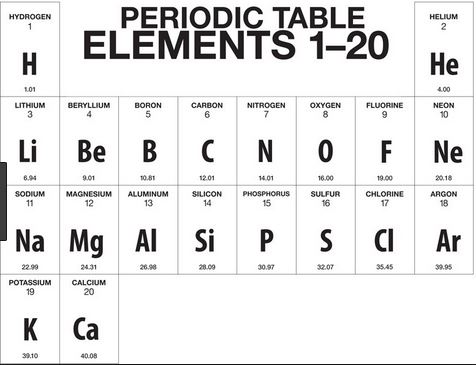
How many electrons does Si contain? (click to see image)
a)
14
b)
28
c)
2
d)
4
23.
How many electrons can the first energy level hold?
a)
1
b)
2
c)
8
d)
0
24.
The electron configuration of an atom is 1s22s22p6.  The number of electrons in the atom is 
a)
3
b)
6
c)
8
d)
10
25.
What is this element?
1s22s22p63s2
a)
Neon
b)
Magnesium
c)
Aluminum
d)
Potassium
26.
Which electron configuration belongs to Chlorine (Cl)?
a)
1s2s2p3s3p5
b)
1s2s2p3s3p6
c)
1s2s2p3s3p7
27.
There are 4 different types of subshells s,p,d,f
a)
true
b)
false
28.

Horizontal (SIDE TO SIDE) rows on the periodic table are

a)

groups

b)

periods

29.

The period number tells you the number of

a)

protons

b)

energy levels

c)

valence electrons

30.

How many energy levels does Au have? Just give me the number.

(a)  

31.

H and He have the same number of energy levels.

a)

True

b)

False

32.

what period would this element be in?

a)

6

b)

8

c)

3

d)

16

33.

True or False: The ground state is the highest energy state of an atom.

a)

True

b)

False

34.
For an electron to change from ground state to an excited stated it must...
a)
Absorb energy
b)
Release energy
35.

What is the light that you can see called?

a)

observatory light

b)

ultraviolet light

c)

visible light

d)

infrared light

36.
Line emission spectrum shown below happens when
a)
Electron transition from lower to higher energy level.
b)
Electron transition from higher to lower energy level.
c)
Electron exist in fixed energy states
d)
Electron transition between different energy levels.
37.

The unknown emissions spectra belongs to the element

a)

Hydrogen

b)

Mercury

c)

Neon

d)

Sodium

38.

If an electron moves from n=4 to n=2 it ____

a)

absorbs energy

b)

releases energy

39.
The section labeled D is known as the?
a)
Electron cloud
b)
Neutron
c)
Nucleus
d)
Electron
40.
Letter A Is positively charged particle called?
a)
Neutron
b)
Proton
c)
Electron
d)
Atom
41.
How many electron shells does this atom have?
a)
1
b)
2
c)
3
d)
4
42.

Who discovered that the atom had an small, dense, positively charged center?

a)

Ernest Rutherford

b)

J.J Thomson

c)

Robert Millikan

d)

John Dalton

43.
What can you conclude from the fact that scientists continue to update the atomic model?
a)
New information about atoms continues to be discovered
b)
Old information about atoms is completely useless
c)
Scientists did not have any information about atoms until a few years ago
d)
Scientists still have no idea what atoms look like
44.

In the model nicknamed "the solar system model" what are the electrons like?

a)

the sun

b)

the nucleus

c)

the planets

d)

the moon

45.

Who proposed that electrons move around the nucleus in circular orbits?

a)

Dalton

b)

Thomson

c)

Rutherford

d)

Bohr

46.
24.1% of all the isotopes of a an element have a mass of 75.23 amu, 48.7% have a mass of 74.61 amu, and 27.2% have a mass of 75.20 amu.
What is the average mass of this element?
a)

74.92 amu

b)

24.97 amu

c)

75.01 amu

d)

74.51 amu

47.
What does the 1.00794 stand for?
a)
Hydrogen
b)
atomic number
c)
atomic mass
d)
atomic explosion
48.

The atomic mass of an element is the ___.

a)

average of the mass number and the atomic number for the element

b)

weighted average of the masses of the isotopes of the element

c)

total mass of the isotopes of the element

d)

total number of subatomic particles in the nucleus

49.
An isotope has three forms.  30% have a mass of 4 amu, 20% have a mass of 5 amu and 50% have a mass of 3 amu.  Average atomic mass will be closest to
a)

2 amu

b)

3 amu

c)

4 amu

d)

5 amu

50.
For a given element, the atomic number indicates the number of _____
a)
protons in the nucleus
b)
neutron in the nucleus
c)
electrons in the atom
d)
nucleons in the atom
51.
As you move down a group, atomic radius increases because - 
a)
you add more and more neutrons
b)
you add more and more protons
c)
you add more and more shells (energy levels)
d)
you add more atomic mass
52.
The atom with the largest atomic radius in Group 18 is - 
a)
Ar
b)
He
c)
Kr
d)
Rn
53.
As you move across the periodic table from left to right, the atomic radius decreases.  This is because - 
a)
the number of protons increases, so attraction to electrons increases
b)
the number of energy levels increases
c)
the number of electrons increases
d)
the atomic mass increases
54.
The atom with the largest atomic radius in Period 4 (row 4) is - 
a)
K
b)
Kr
c)
Fe
d)
Fe
55.
Francium (Fr) has the lowest ionization energy in Group 1 because - 
a)
it has the smallest number of valence electrons
b)
it has the greatest atomic mass
c)
it has the greatest number of protons, so it attracts its electrons the strongest
d)
its 1 valence electron is very far from the nucleus, so little energy is needed to remove it
56.
As you move across the periodic table atoms tend to get smaller because, ______________.
a)
the atoms have more mass.
b)
the atoms have less mass
c)
the atoms have more protons.
d)
the atoms have less electrons.
57.
The energy required to remove electrons is the definition of: 
a)
Electronegativity
b)
Atomic Number
c)
Atomic Radius
d)
Ionization
58.
Families all have similar 
a)
Names
b)
atomic numbers
c)
atomic masses
d)
properties
59.
Electronegativity is...
a)
the ability of an atom to attract/ accept electrons
b)
the ability of an atom to lose electrons
c)
the energy required to remove an electron from a specific atom
d)
how easy it is to make friends. 
60.
Which has the greater Electronegativity: 
N or C?
a)
C
b)
N
61.
Electronegativity __________ from left to right within a period and __________ from top to bottom within a group.
a)
decreases, increases 
b)
increases, increases
c)
increases, decreases 
d)
stays the same, increases
62.
Which of the following will have a lower ionization energy than Scandium (Sc)?
a)
Helium (He)
b)
Titanium (Ti)
c)
Calcium (Ca)
d)
Magnesium (Mg)
63.

Cations are ions with what kind of charge?

a)

positive

b)

negative

c)

neutral

64.

Ions are charged particles.

a)

True

b)

False

65.

What type of elements form cations?

a)

metals

b)

nonmetals

c)

metalloids?

66.

Which of the following elements would form a cation? Choose all that apply.

a)

lithium (Li)

b)

Iron (Fe)

c)

Carbon (C)

d)

Hydrogen (H)

e)

Silver (Ag)

67.

cations are formed when a neutral element ___________ valance electrons giving the atom an overall positive charge because there are more protons than electrons.

a)

loses

b)

gains

68.

What would the correct charge of magnesium (Mg) when it forms a cation?

a)

Mg+

b)

Mg2+

c)

Mg3+

d)

Mg8+

69.

What would the correct charge of potassium (K) when it forms a cation?

a)

K+

b)

K2+

c)

K3+

d)

K4+

70.

What is the charge of anions?

a)

positive

b)

negative

c)

neutral

d)

free of charge

71.

Electrons repel each other and move frantically in their shells because

a)

Their positive charges repel

b)

Their negative charges attract

c)

Their negative charges repel

d)

Their positive charges attract