
 Worksheets
All Equilibrium Review (13&16) Unit 7
Total questions: 75
Worksheet time: 2hrs 36mins
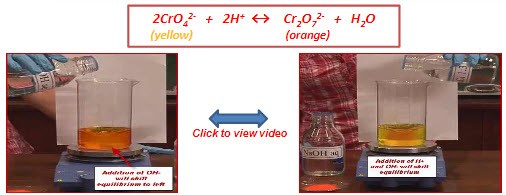
Equilibrium for 2CrO42- + 2H+→Cr2O72- + H2O. What happens when OH- ions are added to the system?
Position of equilibrium will shift to right
Color of system will turn from orange to yellow
Kc will decrease
OH- ions will not react, and thus no change is seen.
Given the Kc for a forward reaction, how can you find Kc for the reverse reaction?
Divide Kc by 1
Divide 1 by Kc
Square Kc
Take the square root of Kc

This endothermic reaction is at equilibrium.
If its temperature is increased (at constant volume and pressure), which way will the equilibrium shift?
To products (right)
To reactants (left)

For the reaction...
SO2 + O2 <−> SO3
If the concentration of SO2 is increased, the system will shift ___________.
left
right
left and right
neither left nor right
For the reaction...
heat + N2 + O2 ↔ 2NO
If heat is added to the chemical system, the system will shift _______.
left
right
left and right
neither left nor right
2SO2 (g) + O2 (g) ⇌ 2SO3 (g)
Decreasing the volume of container will
shift the system right
shift the system left
change K
have no effect
2SO2 (g) + O2 (g) ⇌ 2SO3 (g)
Using a catalyst will...
shift the system right
shift the system left
increase the rate of reaction
have no effect

At what time (in seconds) is equilibrium established?
0 seconds
1 second
5 seconds
10 seconds
N2 + O2 <=> 2NO
If O2 is removed, the concentration of N2 will _______.
2 NO(g) + O2(g) ⇌ 2 NO2(g)
Consider the following reaction:
2SO2(g) + O2(g) <=> 2SO3(g) ΔΗ = - 197 kJ
Which of the following will NOT shift the equilibrium position to the right?
Adding more O2
Adding a catalyst
Decreasing the volume
Lowering the temperature
When the following reaction reached equilibrium,
SO2 (g) + NO2 (g) <=> SO3 (g) + NO (g)
it was found to contain:
0.40 M SO3 , and 0.30 M NO,
0.15 M NO2 , and 0.20 M SO2.
Calculate the equilibrium constant for this reaction.
4.0
0.42
0.25
1.0
Which is true for a system at equilibrium?
Forward reaction rate is faster than the reverse and concentrations are equal
Forward and reverse reaction rates are equal and concentrations are constant
Forward and reverse reaction rates are equal and concentrations are equal
Forward reaction rate is faster than the reverse and concentrations are constant
[CO2] = 0.846M, & [CH4]= 0.0713M?
4CuO(s)+CH4(g)↔CO2(g)+4Cu(s) +2H2O(g)
What is the correct equilibrium expression for the following reaction:
2H2O2 (aq) ↔ 2H2O (l) + O2 (g)
[H2O]2[O2] / [H2O2]2
[H2O2]2 / [H2O]2[O2]
[O2] / [H2O2]2
[H2O]2 / [H2O2]2
0.40 M SO2 and 0.60 M O2 are in a flask when the following reaction occurs:
2SO2 (g) + O2 (g) ↔ 2SO3 (g)
At equilibrium, the flask is found to contain 0.30 M SO3. Based on these results, the equilibrium constant, Kc, for the reaction is...
20
10
6.7
2.0
Which of the following systems would NOT be shifted by a change in the volume of the system at constant temperature?
CO (g) + NO (g) ↔ CO2 (g) + ½N2 (g)
N2 (g) + 3H2 (g) ↔ 2NH3 (g)
N2 (g) + 2O2 (g) ↔ 2 NO2 (g)
NO(g) + O3 (g) ↔ NO2 (g) + O2 (g)
H2 (g) +I2 (g) ↔ 2HI (g)
All gases begin with an initial concentration of 2.0 M. When equilibrium is established, the concentration of HI is 4.8 M. What is the value of the equilibrium constant?
1.2
2.4
32
64
H2 (g) + I2 (g) ↔ 2HI (g) and Kc = 54.3
If 0.500 mol H2 and 0.500 mol I2 were placed in a 1.00L flask, what would be the concentration of HI at equilibrium?
0.5M
1.0M
3.68M
0.393M
H2C2O4 + 2 H2O ↔ 2 H3O+ + C2O4 2–
Oxalic acid, H2C2O4, is a diprotic acid with
K1 = 5 x 10⁻² and K2 = 5 x 10⁻⁵.
What is the equilibrium constant for the reaction represented above?
5 x 10⁻²
5 x 10⁻⁵
2.5 x 10⁻⁶
5 x 10⁻⁷
SO2 + O2 <−> SO3
If the equilibrium shifts to the right, the concentration of O2 will ___________.
SO2 + O2 <−> SO3
If the concentration of O2 is decreased, the equilibrium of the reaction will shift ___________.
Fe3O4(s) + 4H2(g) <--> 3Fe(s) + 4H2O(g)
Consider the following equation: CO(g) + 2H2(g) ⇌ CH3OH(g) + Heat
Which of the factors below would decrease the concentration of CH3OH at equilibrium?
adding CO
incresing H2
decrease in the temperature
increasing the temperature
2NH3(g) ⇋ N2(g) + 3H2(g)
2 NO(g) + O2(g) ⇌2 NO2(g)


For reaction a<-- --> b. Use the graph to determine what the Keq will be.
K > 1
K < 1
K = 1
Not enough information
(Calculator Allowed) What is [H2O] if K = 1.2,
[CO2] = 0.846M, & [CH4]= 0.0713M?
4CuO(s)+CH4(g)↔CO2(g)+4Cu(s) +2H2O(g)
0.101 M
0.318 M
0.0102 M
3.77 M
(Calculator Allowed) The solubility of CuI is 2 x 10⁻⁶ molar. What the the solubility product constant, Ksp, for CuI?
8 x 10-18
2 x 10⁻⁶
4 x 10-12
2 x 10-12
Which one of the following will change the value of an equilibrium constant?
changing temperature
adding other substances that do not react with any of the species involved in the equilibrium
varying the initial concentrations of reactants
varying the initial concentrations of products
changing the volume of the reaction vessel
(Calculator allowed) The concentration of iodide ions in a saturated solution of silver iodide is ________ M. The solubility product constant of AgI is ksp = 8.3 x 10⁻¹⁷.
3.8 × 10⁻¹¹
3.0 × 10⁻¹⁰
9.1 × 10⁻⁹
3.5 × 10⁻⁹
1.4 × 10⁻⁸
2 BaO2(s) ⇄ 2 BaO(s) + O2(g)
ΔH°= 162 kJ/molrxn
APMCQ: A sealed rigid vessel contains BaO2(s) in equilibrium with BaO(s) and O2(g) as represented by the equation above. Which of the following changes will increase the amount of BaO2(s) in the vessel?
Removing a small amount of O2(g)
Removing a small amount of BaO(s)
Adding He gas to the vessel
Lowering the temperature

APMCQ: A 0.10 mol sample of each of the four species in the reaction represented above is injected into a rigid, previously evacuated 1.0 L container. Which of the following species will have the highest concentration when the system reaches equilibrium?
H2S(g)
CH4(g)
CS2(g)
H2(g)
2 S(s) + 2 O2(g) ⇄ 2 SO2(g) K1 = 2 x 10105
2 SO2(g) + O2(g) ⇄ 2 SO3(g) K2 = 7 x 1024
APMCQ: Given the value of the equilibrium constants K1 and K2 for the reactions represented above, what is the value of the equilibrium constant, K3, for the following reaction?
2 S(s) + 3 O2(g) ⇄ 2 SO3(g) K3 = ?
1 x 10130
3 x 1080
1 x 1065
2 x 1040
7 x 1024

2 XY(g) ⇄ X2(g) + Y2(g) Kp = 230
A certain gas, XY(g), decomposes as represented by the equation above. A sample of each of the three gases is put in a previously evacuated container. The initial partial pressures of the gases are shown in the table above.
APMCQ: The temperature of the reaction mixture is held constant. In which direction will the reaction proceed?
The reaction will form more products.
The reaction will form more reactant.
The mixture is at equilibrium, so there will be no change.
It cannot be determined unless the volume of the container is known.
2X(g) + Y(g) ⇄ 3Z(g)
APMCQ: The reaction mixture represented above is at equilibrium at 298 K, and the molar concentrations are [X] = 2.0 M, [Y] = 0.5 M, and [Z] = 4.0 M. What is the value of the equilibrium constant for the reaction at 298 K ?
0.5
2
4
16
32
CaCO3(s) ⇄ CaO(s) + CO2(g) ΔH° = 178 kJ/molrxn
APMCQ: The reaction system represented above is at equilibrium. Which of the following will decrease the amount of CaO(s) in the system?
Increasing the volume of the reaction vessel at constant temperature
Lowering the temperature of the system
Removing some CO2(g) at constant temperature
Removing some CaCO3(s) at constant temperature
COCl2(g) ⇄ CO(g) + Cl2(g)
APMCQ: COCl2(g) decomposes according to the equation above. When pure COCl2(g) is injected into a rigid, previously evacuated flask at 690 K, the pressure in the flask is initially 1.0 atm. After the reaction reaches equilibrium at 690 K, the total pressure in the flask is 1.2 atm. What is the value of Kp for the reaction at 690 K?
0.2
0.05
0.8
1.0
CdF2(s)⇄Cd2+(aq)+2F−(aq)
APMCQ: A saturated aqueous solution of CdF2 is prepared. The equilibrium in the solution is represented above. In the solution, [Cd2+]eq=0.0585 M and [F−]eq=0.117 M. Some 0.90M NaF is added to the saturated solution. Which of the following identifies the molar solubility of CdF2 in pure water and explains the effect that the addition of NaF has on this solubility?
The molar solubility of CdF2 in pure water is 0.0585 M, and adding NaF decreases this solubility because the equilibrium shifts to favor the precipitation of some CdF2.
The molar solubility of CdF2 in pure water is 0.0585 M, and adding NaF has no effect on the solubility because only changes in temperature can increase or decrease the molar solubility of an ionic solid.
The molar solubility of CdF2 in pure water is 0.117M, and adding NaF decreases this solubility because the equilibrium shifts to favor the precipitation of some CdF2.
The molar solubility of CdF2 in pure water is 0.176 M, and adding NaF increases this solubility because the Na+ ions displace the Cd2+ ions, causing the equilibrium to shift to favor the products.
APMCQ: For which of the equilibrium systems represented below will the amount of product(s) at equilibrium increase if the volume of the reaction vessel is increased at a constant temperature?
PCl5(g) ⇄ PCl3(g) + Cl2(g)
2 NO(g) + O2(g) ⇄ 2 NO2(g)
N2(g) + O2(g) ⇄ 2 NO(g)
2 CO(g) ⇄ C(s) + CO2(g)
N2 + O2 <=> 2NO
If O2 is removed, the concentration of N2 will _______.
Using a catalyst
2SO2(g)+O2(g)⇌2SO3(g)
Decreasing the volume of container will
shift equilibrium right
shift equilibrium left
change K
have no change
The solubility of CuI is 2 x 10⁻⁶ molar. What is the solubility product constant, Ksp, for CuI?
4 x 10-12
2 x 10-12
1.4 x 10⁻³
2 x 10⁻⁶
The Ksp expression for the solubility of silver chromate, Ag2CrO4, is
Ksp = [Ag+]2[CrO42-]
Ksp = [Ag+][CrO42-]
Ksp = [Ag+][CrO42-]2
Ksp = [Ag+]2[CrO42-]4

Three saturated solutions (X, Y, and Z) are prepared at 25oC. Based on the information in the table, which of the following lists the solutions in order of increasing [M+] ?
B < C < A
A < C < B
C < A < B
B < A < C
Calculate the molar solubility of AgCl in a 0.10 M solution of NaCl. Ksp of AgCl is 1.8 x 10⁻¹⁰
1.3 x 10⁻⁵ M
5.5 x 10⁻¹ M
4.2 x 10⁻⁵ M
1.8 x 10⁻⁹ M

Based on the Ksp values in the table above, a saturated solution of which of the following compounds has the lowest [Cl–] ?
PbCl2
CuCl
AgCl
NaCl

Solutions of lead(II) nitrate and potassium iodide react according to the following equation:
Pb(NO3)2(aq) + 2 KI(aq) → PbI2(s) + 2 KNO3(aq)
A molecular-level representation illustrating solutions of the reactants lead(II) nitrate and potassium iodide is shown in the image. Which of the following would be the best molecular-level representation after the reaction has taken place?
a
b
c
d
Solutions of lead(II) nitrate and potassium iodide react according to the following equation:
Pb(NO3)2(aq) + 2 KI(aq) → PbI2(s) + 2 KNO3(aq)
Which species act as spectator ions in this reaction?
K+, NO3-
Pb2+, I-
K+, Pb2+
I-, NO3-

Pb2+(aq) + 2Cl-(aq) → PbCl2(s)
A chemist mixes a dilute solution of lead(II) perchlorate with an excess of potassium chloride to precipitate lead(II) chloride (Ksp = 1.7 x 10⁻⁵). The net ionic equation is given above for the reaction.
Which of the following particulate views represents the experiment after the reactants are mixed thoroughly and the solids are given time to precipitate?
(A)
(B)
(C)
(D)
Consider the following solubility data for various chromates at 25oC.
Ag2CrO4, Ksp = 9.0 x 10⁻¹²
BaCrO4, Ksp = 2.0 x 10⁻¹⁰
PbCrO4, Ksp = 1.8 x 10⁻¹⁴
The chromate that is the most soluble in water at 25oC on a molar basis is:
Ag2CrO4
BaCrO4
PbCrO4
impossible to determine
The molar solubility of PbBr2 is 2.17 x 10⁻³ M at a certain temperature. Calculate Ksp for PbBr2.
6.2 x 10⁻⁶
6.4 x 10⁻⁷
4.1 x 10⁻⁸
3.4 x 10⁻⁶
What is the molar solubility, s, of Ba3(PO4)2 in terms of Ksp?
s = Ksp1/2
s = Ksp1/5
s = [Ksp/27]1/5
s = [Ksp/108]1/5
When we mix together, from separate sources, the ions of a slightly soluble ionic salt, the salt will precipitate if Qsp _____ Ksp, and will continue to precipitate until Qsp _____ Ksp.
is greater than; equals
is less than; is greater than
is less than; equals
equals; is less than
A swimming pool was sufficiently alkaline so that CO2 absorbed from the air produced in the pool a solution which was 2 x 10⁻⁴ M in CO32- M. If the pool water was originally 4 x 10⁻³ M in Mg2+, 6 x 10⁻⁴ M in Ca2+ and 8 x 10⁻⁷ M in Fe2+, then a precipitate should form of:
only MgCO3
only CaCO3
only FeCO3
only CaCO3 and FeCO3
Which solid will precipitate first if an aqueous solution of Na2CrO4 at 25oC is slowly added to an aqueous solution containing 0.001 M Pb(NO3)2 and 0.100 M Ba(NO3)2 at 25oC?
BaCrO4(s)
NaNO3(s)
PbCrO4(s)
Pb(NO3)2(s)
A solution is 0.0010 M in both Ag+ and Au+. Some solid NaCl is added slowly until the solid AgCl just begins to precipitate. What is the concentration of Au+ ions at this point? Ksp for AgCl = 1.8 x 10⁻¹⁰ and for AuCl = 2.0 x 10⁻¹³.
2.0 x 10⁻¹⁰ M
1.1 x 10⁻⁶ M
4.5 x 10⁻⁷ M
1.8 x 10⁻⁷ M

