
 Worksheets
PS SEM1 REVIEW
Total questions: 90
Worksheet time: 1hrs 7mins
What is an atom's nucleus made of?
protons and electrons
protons only
protons and neutrons
neutrons only
Atoms of the same element that have different number of neutrons are called
molecules
ions
protons
isotopes
Which particles determine the ATOMIC NUMBER of an element?
protons only
neutrons and protons
neutrons only
protons and electrons
Two different isotopes of an element have different
number of neutrons
numbers of protons
atomic numbers
nothing is different about them
The maximum number of electrons that can occupy the 2nd shell of an atom of magnesium is
1
2
8
18
What is the correct electron arrangement for sulfur? (HINT: think about electron shells/energy levels)
2-8-6
2-8-8
4-6-2
2-8-4
An atom is neutral because
neutrons balance the protons and electrons
nuclear forces stabilize the charges
the number of protons and electrons are equal
the numbers of protons and neutrons are equal
Which part of the periodic table indicates the number of energy levels in the electron cloud?
group
family
valence electrons
period
Which statement about the arrangement of the periodic table is not true?
Noble gases are in the group farthest to the right.
Metals are found on the left side of the periodic table.
Rare earth elements are found in the first two columns o nteh left.
Transition metals are in the center of the periodic table.
Which of the following elements would be the MOST reactive?
iodine
silicon
silver
argon
Hydrogen is in group 1 with Lithium, Sodium, Potassium, Cesium, and Francium because it
is a metal
is a gas
has 1 valence electron

How many protons are in the following atom?
82
125
207
189
A subatomic particle with a positive charge
proton
neutron
electron
nucleus
The negatively charged area around the nucleus where the volume of the atom is located
electron
nucleus
electron cloud
quark
Which of the following is a property of non-metals?
shiny
good conductor
poor conductor
silvery solid
The element that is an alkaline earth metal and has 3 energy levels must be
magnesium
calcium
francium
barium
The semi-conductors or metalloids are located
on the right side of the periodic table
in the middle of the periodic table
on the staircase of the periodic table

What isotope is shown here? (Red = protons, gray = neutrons, blue = electrons)
Beryllium-5
Beryllium-9
Boron-4
Boron-9
The chemical bond formed when two atoms SHARE electrons is a (an)
covalent bond
ionic bond
metallic bond
Which element is most likely to GAIN electrons in a chemical bond?
Kr
K
Br
Ca
Which formula represents substances that contain COVALENT bonds?
LiCl
CaCl2
K2O
CO
Which atoms are most like to form COVALENT bonds?
metals that share electrons
metals that share protons
nonmetals that share electrons
nonmetals that share protons
How many electrons are needed in the outer energy level of most atoms to complete the octet?
2
4
6
8
Why do elements form compounds?
to be stable
to be happy
to remain charged
What two types of atoms make a covalent bond?
2 non-metals
1 metal and 1 non-metal
2 metals
Select the correct formula for the
COVALENT COMPOUND
carbon tetrachloride
CCl
CCl2
C4Cl2
CCl4

This is a correct dot diagram for neon (Ne)
true
false

What is a hypothesis?
A hypothesis is the right answer to an experiment.
A hypothesis is the wrong answer to an experiment.
A hypothesis is an educated guess.

Data we get by using our senses.
inferences
observations
hypothesis

A series of organized steps used by scientists to solve a problem or answer a question.
scientific method
recipe
data collection
metric system

A factor in the experiment.
Independent Variable
Dependent Variable
Variable
Control Variable

Variable that the SCIENTIST CHANGES or TESTS.
Control Variable
Variable
Dependent Variable
Independent Variable

Variable that is MEASURED or OBSERVED; it DEPENDS on the independent variable.
Control Variable
Variable
Dependent Variable
Independent Variable

Variable that the scientist keeps CONSTANT or the SAME.
Control Variable
Variable
Dependent Variable
Independent Variable

Qualitative or Quantitative Observation?:
The cat has orange fur on his ears.
Qualitative
Quantitative

What step does every scientific experiment begin with?
hypothesis
question/problem
procedures
conclusion

The summary at the end of an experiment that explains the results.
conclusion
procedures
materials
hypothesis

Where does an Inference belong in the Scientific Method?
In the Beginning (steps 1 or 2)
At the End (steps 5 and 6)

Lucky Charms Cereal
Compound
Element
Mixture

Mg
Compound
Element
Mixture

Salt (NaCl)
Compound
Element
Mixture
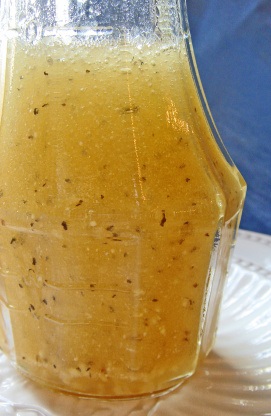


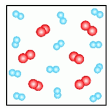

Is this an example of a physical or chemical change?
physical
chemical

Is this an example of a physical or chemical change?
physical
chemical

Melting butter for popcorn is a
chemical change
physical change

Which of the following are physical properties of the matter pictured?
Check all that are true
reacts to oxygen
smooth
malleable (bendable)
reddish-brown
shiny

Which statement best describes what is happening in the images?
a physical change
a chemical change
both a physical and a chemical change
dissolving

A white tablet is dropped into water. The water becomes cloudy and bubbles are produced. What type of change has occurred?
Physical change
Chemical change
No change

Is this an example of a physical or chemical change?
Physical
Chemical

Is this an example of a physical or chemical change?
Physical
Chemical


What two types of measurements make up DENSITY?
Volume and Weight
Temperature and Mass
Mass and Volume

Measuring the volume of a block uses which equation
Length ×Width×Height
(radius)2×Length×π
A block has a mass of 20.0 g and a volume of 40.0 cm3. What is its density?
2.0 g/cm3
1.2 g/cm3
0.5 g/cm3
4.0 g/cm3
263.5 g/cm3
2.804 g
Jack has a rock. The rock has a mass of 14g and a volume of 2cm3. What is the density of the rock?
9 mL
7 g/cm3
28 g/cm3
1/7 g/cm3
Find the density of a 2 cm x 2 cm x 2 cm cube with a mass of 64 g.
(Hint: find the volume first!)
13 g/cm3
2 g/cm3
10 g/cm3
8 g/cm3
If a block of wood has a density of 0.6 g/cm3 and a mass of 120 g, what is its volume?
300 cm3
200 cm3
100 mL
150 cm3
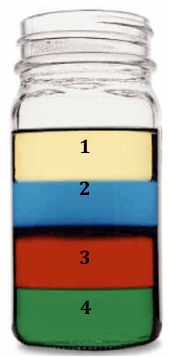
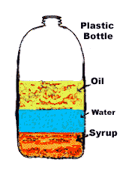
All particles in matter are identical (fixed composition)
substance
matter
mixture
Simplest form of matter from which more complex substances are made
element
compound
mixture
Two or more elements chemically combined in a fixed proportion
compound
element
mixture
These do not have a uniform composition.
Homogeneous
Heterogeneous
Which of the following describes a difference between compounds and mixtures?
Compounds can be broken down only by chemical reactions and mixtures can be physically separated.
Mixtures and chemically combined and compounds are physically combined.
Compounds can be heterogeneous and mixtures cannot.

Temperature at which a solid becomes a liquid
Melting Point
Boiling Point
Freezing Point

Temperature at which a liquid becomes a gas
Melting Point
Boiling Point
Viscosity

A fluid's resistance to flow
viscosity
density
combustibility
solubility

A measure of how well a solute dissolves in a solvent
solubility
combustibility
flammability
A law that states mater is neither created or destroyed
The Law of Conservation of Matter
The Law of Conservation of Properties
The Law of Conservation of Chemistry

Compactness or consistency of a material
Density
Solubility
Solvent
Flammability

The thing that is being dissolved in the solution
Solute
Solvent
Solution

How easily a substance will set on fire
Combustibility
Solubility
Density

How easily a substance reacts, usually with an acid or a base
Reactivity
Combustibility
Solubility

How easily a substance reacts with oxygen
oxidation
reaction
combustion
Matter must be classified as either a substance or a
mixture
compound
element
Which of the following are chemical properties?
hardness
luster
solubility
combustibility

