wayground logo

Free Printable Worksheets

Font size

S
M
L
XL
Worksheets

Chemistry Semester Exam Review

Total questions: 89

Worksheet time: 1hrs 21mins

Name
Class
Date
1.
What subatomic particles would you find in the nucleus of an atom?
a)
Protons only
b)
Protons and Neutrons
c)
Neutrons and Electrons
d)
Protons and Electrons 
2.
Which subatomic particles contribute the most to the mass of an atom?
a)
Protons, Neutrons, Electrons
b)
Protons only
c)
Protons and Electrons
d)
Protons and Neutrons
3.
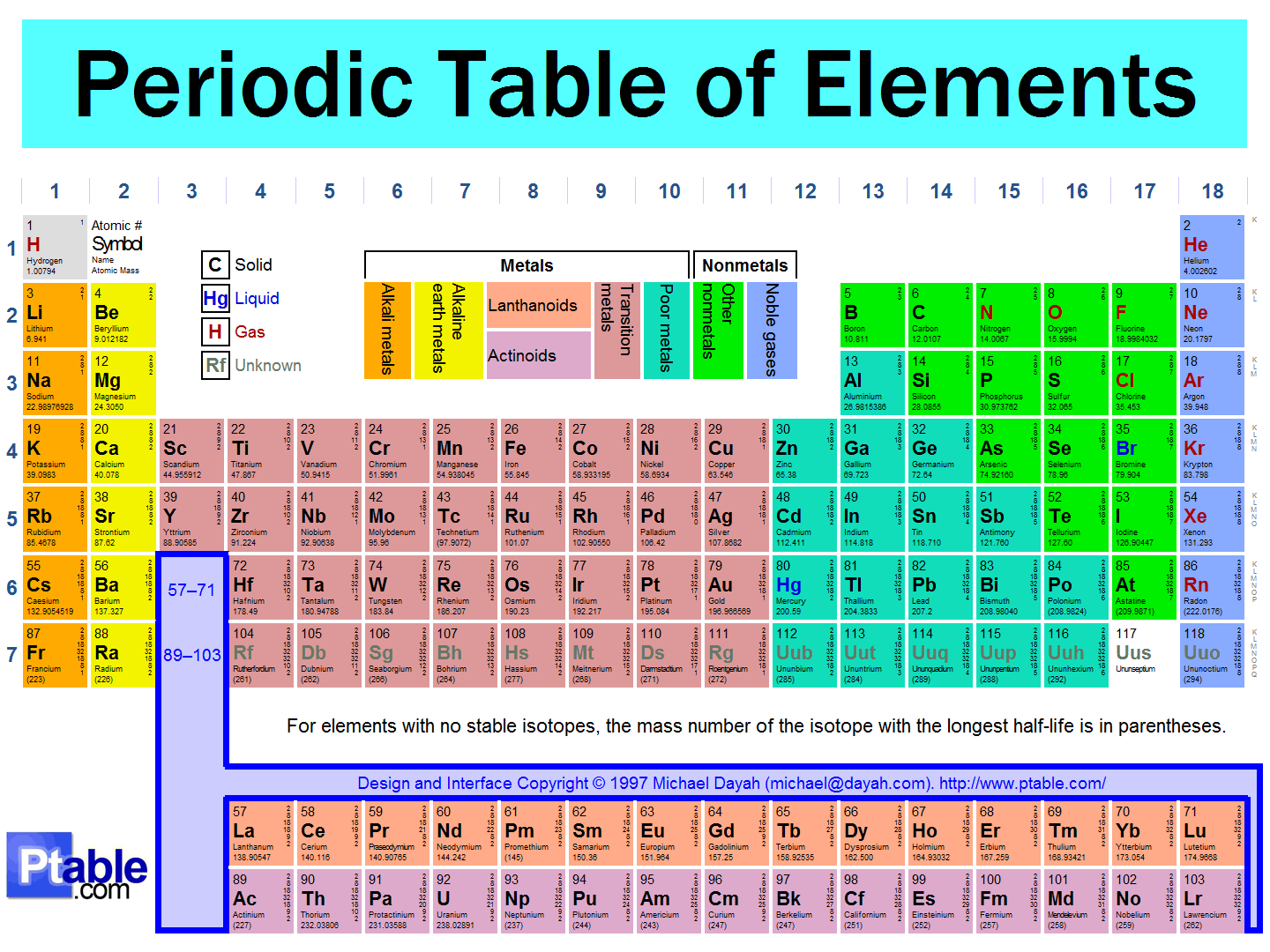
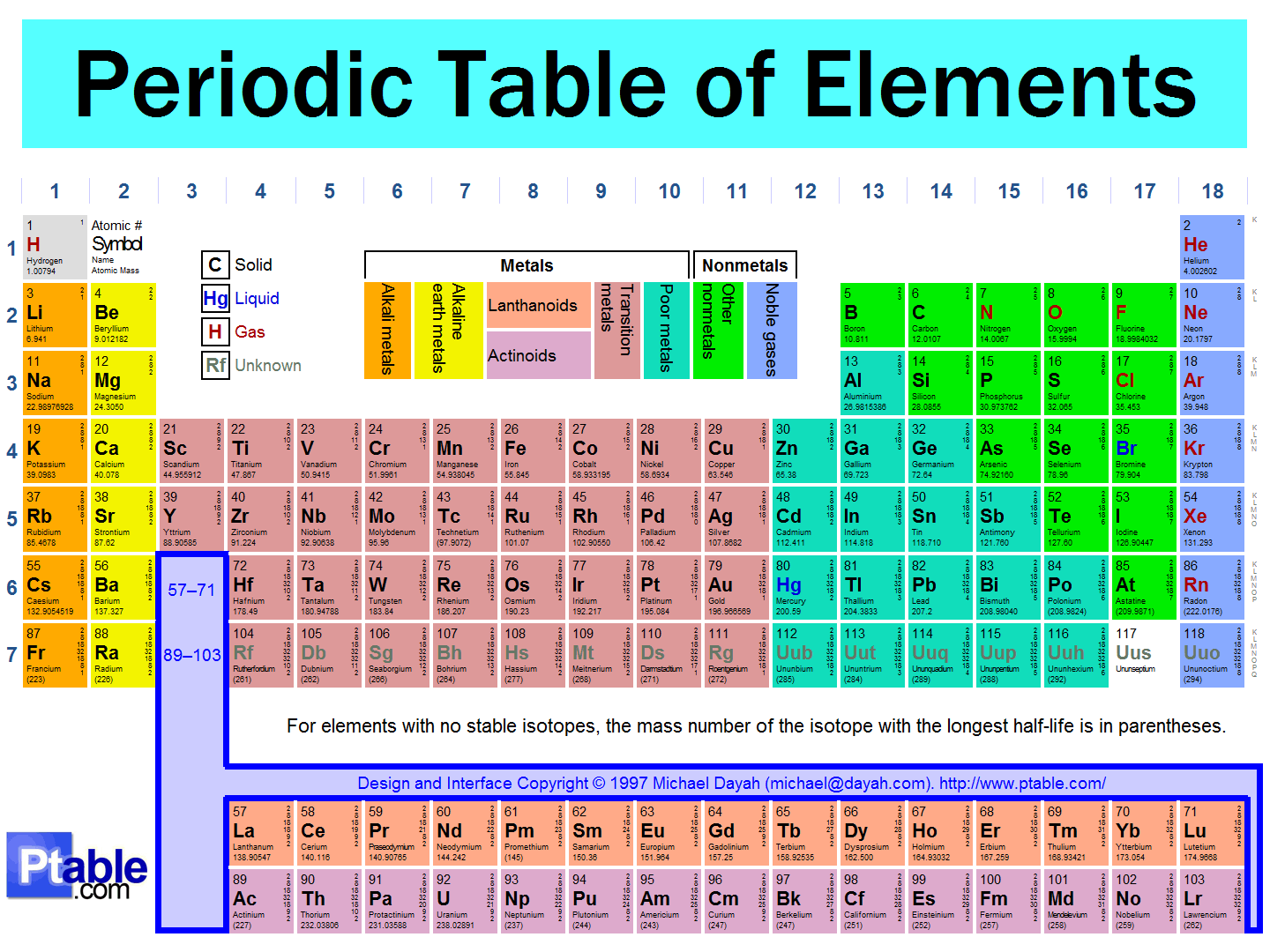
What is the number of protons that the element in this image contain?
a)
14
b)
7
c)
15
d)
18
4.
Protons and Electrons balance the charge of an atom.
a)
True
b)
False
5.
If an atom has 12 positively charged subatomic particles, which of the following must it also have to be considered a neutral atom?
a)
12 neutrons
b)
12 electrons
c)
12 protons
d)
24 protons and neutrons
6.
Which letter represents a proton?
a)
A
b)
B
c)
C
d)
D
7.
Which letter represents an electron?
a)
A
b)
B
c)
C
d)
D
8.
Which scientist conducted experiments using alpha particles and thin gold foil, which later helped him develop his model for the atom? 
a)
Ernest Rutherford
b)
Kneels Bore
c)
Niels Bohr
d)
Earnest Rutherfraud
9.
Which scientist discovered the electron, which helped him develop a model of the atom?
a)
Niels Bohr
b)
John Dalton
c)
Ernst Rutherford
d)
J.J Thompson
10.
Who is responsible for the model of the atom where electrons travel in specific paths or orbits around the nucleus?
a)
Einstein
b)
Bohr
c)
Planck
d)
Dalton
11.

Iron is a good conductor, malleable and magnetic. What type of element is Iron?

a)

Metal

b)

Non-metal

c)

Metalloid

d)

Pretty

12.

Silicon is a semiconductor and has properties of both

metals and non-metals.

What type of element is Silicon?

a)

Metalloid

b)

Pretty

c)

Non-metal

d)

Metal

13.

Where are the metals found on the Periodic Table?

a)

Left-side

b)

Right-side

14.

Which elements are found on the right side of The Periodic Table?

a)

Non-metals

b)

Metals

c)

Metalloids

d)

Water

15.

All of these properties describe metals except...

a)

brittle

b)

malleable

c)

conductors

d)

shiny

16.

Which element is least likely to conduct heat and electricity?

a)

O

b)

Si

c)

Ca

d)

Po

17.

Which of the given choices correctly shows the three main groups of elements listed from least conductivity to greatest conductivity?

a)

Non-metals, Metalloids, Metals

b)

Non-metals, Metals, Metalloids

c)

Metalloids, Metals, Non-metals

d)

Metals, Non-metals, Metalloids

18.

How would this element be classified?

a)

Metal

b)

Non-metal

c)

Metalloid

19.

If a material can easily be drawn into the shape of a wire, it is

a)

Ductile

b)

Malleable

c)

Magnetic

d)

Reactive

20.

______________________ is the ability of an object to carry electric current.

a)

Electrical conductivity

b)

Ductile

c)

Malleable

d)

Thermal conductivity

21.

A material that can be hammered or pressed into shape without breaking or cracking.

a)

Malleable

b)

Ductile

c)

Magnetic

d)

Reactive

22.

Is color a physical or chemical property?

a)

Physical

b)

Chemical

23.

Is flammability a physical or chemical property?

a)

Chemical

b)

Physical

24.

At room temperature (20℃),

most metal oxides are

a)

solids

b)

liquids

c)

gases

25.

At room temperature (20℃),

most non-metal oxides are

a)

gases

b)

liquids

c)

solids

26.

Mendeleev arranged the elements by their ________________

a)

alphabetical

b)

density

c)

melting point

d)

atomic mass

27.

The horizontal rows on the periodic table are called

a)

groups

b)

families

c)

periods

d)

atomic numbers

28.

Each vertical column on the periodic table is called a...

a)

group

b)

tower

c)

period

d)

crew

29.

In each square of the periodic table, the number at the bottom is the:

a)

atomic number

b)

atomic mass

c)

chemical symbol

d)

element name

30.

What is the chemical symbol for Lead?

a)

Le

b)

Fe

c)

Ld

d)

Pb

31.
In the modern periodic table elements are arranged by:
a)
atomic mass
b)
atomic number
c)
valence electrons
d)
number of isotopes
32.

How many Valance electrons does Iodine Have?

a)

6

b)

16

c)

7

d)

17

33.
An element's identity is determined by the number of
a)
electrons.
b)
protons.
c)
neutrons.
d)
valence.
34.
How many electrons do atoms need to be stable?
a)
1
b)
2
c)
6
d)
8
35.

The atomic mass of an element is:

a)

the amount of electrons the element has

b)

the element's size

c)

the number of protons and neutrons an element has in its nucleus

d)

the element's name

36.

Elements in the same group or family have the same number of

a)

neutrons

b)

valence electrons

c)

electrons

d)

energy levels

37.

Electrons...

a)

are found in the nucleus

b)

give us the atomic number of an element

c)

are how we identify each elements

d)

have a negative charge

38.

Which of the "Halogens" is found in liquid state at room temperature?

a)

Flourine

b)

Chlorine

c)

Iodine

d)

Bromine

39.

Which of these elements are Halogens?

a)

Fluorine

b)

Helium

c)

Zinc

d)

Bromine

40.

What group are the Halogens?

a)

6.9

b)

7

c)

8

d)

3

41.

How many electrons do the halogens all have in their outer shells?

a)

1

b)

2

c)

7

d)

8

42.

Which halogen is the most reactive?

a)

iodine

b)

chlorine

c)

bromine

d)

fluorine

43.

Which halogen is a purple-black solid?

a)

iodine

b)

chlorine

c)

bromine

d)

fluorine

44.
What is the name of the group that never reacts--ever ever they are stable with a full outermost ring!!!
a)
noble gases
b)
transition
c)
halogens
d)
borons
45.
Which group of METALS is the most reactive?
a)
Group 2- Alkaline Earth
b)
Group 17- Halogens
c)
Group 18- Noble Gases
d)
Group 1- Alkali metals
46.
When an atom loses an electron, it becomes a:
a)
positive ion
b)
negative ion
c)
neutral ion
d)
neutral atom
47.
Ionic bonds form between metals and ____.
a)
metalloids
b)
metals
c)
nonmetals
48.

What are ionic bonds?

a)

valence electrons TRANSFERRED between atoms

b)

valence electrons SHARED between atoms
49.
Atoms that lose electrons become...
a)
negatively charged
b)
postively charged
c)
remain neutral, no charge
d)
losers
50.
Atoms that gain electrons become...
a)
negatively charged
b)
positively charged
c)
remain neutrally charged
d)
21
51.
How many bonds does carbon have to create in order to satisfy the octet rule
a)
1
b)
2
c)
3
d)
4
52.
How do covalent bonds form?
a)
Donating & receiving valence e- between atoms.
b)
Opposite slight charges attract each other between compounds.
c)
Scientists are still not sure how they form.
d)
Sharing valence e- between atoms.
53.
What two types of atoms make a covalent bond?
a)
2 Nonmetals
b)
1 Nonmetal and 1 Metal
c)
2 Metals
d)
2 Noble Gases
54.
Is Hydrogen considered a metal or a non-metal?
a)
Metal
b)
Non-metal
55.
What region of the periodic table contains atoms that form covalent bonds?
a)
the left side
b)
the middle
c)
the right side
d)
top left
56.
How are ionic bonds formed?
a)
When atoms share an electron
b)
When opposite charged atoms attract
c)
When one atom takes a proton
d)
When one atom takes a neutron
57.
How do the following two elements bond together?
Al3+  O2-         
a)
AlO
b)
Al2O3
c)
Al3O6
d)
Al3O2
58.
This is a correct dot diagram for oxygen (O)
a)
true
b)
false
59.
This is the correct dot diagram for sodium (Na)
a)
true
b)
false
60.
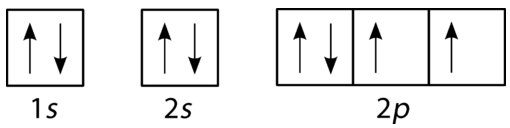
This orbital diagram represents:  
a)
C
b)
B
c)
N
d)
O
61.
 The diagram above represents two electrons with 
a)
a. opposite spins.
b)
 b. the same spin.
c)
c. different energies.
d)
d. different energy levels.
62.

Which example shows a violation of Hund's Rule?

a)

A

b)

B

c)

C

d)

D

63.
All orbitals of equal energy are occupied by one electron before any single orbital is occupied by a second electron.
a)
Aufbau principle
b)
Pauli exclusion principle
c)
Hund’s rule
d)
Core Notation
64.
An electron occupies the lowest energy orbital that can receive it.
a)
Hund’s rule
b)
Pauli exclusion principle
c)
Bohr model of the atom
d)
Aufbau principle
65.
Convert 17 m to cm:
a)
0.17 cm
b)
0.017 cm
c)
1,700 cm
d)
170 cm
66.
Convert 300 meters to centimeters:
a)
3000 cm
b)
0.3 cm
c)
30,000 cm
d)
3 cn
67.
What happens when my glass of water is sitting in the sun and disappears into a gas?
a)
evaporation
b)
burning
c)
melting
d)
freezing
68.
Which form of matter does not take the shape of its container?
a)
liquid
b)
gas
c)
solid
d)
air
69.
What term describes a solid changing to a gas?
a)
Deposition
b)
Sublimation
c)
Evaporation
d)
Freezing
70.
What term describes a liquid changing to a solid?
a)
Deposition
b)
Sublimation
c)
Evaporation
d)
Freezing
71.
Particles of a liquid
a)
are tightly packed together and stay in a fixed position.
b)
have no viscosity.
c)
decrease in volume with increasing temperature.
d)
are free to move around one another but still touch.
72.
a)
It remains the same.
b)
It changes greatly.
c)
It changes minimally.
d)
Unable to tell.
73.
When a gas changes directly to a solid, the process is known as what?
a)
Sublimation
b)
Condensation
c)
Deposition
d)
Evaporation
74.

Which contains only elements?

a)

A

b)

B

c)

C

d)

D

75.

Which contains a pure substance? (Choose all)

a)

A

b)

B

c)

C

d)

D

76.

Which contains a solution? (Choose all)

a)

A

b)

B

c)

None are solutions

77.

Which is a heterogeneous mixture? (Choose all)

a)

1

b)

2

c)

3

d)

4

78.
How many significant figures will be in the answer to the following question:
7.62 x 6.98 x 3.2645
a)
1
b)
2
c)
3
d)
4
79.

What is 78.5 rounded to one significant figure?

a)

79

b)

78.5

c)

70

d)

80

80.

In division and multiplication, the answer should have the same number of significant figures as the

a)

number in the calculation with the fewest significant figures.

b)

number in the calculation with the most significant figures.

c)

average number of significant figures in the calculation.

d)

total number of significant figures in the calculation.

81.

The number of significant figures in the measurement 170.040 km is

a)

three

b)

four

c)

five

d)

six

82.
It is a measure of how close measurements come to each other when they are made in the same way
a)
Accuracy
b)
Precision
c)
Error
d)
Extrapolation
83.
a)
Student A
b)
Student B
c)
Student C
d)
Cannot be determined
84.

How close a measurement is to the accepted value is called..

a)

Accuracy

b)

Precision

c)

Significant

d)

Estimate

85.
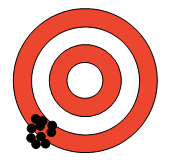
This bullseye demonstrates...
a)
High Accuracy & High Precision
b)
High Accuracy & Low Precision
c)
Low Accuracy & High Precision
d)
Low Accuracy & Low Precision
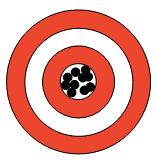
86.
?
a)
High Accuracy & High Precision
b)
High Accuracy & Low Precision
c)
Low Accuracy & High Precision
d)
Low Accuracy & Low Precision
87.
The students measured length during a science experiement, they got 12 cm. But the actual measurement was 14.25 cm. What was the percent error?
a)
15.79%
b)
18.75%
c)
2.25%
d)
18%
88.
What is the formula for density?
a)
density = mass x volume
b)
density = mass / volume
c)
density = mass + volume
d)
density = mass - volume
89.
Jack has a rock. The rock has a mass of 14g and a volume of 2cm3. What is the density of the rock?
a)
7 mL
b)
7 g/cm3
c)
28 g/cm3
d)
1/7 g/cm3