
 Worksheets
Chemistry Final exam practice - part 2 Q pool
Total questions: 152
Worksheet time: 4hrs 40mins


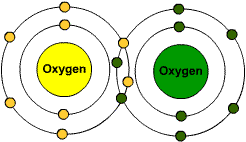
The formation of a covalent bond relies on the interaction or bonding of...
2 Nonmetals
1 Nonmetal & 1 Metal
2 Metals
2 Noble Gases
How do covalent bonds form?
Donating & receiving valence electrons between atoms
Oppositely charged ions attract each other & form bonds
Scientists are still not sure how they form
Sharing valence electrons between atoms
What number do the diatomic elements form on the periodic table?
7
1
2
Is O2 a diatomic element?
Yes
No
What are the seven diatomic elements?
H2, Cl2, Br2, O2, N2, I2, F2
H2, Cl2, I2, F2, Hg2, Br2, Fe2
H2, Cu2, Ni2, B2, O2, I2, Fe2
Which pair of atoms has the most polar bond?
H-Br
H-Cl
I-Br
I-Cl
Which bond is most polar?
C-O
H-O
N-O
S-O
Which molecule has a non-polar covalent bond?
H2
NH3
H2O
HCl
The chemical bonds between which two atoms is the most polar?
C-N
H-H
S-Cl
Si-O
The least polar bond is found in a molecule of
HI
HF
HCl
HBr
Which bond is most polar?
C-O
H-O
N-O
S-O
Which formula represents a molecule with the most polar bond?
CO
NO
HI
HCl
Which molecule has a non-polar covalent bond?
H2
NH3
H2O
HCl
The chemical bonds between which two atoms is the most polar?
C-N
H-H
S-Cl
Si-O
Classify ionic or molecular
LiOH
Ionic
Molecular
Classify ionic or molecular
C2H2
Ionic
Molecular
............................. is a neutral group of atoms joined together by covalent bonds.
A molecule
A formula unit
An ionic group
A molecular formula shows how many .............. of each element a substance contains.
atoms
electrons
protons
A compound composed of molecules is called ..................... compound
a molecular
an ionic
a metalic
Which type of bond occurs between non metals?
covalent bonds
ionic bonds
metallic bonds
all types of bonds
The most electronegative element is
Chlorine
Fluorine
Iodine
Sodium
Name the molecular compound CO
carbon monoxide
monocarbon monoxide
carbide
oxygen carbide
Name the following compound:
CO2
monocarbon dioxide
carbon oxide
carbon dioxide
oxygen carbonide
What is the name for SiCl4?
silicon tetrachloride
silicon quadchloride
monosilicon tetrachloride
silicon chloride
What is the correct Lewis Dot Structure for ammonia NH3


Which is the correct molecular structure for carbon dioxide?


Which Lewis Dot Model drawing correctly shows an O2 molecule?


How many pairs of UNSHARED electrons are shown in this image?
1
2
3
4
0

How many paired of SHARED electrons are shown in this image?
1
2
3
4
0
How many paired of UNSHARED electrons are shown in this image?
1
2
3
4
0

Which of these elements does not exist as a diatomic molecule?
Ne
F
H
I


H2O has how many lone pairs?
0
1
2
3
____Na + ____Cl yields _____ NaCl
Mg + __HCl ---> MgCl2 + H2
What type of reaction is this?
__H2O2 ----> __H2O + O2
Balance this equation: _Zn + _O2 --> _ZnO
1, 1, 2
2, 1, 2
1, 1, 1
2 ,2, 2
How many water molecules do you need to balance the equation: __H20 --> 2H2 + O2?
1
2
3
0
Which coefficients would balance this chemical equation? _Fe2O3 ---> _Fe + _O2
2,1,2
2,4,3
1,1,1
1,3,2
Which coefficients would balance this chemical equation? _K + _Cl2 ---> _KCl
1,1,1
1,2,2
1,1,2
2,1,2
Type of reaction?
Balance it too. :)
N2+O2--> _NO
What are the coefficients that would properly balance this equation?
__Ca + __H2O --> __Ca(OH)2 + __H2
2,1 --> 2,1
1,2 --> 1,1
1,2 --> 2,4
1,2 --> 2,1
What are the coefficients that would properly balance this equation?
__H2 + __S --> __H2S
1,1 --> 1
2,2 --> 2
1,2 --> 1
1,2 --> 2
What are the coefficients that would properly balance this equation?
__AgNO3 + __H2S --> __Ag2S+ __HNO3
2,1 --> 1,2
1,2 --> 1,1
1,2 --> 1,2
1,2 --> 2,1
What are the coefficients that would properly balance this equation?
__Al + __O2--> __Al2O3
4,1 --> 2
4,3 --> 4
3,4 --> 1
4,3 --> 2
Determine the coefficients to balance the equation.
__Al +__HCl --> __H2 +__AlCl3
2,6,3,2
it's already balanced
4,12,3,4
2,1,4,5
Balance the the following equation.
__Zn+__HCl -->__ZnCl2 +__H2
1,1,2,1
1,1,1,2
1,2,1,1
2,1,1,1
Mn + _ HNO3 → Mn(NO3)2 + H2
Choose the most correct sentence to describe the following reaction: Al2O3(s) --heat--> Al(s) + O2(g)
Aluminum oxide thermally decomposes into aluminum and oxygen.
Aluminum reacts with dioxygen to make aluminum oxide.
Solid aluminum(II) oxygen make gas aluminum and oxygen.
Solid aluminum oxide produces solid aluminum metal and oxygen gas when heated.
Choose the most correct sentence to describe the following reaction: Fe(s) + O2(g) --> Fe2O3(s)
An iron solution forms oxygen gas and solid iron oxide.
Solid iron and oxygen gas react to form solid iron(III) oxide.
Solid iron and oxygen make iron oxide.
Iron and dioxygen gas produce solid iron(II) oxide.
Choose the most correct sentence to describe the following reaction: NH3(g) + O2(g) --> NO(g) + H2O(g)
Ammonia and oxygen form nitrogen and water
Nitrogen trihydride and oxygen gases react to form nitrogen monoxide gas and water vapor.
Nitrogen hydride gas and dioxygen gas produce nitrogen oxide and water when mixed.
Nitrogen trihydride and oxygen react to make nitrogen oxide and dihydrogen monoxide.
"When heated, solid mercury(II) oxide decomposes into mercury liquid and oxygen gas." What is the correct skelton equation for this reaction?
Hg (l) + O2 (g) --> Hg2O (s)
Hg2O (s) --> Hg (l) + O (g)
HgO (s) --> Hg (l) + O2 (g)
"Water and sulfur trioxide vapor combine to form sulfuric acid (or hydrogen sulfate solution)." Which is the correct skeleton equation?
H2SO4 (s) --> H2O (l) + S3O (g)
H2O (aq) + SO3 (g) --> H2SO4 (s)
H2O (l) + S3O (v) --> H2SO4 (aq)
H2O (l) + SO3 (g) --> H2SO4 (aq)
"Solid zinc oxide is produced by combining zinc powder with oxygen gas." What is the correct skeleton equation for this reaction?
ZnO (s) --> Zn (s) + O2 (g)
ZnO (s) --> Zn + O (g)
Zn (s) + O2 (g) --> ZnO (s)
Zn + O --> ZnO
Choose the most correct sentence to describe the following reaction: Fe(s) + O2(g) --> Fe2O3(s)
An iron solution forms oxygen gas and solid iron oxide.
Solid iron and oxygen gas react to form solid iron(III) oxide.
Solid iron and oxygen make iron oxide.
Iron and dioxygen gas produce solid iron(II) oxide.
"Solid zinc oxide is produced by combining zinc powder with oxygen gas." What is the correct skeleton equation for this reaction?
ZnO (s) --> Zn (s) + O2 (g)
ZnO (s) --> Zn + O (g)
Zn (s) + O2 (g) --> ZnO (s)
Zn + O --> ZnO
HI → H2 + I2
Zn + H2S → ZnS + H2
CH4 + O2 → CO2 + H2O
FeS + HCl → H2S + FeCl2
Fe + O2 → Fe2O3
Classify the following chemical reaction.
Si(s) + 2Cl2(g) --> SiCl4(l)
Composition/Synthesis
Decomposition
Single Replacement
Double Replacement
Combustion
Classify the follow chemical reaction.
2C6H6(l) + 15O2 --> 6H2O(l) + 12CO2(g)
Composition/Synthesis
Decomposition
Single Replacement
Double Replacement
Combustion
CH4 + O2 → CO2 + H2O
Mg + N2 →Mg3N2
Synthesis
Decomposition
Single replacement
Combustion
Predict the products of this reaction: Al2(SO4)3 + Ca3(PO4)2 --->
This reaction will not occur
Al(PO4) + Ca(SO4)
Al2Ca3 + (PO4)2(SO4)3
Al2(SO4)3 + Ca3(SO4)3
Predict the products of this reaction: AgF + KCl --->
This reaction will not occur.
AgCl + KF
AgCl3 + KF2
AgK + ClF
What are the products of this reaction: Na(NO3) + CaF2 --->
This reaction will not occur
NaF + Ca(NO3)2
NaF2 + Ca(NO3)
NaCa + F(NO3)
Predict the products of the following equation.
PbCl2 + AgNO3 ---->
AgCl(s) + Pb(NO3)2(aq)
No Reaction
AgCl(aq) + Pb(NO3)2(s)
AgCl(s) + PbNO3(aq)
Predict the products fo the following equation.
CuCl2 + H2S ---->
CuS(s) + HCl(aq)
Cu2S(s) + HCl(aq)
No reaction
CuS(s) + HCl(s)
Predict the products of the following reaction.
H2SO4 + BaCl2 ---->
BaSO4(s) + HCl(aq)
BaSO4(aq) + HCl(s)
No Reaction
ClSO4(aq) + BaH(s)
In order for a double replacement reaction to occur, aqueous ions in solution must be removed from the solution. This can happen by the formation of
a precipitate (solid)
water
a gas
any of these
Which of the following would be the correct formulas for the products of the following reaction:
F2 + FeCl3 →
Cl2 + FeF3
Cl2 + FeF2
Fe + FCl
no reaction would occur
Which of the following would be the correct formulas for the products of the following reaction:
Pb + HCl →
H2 + PbCl4
H2 + PCl3
H2 + PbCl
no reaction would occur
Which of the following would be the correct formulas for the products of the following reaction:
Mg + H2O →
H2 + MgO
H2 + Mg2O2
H2 + Mg(OH)2
no reaction would occur
Predict the product(s) of this reaction:
Mg + HCl →
MgCl + H2
MgCl2 + H2
MgCl2 + H
What will be the result of : Zn + AuCl2->
ZnCl2 +Au
ZnAu + Cl2
ClAu + Zn
Predict the results: K + H2O -->
K2OH
KOH + H2
K(OH)2
Which of the following would be the correct formulas for the products of the following reaction:
F2 + FeCl3 →
Cl2 + FeF3
Cl2 + FeF2
Fe + FCl
no reaction would occur
What is the final balanced equation for: Ca + F2 → ?
Ca + F2 → CaF2
Ca + F2 → 2CaF
2Ca + F2 → 2CaF2
2Ca + F2 → Ca2F2
2 NO2 ---> 2 O2 + N2
Synthesis
Single Replacement
Decomposition
Combustion
What type of reaction is illustrated below?
2HI --> H2 + I2
synthesis
decomposition
single replacement
double replacement
What type of chemical reaction is this one?
Al(OH)3 --> Al2O3 + H2O
Decomposition
Combustion
Synthesis
Single Replacement
What is the product for the synthesis reaction: Mg + Br2 → ?
MgBr
MgBr2
Mg2Br
Mg2Br2
What are the products in the decomposition of magnesium hydroxide?
magnesium oxide + hydrogen
magnesium hydride + oxygen
magnesium oxide + water
magnesium hydride + water
Fe2O3(s) + 3H2(g) → 2Fe(s) + 3H2O(l)
How many moles of iron (Fe) can be made from 6 moles H2?
How many moles of water can be produced if 8 moles H2 are used?
How many moles of hydrogen are needed to react with 2 moles of nitrogen?
6 mol H
2 mol H
3 mol H
1 mol H
How many moles of water can be produced if 8 moles H2 are used?
How many moles of HCl are consumed in the production of 7.5 moles of MgCl₂?
NaIO3(aq) + 6HI(aq) --> 3I2(s) + NaI(aq) + 3H2O(l)
How many moles of iodine can be made from 6.55 moles of NaIO3?
How many moles of water can be produced if 8 moles H2 are used?
How many moles of hydrogen are needed to react with 2 moles of nitrogen?
How many moles of carbon dioxide are produced from the combustion of 110 g of CH4?
Fe2O3(s) + 3H2(g) → 2Fe(s) + 3H2O(l)
How many moles of iron can be made from 3 moles of Fe2O3?
Fe2O3(s) + 3H2(g) → 2Fe(s) + 3H2O(l)
How many moles of iron can be made from 6 moles H2?
How many moles of water can be produced if 8 moles H2 are used?
For the reaction
C2H4 + 3 O2 ⟶ 2 CO2 + H2O
If 5.5 mol of CO2 are produced, how many moles of O2 reacted?
3.6 mol
6.8 mol
8.2 mol
13.7 mol
For the following equation
4NH3 + 7 O2 ⟶ 4 NO2 + 6 H2O
How many moles of ammonia are required to produce 11.9 moles of water?
4.76 mol
11.9 mol
7.93 mol
5.95 mol
For the following equation
4NH3 + 7 O2 ⟶ 4 NO2 + 6 H2O
How many molecules of NO2 are produced when 5.38 moles of ammonia react completely?
21.52
6.48 x 1024
3.24 x 1024
247
How many moles of hydrogen are needed to react with 2 moles of nitrogen?

