
 Worksheets
AP 1 1st Half Review
Total questions: 88
Worksheet time: 1hrs 7mins

Sam is hover boarding down they hall at a constant velocity. Assuming there is friction, which of the following must be true?
The force applied by the board must be greater than the frictional force
The frictional force must equal the force applied by the board
The force applied must equal zero
There is not enough information

Camille launches has a catapult that changes the velocity of a ball (m= 2 kg) from 0 to 10 m/s in one sec. What is the average force that is exerted on the ball during launch?
20 N
5 N
8 N
0.2 N

force, accelerate, gravity
accelerate, inertia, gravity
force, velocity, accelerate
velocity, gravity, inertia

If μk = 0.65 and μs = 0.7, acceleration would be equal to
0 m/s/s
9.8 m/s/s
3.35 m/s/s
-2.63 m/s/s
1,520 N
0 N
4.21 N
Not enough information to answer

0 m
10 m
20 m
40 m


M1 is more massive
M2 is more massive
both M1 and M2 are the same mass
A man standing on a scale in an elevator notices that the scale reads 40 newtons greater than his normal weight. Which type of movement of the elevator could cause this greater-than-normal reading?
accelerating upward
accelerating downward
moving upward at a constant speed
moving downward at a constant speed

Three forces of equal magnitude act on the box shown. One force is upward, one downward, and one rightward. Which of the following statements must be true based on this information? Select two answers.
The box must have a rightward component of velocity.
The box has no vertical component of velocity.
The acceleration of the box is directed to the right.
The velocity of the box is changing with time.
0 N.
0.1 N.
1 N.
9.8 N


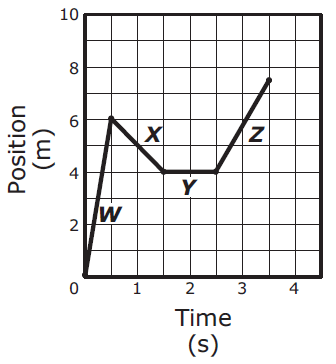
W
X
Y
Z

Constant Speed
Acceleration
Deacceleration
Not moving
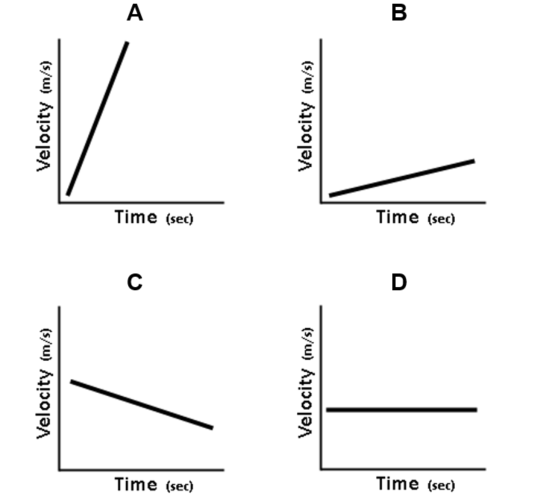
A
B
C
D


If there is no friction, then the acceleration would be equal to
mg
sin(θ)mg
g
sin(θ)g


Given the FBD, which of the following must be true?
The frictional force must be accelerating the system to the left.
The box must be accelerating to the right.
The FBD is incorrectly drawn. This situation isn't possible
The box must be moving to the left

As the angle of the incline increases, what happens to the normal force?
The normal force increases
The normal force decreases
The normal force is not affected by the incline
The normal force is only dependent on the force due to gravity

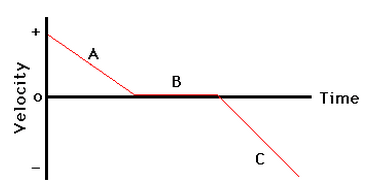
What is happening between 4 and 5 seconds?
The object is slowing down in a negative direction.
The object is slowing down in a positive direction.
The object is speeding up in a positive direction.
The object is speeding up in a negative direction.

A person walking along a straight line moves such that her velocity as a function of time can be represented by the graph above. At what time does the person have the same position as she had at time t = 0?
At t = 5 s
During the interval 5 s < t < 8 s
At t = 8 s
During the interval t > 8 s
In which of the following situations is kinetic energy decreasing?
A lit tinsel llama is dropped from a building.
A satellite is moving in a circular orbit around the moon.
A baseball is headed upward after being thrown up in the air.
An elevator is moving upward at a constant velocity.


Which of the following is not true about the system?
T3 is equal to the scalar sum of the magnitudes of T2 and T1
T3 is equal in magnitude to Fg
The x- components of the T1 and T2 and equivalent but in opposite directions
The system is in equilibrium.
A penguin of mass M is lifted upwards a vertical distance of H at a constant speed of v. Which of the following gives a correct expression for the power developed by the penguin as it is raised upward at constant speed?
Mgv
vmg
vmgh
mgh
A roller coaster car moves down the hill. Assuming that the track is frictionless, which option represents the transfer of energy?
Potential to Kinetic
Kinetic to Potential
Mechanical to Thermal
Mechanical to Potential
Bill and Ted both push a crate of mass m crate across a floor with friction at constant speed. Bill pushes the crate d meters in 100 seconds. Ted takes 200 seconds to push the crate the same distance. Which of the following is true?
More power is developed when Ted pushes the crate.
More power is developed when Bill pushes the crate.
An equal, non-zero amount of power is developed in both cases.
Power is not developed in either case since the crate travels at constant velocity in both cases
A car of mass m is traveling at a speed of when the driver applies the brakes. The car moves a distance of d before it stops completely. What is the magnitude of the braking force required?
v22d
2dmv2
d2v2
dmv

Which of the following statements is true about the image above?
The accelerations of the blocks will vary according to their mass
The net force acting on each block is the same
The blocks will experience the same acceleration
The 3m box will eat the 2m and the m boxes





The system shown consists of two objects of unequal masses, M1 and M2, and pulley with negligible mass and friction. Which of the following is true about the changes in the gravitational potential energy and kinetic energy of the system soon after the objects are released from rest?
ΔU = 0 and ΔK>0
ΔU>0 and ΔK>0
ΔU<0 and ΔK>0
ΔU=0 and ΔK=0
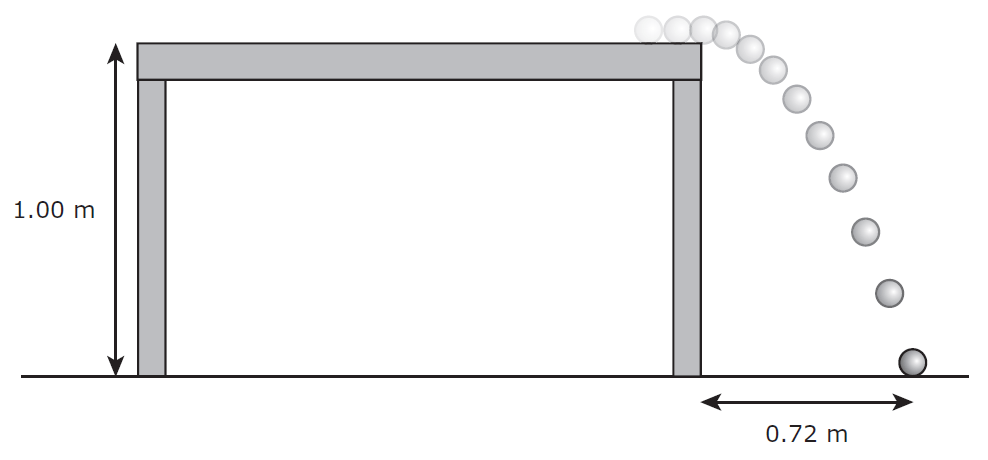
A car is traveling at a velocity of 35.0 miles per hour. The car runs off a cliff that has an unknown height. The car 'lands' 50.0 meters from the base of the cliff.
How long would it take the car to 'land' after exiting the rim of the cliff?

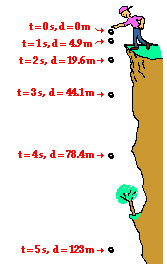
Find the displacement in the first 5 seconds.
8 centimeters
4 centimeters
2 centimeters
5 centimeters

A roller coaster car of mass m has a speed of 0 m/s just before it starts to go down a hill as show above. Assume the roller coaster does not encounter any friction or air resistance. What is the speed of the roller coast car at point B?
gh
2gh
2gh
m2gh

A dude drags a car mass M across a rough floor with a force of magnitude directed at an angle theta of above the horizontal as shown. If he drags the crate for a distance D, which of the following is equal to the work by the force of friction?
−FcosθD
−μmgD
−μ(mg−Fsinθ)D
−μ(mg+Fcosθ)D

A block of mass M on an inclined surface is attached to a spring of negligible mass, as shown. The other end of the spring is attached to a wall, and there is negligible friction between the block and the incline. The block is pulled to a position such that the spring is stretched from its equilibrium position. The block is then released from rest. Which of the following systems can be classified as a closed system?
A system consisting of the block only
A system consisting of the spring and Earth
A system consisting of the block and spring
A system consisting of the block, spring, and Earth
An object is projected vertically upward from ground level. It rises to a maximum height H. If air resistance is negligible, which of the following must be true for the object when it is at a height H/2?
Its speed is half of its initial speed.
Its kinetic energy is half of its initial kinetic energy.
Its potential energy is half of its initial potential energy.
Its total mechanical energy is half of its initial value.
A rubber ball with mass 0.20 kg is dropped vertically from a height of 1.5 m above a floor. The ball bounces off of the floor, and during the bounce 0.60 J of energy is dissipated. What is the maximum height of the ball after the bounce?
0.30 m
0.90 m
1.19 m
1.56 m
Jared holds a book still two feet above his desk. He then lowers the book at a constant speed and places it on the desk. Which of the following describes the change in total mechanical-energy of the book?
The total mechanical energy is unchanged since there is no net work done as the book is lowered.
The total mechanical energy decreases because Jared does positive work on the book.
The total mechanical energy is unchanged because no work is done on the book while it is lowered.
The total mechanical energy decreases, because Jared does negative work on the book.
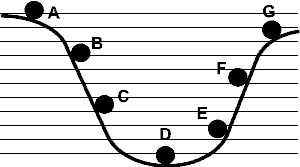
A man weighing 800 Newtons is standing in an elevator. If the elevator rises with an acceleration of 0.5 meters per second2, the force exerted by the elevator on the man will be
400 N
800 N
1200 N
1000 N

A stick figure of mass running at speed grabs a light rope that hangs from a ceiling of height H and swings to a maximum height of In another room with a ceiling of height H/2, a second stick figure with mass running at the same speed grabs a light rope hanging from the ceiling and swings to a height of . How does the maximum height reached by the two stick figures compare and why?
The first stick figure swings to a higher height since he swings from a higher rope.
The second stick figure swings to a higher height since he has more mass.
The two stick figures reach the same height, because the length of the second rope offsets the mass of the second stick figure.
Both stick figures swing to the same height because they have the same initial speed.
True/False: A conservative force does not change the mechanical energy of a system
True
False

The graph on the right shows the kinetic energy over time for a lit tinsel llama in motion. At time t = 0, the potential energy of the llama is 10 J. Determine the potential energy of the object at time t = 9 s.
4 J
10 J
8 J
2 J

A box of oranges slides from rest down a frictionless incline from a height of 5.0 m. A constant frictional force, introduced at point A, brings the block to rest at point B, 19 m to the right of point A. What is the coefficient of kinetic friction of the surface from A to B?
0.11
0.26
0.33
0.47
A baguette is dropped off the top of the Eiffel Tower. What is true concerning of the mechanical energy of the ball as it falls?
The potential energy of the baguette is conserved as it falls.
The sum of the kinetic and potential energies of the baguette is a constant.
The kinetic energy of the baguette is conserved as it falls.
A) The total energy of the object increases as it falls since it gains speed.
True
False

2.81 m
4.81 m
8.81 m
12.81 m
If a roller coaster track is not frictionless, which option best represents the transfer of energy?
Thermal to Kinetic and Potential
Kinetic to Thermal and Potential
Potential to Kinetic and Thermal
60 J
75 J
90 J
180 J
4.20 m
52.5 m
105 m
158 m
0.0024 J
0.024 J
2.4 J
24 J
Which of the following forces does positive work?
The force of a gravity on a block that is slowly lowered from a desk to the ground.
The force of gravity on a satellite that is orbiting the earth.
The force of gravity on a block that is being pushed up an incline and speeding up.
The force of velocity on a free-body diagram.
A frictionless pendulum swings through its full range of motion at the surface of the Earth. At the lowest point of its motion, it is moving with a velocity of 2 m/s. How high above its lowest point will it rise?
0.22 m
0.38 m
0.41 m
0.56 m
A 5 kg ball is lifted 12 m above the ground. The ball:
gains elastic potential energy
gains gravitational potential energy
gains kinetic energy
gains mechanical energy
Which of the following objects has the most kinetic energy?
A 20 kg toddler running at 5 m/s
A 50 kg toddler running at 30 m/s
A 90 kg toddler running at 30 m/s
A 100 kg toddler running at 5 m/s
Kinetic
Thermal
Potential
Mechanical
Which of the following is true for a system consisting of a mass oscillating on the end of an ideal spring?
The kinetic and potential energies are equal to each other at all times.
The kinetic and potential energies are both constant.
The maximum kinetic energy and maximum potential energy are equal, but occur at different times.
The maximum potential energy is achieved when the mass passes through its equilibrium position.
A student is asked to determine the work done on a block of wood when the block is pulled horizontally using an attached string. The student is supplied with a spring scale, a stopwatch, and a meterstick. Which of the following graphical analysis techniques will allow the student to determine the work done on the block by the string?
Graphing the force as a function of time and calculating the slope
Graphing the force as a function of time and calculating the area under the curve
Graphing the force as a function of distance and calculating the slope
Graphing the force as a function of distance and calculating the area under the curve
6.9 cm/s
7.2 cm/s
12.1 cm/s
1.3 m/s
A rock is lifted for a certain time by a force F that is greater in magnitude than the rock's weight W. The change in kinetic energy of the rock during this time is equal to the
work done by the net force (F - W)
work done by F alone
work done by W alone
difference in the momentum of the rock before and after this time
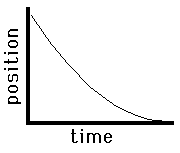
A beat is dropped from the edge of a cliff. Which of the following graphs best represents the beat's kinetic energy KE as a function of time t?


An object is released from rest at a height H near and above the surface of Earth. As the object falls toward the surface, Earth’s atmosphere exerts a resistive force on the object such that it reaches a terminal velocity before it reaches the ground. Which of the following claims is true? Select two answers.
The system consisting of only the object is an open system.
Earth’s atmosphere does negative work on the object as it falls toward the surface.
The change in the object’s kinetic energy from the instant it is released from rest, to the instant it reaches terminal velocity, is zero.
The total mechanical energy of the object-Earth system remains constant at all times in which the object is in motion.

