
 Worksheets
Copper and Geological Layers
Total questions: 71
Worksheet time: 36mins
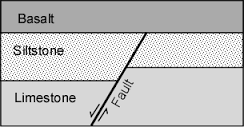

What rock in the Oldest?
Conglomerate
Shale
Breccia
Sandstone




How old do some scientists believe the Earth is?
450 million years
4.5 million years
40 billion years
4.6 billion years
Constructive forces _______________ landforms.
Tear down
Build up

This valley was created by
internal forces of the Earth
the forces of gravity and the sun

Volcanic mountains are created by __________forces
constructive- Earth's internal
destructive- Gravity and sun's
constructive- Gravitational and sun's
destructive- Earth's internal forces

Analyzing the image, is the youngest layer on the top or the bottom of this rock feature?
THE TOP
THE MIDDLE
THE BOTTOM
According to the Law of Original Horizontality, when sediment is deposited, it is deposited _____________ under the action of gravity.
VERTICALLY
DIAGONALLY
HORIZONTALLY
An earthquake or other geologic movement can cause a _____ in rock layers and is a break in the rock. This is represented by a diagonal line in a stratigraphic column.
Intrusion
Fault
Fold

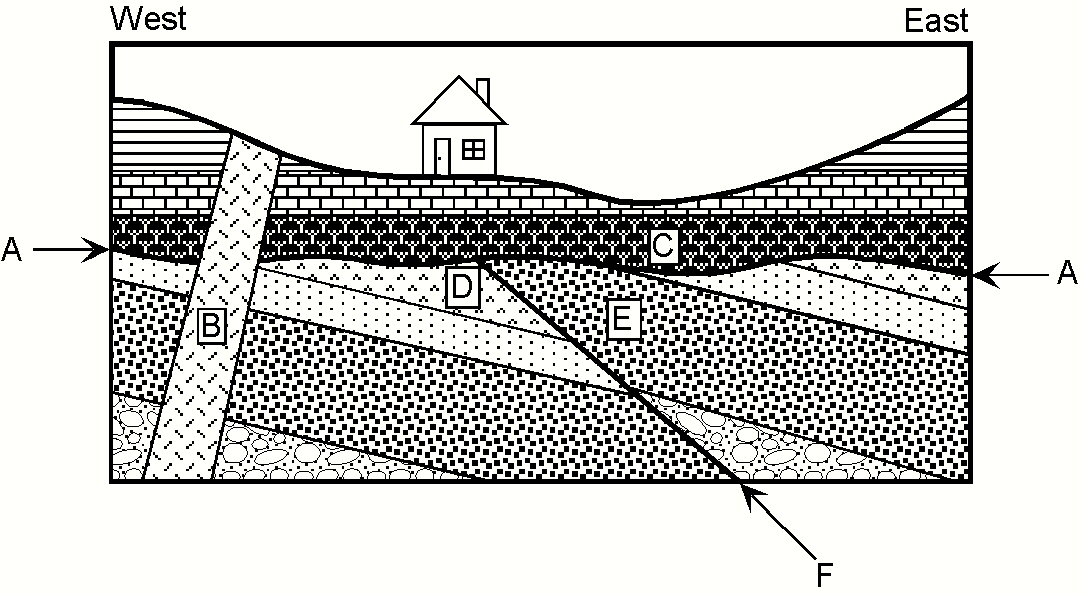
Analyzing the image, which letter represents an INTRUSION (magma seeping into rock layers)?
Letter E
Letter B
Letter D
Letter C

Analyzing the Stratigraphic Column, which fault happened more recently- A or F?
Fault A
Fault F

Copper is an example of a(n)
Element
Electron
Neutron
Carbon
Which of the following statements about minerals is FALSE?
Minerals have a crystalline structure.
Humans can create minerals to suit specific needs.
Minerals are inorganic materials.
Minerals cannot be liquids or gases.
Among the following which mineral is found in electronics we use like wires and circuit boards?
Carbonate
Salt
Iron
Copper
Potash
Sedimentary rocks are _______ .
formed from magma
a type of foliated igneous rock
formed because of changes in temperature and pressure, or the presence of hot watery fluids
formed when loose materials become pressed or cemented together or when minerals form from solutions

Which location from the image is more likely to have copper?
A
B
C
D
E

Which location is more likely to have copper?
1
2
3
4
5

How many protons in copper? Numbers only.
(a)
Porphyry copper is often found...
along plate boundaries on land
along plate boundaries in the ocean
at divergent plate boundaries
at low elevations
Sediment hosted copper is copper that was ...
melted in veins of rocks
dissolved in hot water and infused into sandstone
placer deposits by hotspots
found in conglomerate rock deposits
Porphyry copper is copper that is found...
in liquid
in igneous rocks
in sedimentary rocks
in coal deposits
Where is copper found
higher elevations
along continental plate boundaries
next to volcanoes
all of these is correct

Copper deposits are often found
deep under older continental crust
on transform plate boundaries
in the oceans
on newer continental crust
What mechanism causes copper to move from the mantle to the surface of the Earth?
Divergent plate boundaries and rift valleys
Erosion and deposition
Convection currents with volcanic activity
Transform plate boundaries with upwelling
Where was copper created before it was on Earth?
Core of older stars
Big Bang
Supernova
Core of young stars
Which type of copper is located on the WEST side of Utah and Arizona (where 75% of all US copper comes from)?
Prophryr
Sediment -hosted
Which type of copper is found in San Juan Country at the Lisbon Valley Copper Mine
Sediment hosted copper
Porphyry copper

Many areas with active volcanic activity have unique minerals that rise to the surface of Earth. What metal resource is #1 in Utah?
Salt
Potash
Copper
Gypsum
What type of chemical is mixed with copper to dissolve it into liquid?
potash
water
sulfuric acid
gasoline
What is the last step in mining copper to get it to 99.99% copper?
Smelting
Reacting it with acid
Melting
Electroplating
In electroplating, why does the copper leave the solution to attach to the metal that has the negative electrode?
Copper drops out of solution because it is dense.
Copper has a positive charge.
Copper has a negative charge.
Copper is magnetic.
What is an assay?
A solution used to dissolve copper.
A type of test to identify the purity of an ore.
An essay where you explain a concept.
A test used to identify the density of an ore.
Why are mineral ores often found in mountainous areas?
Because of the elevation levels.
Because of the intense heat and pressure associated with mountain building.
Because of the watersheds in the area.
What is a hydrothermal deposit?
Melting magma and then cooling.
Groundwater that is heated due to magma dissolving minerals, moving them, and depositing them.
Purified and processed minerals.
How do scientists locate mineral resources?
Understanding of geological processes.
Test properties of soil and rock.
Chemistry and physical properties of rock.
All of the above.
Restoring land to its original state after mining has finished is called __.
reclamation
remediation
restoration
redemption
When did the blue mountains (laccolithic magma intrusions) form in San Juan County?
11,000 years ago
1 million years ago
30 million years ago
300 million years ago
When oil, gas, and potash were deposited in San Juan county what was the environment like?
a hot sand dune dessert
swampy jungle with lots of trees
a marine area or ocean
temperate grassland
What is one of the highest paying jobs in San Juan County?
teaching
small business
health care
mining and extracting
city government- police
Identify the correct name for the mining process of leaving the mineral in its original place under the ground, sending down water to dissolve it and pumping that water back up to the surface.
Underground mining
Open surface or pit mining
Placer mining
In situ mining
Sedimentary rocks are _______ .
formed from magma
a type of foliated igneous rock
formed because of changes in temperature and pressure, or the presence of hot watery fluids
formed when loose materials become pressed or cemented together or when minerals form from solutions
Sediment hosted copper is copper that was ...
melted in veins of rocks
dissolved in hot water and infused into sandstone
placer deposits by hotspots
found in conglomerate rock deposits
Which location is more likely to have copper?
1
2
3
4
5
Which location from the image is more likely to have copper?
A
B
C
D
E
A company is likely to mine a site if the site
is rich in minerals
contains gold
contains minerals that can be extracted economically
does not contain gangue minerals
Mining that is done above ground is called...
surface mining.
subsurface mining.
What is required in the refining process besides fossil fuel?
Water use
Tailings
Cyanide
Overburden
Which type of mining involves creating a large pit by digging down into the earth?
Contour Strip Mining
Open-Pit Mining
Mountaintop Removal
Sub-surface Mining
Rock that forms as magma cools slowly and solidifies below Earth’s surface is called
intrusive igneous rock
chemical sedimentary rock.
extrusive igneous rock.
An ore is mined so that ______________ can be removed from it.
Air
Metals
Water

