wayground logo

Free Printable Worksheets

Font size

S
M
L
XL
Worksheets

Unit 6 Matter Review

Total questions: 60

Worksheet time: 1hrs 10mins

Name
Class
Date
1.

When you put an object in a graduated cylinder of water and measure how much the water level changed what is this process called?

a)

Relative Density

b)

Displacement

c)

Density

2.

Why does oil float on top of the water in an oil spill?

a)

Oil has the same density of water

b)

Oil is less dense than water

c)

Oil is more dense than water

3.
Jack has a rock. The rock has a mass of 14g and a volume of 2cm3. What is the density of the rock?
a)
7 mL
b)
7 g/cm3
c)
28 g/cm3
d)
1/7 g/cm3
4.
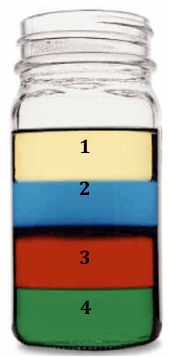
Put the liquids in order from most dense to least dense?
a)
4, 3, 2, 1
b)
1, 2, 3, 4
c)
3, 4, 2, 1, 
d)
4, 3, 1, 2
5.
What is the formula for density?
a)
density = mass x volume
b)
density = mass / volume
c)
density = mass + volume
d)
density = mass - volume
6.
In the picture, the mass of the block is 200 g, the dimensions of the block are 6 cm by 4 cm by 5 cm.  What is its density?
a)
1.67g/cm3
b)
13.33 g/cm3
c)
0.60 g/cm3
d)
 24000 g/cm3
7.

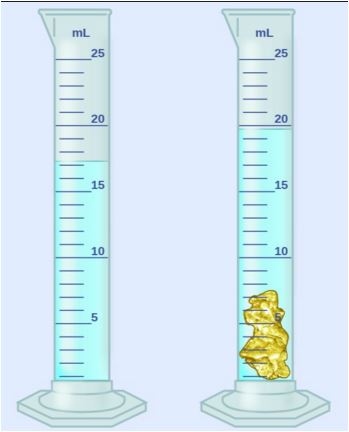
The amount of water displaced is the same as the volume of the object. What is the VOLUME of the object?

a)
40 mL
b)
65 mL
c)
20 mL
d)
25 mL
8.

An object is is placed into 45 mL of water. The water rises to 48 mL. What is the volume of the object?

a)

3 mL

b)

93mL

c)

8 mL

d)

83 mL

9.
An irregularly shaped piece of gold was lowered into a graduated cylinder holding a volume of water equal to 17 ml. The height of the water rose to 20 ml. If the mass of the gold was 27 g, what was its density?
a)
9 g/mL
b)
10.5 g/mL
c)
6.5 g/mL
d)
8 g/mL
10.
What is the mass of a substance with a volume of 72.5 cm3 and a density of 0.94 g/cm3?
a)
68.15 g
b)
77.13 g
c)
62 g
d)
100 g
11.
The _____is the part that gets dissolved. 
a)
solute 
b)
solvent 
c)
solution 
d)
Sacajawea 
12.
A solution is a kind of ________. 
a)
mixture 
b)
compound 
c)
element 
d)
stuff 
13.
A solution is a ________ mixture. 
a)
heterogeneous 
b)
homogeneous 
c)
dumb 
d)
mixed 
14.
This is the part of the solution that does the dissolving. 
a)
solute
b)
solvent 
c)
salt water 
d)
First Continental Congress 
15.
Solubility is a ________ property. 
a)
neat 
b)
chemical 
c)
physical 
d)
an organic 
16.

This is a mixture that will settle over time if you let it sit.

a)

Suspension

b)

Colloid

c)

Solution

d)

Element

17.
A saturated solution is one that....
a)
contains the maximum amount of dissolved solute.
b)
contains less solute than a saturated solution.
c)
contains more solute than a saturated solution.
d)
is the amount of a substance required to form a saturated solution.
18.
A supersaturated solution is one that....
a)
contains the maximum amount of dissolved solute.
b)
contains less solute than a saturated solution.
c)
contains more solute than a saturated solution.
d)
is the amount of a substance required to form a saturated solution.
19.
An unsaturated solution is one that....
a)
contains the maximum amount of dissolved solute.
b)
contains less solute than a saturated solution.
c)
contains more solute than a saturated solution.
d)
is the amount of a substance required to form a saturated solution.
20.
The dissolving medium in a solution is called ... 
a)
colloid
b)
solution
c)
solute
d)
solvent
21.
This solution would be considered
a)
Unsaturated
b)
Supersaturated
c)
Saturated
d)
Undefined
22.
This graph represents a(n) ___ solution
a)
saturated
b)
supersaturated
c)
unsaturated
d)
undefined
23.
salt water is a 
a)
compound
b)
element
c)
heterogeneous mixture
d)
solution
24.
This type of mixture contains two or more substances that are visibly distinguishable. 
a)
homogeneous
b)
heterogeneous
c)
solution
d)
colloid
25.
When materials combine to form a mixture, they
a)
A. keep their original properties.
b)
B. react to form a new substance with new properties.
c)
C. combine in a specific ratio.
d)
D. always change their physical state.
26.
What is it about the water molecule that makes it a great solvent?
a)
water demonstrates polarity; a partial charge on each side of the molecule
b)
due to its molecular formula
c)
it has a liner molecular shape
d)
due to it's non-polar molecular structure
27.
90 grams of sodium nitrate (NaNO3) are put into 100 grams of water and stirred. The final
mixture has a temperature of 20°C. About how many grams of the sodium nitrate dissolved?
a)
23
b)
73
c)
80
d)
88
28.
Which of the following would decrease the rate of solution when dissolving a solid in water?
a)
Raise the temperature of the solution
b)
Crush the solid before mixing
c)
Stir the solution after mixing
d)
Use a single cube of solid
29.

a property that DOESN'T change the composition of a substance

a)

physical property

b)

chemical property

c)

density

d)

volume

30.

properties that HAVE the ability to change chemical bonds and atomic composition

a)

physical property

b)

chemical bonds

c)

chemical property

d)

atomic composition

31.

An ice cream cone melts in a kid's hand while walking outside on a hot summer day. What is this an example of?

a)

Physical property

b)

Chemical property

c)

Physical change

d)

Chemical change

32.

A group of campers burned some wooden logs to make a bonfire. What is this an example of?

a)

Physical property

b)

Chemical property

c)

Physical change

d)

Chemical change

33.
If a new substance is formed would this be a physical or chemical change?
a)
Physical
b)
Chemical
34.

Is this an example of a physical or chemical change?

a)

physical

b)

chemical

35.

Which process is an example of a physical change?

a)

paper burning to ash

b)

dough being baked into bread

c)

apple juice turning into vinegar

d)

rock being crushed into gravel

36.

Which process represents a chemical change?

a)

A lake freezes over into ice

b)

Vinegar bubbles when baking soda is added

c)

A metal bar is rolled into a flat sheet

d)

Sand, water, and salt combine to form a mixture

37.

Coffee, mouthwash, and vinegar are examples of __________________ mixtures.

a)

heterogeneous

b)

homogeneous

c)

colloid

d)

elemental

38.
A substance that contains only one type of atom is a(n)
a)
compound
b)
element
c)
heterogeneous mixture
d)
homogeneous mixture
39.
A substance that is made up of two or more different types of atoms bonded together e.g. water
a)
compound
b)
solvent
c)
element
d)
solution
40.

Anything that takes up space and has mass is

a)

Matter

b)

Volume

c)

Liquid

d)

Atom

41.

Particles are closed and regular arrangement

a)

Solid

b)

Liquid

c)

Gas

42.

Particles move quickly in each direction

a)

Solid

b)

Liquid

c)

Gas

43.

Definite and fixed

a)

Solid

b)

Liquid

c)

Gas

44.

Name the effect

a)

brownian

b)

tyndall

c)

suspension

d)

colloidal

45.

Milk: (select all that apply)

a)

heterogenous mixture

b)

homogenous mixture

c)

colloid

d)

scatters light (tyndall effect)

46.
What does "polar" mean?
a)
A molecule is cold
b)
A molecule has ionic bonds
c)
A molecule has covalent bonds
d)
A molecule has areas of positive and negative charge
47.

A substance made of two or more different elements. Example: H2O, CO2

a)

Molecule

b)

Compound

c)

Surface Tension

d)

Surfactant

48.

The heat absorbed while a solid is melting is known as....

a)

heat of fusion

b)

heat of solid

c)

heat of liquid

d)

heat of vaporization

49.

The amount of heat needed to change 1 gram of a substance from the liquid phase to the gas phase is ___

a)

Heat of Vaporization

b)

Boiling point

c)

Heat Energy

d)

Phase change

50.

Temperature when a substance changes from a liquid to a gas

a)

Heat of Vaporization

b)

Boiling point

c)

Heat Energy

d)

Phase change

51.

The temperature when a liquid turns to a solid

a)

freezing point

b)

heat of fusion

c)

thermal expansion

d)

melting point

52.
What is Evaporation?
a)
1.Process of water movement through a plant from the drying up of its aerial parts
b)
2.Occurs on the surface of a liquid as it changes into the gaseous phase.
c)
3.Occurs when rain drops fall
d)
4.All of the above
53.
Which is NOT an assumption made by the kinetic molecular theory of gases?
a)

All matter is made up of particles.

b)

Particles are in constant, random motion

c)

When particles collide, their total kinetic energy is decreased

d)

Particles collide with each other and the container they are in

54.
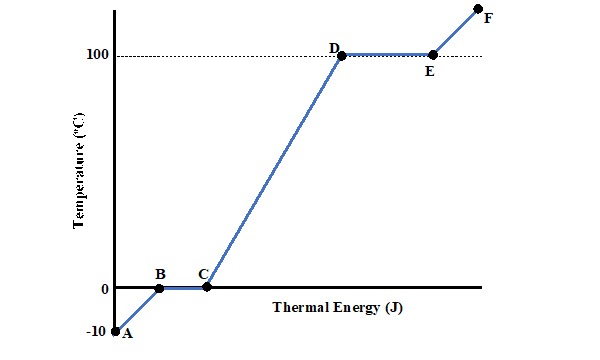
What line segment represents only the solid state?
a)
A-B
b)
B-C
c)
C-D
d)
D-E
55.

Between which two points is Heat of Fusion?

a)

A <----> B

b)

B <----> C

c)

C <----> D

d)

D <----> E

e)

E <----> F

56.

Between which two points is Heat of Vaporization?

a)

A <----> B

b)

B <----> C

c)

C <----> D

d)

D <----> E

e)

E <----> F

57.
A substance's heating curve is shown in the graph.  What is its boiling point?
a)
100 C
b)
60 C
c)
80 C
d)
20 C
58.

A solid is a state of matter that has a(n)

a)

indefinite volume and indefinite shape

b)

definite volume and a definite shape

c)

definite volume and an indefinite shape

d)

indefinite volume and a definite shape

59.
In which state of matter do particles spread apart and fill all the space available to them? 
a)
crystal
b)
liquid
c)
gas
d)
solid
60.
During the process of sublimation
a)
a solid turns directly into a gas
b)
a solid turns into a liquid
c)
a gas turns directly into a solid 
d)
 a liquid turns into a gas