
 Worksheets
PLTW HBS Unit 2.2-Neurons
Total questions: 60
Worksheet time: 3600secs
Motor neurons carry impulses __________ the brain
towards
away from
within
Which of the following describes the function of the Na/K Pumps in the neuron membrane?
depolarizing the cell by allowing Na into the cell
repolarizing the cell by allowing K out of the cell
rearranging Na and K back to return cell to resting state
Which of the following correctly outlines a reflex arc?
Motor neuron - interneuron - sensory neuron
Sensory neuron - interneuron - motor neuron
Sensory neuron - interneuron - brain - motor neuron
The dendrites of a neuron carry a stimulus
Towards the cell body
Away from the cell body
Through the cell body

Carries information from sensory receptors to CNS
Sensory neuron
Association neuron
Interneuron
Motor neuron

Carries info from CNS to muscles
Sensory neurons
Interneurons
Association neurons
Motor neurons
A genetic disease characterized by uncontrollable body movements & degeneration of the nervous system
Huntington's Disease
Multiple Sclerosis
Alzheimers
Parkinson's Disease
Epilepsy

Identify the structure labelled C
dendrite
neurotransmitter
receptor
schwann cell

Identify the structure labelled A
neurotransmitter
synapse
action potential
myelin
A condition caused by the loss of neurons that release acetylcholine leading to memory loss and other mental functions
Huntington's Disease
Multiple Sclerosis
Alzheimers
Parkinson's Disease
Epilepsy
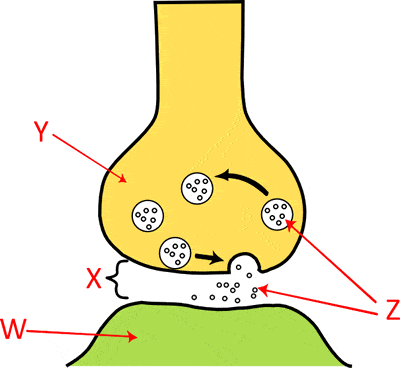

What do we call a nerve cell that is the basic working unit of the brain and nervous system?
axon
neuron
dendrite
neurotransmitter
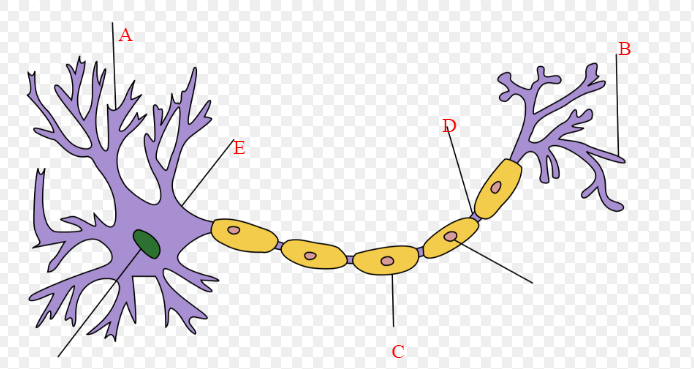
B
Dendrite
Axon
Axon Terminal
Cell Body


During resting membrane potential, the inside of a neuron has a _______________ charge
negative
positive
neutral
Neurotransmitters are stored in which structure of the neuron?
Cell body
Dendrite
Axon terminals
Myelin is located on the ____________ and functions to ____________ nerve transmission.
dendrite - speed up
dendrite - slow down
axon - speed up
axon - slow down
Neurotransmitters bind to complementary sites on a cell called
receptors
axon terminals
cell bodies
Depolarization occurs when the inside of a cell becomes _________________ due to _________ gates opening.
positive - potassium
negative - potassium
positive - sodium
positive - sodiium

The spaces (C on diagram) between myelin on an axon are called
axon gaps
nodes of ranvier
dendrite dents
Which of the following nervous system disorders occurs as a result of tangled plaques forming in brain tissue?
Huntington's disease
Alzheimer's disease
Parkinson's disease
Which of the following disorders is associated with a decrease in the neurotransmitter called dopamine?
Parkinson's disease
Epilepsy
ALS
Which of the following diagnoses best describes a disorder that involves seizure activity?
MS
ALS
Epilepsy
Which of the following diseases does NOT affect memory or mental cognition?
ALS
Huntington's
Alzheimers
What is the function of the myelin sheath?
To insulate and speed up the signal transmission
To store the neurotransmitters
To insulate and slow down the signal transmission
To receive the signal from the previous neuron
What neuron structure receives the message?
Dendrites
Cell Body
Axons
Vesicles
In which direction does the electric signal travel in a neuron?
From the axon terminal to the dendrite
From axon to cell body to dendrite terminal
From the dendrite to cell body to axon to axon terminal

What kind of neuron is this that receives information from the environment?
Motor Neuron
Sensory Neuron
Interneuron
Association Neuron
Which of these describes the neuron?
Myelinated
Nonmyelinated
Which of these describes the neuron?
Unipolar
Multipolar

What type of neuron is this that relays messages to and from other neurons?
Motor Neuron
Sensory Neuron
Interneuron

What type of neuron is this that receives signals from the CNS and carries them to an effector?
Motor Neuron
Association Neuron
Interneuron
Sensory Neuron

Examine the image. If you see a bug, what type of neuron does the SEEING?
Sensory Neuron
Interneuron
Motor Neuron
Examine the image. If you see a bug and decide to step on it, what neuron does the DECIDING?
Sensory Neuron
Interneuron
Motor Neuron
Examine the image. If you see a bug and decide to step on it, what neuron sends signals so you STEP on it?
Sensory Neuron
Interneuron
Motor Neuron
A patient has Multiple Sclerosis, which destroys Myelin Sheath. What might occur?
Signals may be lost or travel slowly
Brain function decreases
Muscles waste away because they aren't stimulated
Signals travel too quickly

This is a reflex neural pathway. Does it travel to the brain?
Yes
No
In order to build muscles, what kind of neurons had to continually signal muscles to contract?
Interneurons
Motor Neurons
Sensory Neurons
Put these neurons in the correct order for a reaction neural pathway.
Sensory - Interneuron - Motor
Motor - Interneuron - Sensory
Sensory - Motor - Interneuron
Motor - Sensory - Interneuron

Lobe of brain associated with body sensations: touch, temperature, pain
Frontal
Parietal
Temporal
Occipital

An automatic response to a stimulus that often does not pass through the brain
Sense
Reaction
Reflex
Contraction

The place at which a nerve impulse passes from one neuron to another
Axon
Synapse
Schwann cell
Neurotransmitter

Insulating coat of cell membrane from Schwann cells
Nucleus
Neurotransmitter
Myelin sheath
Nodes of Ranvier

Transmits nerve impulses across a synapse
Axon terminal
Dendrites
Synaptic cleft
Neurotransmitter

Autoimmune disorder which destroys the myelin sheath
Epilepsy
Multiple sclerosis
ALS
Parkinson's

Neurologic disorder which affects motor neurons leading to progressive weakness, fatigue of arms/legs, and muscle twitches.
Epilepsy
Muscular dystrophy
ALS
Alzheimer's

Momentary reversal in electrical potential across a plasma membrane
Reflex response
Reaction
Impulse conduction
Action potential

Membrane protein responsible for restoring original concentration of ions in neurons
Na+ channel
Na+/K+ pump
K+ channel
Ca++ channel

