
Font size
 Worksheets
Test bank review Chem unit 6
Total questions: 78
Worksheet time: 2hrs 33mins

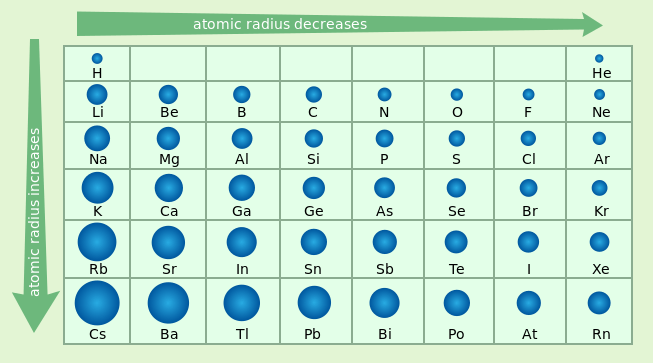


Atomic radius INCREASES when you go (a) a group
Atomic radius DECREASES when
when you go across a row from right to left
when you go down a group
when you go across a row from left to right
when you go across a group from left to right
Put in order from biggest to smallest (decreasing size)
Calcium
Iron
Zinc
Bromine
Krypton
Ionization energy ________________ as you go DOWN a group
increases
decreases
Which atom has larger ionization energy
aluminum
sulfur
Which atom has smaller ionization energy
strontium
iodine
This element has the lowest electron affinity
magnesium
sodium
silicon
sulfur
What element is the most electronegative
chlorine
bromine
iodine
astatine
What element is the LEAST electronegative
cadmium (Cd)
antimony (Sb)
Zirconium (Zr)
Strontium (Sr)
What metal is most reactive
lithium
sodium
potassium
rubidium
What non-metal is the most reactive
iodine
sulfur
oxygen
fluorine
Which metal ion (cation) is the smallest
oxide ion (oxygen ion)
nitride ion (nitrogen ion)
aluminum ion
magnesium ion
F, N, B


carbon, aluminum, oxygen, phosphorus.
Not sure? check out page 151 in your textbook
P or P-3
Which element is a member of the halogen family?
Sulfur
Chlorine
Argon
Carbon
Which element is a member of the noble gases?
Te
Iodine
Xenon
Nitrogen
Which of the following is a nonmetal?
Sulfur
Lithium
Sodium
Silicon
Which of the following is a transition metal?
Mercury
Oxygen
Calcium
Aluminum
Where are the metalloids located on the periodic table?
To the right of the staircase
On the staircase
To the left of the staircase
Who knows
This group is the most reactive of the metals
Alkali
Alkaline earth
Transition
Other metals
Which element has similar properties to magnesium?
Sodium
Aluminum
Calcium
Chlorine
poor conductors; found in upper right of PT; dull and brittle; mostly gases
metalloids
metals
semiconductors
nonmetals
Metalloids; select all that are true
form a vertical line
have properties of metals and nonmetals
semiconductors
shiny, brittle solids
Group 2; less reactive than Group 1
Alkali Metals
Alkaline Earth Metals
Transition Metals
Actinides

