wayground logo

Free Printable Worksheets

Font size

S
M
L
XL
Worksheets

Nervous system Review

Total questions: 64

Worksheet time: 1hrs 1mins

Name
Class
Date
1.
The central nervous system is comprised of all the neurons in the brain and the ____.
a)
Spinal Cord
b)
Cerebellum
c)
Medulla
d)
Pons
2.
Heartbeat would be accomplished by which branch of the nervous system?
a)
Sensory
b)
Autonomic
c)
Motor
d)
Pineal
3.
What does the autonomic nervous system control?
a)
Voluntary movement
b)
Cardiac muscles only
c)
Involuntary responses
d)
The spinal cord
4.
The gap that a message has to cross to get from one neuron to the other is called the _____
a)
synapse
b)
dendrite
c)
axon
d)
nucleus 
5.
Which part of a neuron RECIEVES information?
a)
axon
b)
dendrite
c)
cell body
d)
axon terminal
6.
Which part of the neuron is a long fiber that send information to other cells?
a)
dendrite
b)
terminal
c)
cell body
d)
axon
7.
The part of the neuron that receives signals is the:
a)
Axon
b)
Dendrite
c)
Axon Terminal
d)
Cell Body
8.
Label the Neuron-What does the letter "H" represent?
a)
Schwann Cell
b)
Axon
c)
Axon Terminal
d)
Dendrite
9.

Identify letter E

a)

Synapse

b)

Cell Body

c)

Axon

d)

Dendrite

10.
The part of the neuron that transmits signals to muscles is the:
a)
Axon
b)
Dendrite
c)
Axon Terminal
d)
Cell Body
11.
A
a)
Dendrite
b)
Axon
c)
Axon Terminal
d)
Cell Body
12.
Label the Neuron-What does the letter "G"
represent?
a)
Axon Terminal
b)
Node of Ranvier
c)
Nucleus
d)
Myelin Sheath
13.
This nervous system branch causes increases in heart rate and breathing.
a)
Sympathetic
b)
Parasympathetic
c)
Motor
d)
Sensory
14.
Two major branches of the nervous system
a)
central and peripheral
b)
peripheral and motor
c)
motor and sensory
d)
central and motor
15.
The brain is part of the ____ nervous system.
a)
central
b)
peripheral
c)
motor
d)
internal
16.
This portion of a neuron allows the electrical signal to move very quickly
a)
Dendrites
b)
myelin sheath
c)
nucleus
d)
axon terminals
17.
The nerves in your legs are part of the ____ nervous system.
a)
Central 
b)
Peripheral
18.

This releases neurotransmitters which are sent into the synaptic gap

a)

axon

b)

axon terminal

c)

gene

d)

neuron

19.

Neurons that carry information from the sensory receptors to the CNS:

a)

Sensory, afferent

b)

Sensory, efferent

c)

Moror, afferent

d)

Motor, efferent

20.

Type of neuron located only in the brain and spinal cord that pass impulses from one neuron to another.

a)

Motor Neuron

b)

Interneuron

c)

Sensory Neuron

21.

Type of neuron that perceive information about your environment.

a)

Motor Neuron

b)

Interneuron

c)

Sensory Neuron

22.
The nervous system_________
a)
receives information about what is going on in your body as well as what is going on around you. 
b)
tells your body how to react to the information it receives. 
c)
helps your body maintain homeostasis. 
d)
all of the above.
23.
The "fight or flight" response during threatening situations in the role of the:
a)
sympathetic nervous system
b)
parasympathetic system
c)
somatic nervous system
d)
cerebellum
24.

What are the two divisions of the autonomic nervous system?

a)

central and peripheral

b)

parasympathetic and sympathetic

c)

brain and spinal cord

d)

nerves and ganglia

25.

The system which connects the central nervous systems to internal organs and glands and is self-regulating

a)

Central nervous syetsm

b)

Autonomic nervous system

c)

Somatic nervous system

d)

Spinal cord

26.

The nervous system which controls and carries messages to and from the skeletal muscles to control voluntary responses is called

a)

Central nervous system

b)

Autonomic nervous syetm

c)

Somatic nervous system

d)

Sympathetic nervous system

27.

The parasympathetic nervous system is responsible for

a)

Connecting the brain and peripheral nervous system

b)

Calming the body after action

c)

Preparing the body for action

d)

Carries messages for voluntary movements

28.

which of the following best represents the order in which a neuron receives and transmits information?

a)

axon, cell body, dendrites, axon terminals

b)

dendrites, cell body, axon, axon terminals

c)

axon terminals, dendrites, cell body, axon

d)

cell body, dendrites, axon terminals, axon

29.

what do we call the state of neurons when it is not firing a neural impulse?

a)

myelination signal

b)

resting potential

c)

action potential

d)

transmission impulse

30.

when a neuron fires, it fires in an _______ fashion as there is no such thing as "partial" firing.

a)

rapid fire

b)

all-or-nothing

c)

quick successioned

d)

accidental patterned

31.

reuptake is _____

a)

a chemical that is released into the synaptic gap

b)

a chemical that plays a role in learning and attention

c)

a protein molecule on the dendrite or cell body of a neuron that will interact only with specific neurotransmitters

d)

a process by which neurotransmitters are stucked back into the synaptic vesicles

32.

____ receive messages from other neurons and _______ send messages to other neurons.

a)

soma; glial cells

b)

dendtries; axon

c)

axon; soma

d)

axons; dendrites

33.

which of the following are the three basic types of neurons ?

a)

sensory neurons, motor neurons, stem cells

b)

reflexes, sensory neurons, motor neurons

c)

motor neurons, stem cells, reflexes

d)

inter-neurons, sensory neurons, motor neurons

34.
During repolarization, which ion(s)moves outside of neuron?
a)
sodium
b)
potassium
c)
sodium and potassium
35.
What causes depolarization of the neuron?
a)
sodium going into neuron
b)
sodium going out of neuron
c)
potassium going into neuron
d)
potassium going out of neuron
36.
Threshold stimulus means that
a)
the size of the action potential does not change
b)
only one impulse is conducted at a time
c)
a certain level of stimulus is required to generate an action potential
d)
the membrane becomes repolarised quickly after an action potential passes
37.
What number on the graph represents the Depolarization phase?
a)
1
b)
2
c)
3
d)
4
38.
What number on the graph represents the Hyperpolarization phase?
a)
1
b)
2
c)
3
d)
4
39.
What number(s) on the graph represents the Resting Potential?
a)
1 and 2
b)
1 and 5
c)
2 and 3
d)
3 and 4
40.
-70 mV is the measure of a
a)
Threshold Potential
b)
Action Potential
c)
Resting Potential
d)
End Point Potential
41.

When a membrane potential reaches +30mV, ________ channels close, ________ channels open, and ______________ happens.

a)

Potassium, sodium, repolarization

b)

Sodium, potassium, depolarization

c)

Potassium, sodium, depolarization

d)

Sodium, potassium, repolarization

42.
Why is -55 mV a significant number?
a)
This is the largest charge achieved during an action potential
b)
This is the threshold required to complete an action potential
c)
This is the resting charge of a neuron
d)
This is the charge when all the sodium is inside the cell
43.
Neurotransmitters are released from the
a)
Dendrites
b)
Post-synaptic neuron
c)
Presynaptic neuron
d)
Axon
44.
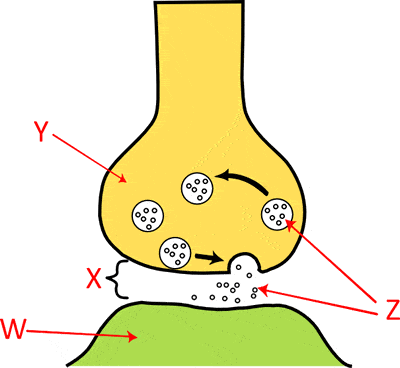
W
a)
Axon Terminal Button
b)
Neurotransmitters
c)

Dendrite of the postsynaptic neuron

d)
Synapse
45.
Z
a)
Dendrite
b)
Axon Terminal
c)
Neurotransmitters
d)
Synapse
46.

What is the name of cells that support the neuron?

a)

Neurons

b)

Axons

c)

Dendrites

d)

Neuroglia

47.
What type of neuroglial cell attaches neurons to capillaries?
a)
Astrocyte
b)
Oligodendrocytes
c)
Microglial
d)
Ependymal
48.

Neuroglial cells that form the fatty myelin sheath on neurons in the CNS are ___________ in the PNS are ________________?

a)

ganglia and oligodendroglia

b)

astrocytes and schwann cells

c)

schwann cells and oligodendroglia

d)

oligodendroglia and schwann cells

49.

Small cells that engulf and destroy microbes and cellular debris in the CNS

a)

microglia

b)

horns

c)

neuroglia

d)

astrocytes

50.

Produce cerebrospinal fluid in the brain & spinal cord

a)

ependymal cells

b)

oligodendrocytes

c)

microglia

d)

astrocytes

51.

A reflex reaction is an .....

a)

involuntary response

b)

voluntary response

c)

conscious response

d)

response

52.

Look at the reflex arc shown in the diagram. Which neurone is marked by the letter X?

a)

Sensory neurone

b)

Relay neurone

c)

Motor neurone

d)

CNS

53.

Look at the reflex arc shown in the diagram. Which neurone is marked by the letter Y?

a)

Sensory Neurone

b)

Relay Neurone

c)

Motor neurone

d)

CNS

54.
What is the final component of a reflex arc?
a)
Effector
b)
Receptor
c)
Integrating Centre
d)
Afferent Pathway
55.

Another name for motor neurons is

a)

efferent neurons.

b)

afferent neurons.

c)

somatic neurons.

d)

sympathetic neurons.

e)

parasympathetic neurons .

56.

Which of the following increase the speed of transmission of a nerve impulse?

a)

absence of myelin sheath

b)

smaller diameter of axon

c)

increased temperature

57.

Which of the following does not affect the transmission speed of a neuron cell?

a)

the diameter of the nerve fiber

b)

the presence of myelin in the nerve cell

c)

temperature

d)

the strength of the stimulus

58.
Serotonin is a neurotransmitter that helps regulate:
a)
learning and memory
b)
pain and pleasure
c)
muscle movements
d)
sleep, moods/emotions
59.
Which neurotransmitter is involved in muscle movements?
a)
Acetylcholine
b)
Endorphins
c)
Serotonin
d)
GABA
60.

This is a really strong inhibitory neurotransmitter that stops messages from firing.

a)

GABA

b)

norepinephrine

c)

substance p

d)

glutamate

e)

acetylcholine

61.

This neurotransmitter STOPS pain messages from following.

a)

endorphins

b)

substance p

c)

serotonin

d)

glutamate

e)

norepinephrine

62.

This neurotransmitter is linked to feelings of pleasure, euphoria, and reward.

a)

dopamine

b)

serotonin

c)

substance p

d)

glutamate

e)

endorphins

63.
Too much dopamine is linked with
a)
Alzheimers
b)
Schizophrenia
c)
Parkinsons
d)
Depression
64.
Parkinson's is the result of too little:
a)
Serotonin
b)
Glutamate
c)
Dopamine
d)
ACh