
 Worksheets
Science MId Year Review (Big bang - plate tectonics)
Total questions: 144
Worksheet time: 4hrs 41mins
What Galaxy is Earth located?
Andromeda
Milky Way
Sagittarius
Snickers
The distance light can travel in one year is ______________
15,000 kilometers
1 light-year
15 Astronomical Units
6,000 miles
Most scientists believe the Big Bang Theory explains which of the following questions?
How our planets and moons formed
How our universe began
How the sun turns hydrogen into helium
How fast light travels through space
Which statement is true?
The galaxies are moving toward us.
The galaxies are moving away from us.
The universe remains static or unchanged in motion.
None of the above
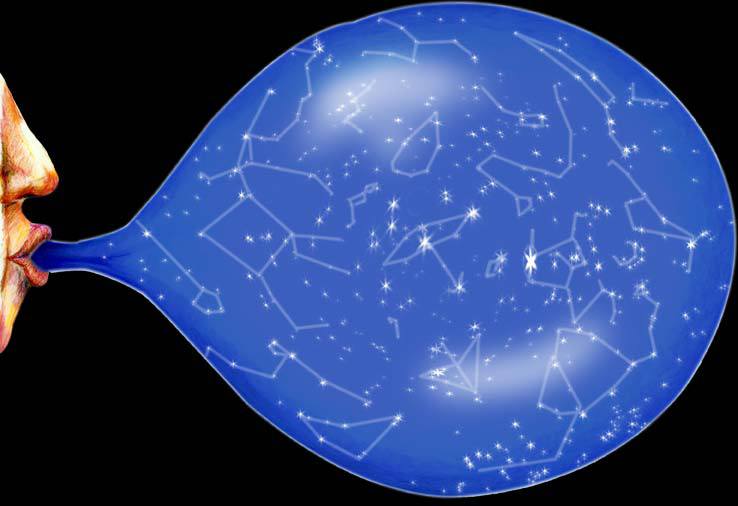
As galaxies move away from our galaxy
a shift on the electromagnetic spectrum is noticed. This phenomena is
called _____________.
redshift
blueshift

The CMB (Cosmic Background Radiation) is:
the remaining energy from the big bang.
incredibly cool.
a cloud of light
only located in certain places in the universe.

The gravitational attraction between two objects would increase if both masses are –
increased, and the distance between them is increased.
increased, and the distance between them is decreased.
decreased, and the distance between them is decreased.
decreased, and the distance between them is increased.

Why do planets orbit the Sun?
The Sun is the only celestial object that has a gravitational pull.
The Sun’s chemical composition makes it attract planets.
Only celestial bodies that emit light, like the Sun, can be at the center of an orbit.
The Sun is the most massive object in our solar system, so it exerts the greatest gravitational pull.

Gravity can be defined as the –
force of attraction between two or more masses.
friction created when two objects are in contact.
energy given off by stars due to nuclear reactions.
path an object follows as it moves through space.
The planets in our solar system are thought to have come from
Clumps of rocky material that existed between the stars
The same cloud of gas and dust that formed the sun
A fast spinning young sun that flung them out over time
the sun capturing them as they wandered into the sun's gravitational path.
Newton's 1st Law is also called the Law of ...
Friction
Inertia
Unbalanced forces
Newtons
Because of inertia, a moving object will keep ________ unless acted on by an unbalanced force.
at rest
moving
in one spot
inertia


What is the net force acting on this box?
8N to the right
5N to the left
5N to the right
9N to the left
combine and form a net force of zero
unbalanced forces
newton's first law
balanced forces
inertia
states that if the net force acting on an object is zero, the motion of the object will not change (object in motion stays in motion, object at rest stays at rest until an outside force acts on it)
Newton's First Law
Newton's Second Law
Newton's Third Law
Newton's Fourth Law
What is the formula for solving force?
mass x acceleration
force / mass
mass x velocity
distance / time
The acceleration due to gravity on Earth
9.8 seconds
9.8 m/s 2
9.8 N
What is the unit for force?
meter
m/s2
mass x acceleration
Newton (N)
Objects that INCREASE in mass (heavier), causes the acceleration to....
increase
decrease
stay the same
not move
It takes _______ force to move a larger/more massive object.
more
less
same
Newton's Third Law States that..?
Objects in motion stay in motion and objects at rest stay at rest.
Force is equal to mass times acceleration.
For each action, there is an equal and opposite reaction.
In which of the following shows the Law of Interaction being used in our everyday lives?
Person walking on earth.
Animal swimming in water.
Person hitting a tree.
All of the above.
For every action, there is...
an equal and opposite reaction.
mass times acceleration.
food and water.
none of the above.

What happens when two objects, such as a baseball and a bat, collide?
They hit each other with the same force in the same direction.
They hit each other with the same force in opposite directions.
They hit each other with unequal force in opposite directions.
One remains still while the other one moves in the same direction.
A rubber ball moving at a speed of 4 m/s hits a wall and returned to the thrower at 4 m/s. The momentum of the rubber ball:
increases
decreases
remains the same
equals zero.
When two magnets are brought close together, their magnetic __________ interact.
fields
poles
force
True or False: Like poles attract and opposite poles repel each other.
TRUE
FALSE
A bar magnet is divided in two pieces. Which of the following statements is true?
A. The bar magnet is demagnetized.
B. The magnetic field of each separated piece becomes stronger.
C. The magnetic poles are separated.
D. Two new bar magnets are created.
What must happen for an electromagnet to have a magnetic field?
A. It must be heated.
B. It has to be touching another magnet.
C. It must be lined up with Earth’s magnetic field.
D. It must be connected to an electrical source.

Which diagram shows the shape of the magnetic field of a bar magnet
A
B
C
D


A cat shoving a glass off a table
Unbalanced force
Balanced force

A car slowing down
Unbalanced force
Balanced force

The highest point on a wave is:
the crest
the trough
the top
the coast


You can't hear sounds in outer space because there is no
medium
light
energy
heat

All waves carry ________ as they travel from one place to another.
matter
space
energy
water


What does a wave carry from place to place?
energy
matter
people
A wave that can travel through matter and empty space is a:
electromagnetic wave
longitudinal wavy
transverse wave
Which are properties of a mechanical wave?
can be longitudinal or transverse
can move through space
must have matter to move
carries energy
Which color of visible light has the highest frequency?
green
blue
red
yellow
Which color of visible light has the longest wavelength?
red
orange
yellow
green
Which of the following colors of visible light has the lowest frequency?
yellow
green
blue
indigo
Infrared waves have a shorter wavelength than...
ultraviolet waves
x-rays
radio waves
gamma waves
The full range of frequencies of electromagnetic radiation is called
visible light.
radio waves.
the electromagnetic spectrum.
invisible radiation.
Which is an example of a radio wave?
television
lasers
remote controls
cancer treatments
The portion of the electromagnetic spectrum that humans can see is called:
radio waves
visible light
gamma rays
x-rays
When wavelength increases...
energy decreases
energy increases
the distance between peaks of adjacent electromagnetic waves is called:
wavelength
frequency
energy
amplitude
Which type of electromagnetic energy carries the least energy?
X-Rays
Visible Light
Ultraviolet
Microwaves
We perceive various wavelengths within the visible light spectrum as:
sound
color
time
smell
Which of the following is a unit for frequency?
Joules
Hertz
meters per second
seconds
A light particle is called a(n):
electromagnetic wave
photon
electron
atom
If you see an object that is "red", what does this mean?
The object is absorbing only red wavelengths
The object is reflecting only red wavelengths
What are the parts of a longitudinal wave? SELECT TWO from the choices below
compression
crest
expansion
trough
Which of the following describes the height of a transverse wave?
frequency
trough
crest
amplitude
Select the correct order of waves on the EMS from low to high energy
Radio, Micro, Infrared, Visible light, Ultraviolet, X-ray, Gamma
Gamma, X-ray, Ultraviolet, Visible light, Infrared, Micro, Radio
Visible light, Micro, Infrared, Ultraviolet, X-ray, Gamma, Radio
Micro, Radio, Visible light, Infrared, Ultraviolet, X-ray, Gamma
The areas of "expansion" between compressions of a longitudinal wave are called ________________.
stretches
reflection
rarefaction
frequency
the LOWEST point in a transverse wave is called the...
crest
trough
wavelength
frequency
Light that appears "red" to our eyes has a wavelength of...
700 nm
400 nm
500 nm
100 nm

Arrows are close together on a force field when the force is
stronger
weaker
opposite
A compass needle points north because of Earth's magnetic field unless
it is close to a wire with a current
it is close to any wire
it is close to a battery

The electromagnetic forces from a current carrying wire are strong enough to move the compass needle. The forces can be made stronger by
making the wire shorter
making the wire longer
making the wire into loops
An electromagnet is a magnet that
its strength can be varied and turned on and off
always has a magnetic field around it
has very little strength
What THREE ways are electromagnets different from permanent magnets?
they can be turned off and on
they can increase in strength by increasing the current in the wire
they are smaller in size
they can change which is the north and south pole
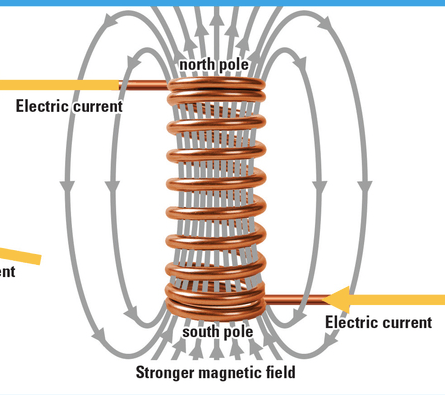
Permanent Magnets and Electromagnets are similar in which TWO ways?
it can be turned off and on
they both have a north and south pole
they are surrounded by a magnetic field
A force that can act at a distance is called
non contact force
friction
balanced
How could the strength of an electromagnet be increased?
by decreasing the amount of current in the electromagnet
by increasing the number of coils in the wires of the electromagnet
A magnetic field is
something used to demagnetize pieces of metal
the area in which a magnet exerts magnetic force
an open area where you are likely to find natural magnets
an electric charge that can be sent through a wire to make it magnetic
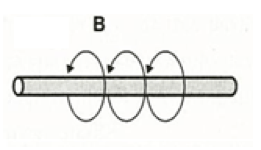
1) A wire carries a current, creating a magnetic field around itself as shown. The current in the wire is:
A. Directed to the right
A. Directed to the left
A. Equal to the magnetic field
In the same direction as the magnetic field
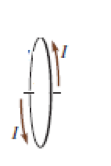
1) The magnetic field inside the coil shown below is directed:
Into the page
Out the Page
To the left
Towards the bottom of the page
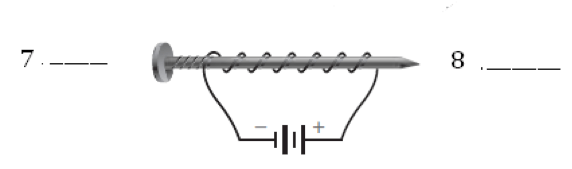
1) In the figure, using the right hand rule around a solenoid, which of the below statements is correct:
North Pole is 7 and South pole is 8
North Pole is 8 and South Pole is 7
There is no magnet, so no north or south
The current is flowing in the direction from 7 to 8
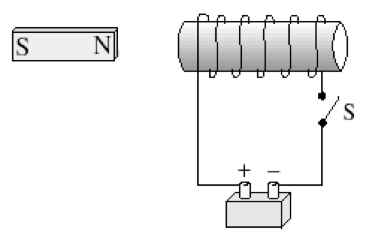
1) A bar magnet is at rest, next to a fixed electromagnet. In which direction will the bar magnet move when switch S is closed?
to the left
to the right
up the page
down the page
Which best describes how a motor works?
When a fan blows on a wire, it causes it to spin, creating a force.
When a fan blows on a wire, it causes it to spin, creating an electrical current.
When a wire that carries electrical current is placed in zero gravity, the wire experiences a force.
When a wire that carries electrical current is placed in a magnetic field, the wire experiences a force.

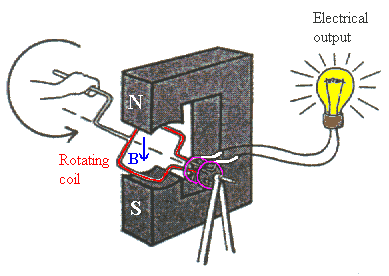
What is the energy transfer in a generator?
Mechanical to Electrical
Physical to Potential
Electrical to Mechanical
Yogurt to Light

Which of the following is the name of the ancient supercontinent formed 280 Million Years ago.
Pangea
Gondwanda
Laurasia
Neverland


What do we call an area where more then two plates interact in different ways
plate boundary zones
hot spots
convergent boundaries
subduction

Mixture of minerals, volcanic glass, organic matter, or other material
Brick
Soda Pop Bottle
Steel
Rock

A model showing the processes that create and change rock.
Water Cycle
Carbon Cycle
Rock Cycle
Nitrogen Cycle

_________ rock can be changed by heat and pressure into metamorphic rock.
Large
Sedimentary
Hard
Soft

__________ rock can be broken into fragments that may later form sedimentary rock.
Igneous
Hard
Soft
Small

______ rock can melt and cool to form igneous rock.
Soft
Hard
Metamorphic
Large

Magma that reaches the surface flows from a volcano as ____________
Magma
Water
Ice
Lava

Magma trapped below the surface forms large – grained ______________ rock when it cools.
Extrusive
Metamorphic
Sedimentary
Intrusive

Magma cooling at or near Earth’s surface forms small-grained __________ igneous rock.
Extrusive
Intrusive
Sedimentary
Metamorphic

Igneous rocks are classified in 2 ways.
Heavy and Light
Hot and Cold
Sedimentary and Metamorphic
Extrusive and Intrusive

Volcanic glass rock (obsidian) __________ so quickly that few crystals form.
break
melt
cool
flow

_____________ and ______________ result from one layer of rock on top of another layer.
Tall and short
Heat and pressure
Big and small
Sand and gravel

Sometimes temperature and pressure are great enough to melt rock, forming ______________.
magma
lava
water
sandstone

_____________ texture – mineral grains flatten and line up in parallel layers or bands.
Sandstone
Limestone
Granite
Foliated

_______ texture - mineral grains grow and rearrange but do not form layers.
Drywall
Non-foliated
Smooth
Rough

Sometimes ____________ flattens mineral grains in rocks without melting them.
lava
cold
pressure
granite

Type of rock mostly found on the exposed surface of Earth.
Igneous
Granite
Metamorphic
Sedimentary

Sedimentary Rocks form in
Layers
the desert only
underground
on top of water

Rock fragments, mineral grains, and bits of plants and animal remains moved by wind, water, ice or gravity are called _________________.
sediments
granite
marble
sandstone

When water and other minerals move through open spaced between larger sediments, gluing them together, ____________ occurs.
Compaction
Deposition
Cementation
Erosion

_________ ___________ rocks are made from the remains of once – living plants or animals.
Igneous and metamorphic
Clastic sedimentary
Chemical sedimentary
Organic sedimentary

