wayground logo

Free Printable Worksheets

Font size

S
M
L
XL
Worksheets

Punnett squares and inheritance

Total questions: 60

Worksheet time: 48mins
Name
Class
Date
1.
Aa, DD, bB, yy are all examples of
a)
genotypes
b)
phenotypes
2.
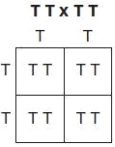
What ratio of the offspring from the cross shown will be homozygous recessive for the  trait of tallness? 
a)
0 in 4
b)
1 in 4
c)
2 in 4
d)
4 in 4
3.
Which of the following genotypes is homozygous dominant?
a)
A
b)
Aa
c)
AA
d)
aa
4.
Which of the following genotypes is heterozygous?
a)
Bb
b)
BB
c)
bb
d)
B
5.
In a heterozygous genotype, the ___________ allele takes over in the phenotype.
a)
recessive
b)
dominant
c)
lower case letter
d)
both 
6.
What you see, or the physical appearance.
a)
Genotype
b)
Phenotype
c)
Homozygous
d)
Heterozygous
7.
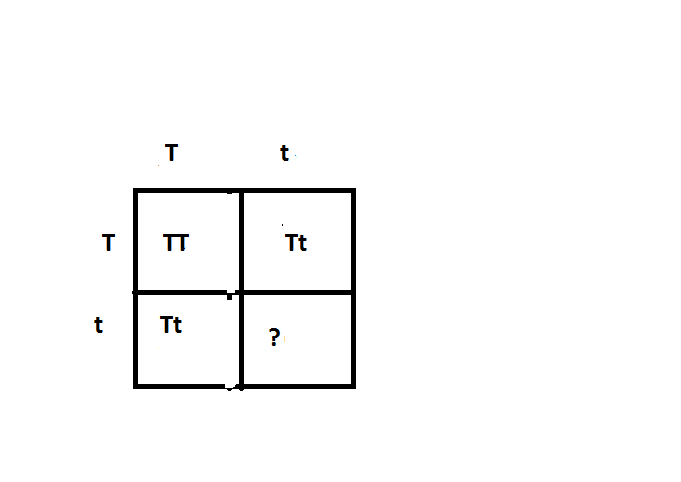
T - tall and t = short
In the punnett square below, what belongs in the missing square
a)
tt
b)
Tt
c)
Bb
d)
TT
8.
B = brown eyes
b = blue eyes
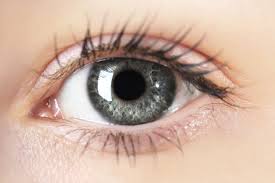
What is true about these two brothers that have brown eyes?
One has genotype BB the other Bb.
a)
they have same phenotype and genotype
b)
they have different genotypes and phenotypes
c)
they have same phenotype but different genotypes
d)
they have same genotype but different phenotypes
9.
aa always shows up as
a)
dominant
b)
recessive
10.
Aa is
a)
homozygous
b)
heterozygous
11.
B = brown fur  b = white fur
In the punnett square, what is the probability for white fur? 
a)
0%
b)
25%
c)
50%
d)
75%
12.
What is the probability of heterozygous offspring?
a)
25%
b)
50%
c)
0%
d)
100%
13.
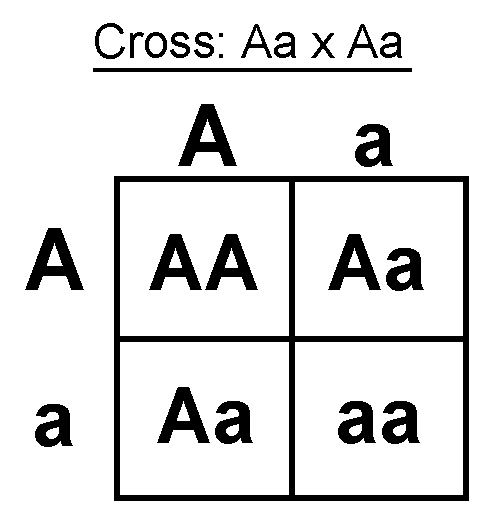
What allele combination should go in the missing box?
a)
AA
b)
Aa
c)
aa
d)
none of these
14.
What is the phenotype of the offspring? (A-Brown hair; a-blond hair) 
a)
50 % Brown Hair and 50% Blond Hair 
b)
25 % Brown Hair and 75% Blond Hair 
c)
75 % Brown Hair and 25% Blond Hair 
d)
0% Brown Hair and 100% Blond Hair 
15.
In pea plants, the tall allele is dominant to the short allele. What key would demonstrate this?
a)
Tall = T
Short = S
b)
Tall = T
Short = t
c)
Tall = t
Short = T
d)
Tall = TT
Short = tt
16.
Identify the homozygous dominant genotype:
a)
FF
b)
Ff
c)
ff
17.
Dominant alleles are represented by a:
a)
Male gene
b)
lowercase letter
c)
recessive trait
d)
capital letter
18.
What chance does the offspring have of showing a recessive trait?
a)
50%
b)
75%
c)
100%
d)
25%
19.
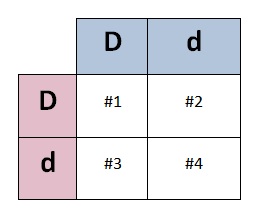
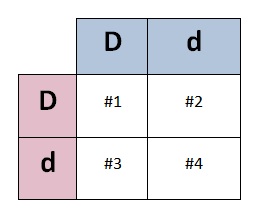
What is the allele combination for square 1?
a)
Dd
b)
DD
c)
dd
d)
D
20.
What is the possibility of this offspring having a dominate trait?
a)
50%
b)
75%
c)
25%
d)
0%
21.
What is the missing allele?
a)
a
b)
A
c)
AA
d)
aa
22.

What would a homozygous allele combination look like? (Choose all that apply)

a)

AA

b)

Tt

c)

aa

d)

RR

23.

What is a synonym for purebred?

a)

hybrid

b)

heterozygous

c)

homozygous

d)

allele

24.

What does purebred mean in the context of Punnett Squares?

a)

a mix of dominant are recessive alleles

b)

both alleles are the same

c)

hybrid

25.

What is a phenotype?

a)

The letter combination that are used to label the different forms of a gene

b)

The physical traits an organism has due to it's genes

c)

The percentage change for a trait in the offspring

d)

none of the above

26.
What ratio of the offspring from the cross shown will be homozygous recessive for the  trait of tallness
a)
0 in 4
b)
1 in 4
c)
2 in 4
d)
4 in 4
27.
What are the possible genotypes for this cross?
(Click the picture to see it without the text)
a)
TT = 25% Tt= 50% tt=25%
b)
all tall
c)
TT= 75% tt = 25%
d)
Tt = 100%
28.
What is the dominant trait?
a)
yellow pea seeds
b)
green pea seeds
c)
there is no dominant seed
d)
Jolly green giant
29.
What genotype would go in box 3?
a)
BB
b)
Bb
c)
bb
30.
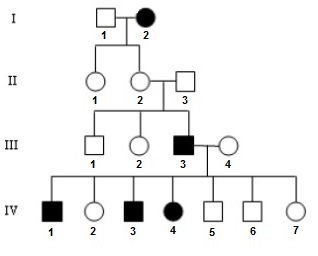
Is this trait (the shaded individuals) dominant or recessive?
a)
dominant
b)
recessive
31.
This pedigree represents the inheritance of hemophilia in this family. How many of the females have the hemophilia trait?
a)
8
b)
5
c)
2
d)
3
32.
What does a filled in square represent?
a)
Not affected Female
b)
Not affected Male
c)
Affected Male
d)
Affected Female
33.
What does an open circle represent?
a)
Not Affected Male
b)
Not Affected Female
c)
Affected Male
d)
Affected Female
34.
What do we use pedigrees for?
a)
To look at families
b)
To make determinations about the offspring
c)
To track traits in families
d)
Nothing
35.
How many females are in this pedigree?
a)
3
b)
4
c)
6
d)
7
36.
How many kids did the mother and father from the first generation have?
a)
2
b)
4
c)
5
d)
6
37.

How many daughters did the mother and father from the first generation have?

a)

2

b)

4

c)

5

d)

6

38.

How many females show the trait?

a)

1

b)

2

c)

3

d)

4

39.

How many males in this pedigree chart show the trait?

a)

1

b)

2

c)

3

d)

4

40.
Determine the sex of the individual whose karyotype is displayed in the image.
a)
female
b)
male
41.
Chromosome pairs 1-22 are referred to as
a)
sex chromosomes
b)
sister chromatids
c)
a karyotype
d)
autsomes
42.

This is a karyotype of someone with Kleinfelters syndrome. What is their mutation?

a)

There is only 1 Y chromosome.

b)

There is an extra sex chromosome.

c)

They are missing chromosomes.

d)

One of the chromosomes is too curved.

43.
If a father is AA and a mother is AB, what is the probability for a child with AB blood? 
a)
0%
b)
25%
c)
50%
d)
75%
44.
If two parents have type AB blood, what is the probability that their child will have type O blood?
a)
0%
b)
25%
c)
50%
d)
100%
45.
An individual's blood type is determined by
a)
environment
b)
genetics
c)
both environment and genetics
d)
your children's blood type
46.
What are the blood types of the possible children that a woman (type O) and man (type AB) can have?
a)
O and AB
b)
O and A
c)
O and B
d)
A and B
47.

A father has type AB blood and the mother has type O. What percentage of their offspring would you expect to have?

a)

Type A, 25%, Type B 25%, Type AB 25%, Type O 25%

b)

Type A 50%, Type B 25%, Type AB 25%, Type O 50%

c)

Type A blood 50%, Type B 50%, Type AB 0%, Type O Blood 0%

d)

Type A blood 100%

48.

A woman has type B blood and her husband has type O blood. What must be the woman's genotype, if they have a child with type O blood?

a)

Heterozygous B

b)

Homozygous B

c)

Homozygous O

d)

Heterozygous O

49.

If a father is heterozygous A and the mother is heterozygous B, what are the possible phenotypes of the offspring?

a)

25% AO

25% AB

25% BO

25% OO

b)

50% A

50% B

c)

25% A

25%AB

25% B

25% O

d)

25% A

25% B

50% O

50.
If two parents are heterozygous for type A blood, what is the probability that their offspring would have type O blood?
a)
100 %
b)
75%
c)
50%
d)
25%
51.

If both traits are fully and equally expressed, one trait is __________ to the other.

a)

Dominant

b)

Codominant

c)

Incompletely Dominant

d)

Recessive

52.

Chickens with black feathers are crossed with chickens with white feathers. Their offspring have black and white feathers. Which pattern of inheritance is this?

a)

Codominance

b)

Incomplete Dominance

c)

Multiple Alleles

d)

Polygenic Inheritance

53.
For an XX female to express a recessive sex-linked trait, she must have....
a)
two recessive alleles
b)
a Y chromosome 
c)
one recessive allele
d)
two dominant alleles
54.
Does this pedigree show a dominant or recessive trait?
a)
Dominant
b)
Recessive
55.

Hemophilia is a recessive sex-linked trait. If H = normal & h = has hemophilia, which genotype represents a male with hemophilia.

a)

XHY

b)

XHXh

c)

XhXh

d)

XhY

56.

What is the mode of inheritance shown here?

a)

Autosomal Recessive

b)

Sex-Linked

c)

Autosomal Dominant

57.
How many PAIRS of chromosomes do humans have?
a)
23
b)
46
c)
1
d)
2
58.

Look at this cross: XBXb x XBY


What proportion of the male children are colorblind?

a)

100%

b)

75%

c)

50%

d)

25%

59.

Hemophilia is a sex-linked recessive gene. If a carrier mother married to a hemophiliac husband, their genotypes are

a)

XHXH and XHY

b)

XHXh and XhYh

c)

XhXh and XHY

d)

XHXh and XhY

60.

A human being has _____ autosomes and ______ sex chromosomes.

a)

23 pairs, 1 pair

b)

22 pairs, 1 pair

c)

2 pairs, 2 pairs

d)

23 pairs, 23 pairs