wayground logo

Free Printable Worksheets

Font size

S
M
L
XL
Worksheets

MP4 Mastery Review

Total questions: 126

Worksheet time: 3hrs 53mins

Name
Class
Date
1.

Which best describes the term evolution?

a)

Naturally occurring mutations

b)

inherited, genetic changes in organisms over time

c)

the ability of an organism to survive and reproduce

d)

random changes in a DNA sequence

2.

What did Darwin notice about the Finches in the Galapagos?

a)

the size and shape of beak was different depending on the food source of each island

b)

the size of finch was different depending on the habitat of each island

c)

the shape and size of beak was the same

d)

the size of finch was the same but the color was different

3.

Which best describes a phylogenetic tree?

a)

a diagram that shows how species share common features

b)

a diagram that shows the genetic similarities and differences between species

c)

a diagram that shows the differences between species

d)

a diagram that shows how living species are related and descended from a common ancestor

4.

Which best describes a cladogram?

a)

a diagram that shows how species share common features

b)

a diagram that shows the genetic similarities and differences between species

c)

a diagram that shows the differences between species

d)

a diagram that shows how living species are related and descended from a common ancestor

5.

Which of the following is not considered evidence for evolution?

a)

fossil record

b)

common ancestor

c)

embryological evidence

d)

homologous structures

6.

Which is not considered a mechanism for evolution?

a)

anatomical variation

b)

DNA mutation

c)

natural selection

d)

competitive advantage

7.

Which statement best describes biological fitness?

a)

the ability for a organism to compete for limited resources

b)

an organism's ability to survive and reproduce in a given environment

c)

a change in an organism that allows it to better survive in its environment

d)

a mechanism of evolution where organisms pass down genetic traits that ensure survival of the organism

8.

Look at the cladogram: which dinosaur is most closely related to the Spinosaurus (blue) AND

which dinosaur is the least closely related to the Spinosaurus (blue)

4 lines
9.

Match the following

a)

Immigration

1.

Movement of individuals into a population

b)

Emigration

2.

Movement of individuals out of a population

c)

Gene Flow

3.

The movement of alleles by immigration or emigation.

d)

Genetic Drift

4.

Loss of genetic variability due to interbreeding of the exact same species.

e)

Sexual Selection

5.

Female species choose a mate based on certain traits.

10.

Match the following

a)

Directional Selection

1.

This occurs when individuals favor one extreme phenotype.

b)

Stabilizing Selection

2.

Acts against both extreme phenotypes and favors the average form of a trait.

c)

Disruptive Selection

3.

Conditions favor individuals at both phenotypic extremes at the expense of the "average" individual

d)

Speciation

4.

Formation of new species.

e)

Species

5.

Group of organisms that produce fertile offspring.

11.
A few deer wander out of their native woods into a completely new park where no deer had ever been before. They go on to create an entirely new population.
a)
Genetic Drift
b)
Natural Selection
c)
Non-random mating
d)
Mutation
12.
During gestation (pregnancy), a developing male pig had a change in his genetic code. The result was that he was able to walk and do karate.
a)
Genetic Drift
b)
Non-random mating
c)
Mutation
d)
Natural Selection
13.
Five hundred years after the deer had established a flourishing population in the park, a few of them venture back to their original woods and have babies with the deer there.
a)
Genetic Drift
b)
Mutations
c)
Non-random mating
d)
Gene flow
14.
Wolves from the Arizona mesa were transferred to the Colorado Rockies after a forest fire destroyed their habitat. They quickly became part of the local pack and had offspring.
a)
Mutation
b)
Natural Selection
c)
Genetic Drift
d)
Gene Flow
15.
7 Wild Mustangs were taken from the prairies of Iowa after a Texan Rancher purchased them and provided them with their own pasture. Those 7 Mustangs eventually became 122.
a)
Genetic Drift (small popultaion)
b)
Non-random mating
c)
Gene flow
d)
Mutations
16.
Logan was born with unique abilities for quick healing and awesome claws that stick out of his fingers.
a)
Gene flow
b)
Natural Selection
c)
Mutation
d)
Genetic Drift
17.
What does the image represent?
a)
Gene flow
b)
Gene drift
c)
Mutation
d)
Adaptation
18.
Which organisms are most likely to survive?
a)
the best adapted
b)
the fastest
c)
the strongest
d)
the most domesticated (tamed)
19.
Gene Flow tends to ___________ genetic variation (diversity)
a)
Increase
b)
Decrease
c)
Stabilize
d)
Exaggerate 
20.
Which of the following is NOT an example of natural selection? 
a)
People selectively breeding hamsters.
b)
Insect populations developing resistance to certain pesticides.
c)
Bacteria becoming resistant to antibiotics.
d)
Male birds of certain species developing colorful feathers to attract female mates.
21.

Bats are common in Texas, especially in rocky regions. Bats with longer hang claws have demonstrated higher fitness because of their ability to cling to rock while resting. This adaptation is becoming more frequent in the population. What mechanism of evolution is this?

a)

Natural Selection

b)

Non-random mating

c)

Gene Flow

d)

Genetic Drift

22.

Evolution by chance, survival of the luckiest:

a)

genetic drift

b)

sexual selection

c)

fitness

d)

coevolution

23.
Yellow toucan birds seek out one another to make babies together and tend to avoid the green toucan birds.
a)
Genetic Drift
b)
Non-random mating
c)
Gene flow
d)
Mutation
24.
What are sources of genetic variation?
a)
mutations
b)
genetic recombination
c)
mutations and genetic recombination
d)
mutations and migrations
25.
What do you call all of the genes in a population?
a)
Gene pool
b)
Relative Frequency
c)
Genetic Drift
d)
Allele pool
26.
Which of the following is true of genetic drift?
a)
It can decrease genetic diversity in a population
b)
It is necessary in order for a population to be in equilibrium
c)
It can increase genetic diversity in a population 
d)
It plays a much larger role in determining the genetic makeup of populations than natural selection 
27.
Which evolutionary mechanism is necessary for evolution to occur?
a)
genetic drift
b)
gene flow
c)
nonrandom mating
d)
mutation 
28.
 Genetic Drift is more likely to happen in... 
a)
aquatic populations
b)
small populations
c)
terrestrial populations
d)
older populations
29.
This mechanism of evolution occurs when populations migrate.
a)
Extinction
b)
Gene flow
c)
Genetic drift
d)
Natural Selection
30.
The model below shows a how populations of organisms can change. Which of the   following concepts is best illustrated by this demonstration?                                          
a)
 Evolution of a predatory species
b)
Genetic drift 
c)
 Environmentally induced genetic mutations 
d)
Gene flow 
31.
Which of the following cannot introduce new alleles into a population's gene pool?
a)
Mutataion
b)
Natural selection
c)
Gene Flow
d)
All of the above introduce new alleles into the population
32.
Formation of new species.
a)
artificial selection
b)
species
c)
speciation
d)
fossils
33.
The type of genetic drift that follows the colonization of a new habitat by a small group of individuals is called
a)
the Hardy-Weinburg principle
b)
the founder effect
c)
directional selection
d)
the bottleneck effect
34.
A random change in a small population's allele frequency is known as
a)
a gene pool
b)
genetic drift
c)
variation
d)
fitness
35.

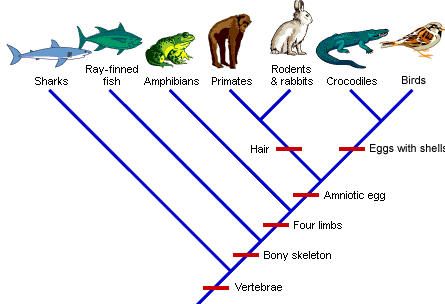
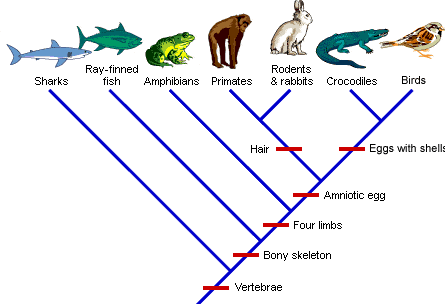
According to this cladogram, primates are most closely related to....

a)

Amphibians

b)

Rodents & rabbits

c)

Crocodiles

d)

Birds

36.

Which trait do only humans have, according to the cladogram?

a)

jaws

b)

mammary glands & hair

c)

terrestrial during all life stages

d)

bipedal & opposable thumbs

37.

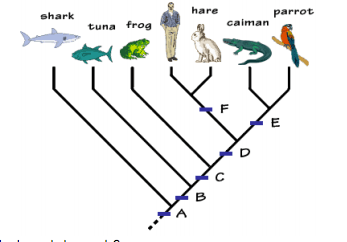
On the cladogram, which organism is the closest relative of the parrot?

a)

Frog

b)

Hare

c)

Caiman

d)

Parrot

38.

According to this cladogram, primates are most closely related to....

a)

Amphibians

b)

Rodents & rabbits

c)

Crocodiles

d)

Birds

39.

Which trait do only humans have, according to the cladogram?

a)

jaws

b)

mammary glands & hair

c)

terrestrial during all life stages

d)

bipedal & opposable thumbs

40.

On the cladogram, which organism is the closest relative of the parrot?

a)

Frog

b)

Hare

c)

Caiman

d)

Parrot

41.

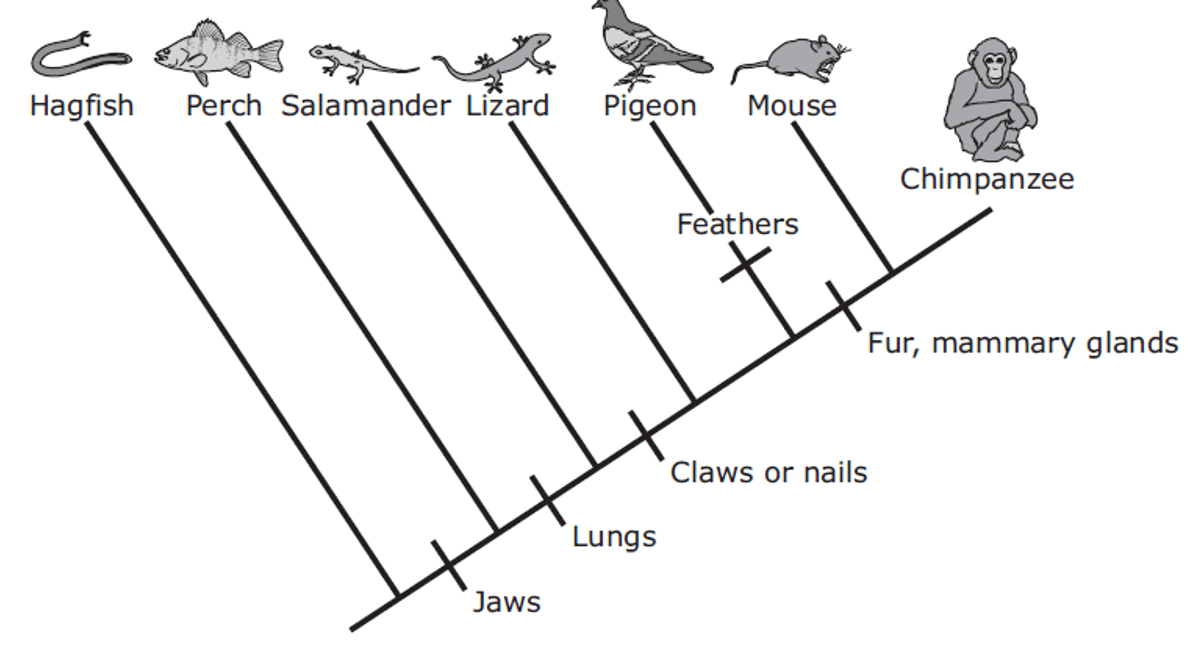
All the animals to the right of the salamander would have the common characteristic of...

a)

Fur

b)

Claws or nails

c)

Lungs

d)

Jaws

42.

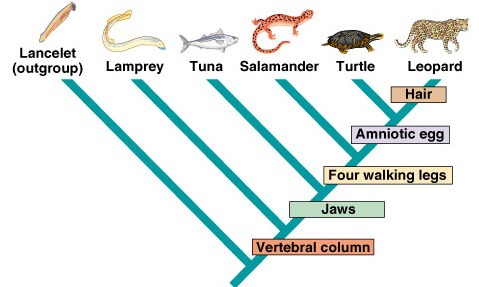
Which is the newest trait?

a)

Amniotic egg

b)

Walking legs

c)

Jaws

d)

Hair

43.

According to this cladogram, sharks are MOST closely related to which organism?

a)

Amphibians

b)

Ray finned fish

c)

Crocodiles

d)

Birds

44.

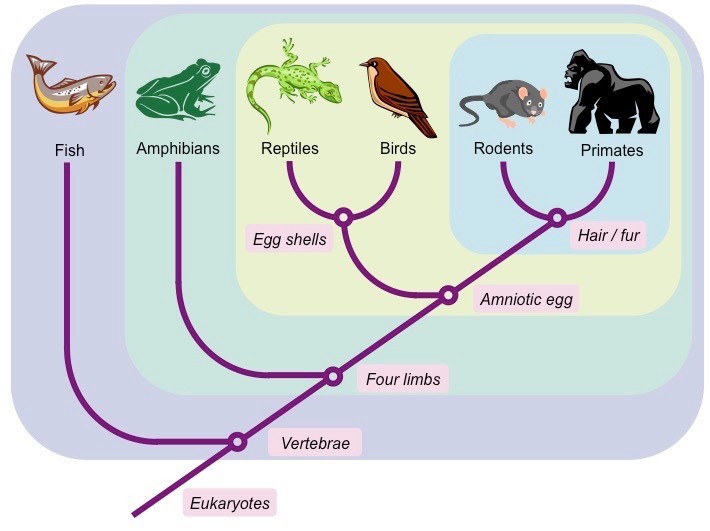
What is this a picture of?

a)

Pedigree

b)

Cladogram

c)

Family Tree

d)

Oak Tree

45.

What characteristic distinguishes amphibians from birds and reptiles?

a)

Amniotic egg

b)

Egg shells

c)

Vertebrae

d)

Hair/fur

46.

What distinguishes zebras from from giraffes?

a)

un-branching horns (in males)

b)

even number of toes

c)

fur

d)

carnivorous teeth

47.

What characteristic do all the organisms on this cladogram share?

a)

Being bi-pedal & having language

b)

Complex brains

c)

Fully binocular vision

d)

Partial binocular vision & opposable thumbs
48.
The scientific name for an organism is made from the:
a)
class and family name
b)
genus and species name
c)
domain and kingdom name
d)
kingdom and phylum name
49.
Tool used by a taxonomist to identify an unknown organism is a:
a)
dichotomous key
b)
binomial nmenclature
c)
scientific name
d)
binomial key
50.
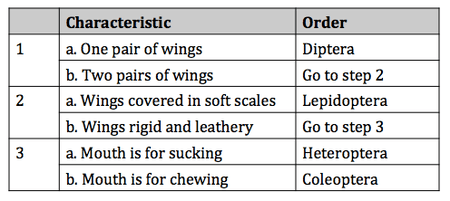
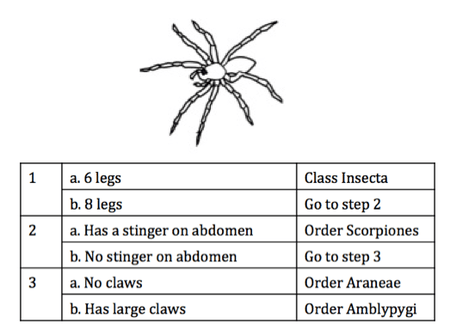
An illustration and a dichotomous key are given. What is the correct classification for this organism?
a)
Class Insecta
b)
Order Amblygygi
c)
Order Araneae
d)
Order Scorpiones
51.
A table of arachnid and insect characteristics is shown. Which characteristic could be used to distinguish between
arachnids and insects?
a)
Jointed legs
b)
Body segments
c)
Presence of eyes
d)
Presence of antennae
52.
A botanist discovers a new plant in the jungle. Which of the
following observations of the plant’s characteristics would be useful in determining its identity with a dichotomous key?
a)
It was discovered in the summertime
b)
It is wet from a recent rain storm.
c)
Its leaves curl up on the edges.
d)
It is eaten by native jungle ants.
53.
When using a dichotomous key to identify organisms, what do we look at?
a)
physical features
b)
weather patterns
c)
environment
d)
diet
54.
A dichotomous key for trees is provided. Hikers found a tree that has large brown cones and single sharp needles. What species of tree have the hikers found?
a)
Juniper
b)
Pine
c)
Spruce
d)
Fir
55.
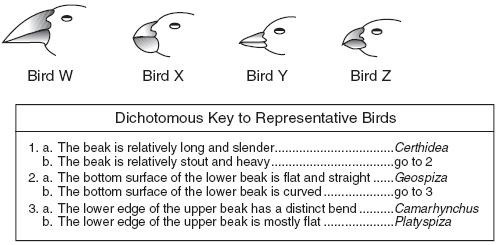
What is the name of bird W?
a)
Certhidea
b)
Geospiza
c)
Camarhynchus
d)
Platyspiza
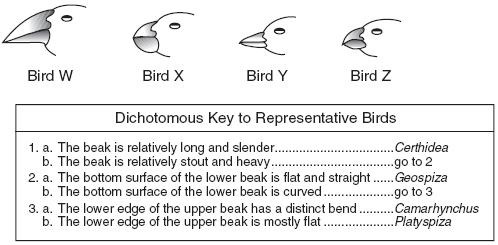
56.
What is the name of bird Z?
a)
Certhidea
b)
Geospiza
c)
Camarhynchus
d)
Platyspiza
57.
A student discovers an arachnid with a segmented abdomen, long legs, and a tail with no stinger. The student uses the dichotomous key below to identify it. Which arachnid has the student found?
a)
Whip Scorpion
b)
Wind Scorpion
c)
Daddy long legs
d)
Scorpion
58.
Using this dichotomous key, identify the name of the circled Fish, J.
a)
peacock flounder
b)
band-tail puffer
c)
trumpet fish
d)
spotted goat fish
59.
A dichotomous key for insects is given. To what order does an insect with two pairs of scaly wings belong?
a)
Coleoptera
b)
Heteroptera
c)
Diptera
d)
Lepidoptera
60.
The 8 levels of classification, most broad to most specific.
a)
Domain, Genus, Family, Order, Class, Phylum, Kingdom, Species
b)
Domain, Species, Kingdom, Genus, Phylum, Family, Class, Order
c)
Domain, Kingdom, Phylum, Class, Order, Family, Genus, Species
d)
Order, Kingdom, Species, Domain, Phylum, Family, Class, Genus
61.
A dichotomous key for insects is given. To what order does an insect with two pairs of scaly wings belong?
a)
Coleoptera
b)
Heteroptera
c)
Diptera
d)
Lepidoptera
62.

What kingdom?

Characteristics: eukaryotic, multi-celled-photosynthetic.

a)

animal

b)

plant

c)

protist

d)

fungi

63.

What kingdom- eukaryotic-multi-celled-heterotrophic

a)

plant

b)

animal

c)

protista

d)

fungi

64.

MUSHROOMS ARE IN WHAT KINGDOM

a)

PLANT

b)

ANIMAL

c)

FUNGI

d)

PROTIST

65.

AMOEBA-PARAMECIUM-EUGLENA-DINOFLAGELLATES BELONG TO WHAT KINGDOM

a)

PLANT

b)

PROTIST

c)

FUNGI

d)

ANIMAL

e)

ARCHAEBACTERIA

66.

HAS A CELL WALL

a)

FUNGI-ANIMALS

b)

SOME BACTERIA-FUNGI

c)

SOME BACTERIA-FUNGI-PLANTS

d)

SOME PROTIST-ANIMALS

67.
All of the following have a nucleus except...
a)
Bacteria
b)
Animalia
c)
Plantae
d)
Protista
68.
Which kingdom is Autotrophic, Eukaryotic and reproduces sexually?
a)
Bacteria
b)
Fungi
c)
Plantae
d)
Protista
69.
Archeabacteria...
a)
are eukaryotic
b)
live in extreme environments
c)
are non-living
d)
live in the soil
70.
What kingdoms are PROKARYOTIC?
a)
plant and animal
b)
protist and fungus
c)
archaebacteria and eubacteria
d)
archaebacteria and protist
71.
Which kingdom contains multicellular, heterotrophic organisms whose cells have NO cell walls?
a)
Protista
b)
Fungi
c)
Plantae
d)
Animalia
72.
This organism is best classified as...
a)
prokaryotic, unicellular, and heterotrophic
b)
eukaryotic, unicellular, heterotrophic
c)
eukaryotic, unicellular, autotrophic
d)
prokaryotic, unicellular, autotrophic
73.
Identify the kingdom...
Multicellular organism with cell walls made of chitin found growing on a decomposing manure pile.
a)
Archaebacteria
b)
Eubacteria
c)
Protista
d)
Fungi
74.

I can be either a heterotroph or an autotroph-

I am mostly unicellular

I am the "Junk Drawer" kingdom

The only thing for sure about me is that I have a nucleus in my cells...

I am Kingdom ____________ .

a)

Plantae

b)

Protista

c)

Animalia

d)

Fungi

75.

The three species pictured do not share a common ancestor, yet have evolved to have a similar anatomy and life style. This is an example of ?

a)

Homologous Structures

b)

Divergent Evolution

c)

Vestigial Organs

d)

Convergent Evolution

76.

The three species pictured share a common ancestor and have adapted so that each lives in a different environment. This is an example of

a)

Law of Superposition

b)

Evolutionary Arms Race

c)

Divergent Evolution

d)

Convergent Evolution

77.

By what mechanism did the anoles on Puerto Rico diverge to occupy species specific niches?

a)

Adaptive Radiation

b)

Artificial Selection

c)

Stabilizing Natural Selection

d)

Coevolution

78.

Cichlid fishes in lakes of the East African Rift. The lakes in this area are believed to support and sustain about 2,000 different species of these fish, each with different ecological and morphological characteristics such as body size. These lakes form a fragmented landscape that bio-geographically isolates the different species of cichlid fish from one another, allowing them, and many of the organisms they live with, to evolve separately.

a)

Phyletic Speciation

b)

Adaptive Radiation

c)

Convergent Evoltion

d)

Divergent Evoltuion

e)

Co-evolution

79.

In the frigid waters of the ocean surrounding Antarctica, fish have a special trait which allows them to survive the big chill. As scientists discovered in the 1960s, the fish have adapted by evolving a kind of antifreeze. It's composed of molecules called glycoproteins that circulate in the blood of the fishes, slightly lowering the temperature at which their body fluids would otherwise freeze and kill them. The glycoproteins surround tiny ice crystals and keep them from growing. The fish at the other pole of the globe also have a similar protein. It was, however, seen as a mutation after they had diverged from the southern species.

a)

Phyletic Speciation

b)

Adaptive Radiation

c)

Convergent Evoltion

d)

Divergent Evoltuion

e)

Co-evolution

80.
a)

Phyletic Speciation

b)

Adaptive Radiation

c)

Convergent Evoltion

d)

Divergent Evoltuion

e)

Co-evolution

81.

A species of birds exists in stasis for many thousands of years. Suddenly, a bacteria causes their primary tree of sheltering choice to die. The birds must adapt within the environment to trees that are much higher requiring more wing strength. Some birds die. The remaining birds' bodies adapt as necessary and they return to a state of stasis.

a)

Phyletic Speciation

b)

Adaptive Radiation

c)

Convergent Evoltion

d)

Divergent Evoltuion

e)

Co-evolution

82.
a)

Phyletic Speciation

b)

Adaptive Radiation

c)

Convergent Evoltion

d)

Divergent Evoltuion

e)

Co-evolution

83.

The Rough-skinned newt produces a potent neurotoxin that concentrates in their skin. Garter snakes, have evolved resistance to this toxin through a series of genetic mutations, and prey upon the newts. The relationship between these animals has resulted in an evolutionary arms race that has driven toxin levels in the newt to extreme levels.

a)

Phyletic Speciation

b)

Adaptive Radiation

c)

Convergent Evoltion

d)

Divergent Evoltuion

e)

Co-evolution

84.

The Apple Maggot Fly infests the fruit of a native North American Hawthorn Apple tree. In the 1860s some maggot flies began to infest apples. Now there are two populations of the fly feeding on the two food sources. The populations rarely interbreed and are showing genetic differences and therefore are becoming two separate species.

a)

Phyletic Speciation

b)

Adaptive Radiation

c)

Convergent Evoltion

d)

Divergent Evoltuion

e)

Co-evolution

85.
The model that predicts evolution occurs in rapid bursts followed by long periods of no change is called...
a)
gradualism
b)
punctuated equilibrium
c)
adaptive radiation
d)
convergent evolution 
86.

Convergent evolution can lead to _____ traits because unrelated species develop similar traits for the same function.

a)

Homologous

b)

Analogous

87.

Divergent evolution describes evolution toward ______ traits in closely related species.

a)

Different

b)

Similar

c)

The same

88.

Which picture shows an example of co evolution?

a)
b)
89.

The adaptations of wasps, flying fish, flying birds, and bats that allow them to fly are examples of:

a)

punctuated evolution

b)

convergent evolution

c)

divergent evolution

d)

gradual evolution

90.

A bumble bee has just enough mass to pull down and open up the snapdragon flower to get to the nectar inside. Other insects cannot do this. This adaptation is an example of:

a)

convergent evolution

b)

co-evolution

c)

divergent evolution

d)

speciation

91.

What pattern of evolution occurs when 2 different species evolve together b/c they rely on each other?

a)

divergent evolution

b)

convergent evolution

c)

co-evolution

d)

endosymbiosis

92.

What describes a group of organisms that can interbreed and produce fertile offspring?

a)

species

b)

speciation

c)

population

d)

hybrid

93.

What describes a group of organisms from the same species living in the same area?

a)

species

b)

speciation

c)

population

d)

hybrid

94.

The Apple Maggot Fly infests the fruit of a native North American Hawthorn Apple tree. In the 1860s some maggot flies began to infest apples. Now there are two populations of the fly feeding on the two food sources. The populations rarely interbreed and are showing genetic differences and therefore are becoming two separate species.

a)

Phyletic Speciation

b)

Adaptive Radiation

c)

Convergent Evoltion

d)

Divergent Evoltuion

e)

Co-evolution

95.
Flashy tails on many animals is an example of coloration. Why might flashy tailed animals display their colors to another of the same species? 
a)
make friends
b)
help build a nest
c)
attract a mate 
d)
scare predators
96.

The picture shows a male and female pheasant. What type of selection occurred for them to have these adaptations?

a)

Natural Selection

b)

Evolution

c)

Sexual Selection

d)

Random Selection

97.
A bird that can easily outcompete other birds for food and that can produce many eggs has a high ___________.
a)
IQ
b)
mutation rate
c)
fitness
d)
adaptability
98.
What is the advantage of having different shaped beaks?
a)
To look different from other species.
b)
To be able to eat the food readily available in the environment.
c)
To protect itself against predators.
d)
To protect itself against prey.
99.
Why are advantageous traits more likely to be passed onto offspring?
a)
Because they are more likely to survive and reproduce.
b)
Because they come from dominant alleles.
c)
Because they come from recessive alleles.
d)
Because the trait is an acquired phenotype.
100.
The differences among a species, like different bird beaks, are called
a)
genes.
b)
variations.
c)
traits.
d)
theories.
101.

According to Charles Darwin, favourable features makes it more likely that the possessor will attract a ________ and ________ to pass on their genes.

a)

genes, reproduce

b)

mate, reproduce

c)

reproduction, offspring

d)

offspring, reproduction

102.

What is sexual selection?

a)

The process by which physical attraction causes people to fall in love

b)

The process by which reproduction occurs

c)

The process by which traits that increase reproductive success are passed on to succeeding generations of offspring

103.
Genetic drift is change in the allele frequency of a population due to...
a)
random chance
b)
natural selection
c)
non-random mating (sexual selection)
d)
artificial selection
104.
This mechanism of evolution occurs when individuals migrate between populations.
a)
Extinction
b)
Gene flow
c)
Genetic drift
d)
Natural Selection
105.
A virus killed most of the seals in the North Sea (e.g. dropped the population from 8000 to 800).  In an effort to help preserve the species, scientists caught 20 of the remaining seals and used them to start a new population in the northwest Pacific Ocean.  Which of the following statements would accurately describe the new   population?  
a)
The new seal population is genetically less diverse than the original population 
b)
The new seal population is genetically more diverse than the original population
c)
There is equal genetic variety compared  to the original population 
d)
None of the answers
106.
Which of the following is an example of the bottle neck effect?
a)
Bald Eagles are hunted until near extinction, population recovers.
b)
Small group of iguanas floats to an island, starts a new population.
c)
Red fox pups are more likely to survive in a snowy environment if they are born white.
d)
Farmer chooses seeds from largest apples to plant next year.  This results in larger apples from year to year.
107.

Which of the following is an example of natural selection?

a)

Bald Eagles are hunted until near extinction, population recovers.

b)

Small group of iguanas floats to an island, starts a new population.

c)

Red fox pups are more likely to survive in a snowy environment if they are born white.

d)

Farmer chooses seeds from largest apples to plant next year. This results in larger apples from year to year.

108.
A change in the genetic composition of a population as a result of descending from a small number of colonizing individuals is called:
a)
founder effect
b)
bottleneck
c)
genetic drift
d)
gene flow
109.
Gene Flow tends to ___________ genetic variation (diversity)
a)
Increase
b)
Decrease
c)
Stabilize
d)
Exaggerate 
110.
Which of the following is an example of the bottleneck effect?
a)
Cheetah populations reach their lowest levels with reduced diversity and as they rebound are so genetically similar they appear to be inbred.
b)
Affected individuals with blue skin can trace their ancestry back to one of the first settlers in the region.
c)
The environment of a fox population changes and over time foxes who are white survive and pass on their genes to their offspring.
d)
Humans choose two dogs they like the characteristics of and breed them together.
111.
Which of the following is true?
a)
Gene pool frequencies do not change as a result of migration in or out of a population.
b)
Gene flow occurs only as a result of isolation of a small population.
c)
Gene flow can cause new alleles to enter a population's gene pool.
d)
Gene flow is due the the selection of the most favorable traits.
112.

Which genotype appears to be the variety that is well adapted to its environment?

a)

AA

b)

Aa

c)

aa

113.

Mutations are the only way to introduce a new variety into a population.

a)

True

b)

False

114.

The 3 butterflies in the top right of the image left the original population and started a new population. This is an example of:

a)

gene flow

b)

founder effect

c)

bottleneck effect

115.

The bottle neck effect ensures that only the most well adapted varieties survive.

a)

True

b)

False

116.

Rare recessive diseases are more likely to occur in large populations than in small populations

a)

True

b)

False

117.

A forest fire ignites in the Sam Houston State Forest and kills many members of a population of pigmy rattlesnakes.

a)

Gene Flow

b)

Genetic Drift

118.

Maria Concepcion Soto settled in the northern area of Venezuela. She suffered from a rare genetic disorder called Huntington’s Disease. As a result, the now 20,000 individuals who live there also have a high risk of Huntington’s Disease.

a)

Gene Flow

b)

Genetic Drift

119.

Select the best answer based on the image.

a)

Gene Flow

b)

Genetic Drift

120.

One of the original Amish settlers who founded a new area for them had a rare, genetic disorder which causes short limbs and extra digits. Now, many within the population show this trait.

a)

Gene Flow

b)

Genetic Drift

121.
A hawk captures a black mouse in a desert, and leaves a tan mouse behind
a)
Natural Selection
b)
Mutation
c)
Genetic Drift
d)
Gene Flow
122.
This mechanism of evolution occurs when populations migrate.
a)
Extinction
b)
Gene flow
c)
Genetic drift
d)
Natural Selection
123.
 A lion gets chased off from his pride, then joins another pride. He mates with a lioness and make 6 lion cubs.
a)
Natural Selection
b)
Mutation
c)
Genetic Drift
d)
Gene Flow
124.

What occurs during crossing over of chromosomes in meiosis?

a)

mutation

b)

survival of the fittest

c)

recombination

d)

genetic drift

125.

Individuals don't evolve; ______ do.

a)

families

b)

populations

126.

Selective breeding is another term for

a)

Natural selection

b)

Artificial selection

c)

Random selection

d)

Special selection