
 Worksheets
G9 BIology End of year EXAM revision Worksheet
Total questions: 128
Worksheet time: 2hrs 8mins
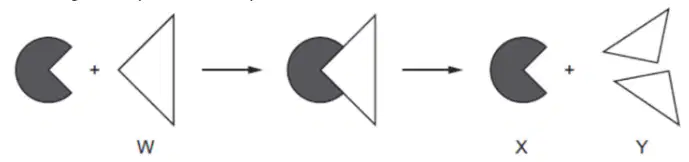
What are parts of W, X and Y in this chemical reaction?
W: enzyme, X: product, Y: substrate
X: enzyme, W: product, Y: substrate
X: enzyme, Y: product, W: substrate
Y: enzyme, W: product, X: substrate
What controls the speed of chemical reactions in all living cells?
A. Enzymes
B. Hormones
C. Ions
D. Vitamins
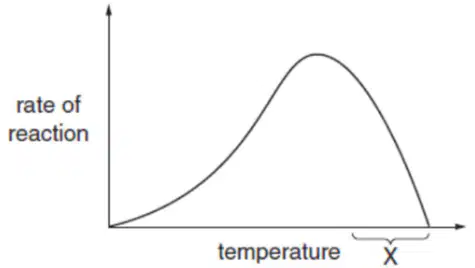
What describes the shape of the graph within the temperature range marked X?
The rate of reaction decreases
The rate of reaction increases then decreases
The rate of reaction reaches a maximum
The reaction is occurring at the optimum temperature
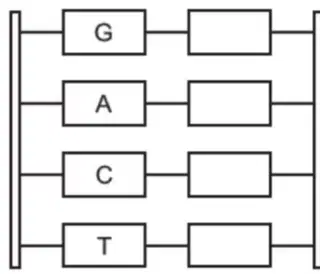
The diagram shows a section of the DNA, with four bases identified on one strand. Which sequence of bases would be on the other strand, starting from the top?
AGTC
CTGA
GACT
TCAT
Which nutrient produces a purple colour when mixed with biuret solution?
Fat
Protein
Reducing sugar
Starch
Small molecules are used as the basic units in the synthesis of large food molecules. Which statement is correct?
A. Amino acids are basic units of carbohydrates
B. Fatty acids are basic units of glycogen
C. Glycerol is a basic unit of oils
D. Simple sugar is a basic unit of protein
Which identifies the chemical elements found in proteins?
A. carbon ✓, hydrogen ✓, oxygen ✓, nitrogen ✓
B. carbon ✓, hydrogen ✓, oxygen ✓, nitrogen x
C. carbon ✓, hydrogen x, oxygen ✓, nitrogen ✓
D. carbon ✓, hydrogen ✓, oxygen x, nitrogen ✓
What are the chemical elements found in carbohydrates?
Carbon, hydrogen and oxygen only
Carbon, hydrogen, oxygen and nitrogen only
Carbon, hydrogen, oxygen and sulfur only
Carbon, hydrogen, oxygen, nitrogen and sulfur only
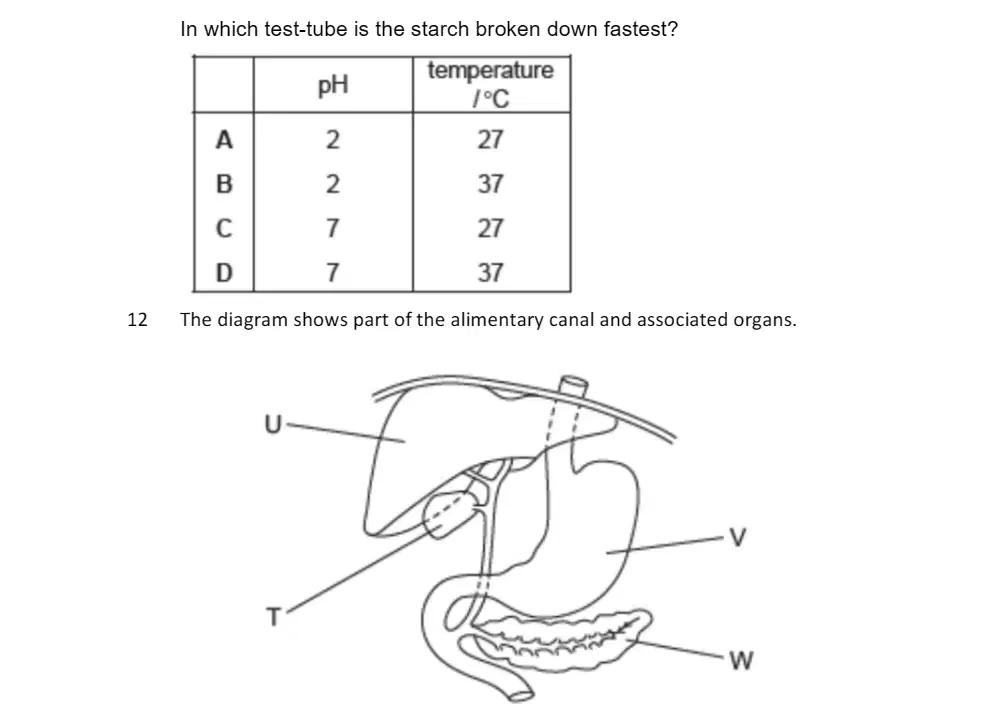
The table shows the conditions in four test-tubes containing equal amounts of starch and salivary amylase. In which test-tube is the starch broken down fastest?
A
B
C
D
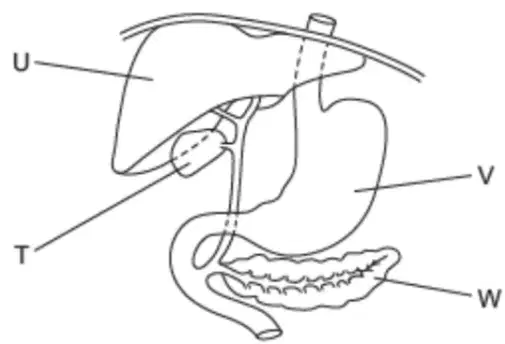
Which structures secrete enzymes that digest proteins?
A. T and U
B. U and V
C. V and W
D. W and T
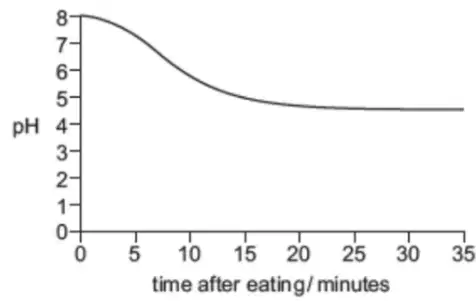
The graph shows pH changes in the mouth after eating. Why is it a good idea to brush teeth after eating?
A Acidic conditions help bacteria to grow.
B Acids dissolve tooth enamel.
C Alkaline conditions help bacteria to grow.
D Alkalis dissolve tooth enamel.

The diagram shows a large food molecule changing into smaller molecules. What is process X?
Absorption
Chewing
Digestion
Secretion
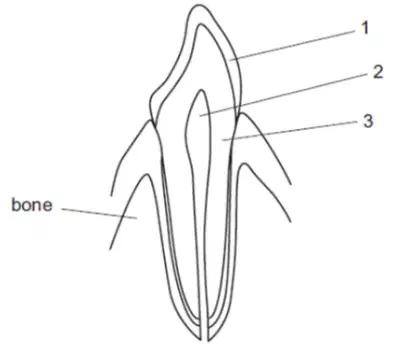
The diagram of a tooth is shown. What are the parts labelled 1, 2 and 3?
1: dentine, 2: enamel, 3: pulp
1: enamel, 2: dentine, 3: pulp
1: enamel, 2: pulp, 3: dentine
1: pulp, 2: dentine, 3: enamel
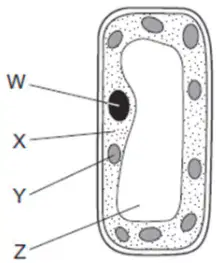
The diagram shows a palisade mesophyll cell from a green leaf. In which labelled part does photosynthesis occur and where is starch stored?
photosynthesis occurs in X, starch is stored in W
photosynthesis occurs in X, starch is stored in Z
photosynthesis occurs in Y, starch is stored in X
photosynthesis occurs in Y, starch is stored in Y
Plant makes their own supplies of carbohydrates. What are the raw materials and the waste product of this process?
raw materials: carbon dioxide and chlorophyll, waste product: oxygen
raw materials: carbon dioxide and water, waste product: oxygen
raw materials: oxygen and chlorophyll, waste product: carbon dioxide
raw materials: oxygen and water, waste product: carbon dioxide
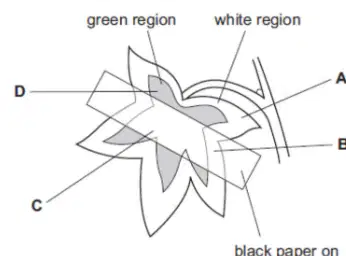
A plant with variegated leaves has the starch removed from its leaves by placing it in a dark cupboard for 48 hours. Black paper is then fixed on one leaf as shown and the plant is exposed to light. After 24 hours, which part of the leaf contains starch?
A (the green region exposed to light)
B (the region covered by black paper)
C (the non-green region)
D (the entire leaf)
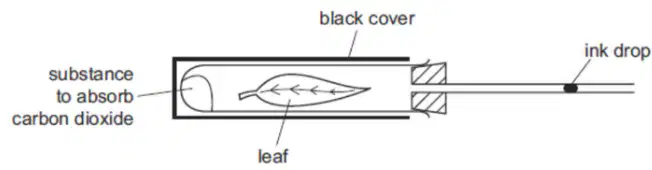
The diagram shows an experiment to investigate gas exchange in a leaf. In which direction does the ink drop move and for what reason?
to the left - photosynthesis
to the left - respiration
to the right - photosynthesis
to the right - respiration
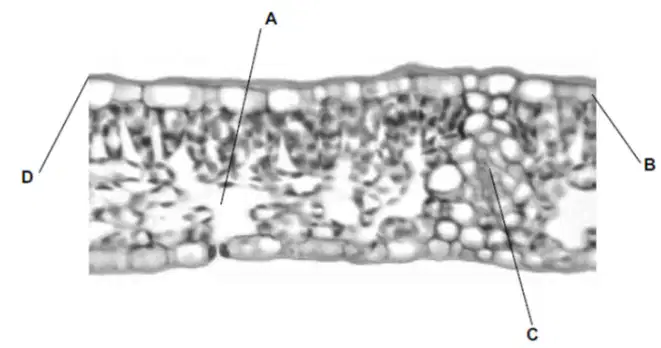
The photograph shows a section through the leaf of a plant. Which label shows the position of the cuticle?
A
B
C
D
Which of the following best describes the function of enzymes in the human digestive system?
They absorb nutrients into the bloodstream
They store energy in the form of fat
They speed up the breakdown of large molecules into smaller ones
They transport oxygen to cells
Which test would you use to identify the presence of starch in a food sample?
Ethanol emulsion test
Iodine solution
Biuret test
Benedict's test
What is the main role of chlorophyll in photosynthesis?
To absorb light energy
To produce oxygen directly
To break down starch
To store glucose
Which of the following statements about enzymes is correct?
Enzymes are used up during chemical reactions
Enzymes lower the activation energy of reactions
Enzymes work best at any temperature
Enzymes are made of carbohydrates
What is the main function of bile in the digestive system?
To absorb glucose into the blood
To digest starch into simple sugars
To break down proteins into amino acids
To neutralize stomach acid and emulsify fats
Which test is used to identify the presence of proteins in a food sample?
Benedict's test
Iodine solution
Biuret test
Ethanol emulsion test

Dissolved gases move between the blood and body cells by which process?
absorption
respiration
diffusion
osmosis
Which of the following statements about diffusion is true?
substances move from high to low concentration
diffusion only happens across a partially permeable membrane
water moves from high to low water potential
substances move from low to high concentration
What happens during osmosis?
water molecules moves from high to low concentration without the use of energy
water molecules moves from high to low concentration with the use of energy
water molecules moves from high to low water potential without the use of energy
water molecules move from high to low water potential with the use of energy

What is the direction of osmosis?
From left side to right side.
From right side to left side.
Select the image that best represents diffusion.


Osmosis is the movement of ____ from a region of _____ to a region of _____, through a _____.
substances, higher concentration, lower concentration, concentration gradient
water molecules, higher water potential, lower water potential, partially permeable membrane
water molecules, higher concentration, lower concentration, partially permeable membrane

Dissolved gases (e.g. CO2, O2) enter and leave plant cells by which process?
Photosynthesis
Respiration
Diffusion
Osmosis
A student noticed that placing wilted lettuce in a bowl of cool water caused the lettuce to become more crisp and firm. What is the best explanation for his observation?
Salt moved out of the lettuce cells by diffusion.
Water moved into the lettuce cells by osmosis.
Salt moved into the lettuce cells by diffusion.
Water moved out of the lettuce cells by osmosis.
Why are diffusion and osmosis important to cells?
It allows them to take in materials without using energy.
It allows them to reproduce.
It allows them to absorb sunlight.
It allows cells to use all energy.
The molecules in a solid lump of sugar do not move
TRUE
FALSE
Simple Diffusion is a type of Active Transport.
TRUE
FALSE
In a plant, what is formed by a group of xylem vessels?
a cell
a tissue
an organ
an organ system
What are the functions of xylem vessels?
absorption
conduction
photosynthesis
support

The diagram shows a palisade mesophyll cell.
Which structure is not found in an animal cell?
A
B
C
D
Which statement is correct for phloem but not for xylem?
It carries mineral ions.
It carries starch.
It carries sucrose.
It is no longer living.
What is the correct order of increasing size of the following structures, from smallest to largest?
chromosome → liver → white blood cell
chromosome → white blood cell → liver
liver → chromosome → white blood cell
white blood cell → liver → chromosome
A palisade cell and a nerve cell are observed under a light microscope.
Only the palisade cell has a :
cell membrane.
cytoplasm.
nucleus.
vacuole.
Which of the following is true for root hair cell?
allows water to pass into the plant
increases the surface area of the root
loses water by transpiration
At which level of organisation is a root?
organ
organ system
organism
tissue
Which description of the heart is correct?
The heart is an organ, containing several systems, which forms part of the circulatory tissue.
The heart is an organ, containing several tissues, which forms part of the circulatory system.
The heart is a system, containing several organs, which forms part of the circulatory tissue.
The heart is a system, containing several tissues, which forms part of the circulatory organ.
Which is not an organ?
blood
heart
tooth
vein
Plant cells are often green but animal cells are not usually green.
Which structure in plant cells makes them green?
cell wall
chloroplast
cytoplasm
vacuole
Which structures are found in a liver cell?
cell membrane
nucleus
chloroplast
large vacuole
cytoplasm
Which structures are adapted for supporting a plant?
phloem tissue
root hair cells
stomata
xylem vessels

The cell shown in the diagram has been magnified 3000 times. The diagram is 21mm wide.
What is the actual diameter of the cell?
21 mm
300021mm
21 × 3000 mm
213000 mm
What is taxonomy?
Taxonomy is the study of rocks.
Taxonomy is the process of baking bread.
Taxonomy is the art of playing the piano.
Taxonomy is the science of classification.
Who is known as the 'Father of Taxonomy'?
Charles Darwin
Carl Linnaeus
Albert Einstein
Isaac Newton
What is binomial nomenclature?
Binomial nomenclature is a system of naming colors in the visible spectrum.
Binomial nomenclature is a system of naming musical notes in a scale.
Binomial nomenclature is a system of naming planets in our solar system.
Binomial nomenclature is a system of naming species in which each species is given a two-part scientific name.
Which two levels of classification make up a species name in binomial nomenclature?
Kingdom and domain
Family and order
Class and phylum
Genus and species
What is the correct way to write a scientific name using binomial nomenclature?
Family species
Genus species
Genus family
Genus species species
What is the purpose of binomial nomenclature?
To confuse scientists with unnecessary jargon
To create chaos in the scientific community
To provide a universal and standardized way to identify and classify organisms.
To make it harder to identify organisms
What are the different taxonomic ranks in hierarchical classification?
Kingdom, Division, Class, Order, Family, Genus, Species
Tribe, Rank, Domain, Order, Family, Genus, Species
Kingdom, Phylum, Class, Order, Family, Genus, Species
Division, Phylum, Class, Order, Family, Genus, Species
What is the difference between a genus and a species in binomial nomenclature?
A genus is a category used for plants, while a species is used for animals in binomial nomenclature.
A genus is a broader category that includes multiple related species, while a species is a specific group of organisms that share common characteristics and can interbreed.
A genus is a specific group of organisms that share common characteristics, while a species is a broader category that includes multiple related genera.
A genus and a species are interchangeable terms in binomial nomenclature.
How are organisms classified into different taxonomic groups?
By flipping a coin
Based on shared characteristics and evolutionary relationships.
Based on random selection
According to the alphabet
Why is binomial nomenclature important in the field of biology?
Binomial nomenclature is irrelevant in biology
Binomial nomenclature causes confusion among scientists
Binomial nomenclature is only used for plants, not animals
Binomial nomenclature provides a standardized system for naming and classifying organisms.
What organ stores bile produced by the liver?
Gall Bladder
Pancreas
Small Intestine
Spleen
What is the main function of the small intestine?
The small intestine is responsible for the majority of nutrient absorption during digestion.
The small intestine produces bile for fat digestion.
The small intestine stores waste before excretion.
The small intestine regulates blood sugar levels.
What is chyme?
A solid food particle that is digested in the mouth.
A semi-liquid mixture of food and digestive juices formed in the stomach.
A type of enzyme that breaks down proteins in the stomach.
A liquid that is absorbed in the intestines.
What is the esophagus?
A muscular tube that connects the throat to the stomach, transporting food.
A part of the brain responsible for processing visual information.
A type of muscle found in the heart that pumps blood.
An organ that produces insulin for regulating blood sugar.
What is the process of breaking down food into smaller components called?
Metabolism
Absorption
Digestion
Fermentation
Why does the small intestine have a large surface area?
The large surface area is due to the presence of villi and microvilli, which increase absorption efficiency.
The large surface area is due to the presence of folds in the intestinal wall.
The large surface area is due to the secretion of digestive enzymes.
The large surface area is due to the length of the small intestine.
What type of digestion occurs when food is chewed and mixed in the mouth?
Chemical digestion
Mechanical digestion
Biological digestion
Thermal digestion
What is the role of saliva in digestion?
Saliva helps in the absorption of nutrients.
Saliva contains enzymes that begin the chemical breakdown of carbohydrates.
Saliva neutralizes stomach acid.
Saliva acts as a lubricant for food during swallowing.
What is the function of the gall bladder?
It produces insulin to regulate blood sugar levels.
It stores and concentrates bile until it is needed for digestion.
It filters toxins from the blood.
It absorbs nutrients from digested food.
What is the role of the large intestine in the digestive system?
To absorb nutrients and vitamins from food
To absorb water and electrolytes from indigestible food matter and compact waste into feces
To break down proteins and fats
To produce digestive enzymes
What is the role of the liver in digestion?
The liver produces bile, which helps in the emulsification and digestion of fats.
The liver filters toxins from the blood.
The liver stores glucose for energy.
The liver produces insulin to regulate blood sugar.
What is the function of the pancreas in digestion?
The pancreas produces insulin to regulate blood sugar levels.
The pancreas produces digestive enzymes and bicarbonate to aid in digestion in the small intestine.
The pancreas stores bile for fat digestion.
The pancreas absorbs nutrients from digested food.
What is the primary function of the stomach in digestion?
The stomach absorbs nutrients directly into the bloodstream.
The stomach mixes food with gastric juices to begin the digestion of proteins.
The stomach stores food until it is ready to be digested.
The stomach produces bile to aid in fat digestion.
What is the difference between chemical and mechanical digestion?
Mechanical digestion involves physical processes like chewing, while chemical digestion involves enzymatic breakdown of food.
Chemical digestion occurs only in the stomach, while mechanical digestion occurs in the mouth.
Mechanical digestion is faster than chemical digestion.
Chemical digestion does not involve any enzymes.
What nutrients are primarily absorbed in the small intestine?
Vitamins, minerals, and water
Carbohydrates, proteins, and fats
Nucleic acids, fiber, and sugars
Electrolytes, amino acids, and starches
What type of disease pattern spreads rapidly over countries and continents?
Outbreak
Pandemic
Epidemic
Endemic
A toxin or other foreign substance which creates an immune response and the production of antibodies
Antigen
Pathogen
Antibody
Immunity
A vaccine made from weakened pathogens is called
Viral Vector Vaccine
Subunit Vaccine
Live-attenuated Vaccine
Inactive Vaccine
Which of the following cells make antibodies?
T Cells
Phagocytes
B Cells
Pathogens
Which of the following is part of our specific (adaptive) immune defense?
Phagocytes
Mucus
Stomach Acid
T Cells
Any virus, bacteria, fungi, or parasite that can cause a disease in a living thing is called a
cancer.
pathogen.
gene.
toxin.
What do we call a disease that can spread between living things in close contact?
Physiological disease
Genetic disease
Infectious disease
Contagious Disease
what do we call a disease caused by a pathogen?
Contagious Disease
Infectious Disease
Genetic Disease
Physiological Disease
An infectious disease from an animal passed to a human that causes illness is a genetic disease.
True
False
Which of the following is NOT a zoonotic disease?
Zika
Ebola
COVID-19
Cancer
What type of disease pattern spreads rapidly in a population or region affecting more than expected?
Endemic
Pandemic
Epidemic
Outbreak
A disease is a disruption in the structure of function of a living thing.
True
False
Which blood vessel carries blood at the highest pressure?
Arteries
Veins
Capillaries
Which blood vessel contains valves?
Arteries
Veins
Capillaries
Which blood vessel carries blood away from the heart?
Arteries
Veins
Capillaries
Which blood vessel carries blood towards the heart?
Arteries
Veins
Capillaries
Which component of blood is responsible for transporting oxygen?
Red Blood Cells
White Blood Cells
Platelets
Plasma
Which component of blood contains phagocytes and lymphocytes?
Red Blood Cells
White Blood Cells
Platelets
Plasma
Which component of blood is the liquid part of blood?
Red Blood Cells
White Blood Cells
Platelets
Plasma
What is the function of phagocytes?
Transport oxygen around the body
Engulf and digest pathogens
Produce antibodies which destroy pathogens
Clot together to prevent bleeding
What is the function of lymphocytes?
Transport oxygen around the body
Engulf and digest pathogens
Produce antibodies which destroy pathogens
Clot together to prevent bleeding
What blood vessel transports deoxygenated blood from the body to the heart?
Vena Cava
Aorta
Pulmonary Vein
Pulmonary Artery

A
B
C
D

A
B
C
D

A
B
C
D

A
B
C
D

A
B
C
D

A
B
C
D

A
B
C
D

A
B
C
D

A
B
C
D

A
B
C
D

A
B
C
D

A
B
C
D

A
B
C
D

A
B
C
D

A
B
C
D

A
B
C
D

A
B
C
D

A
B
C
D

