
 Worksheets
RC3 Practice: Evolution and Classification
Total questions: 126
Worksheet time: 2hrs 41mins
Which of the following are true regarding endosymbiotic theory?
some ancient prokaryotes engulfed others that could perform photosynthesis
some ancient prokaryotes engulfed others that could perform cellular respiration
all eukaryotic organelles had prokaryotic ancestors
chloroplasts and mitochondria had prokaryotic ancestors
the nucleus, chloroplasts, and mitochondria all had prokaryotic ancestors
Which of the following provide advantages to a species?
asexual reproduction
sexual reproduction
genetic diversity
being unicellular
oxidative metabolism
Slow and steady change of biological species.
Stasis
Co-evolution
Punctuated equilibrium
Convergent evolution
Gradualism
Biological species stay the same for long periods of time.
Stasis
Co-evolution
Punctuated equilibrium
Convergent evolution
Gradualism
Rapid change of biological species following a long period of staying the same.
Stasis
Co-evolution
Punctuated equilibrium
Convergent evolution
Gradualism
What were the earliest life forms?
unicellular prokaryotes
unicellular eukaryotes
unicellular protists
unicellular fungi
What is the term for large-scale evolutionary patterns and processes that occur over long periods of time?
macroevolution
microevolution
survival of the fittest
genetic drift
To be considered members of the same species, organisms must be able to
look alike
reproduce together and have fertile offspring
live in the same habitat
eat the same types of food
Darwin saw populations of various species that seemed well-suited to their environment. What did this suggest?
The species Darwin saw were all related to each other.
Species had been introduced to particular areas by humans on purpose.
Species might be able to adapt to their surroundings over time.
Some environments rarely ever change.
The difference in the physical traits of an individual from those of other individuals in the group to which it belongs
adaptation
variation
descent with modification
fitness
A feature that allows an organism to better survive in its environment.
adaptation
variation
descent with modification
fitness
A tortoise population lives in an area with high grass. These tortoises have longer necks than tortoises that live in other areas. The long necks of the tortoises are an example of
adaptation
variation
descent with modification
fitness
One bird in a population has a slightly thicker beak than its relatives. The bird’s thicker beak is an example of __ in its population.
adaptation
variation
descent with modification
fitness
Why must selected traits be heritable?
If a selected trait is not heritable, it cannot be passed down to the next generation
Heritable traits are those traits that farmers and breeders consider worth passing on
Heritable traits are common in domesticated animals that are used in breeding
A selected trait that is heritable is likely to make an animal easier to domesticate
In natural selection, what must be true of traits that are passed down through generations?
The trait must be one that members of the species like and enjoy.
The trait must be one that members of the species have chosen to reproduce.
The trait must be one that gives an advantage to certain individuals.
The trait must be one that does not give an advantage to any
particular individuals.
Large teeth and jaws become more common in jaguars because they are heritable characteristics.
overproduction
variation
adaptation
descent with modification
Jaguars with large teeth and jaws survive longer because they can eat shelled reptiles.
overproduction
variation
adaptation
descent with modification
By chance, some jaguars are born with slightly larger teeth and jaws.
overproduction
variation
adaptation
descent with modification
A jaguar may produce many offspring, but because of competition, not all of them will survive long enough to reproduce.
overproduction
variation
adaptation
descent with modification
The environment is the selective agent in
artificial selection
natural selection
The measure of the ability to survive and produce more offspring relative to other members of the population is called
fitness
adaptation
overproduction
variation
The ability of a trait to be passed down from one generation to the next is called
adaptation
heritability
overproduction
natural selection
All the individuals of a species that live in an area are called the
population
ecosystem
common ancestors
family
Occurs when individuals with beneficial adaptations produce more surviving offspring than other individuals of the same species.
natural selection
artificial selection
excessive mutations
population equilibrium
Feature that is similar in structure in different organisms but has different functions.
homologous structure
analogous structure
vestigial structure
Feature that performs a similar function in different organisms but is not similar in origin or structure.
homologous structure
analogous structure
vestigial structure
Feature that is not evidence of a common ancestor
homologous structure
analogous structure
vestigial structure
Remnant of an organ or structure that had a function in an early ancestor
homologous structure
analogous structure
vestigial structure
Examples include the wing of a bat and the hand of a human
homologous structure
analogous structure
vestigial structure
Examples include the wing of a bird and the wing of an insect
homologous structure
analogous structure
vestigial structure
Examples include the pelvis and femur in whales and the appendix and wisdom teeth in humans
homologous structure
analogous structure
vestigial structure
the distribution of living and fossil organisms
biogeography
fossil record
homologies
variation
The extent of molecular homologies between species is usually determined by analyzing
DNA sequences
amino acid sequences
phospholipids
large carbohydrates
In order to have a wide range of phenotypes, a population must also have
competition for scarce resources
genetic variation
environmental stability
a very ancient population
How can a wide range of phenotypes increase the chance that some individuals will survive in a changing environment?
Populations with fewer phenotypes tend to be very strong and hardy.
Phenotypes tend to adapt along with the environment.
A changing environment often produces a wide range of phenotypes.
If there are many variations, there are more chances for some individuals to improve the chance of survival.
A population's __ contains the genetic variation for the entire population.
gene pool
allele frequency
equilibrium
genetic drift
__ measures how common a certain allele is in a population.
gene pool
allele frequency
equilibrium
genetic drift
How is genetic drift different from natural selection?
Genetic drift prevents natural selection.
Genetic drift occurs by chance alone.
Genetic drift only occurs in marine species.
Genetic drift is a method used for breeding.
Genetic drift is more likely to occur in ___ populations.
small
new
large
established
Event that drastically reduces the size of a population can lead to...
bottleneck effect
founder effect
gene flow
genetic drift
Occurs after a small number of individuals colonize a new area.
bottleneck effect
founder effect
gene flow
genetic drift
May cause genetic drift to occur.
bottleneck effect
founder effect
gene flow
extinction
What is one problem that can result from genetic drift?
loss of genetic variation
increased genetic variation
changes in genetic variation
changes in genetic variation of neighboring species
What happens to a population that is in Hardy-Weinberg equilibrium?
It evolves much faster.
It evolves much slower.
It evolves at a uniform pace.
It stops evolving at all.
Isolated populations may become genetically different as they adapt to new environments, or through random processes such as
mutation
genetic drift
natural selection
artificial selection
The final step in speciation is
reproductive isolation
behavioral isolation
temporal isolation
geographic isolation
Natural selection acts directly on ___.
phenotypes
genotypes
Which of the following increase genetic diversity?
sexual reproduction
gene shuffling
mutation
asexual reproduction
genetic drift
GG and Gg= green frogs; gg= brown frogs. If brown frogs have a survival advantage, what will happen to allele frequencies?
G will increase and g will decrease
g will increase and G will decrease
both G and g will increase
both G and g will decrease
G and g will continue to add up to 100%
What is the term for observable changes in allele frequencies in ONE population over a relatively short time frame?
macroevolution
microevolution
survival of the fittest
genetic drift
Which are true about gene flow?
movement of alleles between populations
reduces genetic diversity of new population
increases genetic diversity of new population
lack of gene flow between populations can lead to speciation
changes allele frequencies of populations
the rise of 2 or more species from 1 existing species is...
speciation
natural selection
genetic drift
gene flow

The bones in the diagram are examples of...
homologous structures
analogous structures
vestigial structures
artificial structures
The term "developmental homologies" refers to...
similarities in embryos
differences in embryos
similarities in DNA
similarities in bone structures
What must a population have before natural selection can occur?
genetic variation
no mutations
an unchanging environment
sexual reproduction
What must be true of inherited mutations?
they must occur in a gamete
they must occur in a somatic cell
they may occur in either a gamete or a somatic cell
mutations may not be inherited
Small populations may experience situations similar to inbreeding, which may include...
reduced genetic diversity in the population
increased incidence of recessive genetic disorders
difficulty adapting to changing environmental conditions
increased rate of mutations leading to higher genetic diversity
On a farm, Marcia observes that individuals of a certain goat species have slightly different sizes and colors. What characteristic of populations is Marcia observing?
adaption
evolution
selection
variation
What is the ultimate cause for all variation within a population?
Natural Selection
Adaptation
Mutation
Environmental Changes

Which of the following would most likely prevent two populations of field mice from breeding?
Active time of day
Color
Average weight
Favorite food
The science of naming & classifying organisms
Taxonomy
Cladistics
Binomial Nomenclature
Phylogeny
Number of words in a scientific name.
one
two
three
it could be any number
The name of the scientific naming system we use today is called:
molecular clocks
cladistics
taxonomy
binomial nomenclature
Which is the most inclusive taxon?
Species
phylum
Class
kingdom
Which is the most exclusive taxon?
Species
Kingdom
Domain
Phylum
List the taxa in order from broad to specific.
kingdom, phylum, class, order, family, species, genus
kingdom, class, phylum, order, family, genus, species
kingdom, phylum, order, class, family, genus, species
kingdom, phylum, class, order, family, genus, species
What is the newer taxon that's broader than a kingdom?
Species
Domain
Sub-kingdom
Classification
These are a group of organisms similar enough to breed and produce fertile offspring.
Eukaryotes
Heterotrophs
Species
Mammals
Two organisms in the same family also share these classification taxa.
Kingdom, phylum, class, order, family, genus and species
Kingdom, phylum, class, order (and of course, family)
Family, genus and species
Kingdom, phylum and class
Evolutionary relationships among organisms is called
phylogeny
classification
taxonomy
mutations
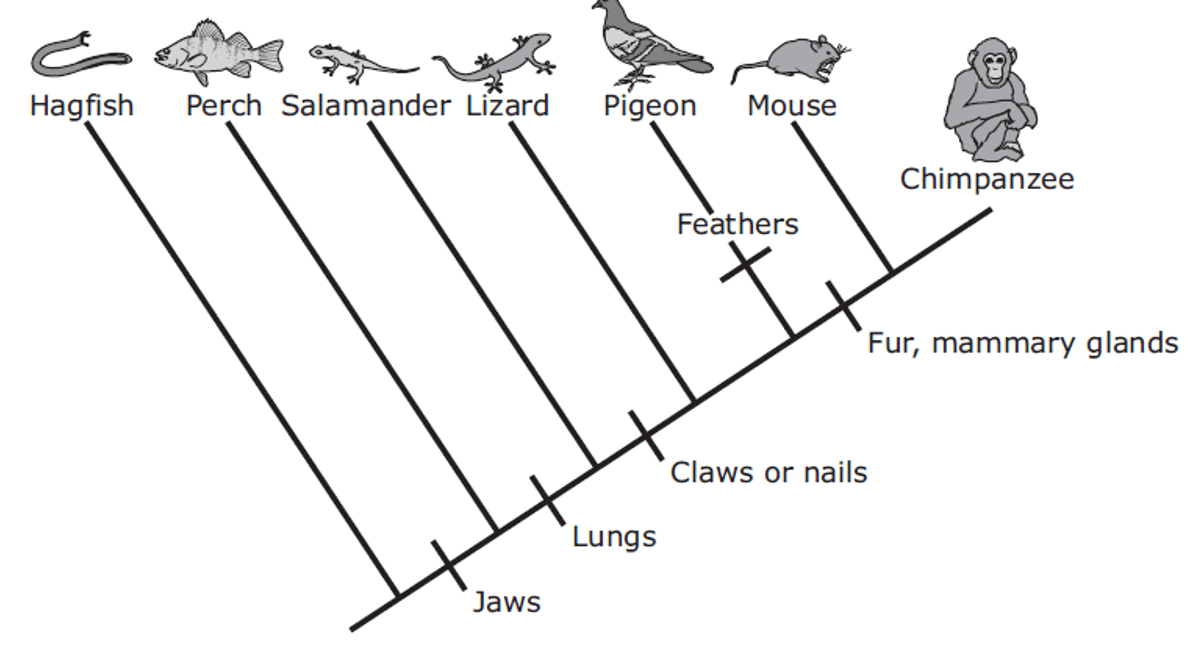
What are cladograms or phylogenetic trees?
Diagrams that shows organisms in the same kingdom.
Tools to identify organisms.
Systems scientists use to name organisms.
Diagrams that show evolutionary relationships between organisms.
What are cladograms based on?
physical features
derived characters
opposite characters
similar characters
What is cladistics analysis/ systematics?
Method to identify unknown organisms.
Method used to combine organisms in one species.
Method biologists use to construct cladograms.
Method used to build dichotomous keys.
Nucleated heterotrophs with cell walls of chitin belong to this kingdom
Animalia
Plantae
Eubacteria
Fungi
Unicellular prokaryotes that live in extreme environments belong to this kingdom.
Eubacteria
Archaebacteria
Protista
Fungi
Unicellular prokaryotes with cell walls of peptidoglycan belong to this kingdom
Archaebacteria
Eubacteria
Protista
Fungi
Multicellular autotrophs with cell walls of cellulose belong to this kingdom
Eubacteria
Archaebacteria
Plantae
Fungi
Unicellular eukaryote with chloroplasts and a flagellum belong to this kingdom
Eubacteria
Protista
Plantae
Fungi
Process that leads organisms without close
ancestry to develop similar features
convergent evolution
adaptive radiation
genetic drift
Microevolution
Name of features that appear similar but have different structures
Vestigial structures
Homologous structures
Analogous structures
Derived structures


A dichotomous key for trees is provided. Hikers found a tree that has large brown cones and single sharp needles. What species of tree have the hikers found?
Juniper
Pine
Spruce
Fir
The more similar the DNA of two species, the more recently they
shared a common ancestor.
did not share a common ancestor.
more different they are in evolutionary terms.
became the same species.


Kingdom Animalia is
Eukaryotic
Prokaryotic
Autotrophs
Photosynthetic

What is the main difference between members of the plant and fungi kingdoms?
fungi are multicellular
fungi are heterotrophs
fungi are eukaryotic
fungi have a cell wall
How many kingdoms of living things exist today?
3
5
6
4
This organism is found in pond water. It has a nucleus, is microscopic, unicellular and can perform photosynthesis. What kingdom does it belong in?
protista
eubacteria
archaebacteria
plantae
Which domain contains organisms that are unicellular, prokaryotic, and can cause strep throat or E. coli infections?
Eukarya
Archaea
Fungi
Bacteria
What would provide evidence that three distinctly different primates share a recent common ancestor?
They are found on land.
They eat a similar diet of tropical fruits.
They are about the same color.
They have nearly identical DNA.
Which of the following is the least closely related animal:
Gray Wolf: Canis lupus
Aardwolf: Proteles cristatus
Coyote: Canis latrans
Coyote
Aardwolf
Gray Wolf
Need more information on body characteristics


Scientists can determine relatedness among organisms by comparing partial amino acid sequences. The table shows four partial amino acid sequences from four organisms.
Which organism is the LEAST related to the other three organisms?
Organism 1
Organism 2
Organism 3
Organism 4

The image shows part of the humerus bone in different genera of primates.
Which statement is best supported by the observable structures of the different humerus bones?
The primates lived in similar environments.
The primates shared a common ancestor.
The primates interbreed with similar organisms in a population.
The primates had diets that consisted of similar types of foods.

Where is the alligator and T. rex's common ancestor?
Point A
Point B
Point C
Point D

The grizzly bear is most related to the
squirrel
snake
fox
sea star
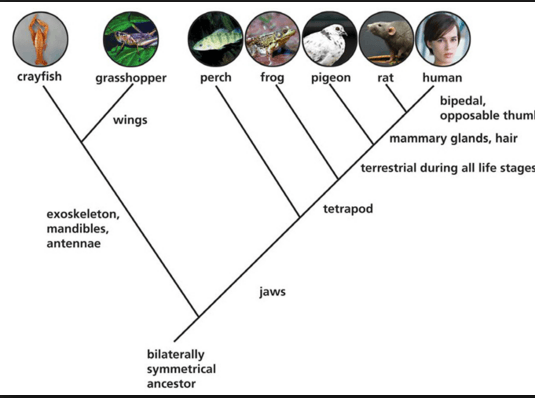

What number is the common ancestor of C and D
1
2
4

Which of the following evolve over time?
populations
individuals
Overproduction of offspring is a strategy that...
Doesn't work because lots of the offspring die
Increases chances some offspring will survive to reproduce
Ensures the offspring will have to compete for food
Dooms a species to extinction
What would be an advantage of a species giving birth in the spring, rather than in the winter?
There are no predators in the warmer months
It is safer to be pregnant in the wintertime
More food will be available to offspring
There is no advantage to springtime births
What is the benefit of using scientific names and a standardized classification system?
Scientific names are fun to say
Many scientific names are in Latin
There is less confusion than using common names
It is easier to determine relatedness among organisms

