
 Worksheets
Cell Organelles and Cell Theory
Total questions: 125
Worksheet time: 2hrs 53mins
Who was the scientist that looked at cork under a microscope?
Alfred Wegner
Howard Hess
Robert Hooke
Mattias Schleiden
Robert Hooke named the small compartments that made up the cork __________after the rooms monks lived in.
organelles
membranes
mocroscopes
cells
Cell theory states that...
cells are the basic building block of life
cells are cool
cells are microscopic
cells cannot be destroyed
Cell theory also states that...
bacteria are eukaryotic cells
animals are prokaryotic cells
cells come from other cells (cell division or splitting apart)
cells are awesome!
Lastly cell theory states....
cells don't do much
cells are microscopic
all living things are made up of cells (either unicellular or multicellular)
bacteria aren't cells

What kind of cell is this?
virus
animal
plant
bacteria

What kind of cell is this?
virus
animal
plant
bacteria

What kind of cell is this?
virus
animal
plant
bacteria
Prokaryotes DO NOT HAVE...
DNA
flagella
a membrane bound nucleus
ribosomes
Eukaryotes DO HAVE
a membrane bound nucleus
a virus
pili
antibacterial protection
Bacteria is
Eukaryotic
Prokaryotic
A plant cell is
Eukaryotic
Prokaryotic

An amoeba is a one-celled organism. The cell theory states that which of the following characteristics of amoebas must be true?
All amoebas have a regular, spherical shape.
All amoebas move rapidly using cilia.
All amoebas have organelles called chloroplasts.
All amoebas come from other amoebas.
What sort of evidence would support at least one of the components of the cell theory?
Rocks and other nonliving things are not composed of cells.
Cells are observed converting one form of energy into another.
A microscope is necessary to make observations of nearly all cells.
The origin of all cells observed can be traced to previous cells.

The number of cells in two separate petri dishes was recorded over a period of 20 days. The data shown in the table best illustrates which part of the cell theory?
All living things are made up of cells.
Cells are the most basic unit of living things.
Organisms can be unicellular or multicellular.
All cells come from preexisting cells.
Which scientist first observed living cells and was later accredited for discovering bacteria?
Robert Hooke
Anton van Leuwehoek
Matthias Schleiden
Robert Remak
Which scientist discovered the existence of cells by looking at pieces of cork under a microscope?
Robert Hooke
Theodor Schwann
Anton Van Leuwenhoek
Matthias Schleiden
Which scientist observed animal cells and came to the conclusion that all animals were made of cells?
Anton van Leuwenhoek
Robert Hooke
Matthias Schleiden
Theodor Schwann
Which botanist observed plans under a microscope and noticed that all plants were made of cells?
Matthias Schleiden
Robert Hooke
Robert Remak
Theodor Schwann
Which scientist discovered that all cells come from the division of pre-existing cells?
Theodor Schwann
Robert Remak
Robert Hooke
Matthias Schleiden
Select all the characteristics of ALL living things.
All living things have DNA.
All living things use energy.
All living things use stimuli and adapt to their environment.
All living things reproduce.
What is an individual form of life that is capable of growing, taking in nutrients, and usually reproducing (organ systems working together)?
Cellular Theory
Cells
Organisms
Atoms
This is the smallest unit of an organism; it is enclosed by a membrane and performs life functions.
Atoms
Cells
Matter
Elements
Which is NOT an example of a single-celled organism?
Parameicum
Triceratium
Protozoa
Euglena


storage area for the cell
vacuole
cytoplasm
chloroplast
cell wall

builds proteins for cell functions
ribosomes
mitochondria
nucleus
lysosome

command center, direct's the cell's activities
nucleus
lysosome
mitochondria
endoplasmic reticulum

Which part is colored in the picture? (Look closely--it's the little dots!)
Nucleus
Mitochondria
Vacuole
Ribosomes

Which organelle is colored in this picture?
Endoplasmic reticulum
Gogli body
Lysosomes
Cell mebrane

Examine the animal cell, what does number 8 represent?
Smooth ER
Rough ER
Nucleus
Golgi Apparatus
Mitochondria
This organelle is responsible for structure and support of the cell. It can also assist with transportation.
Endoplasmic reticulum
Cytoskeleton
Lysozome
Mitochondria
Nucleolus

This part of the cell is responsible for ribosome synthesis. See diagram
1
2
4
5
9
What organelle synthesizes lipids?
(a)
The organelle that contains digestive enzymes to break down worn out organelles and invading organisms
(a)
Schwann (Cell Theory)
all animals are made of cells
first to see cells under a microscope
all plants are made of cells
all cells are made of cells
Which of these is most likely an enzyme?
Which type of cell has a cytoplasm?
Prokaryotic cells
Eukaryotic cells
Both prokaryotic and eukaryotic cells
Both euglena and cyanobacteria are photosynthetic unicellular organisms found in pond water. Euglena, however, is eukaryotic while cyanobacteria are prokaryotic.
What feature distinguishes euglena from cyanobacteria?
the ability to reproduce asexually
the presence of ribosomes in cells
the ability to maintain homeostasis
the presence of a nuclear membrane
What are the two categories of Prokaryotic Cells?
There is only one category
Plant and Animal
Bacteria and Archaea
Big and Small
When these bond together, they form a protein.
Amino Acids
Peptide Bonds
Ribose
Nucleotides
Click on the temperature that this enzyme is having optimum activity.
Enzymes are (a) that (b) chemical reactions by (c) the amount of activation energy required to start the reaction.
proteins
speed-up
decreasing
carbohydrates
increasing
slow-down
Enzymes can be used again and again
True
False
Which of the following structures is common to ALL cells?
Ribosome
Cell wall
Flagellum
Plasmid
Animal cells typically belong to the Domain ____________.
Eukarya
Archae
Bacteria
Vertebrata
This organelle contains DNA which is the recipe (or blueprint) for a living organism.
Nucleus
Endoplasmic reticulum
Golgi bodies
Lysosome
This organelle receives protein molecules from the rough endoplasmic reticulum and sorts them into various packages to exit from the cell.
Golgi body
Membrane
Mitochondria
Peroxisome
The _______________ is an organelle that recycles and breaks down organic matter in the cell.
Lysosome
Phospholipid
Cell wall
Peroxisome
This organelle is found in all cells and provides a structure that allows for organelle movement inside of the cell.
Cytoskeleton
Rough endoplasmic reticulum
Membrane
Receptor proteins
Which of the following domains is noted for NOT having an organized, central nucleus?
Prokarya
Eukarya
Archae
Mitochondria

What is a key feature that distinguishes prokaryotic cells from eukaryotic cells?
Presence of a plasma membrane
Lack of a nucleus
Presence of DNA
Ability to perform photosynthesis
What molecule forms the plasma membrane of cells?
Carbohydrates
Lipids
Proteins
Nucleic acids
What is the primary function of ribosomes?
DNA replication
Protein synthesis
Lipid breakdown
Energy production
Which organelle is responsible for modifying, sorting, and packaging proteins?
Rough ER
Smooth ER
Golgi body
Lysosome
Fills cell’s empty space
Cilia & Flagella
Vacuoles
Cytoplasm
Mitochondria
Cytoplasm
Plant Cells
Animal Cells
Both
Cell wall
Plant Cells
Animal Cells
Both
Cell Membrane
Plant Cells
Animal Cells
Both
Chloroplasts
Plant Cells
Animal Cells
Both
Vacuoles
Plant Cells
Animal Cells
Both
Muscle cells use an incredible amount of energy. The energy used is ATP, which is produced by breaking down glucose in a process called cellular respiration. What organelle would you expect to find in high numbers within muscle cells?
Lysosomes
Cell Membrane
Mitochondria
Vacuoles
Plants, animals, fungi, and protists are examples of ______.
prokaryotes
eukaryotes
both eukaryotes and prokaryotes
neither

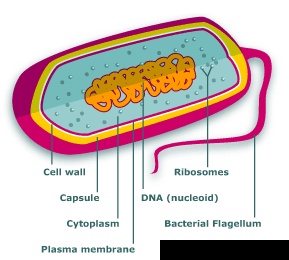
floating around in the cytoplasm (nucleoid region)

This organelle controls what material enters and exits cells.
Cell Wall
Cell Membrane
Cytoplasm
Cytoplasm

An organism made of only one cell is called _____ .
Eukaryotic
Mutlicellular
Monocellular
Unicellular
What fluid can be found in cells that holds organelles?
Blood
Plasma
Chlorine
Cytoplasm
Which organelle assembles proteins from amino acids?
Lipids
Ribosomes
Carbohydrates
Nucleic Acids
Which organelle produces ribosomes?
Nucleolus
Cell Membrane
Nucleus
Mitochondria
Organize these options into the correct and appropriate categories.
Lacks Nucleus
Nucleus Present
DNA Present
Ribosomes
Cell Membrane
Golgi Apparatus
Mitochondria
Nucleolus
Cytoplasm

What are the three domains we find in biology?
Archaea, Bacteria, Eukarya
Protista, Eubacteria, Animalia
Archaea, Eubacteria, Eukarya
Prokarya, Bacteria, Archaea
Which domain is characterized by organisms that live in extreme environments?
(a)
An organism is observed under a microscope. A nucleus is seen in its cells. What domain should that organism be classified into?
Bacteria
Archaea
Eukarya
Which domain is characterized by multi-cellular organisms?
(a)
Humans belong to which domain?
Eukarya
Bacteria
Archaea
Eubacteria

This organelle synthesizes lipids
nucleus
Smooth ER
Rough ER
Golgi Apparatus
Both humans and fungi have _____________ cells.
photosyntheic
prokaryotic
eukaryotic
What two levels make up a scientific name?
genus and order
genus and species
domain and kingdom
family and genus
What level comes after order?
genus
kingdom
family
species
What level comes before class?
phylum
domain
order
family
The 4 eukaryote kingdoms are Animals, Plants, Fungi, and
Bacteria
Archaea
Humans
Protists
A heterotroph
cannot make its own food.
is able to make its food.
What is the correct order of classification?family
kingdom, domain, phylum, class, order, family, genus, species
domain, kingdom, phylum, class, order, family, genus, species
domain, phylum, class, order, kingdom, family, genus, species
species, genus, family, phylum, order, class, domain, kingdom


I have cell walls
I am an autotroph
I am multicellular
What am I?
Plant
Animal
Eubacteria
Protist
I have no cell walls
I am eukaryotic
I reproduce sexually
I am multicellular
What kingdom do I belong to?
Plant
Animal
Protist
Fungi
I am unicellular
I am prokaryotic
I am found in extreme ecosystems
What kingdom do I belong to?
Protist
Plant
Animal
Archaea

