
 Worksheets
Electricity Unit Reivew
Total questions: 136
Worksheet time: 3hrs 34mins
Ms Pippin rubbed two balloons with a piece of wool. What will happen when the balloons are brought near each other?
The balloons will repel each other.
The balloons will attract each other.
The balloons will become positively (+) charged.
The balloons will pop.

Will the balloons ATTRACT or REPEL each other?


What happens when you touch a metal doorknob after rubbing your shoes on the carpet?
The doorknob sends a burst of electric current into your body
Millions of electrons go from your finger into the doorknob
The doorknob sends millions of electrons into your finger
Your finger becomes negatively charged


According to the illustration, the charge on Object A is ______________, and the charge on Object C is ______________.
negative, positive
positive, negative
positive, positive
negative, negative
Why does a Van de Graaff generator make your hair stand up if you touch the dome?
The current is trying to flow out of the hair ends.
The electrons gather on the hair ends and repel each other.
The hair is repelled by the dome of the Van de Graaff generator.
The hair is attracted to the surrounding air.

Charged objects attract neutral objects because
of charge separation (polarization) in the neutral oject
electrons flow from one object to the next
of electrical discharge
of current flow of electricity
What is an electric current?
a build up of electrons
the difference in charge between 2 points
the flow of electrons over a circuit
the opposition to flow of electrons


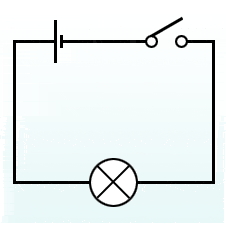
Which statement is true?
The light bulb will light up because the circuit is complete.
The light bulb will light up because the circuit is broken.
The light bulb will not light up because the circuit is complete.
The light bulb will not light up because the circuit is open.

When the switch is closed the buzzer will sound because -

Which schematic circuit matches this circuit picture?


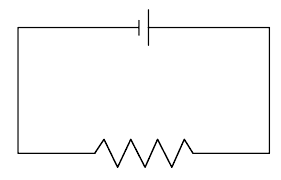
What components are in this schematic diagram?
battery, switch, bulb, wire
switch, switch, bulb
battery, switch, bulb, motor

In the diagram above, identify circuit component D.
Switch
Transformer
Conductor
Source


A PATH along which electricity can flow is a ___________________?
light bulb
switch
insulator
circuit

The path of electricity through a circuit
Electrons move from the negative terminal of battery, through all components, and return to the positive terminal of the battery.
Electrons move from the positive terminal of battery, through all components, and return to the negative terminal of the battery.
Electrons come from the negative terminal of battery and are absorbed by circuit components.
Electrons come from the positive terminal of battery and are absorbed by circuit components.


A student is testing the conductivity of 4 different substances. He uses a 2.5 V battery and records the current in the circuit in each of the 4 substances. The chart below indicates the current measured.
Which substance is most likely an insulator?
Substance Q
Substance R
Substance S
Substance T

What is the purpose of a lightning rod?
So birds won't sit on the roof
To look cool
To safely send electric charges from lightning into the ground
A connection that allows current to take the path of least resistance is a
short circuit
long circuit
parallel circuit
series circuit

Look at the picture above! why is it not allowed?
Because it will make people stumble and hurt
Because it makes the house messy
Because creates the risk of wire overheating from too much energy
Because it incurs huge electricity bills from too much energy
Without a fuse or circuit breaker, what might happen in a house with an overloaded electric circuit?
the thin piece of metal would melt, breaking the circuit
the metal band would heat up, disrupting the circuit
a fire would start
the electricity for the house would turn off
You want to build a device that can conduct current, but that will be safe if touched by a person. Which of the following pairs of materials could you use?
glass for the conductor and rubber for the insulator
copper for the insulator and silver for the conductor
sand for the conductor and plastic for the insulator
plastic for the insulator and silver for the conductor
What is the difference between a fuse and a circuit breaker?
a fuse can only be used once and a circuit breaker is reusable
a fuse is reusable and a circuit breaker can only be used once
both fuses and circuit breakers can only be used once
both fuses and circuit breakers are reusable
Which is more dangerous to humans?
high voltage
high current

Which of the following changes to the cell shown above would result in voltage being produced?
Reversing the leads on the voltmeter
Using a greater volume of sulfuric acid
Replacing 5% sulfuric acid with 20% sulfuric acid
Changing one of the electrodes to a zinc electrode

What kind of cell is this?
electrochemical cell
electrolytic cell

What was the manipulated variable in this lab?
type of wet cell
acid concentration
voltage
acid concentration vs voltage
What is the relationship between acid concentration and voltage?
the the greater the acid concentration the greater the voltage
the the greater the acid concentration the lower the voltage
acid concentration is not related to Voltage

In the model, what do the arrows represent?
The flow of current
The flow of resistance
The flow of voltage
The flow of positrons

In this model, the moped riders represent the
power pack
bulbs
flow of charge
ammeter

In this model, the electrical energy carried around the circuit is represented as the
pizza
party goers
party house
roads going back and forth the house

In this model, the pump that pushes water round the system represents the
battery
electricity
voltmeter
bulb

In this model, the pipes are like ....... they carry ......... round the circuit
wires; voltage
bulbs; current
bulbs; voltage
wires; current
If an electrical circuit were analogous to a water circuit at a water park, then the battery voltage would be comparable to ___________________.
the rate at which water flows through the circuit
the speed at which water flows through the circuit
the distance that water flows through the circuit
the water pressure between the top and bottom of the circuit
the hindrance caused by obstacles in the path of the moving water
If you decrease the voltage of circuit, what happens?
Current decreases
Current increases
If the Voltage stays the same and Resistance is increased, Current will
Increase
Decrease
Stay the same
what is the resistance of a lamp whose current is 6 A and the voltage across it is 120 V?
120 0hm
20 ohm
16 ohm
10 ohm
Which of the following has the least resistance?
Long, thin wires
Short, thick wires
Long, thick wires
Short, thin wires

What is the formula for voltage?
V = (I x R) / 2
V = I / R
V = R / I
V = I x R

Based on the model, which of the following would be true regarding the relationship between voltage, current, and resistance?
Current will reduce voltage.
Current will not pass through resistance.
Resistance will reduce current.
Voltage will reduce resistance.

Based on the graph, which of the following would be true regarding the relationship of voltage and current?
As voltage increases, current decreases.
Voltage will not affect current.
As voltage decreases, current increases.
As voltage increases, current also increases.


It gets confusing.
it takes less wire
If one load goes down, it does not affect the others.
the battery lasts longer

A student builds a circuit made up of a battery, two light bulbs, and a switch. What will the student most likely observe in this circuit?
Light bulb 1 and light bulb 2 will both be on
Light bulb 1 will be off, but light bulb 2 will be on
Light bulb 1 and light bulb 2 will both be off
Light bulb 1 will be on, but light bulb 2 will be off

If you add another bulb in parallel,_____
All the bulbs will go out
The bulbs get dimmer
The bulb brightness stays the same

If the middle bulb goes out, _______
The other bulb goes out
The other bulb's brightness stays the same
The other bulb gets dimmer

Students constructed a circuit using different-colored lightbulbs. What will happen if Switch 3 is closed and the other switches are left open?
Only the white bulb will operate
None of the bulbs will operate
Only the white and yellow bulbs will operate
Only the red and blue bulbs will operate


Which switch(s) need to be closed for only lightbulb 2 to glow?
A only
B only
A and B
A, B, and C

In which situation will the globe(s) glow brighter compared to the other situations? (assuming all lightbulbs and batteries are identical)
X only
Y only
X and Y
X, Y, and Z are all the same brightness
Which one of the following correctly describes how a voltmeter and ammeter need to be connected to a circuit?
both need to be connected in series
both need to be connected in parallel
a voltmeter in parallel, an ammeter in series
a voltmeter in series, an ammeter in parallel
Jake needs to repair a car stereo system. The system contains a stereo and a fuse that are connected in series and two speakers that are connected in parallel.
Which of the following diagrams represents the car stereo system described above?


Electrical energy is the energy
stored in chemicals
of charged particles
of all the moving particles in a substance
built up by friction
Example of electrical energy changing to light energy.
Light Bulb
Batteries
Glow Stick
Plants

The energy transformation that occurs in the circuit above when the switch is closed is
chemical energy → electrical energy → light and thermal energy
light energy → electrical energy → chemical and thermal energy
thermal energy → chemical energy → electrical and light energy
chemical energy → thermal energy → electrical and light energy
energy is transferred through electromagnetic waves.
Nuclear
Radiant
Thermal
Potential
Potential
mechanical Kinetic
Sound
Gravitational


Which of these might spin a generator at a power plant to produce electricity?
wind
water
steam from burning coal
all of these

Which part INCREASES the voltage of the power supply?
Power Station
Step Up Transformer
Transmission Cables
Step Down Transformer
Homes
Which part DECREASES the voltage of the power supply?
Power Station
Step Up Transformer
Transmission Cables
Step Down Transformer
Homes
Which part burns FOSSIL FUELS?
Power Station
Step Up Transformer
Transmission Cables
Step Down Transformer
Homes
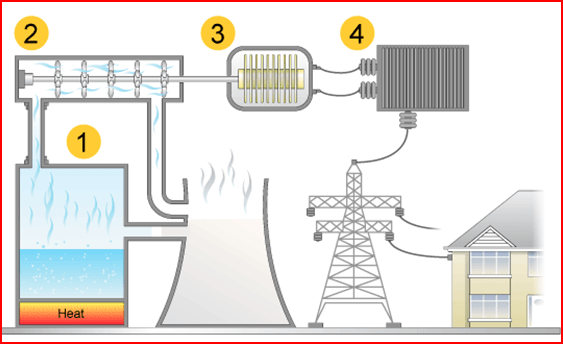
What is happening at stage 1 in the diagram?
fuel is burned to boil water to make steam
steam makes a turbine spin
the spinning turbine turns a generator which produces electricity
the electricity goes to the transformers to produce the correct voltage
What is happening at stage 2 in the diagram?
fuel is burned to boil water to make steam
steam makes a turbine spin
the spinning turbine turns a generator which produces electricity
the electricity goes to the transformers to produce the correct voltage
What is happening at stage 3 in the diagram?
fuel is burned to boil water to make steam
steam makes a turbine spin
the spinning turbine turns a generator which produces electricity
the electricity goes to the transformers to produce the correct voltage
What is happening at stage 4 in the diagram?
fuel is burned to boil water to make steam
steam makes a turbine spin
the spinning turbine turns a generator which produces electricity
the electricity goes to the transformers to produce the correct voltage
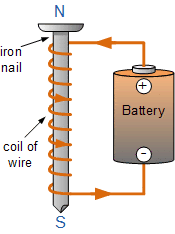
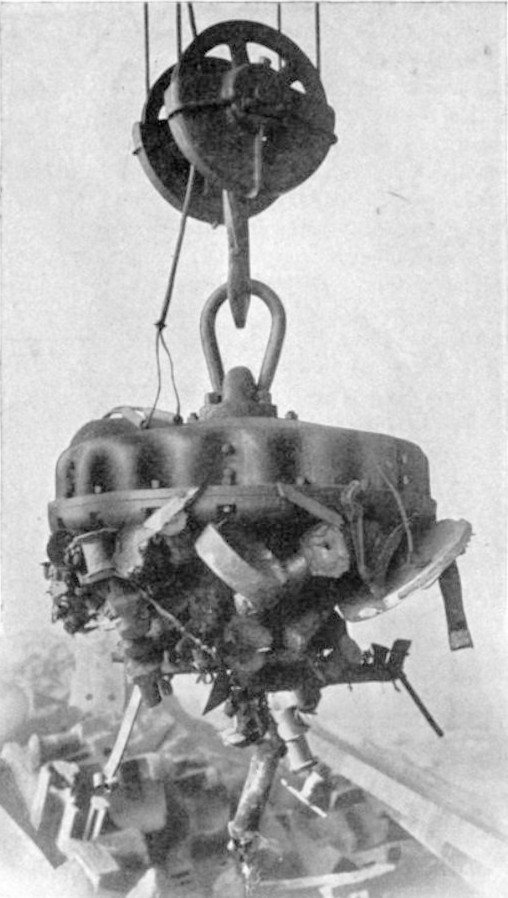
How are electromagnets different from permanent magnets?
permanent magnets can be turned on/off
you can turn an electromagnet on/off
permanent magnets are more powerful
permanent magnets have a North and South pole
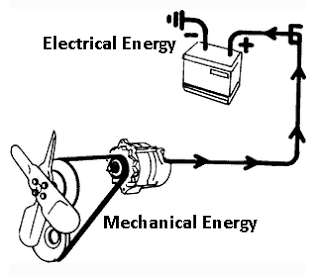
In an electric generator, the energy transformation begins as ----
electrical and becomes chemical
mechanical and becomes electrical
electrical and becomes mechanical
mechanical and becomes chemical
What can you do to make electromagnets stronger?
Increase number of coils of wire.
Increase number of batteries used.
Both A and B.
Neither A nor B.
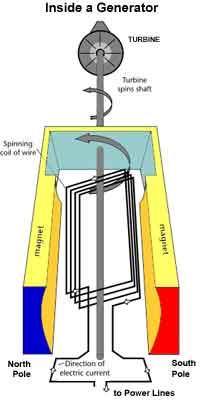
Which of the following is spun due to the interactions between the magnetic fields?
powersupply
field magnets
commutator
armature

In the image of the motor, what is letter B?
Armature
Commutator
Permanent Magnet
Energy Source
Look at the picture what is letter D?
Armature
Commutator
Permanent Magnet
DC Source
Brush
Which of the following allows the current in the electromagnet of a motor or generator to change directions every half turn?
Powersupply
field magnets
commutator
armature

Motor or Generator?
Motor
Generator
Which of these is the best description of a motor?
something spins -> moving magnets -> electric current
electric current -> moving magnets -> something spins
moving magnets -> something spins -> electric current
electric current -> nothing happens
Which of these is the best description of a generator?
something spins -> moving magnets -> electric current
electric current -> moving magnets -> something spins
moving magnets -> something spins -> electric current
electric current -> nothing happens

What will be the current drawn by an electric bulb of 1000 W when it is connected to a source of 220 V?
4.55 A
28800 J or 28.8 KJ
80 W
200 W
The unit of energy is?
Amp
Joule
kiloWatt
Volt
A kilowatt (kW) is how many watts?
10
50
100
1000
A kettle has a power rating of 2 kW, if it's left on for 6 hours, how much energy in kWh is consumed?
10
3
12
24
Calculate the voltage applied when a 60 watt light-bulb uses a current of 5 amps
300 volts
30 volts
12 volts
0.08 volts

Total energy = 200J Useful energy = 20J Workout the efficiency of this lightbulb. efficiency = total energy inuseful enegy ×100
100%
80%
40%
10%
Calculate the percent efficiency of an electric motor that uses 15 000 J of energy to produce 11 500 J of useful movement.
76.6%
82.3%
75.4%
23.3%
A TV uses 200 J of electricity and transforms it into 125 J of sound and light and 75 J of heat. How efficient is it?
62.5%
.625%
37.5%
.375%


The advantages and disadvantages of a particular energy source are shown in the following table. The energy source being described in the table above is most likely
solar
biomass
geothermal
natural gas
What is the energy transformation in hydroelectric dams?
Kinetic to electrical
Kinetic to heat
Electric to kinetic
Sound to electric

geothermal
solar
wind
What type of power plant uses scraps from farming, waste products and wind to generate electricity?
Hydroelectric Power Plant
Geothermal Power Plant
Biomass Power Plant
Nuclear Power Plant

Name the type of power station.
Thermal Power Station
Nuclear Power Station
Hydroelectric Power Station
Biomass Power Station

Name the type of power station.
Thermal Power Station
Nuclear Power Station
Wind Power Station
Solar Power Station


They do not produce emissions
They can interfere with bird migration
They're more expensive in the long run than fossil fuels
They must be placed near moving water

This power plant produces electricity most likely by using-
Which are the problems of using solar power?
It provides unlimited supply of energy.
A large piece of land is needed to place the solar cells.
The solar cells do not work at night.
Why are fossil fuels not a good long term energy source? Choose all that apply.
they produce emissions that are harmful to the environment
they have a limited supply
they are renewable
they are not as reliable as solar power

