Wayground logo

Free Printable Worksheets

Font size

S
M
L
XL
Worksheets

Year 7 forces

Total questions: 89

Worksheet time: 1hrs 17mins

Name
Class
Date
1.

Which one of the following is NOT a force?

a)

Pulling

b)

Lifting

c)

Thinking

d)

Stretching

2.

What type of force occurs when a human, animal or machine pushes, pulls or twists an object?

a)

Tension

b)

Applied force

c)

Magnetism

d)

Gravity

3.

Forces can do all except one of the following things. Which of the following can’t a force do?

a)

Change the shape of an object

b)

Change the speed of an object

c)

Change the direction of a moving object

d)

Change the mass of an object

4.

Which of the following forces would act at a distance (or non-contact) from an object?

a)

Friction

b)

Magnetism

c)

Air pressure

d)

Elastic force

5.

Force is usually measured in:

a)

Tonnes

b)

Joules

c)

Litres

d)

Newtons

6.

What is gravity?

a)

An inward pulling force that occurs when a solid object is stretched

b)

A force of attraction between materials that contain iron, cobalt or nickel

c)

A force of attraction between all objects that have mass

d)

A push, pull or twist on an object

7.

What force gets the ball moving?

a)

Gravity

b)

Applied force

c)

Elastic force

d)

Air resistance

8.

Identify a force acting on the ball as it moves through the air.

a)

Elastic

b)

Tension

c)

Air restistance

d)

Friction

9.

What type of force tends to slow you down as you are swimming?

a)

Gravity

b)

Water resistance

c)

Applied force

d)

Elastic force

10.

Forces are not things we can see. But we can often tell when a force is acting.

            We know a force must be acting if we observe a:

a)

change in the shape of an object.

b)

change in the colour of an object.

c)

change in the temperature of an object.

d)

new substance being formed.

11.

The weight of an object is the:

a)

amount of matter it contains.

b)

space it takes up.

c)

force created by gravity pulling it towards the Earth.

d)

resistance of the object to being moved.

12.

Which type of force is demonstrated by the picture?

a)

Electric

b)

Gravitational

c)

Magnetic

d)

Applied

13.

The diagram on the right shows a stone being weighed on a spring

balance. The weight of the stone is:

a)

130 kg

b)

20 Newtons

c)

103 Newtons

d)

130 Newtons

14.

The force that always acts opposite to the direction of the motion of an object is called

a)

Inertia

b)

Reaction

c)

Lift

d)

Friction

15.

Which one of the following objects could be picked up using a magnetic screwdriver?

a)

A small stone

b)

A piece of nylon fishing line

c)

A plastic shirt button

d)

A small steel screw

16.

In science, Force is DEFINED as...

a)

A push or pull

b)

A hop, skip and jump

c)

A push, pull or twist

d)

What gives a Jedi his power

17.

Named after the famous scientist, I am the unit for measuring Force

a)

Tesla

b)

Newton

c)

Neutron

d)

Sheldon

18.

Which of the following is a contact force?

a)

Magnetic

b)

Friction

c)

Electrical

d)

Gravitational

19.
What is the unit for FORCE? 
a)
N (Newtons)
b)
lbs (pounds)
c)
g (grams)
d)
m/s (meters per second)
20.
What pulls a ball back to earth?
a)
Gas
b)
Gravity
c)
Friction
d)
Molecules
21.

When a skydiver is falling through the air, what is the name of the force acting upwards

a)

Gravity

b)

Air resistance

c)

upward force

d)

the moon

22.

What is the name of the force which pushes upwards in a fluid?

a)

Weight

b)

Upthrust

c)

Density

d)

Floating

23.

Which of these is not a contact force.

a)

Friction

b)

Air resistance

c)

Magnetism

d)

Reaction Force

24.

In which force diagram would the car slow down?

a)

A

b)

B

c)

C

25.

These forces are...

a)

Balanced

b)

Unbalanced

26.

These forces are...

a)

Balanced

b)

Unbalanced

27.
If these boys are pulling with the same amount of force.  What will happen?
a)
The boy in blue will win.
b)
They will not move at all.
c)
The boy in red will win.
d)
Both will fall down.
28.
How will this object move? 
a)
It won't move. 
b)
It will move to the right. 
c)
It will move to the left. 
d)
It will move up. 
29.

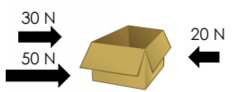
The resultant force of the following diagram is

a)

620N→

b)

To the right→

c)

20N←

d)

balanced↔

30.

Calculate the resultant force.

a)

60N, Left

b)

40N, Right

c)

0N

d)

60N, Right

31.

What you measure or observe in an experiment.

a)

lonely variable

b)

control variable

c)

dependent variable

d)

independent variable

32.

The ONE thing you change in an experiment.

a)

lonely variable

b)

control variable

c)

dependent variable

d)

independent variable

33.

All the things that have to stay the same in an experiment (except for the one thing you change).

a)

lonely variable

b)

control variable

c)

dependent variable

d)

independent variable

34.
What is force?
a)
A push exerted on an object
b)
A push or pull exerted on an object
c)
A pull exerted on an object
d)
Nothing
35.
Forces that have a net force of zero ( the object is still).
a)
Balanced force
b)
Unbalanced force
36.
What is the net force?
a)
5000 N right
b)
4000 N right
c)
40 N left
d)
4000 N left
37.
A force that acts where two objects touch
a)
Contact Force
b)
Non-contact Force
c)
Balanced Force
d)
Unbalanced Force
38.
The sum of all forces acting on an object and direction
a)
Contact Force
b)
Balanced Force
c)
Unbalanced Force
d)
Net Force
39.
Which of the following is an example of a contact force?
a)
A magnet picking up safety pins
b)
The moon orbiting Earth
c)
Wind blowing leaves across the yard
d)
An apple falling from a tree
40.
Which is a factor that affects the strength of gravitational, magnetic, and electrostatic force fields?
a)
Mass
b)
Volume
c)
Distance
d)
Density
41.
Distance and mass are two factors that affect
a)
Gravitational Force Fields
b)
Magnetic Force Fields
c)
Electric Force Fields
d)
Electrostatic Force Fields
42.
Which of the following is an example of a non-contact force
a)
Static force picking up sugar
b)
Wind moving a sailboat
c)
A duck floating on water
d)
Your book lying on a table
43.
Opposite magnetic forces _____ each other.
a)
Attract
b)
Repel
44.
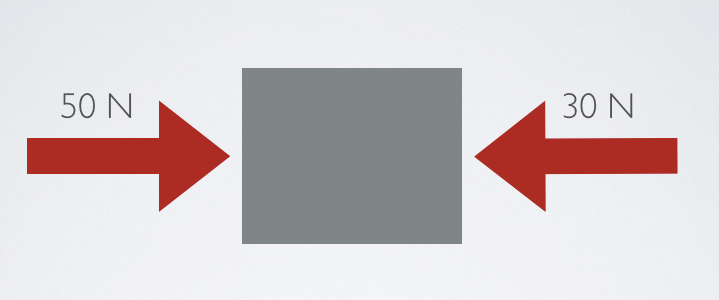
What is the net force in this diagram?
a)
8N right
b)
2 N right
c)
8N left
d)
2N left
45.
What is the net force of an object that is not moving?
a)
0N
b)
100N
c)
Upward force
46.
What is the net force in this picture?
a)
50 Newtons to the right
b)
950 Newtons to the right
c)
950 Newtons to the left
d)
50 Newtons to the left
47.
Why does a book on a table not move?
a)
No forces are acting on the book
b)
Gravity is the only force acting on the book
c)
Forces of the table pushing up and gravity pulling down are balanced
48.
What will cause an object to move?
a)
Applied forces
b)
Balanced forces
c)
Unbalanced forces
49.
What makes a rolling ball stop moving?
a)
gravity
b)
friction
c)
a balanced force
50.
What type of force lights the match?
a)
Gravitational
b)
Friction
c)
Normal
d)
Magnetic
51.
What type of force?
a)
Gravitational
b)
Normal
c)
Magnetic
d)
Electrical
52.
What force holds the planets in motion around the sun?
a)
Magnetic
b)
Electrical
c)
Gravitational
d)
Air Resistance
53.
What type of force?
a)
Magnetic
b)
Gravitational
c)
Applied
d)
Normal
54.
A ____________ is a push or a pull on an object.
a)
chemical
b)
force
c)
magnet
d)
gravity
55.
On which surface would friction be the greatest?
a)
carpet
b)
ice
c)
snow
d)
satin
56.
The force that opposes the motion of two surfaces sliding past each other is called ___________.
a)
acceleration
b)
inertia
c)
friction
d)
unbalanced
57.
A type of friction that occurs when air pushes against a moving object causing it to negatively accelerate
a)
air resistance
b)
surface area
c)
descent velocity 
d)
gravity 
58.
Which of the following shows the direction of the friction force?
a)
A
b)
B
c)
C
d)
D
59.
___________ is the amount of matter in an object.
a)
mass
b)
weight
c)
volume
d)
force
60.
Iron, Nickel and cobalt are all __________________ materials
a)
Shiny
b)
poles
c)
magnetic
d)
cold
61.
Magnets can attract or __________________ other magents
a)
keep
b)
react
c)
repel
d)
destroy
62.
If you put a __________________ pole and a south pole together, they attract. 
a)
North
b)
South
c)
Positive
d)
Magnetic
63.
You can make an electromagnet stronger by:  using __________________ coils of wire
a)
bigger
b)
smaller
c)
more
d)
less
64.
Why does a compass needle point north?
a)
The compass is a bar magnet
b)
Because north is up
c)
Because it's magic
d)
It lines up with the Earth's magnetic field
65.
What will happen when these magnets are brought close together?
a)
They will attract each other.
b)
They will repel each other.
c)
Both magnets will turn to the left
d)
Both magnets will turn to the right
66.
This large crane magnet functions only when the electrical current is ON.  The crane magnet is an example of what type of magnet?
a)
NIB Magnet
b)
Ceramic Magnet
c)
Electromagnet
d)
funnel magnet
67.
Electric charges that are alike _______ each other.
a)
Attract
b)
Repel
68.
Which of the following is an example of friction that is helpful?
a)
Brakes used on a bike
b)
Tires from a car on the road
c)
Tread on the bottom of your shoes
d)
All are examples that are helpful
69.
How does friction affect speed?
a)
more friction decreases speed
b)
more friction increases speed
c)
less friction decreases speed
70.
Oil helps to lubricate the parts of a car engine and reduces friction.
a)
True
b)
False
71.
What is the SI unit used to measure force? 
a)
pounds 
b)
grams 
c)
newtons 
d)
kg/ m2
72.
Gravity attracts all objects towards one another.
a)
False
b)
True
c)
It depends
d)
I don't care
73.
Where would you have to travel to reduce your weight but not lose any mass?
a)
The moon
b)
The Sun
c)
Jupiter
d)
Saturn
74.
This FORCE pulls things.  It PULLS things into orbit around the sun. 
a)
Newton
b)
gravity
c)
weight
d)
path
75.
A person would weigh more on Jupiter than on the Earth because . . .
a)
Jupiter has more mass, and therefore more gravity
b)
Jupiter has less mass, and therefore more gravity
c)
Jupiter has more mass, and therefore less gravity
d)
Jupiter has less mass and therefore less gravity
76.
What is the most famous pizza topping?
a)
Pepperoni
b)
sausage
c)
cheese
d)
bacon
77.
Safety helmets are used when riding bikes to:
a)
Make us look stylish
b)
Increase stopping time which decreases force
c)
Increase stopping time which increases force
d)
decreases stopping time
78.
What is the latest Star Wars movie?
a)
Star Wars: Revenge of the SIth 
b)
Star Wars: Phantom Menace
c)
Star Wars: Force Awakens
d)
Star Wars: First Order Strikes BAck 
79.

The statement; To investigate the relationship between stress and illness, is an example of

a)

an aim

b)

a hypothesis

c)

an independent variable

d)

a dependent variable

80.
. Any magnet has two ends, each one called a:
a)
A.  Magnetic field
b)
B.  Magnetic pole
c)
C.  Magnetized material
d)
D.  None of the above
81.

Zoe is conducting an experiment to determine how many words she can say in three minutes.

Based on the information from the table, what could Zoe's independent variable be?

a)

Minutes of talking

b)

Words spoken

c)

1, 2, 3 minutes

d)

50, 100, 150 words

82.

Research Question: What effect does studying with music have on student test scores?

What could be a possible hypothesis for this research question?

a)

I think students will study better with music then without music

b)

If students study, then they will perform better on tests, because they have more knowledge

c)

If students study while listening to music, then they will achieve higher test scores because music helps concentration

d)

If students get high test scores, then they should listen to music, because music helps concentration

83.
If plants are exposed to sunlight, then they will grow taller.
What part of the scientific method is this an example of?

a)
Procedure
b)
Hypothesis
c)
Question
d)
Results
84.
An experiment is performed on plants to see how different liquids affect plant growth. Each plant in the experiment is given a different liquid; water, apple juice, or milk. Each plant has the same amount of soil, sunlight, and listens to the same music. In this investigation, the independent variable is ...
a)
The type of plant
b)
The amount of sunlight
c)
The type of music
d)
The type of liquid
85.
This is the outcome of the experiment. We get data and results from this.
a)
Independent Variable
b)
Dependent Variable
c)
Control
d)
Constant
86.
An experiment is performed on plants to see how different liquids affect plant growth. Each plant in the experiment is given a different liquid; water, apple juice, or milk. Each plant has the same amount of soil, sunlight, and listens to the same music. In this investigation, what are the controlled variables?
a)
Type of plant, amount of music, and sunlight
b)
Water, apple juice, milk
c)
Plant growth
87.
Mr. S. sets up an experiment to see how the mass of a ball affects the distance it rolls off a ramp.  Identify the dependent variable.
a)
height of the ramp
b)
 distance traveled by the ball
c)
mass of the ball
d)
weight of the ball
88.
A student is planning an experiment to find out how the height from which he drops a ball affects how high the ball bounces. The dependent variable is the _____.
a)
Diameter of the ball
b)
Force acting on the ball
c)
Height that the ball bounces
d)
Height from which the ball is dropped
89.
When experimenting with the growth of a plant, a scientist uses three (of the same type of) plants, two different fertilizers, equal light, and equal water. What type of variable is the fertilizer?
a)
Dependent
b)
Independent
c)
Control
d)
Compound