
 Worksheets
Cellular Transport Test Review
Total questions: 78
Worksheet time: 59mins
Name
Class
Date
1.
When cells take in external fluid, macromolecules, large particles, and other cells, it is a type of active transport called _.
a)
exocytosis
b)
Na+/K+ pump
c)
passive transport
d)
endocytosis
2.

What process is shown in this image?
a)
endocytosis
b)
exocytosis
c)
sodium-potassium pump
d)
diffusion
3.
What will happen to an animal cell if it is placed in a hypotonic solution?
a)
It will shrink.
b)
It will remain the same size.
c)
It will swell, and possibly burst (lyse).
d)
It will swell, but will not burst open.
4.
What is the term for the internal water pressure in a plant cell?
a)
turgor pressure
b)
barometric pressure
5.
Which of the following would MOST likely move a substance in active transport?
a)
carrier protein
b)
phospholipid
c)
lipoprotein
d)
marker protein
6.
The cell membrane is primarily made of
a)
phospholipids
b)
proteins
c)
carbohydrates
d)
nucleic acids
7.
All of the following require ATP energy EXCEPT
a)
facilitated diffusion
b)
pinocytosis
c)
exocytosis
d)
Na+/K+ pump
8.

Select the response that correctly completes the sentence.
Passive transport...
Passive transport...
a)
requires energy
b)
moves things up the concentration gradient
c)
is passive aggressive
d)
requires no energy and moves things down the concentration gradient
9.

Select the response that correctly completes the sentence.
Active transport..
Active transport..
a)
requires energy and moves things against the concentration gradient
b)
requires energy and moves things down the concentration gradient
c)
requires no energy
d)
is very active
10.

True or False: Facilitated diffusion moves things from high concentration to low concentration with the help of proteins.
a)
True
b)
False
11.
Osmosis is the movement of _____ across a membrane.
a)
food
b)
energy
c)
oxygen
d)
water
12.

This picture represents what type of cell transport?
a)
endocytosis
b)
exocytosis
c)
osmosis
d)
passive transport
13.
In a _ solution, the concentrations of dissolved solutes are the same as those inside the cell. There is no overall movement or change in cell size.
a)
hypertonic
b)
hypotonic
c)
isotonic
14.
A solution with a higher concentration of solutes than that of the cell.
a)
hypotonic
b)
isotonic
c)
hypertonic
d)
equilibrium
15.
Continuous and random movement of particles with no further change in concentration.
a)
dynamic equilibrium
b)
active transport
c)
passive transport
d)
diffusion
16.
Movement of particles across the plasma membrane against a concentration gradient, using energy
a)
active transport
b)
passive transport
c)
facilitated diffusion
d)
osmosis
17.
A solution that has a lower concentration of solutes than that of the cell.
a)
hypotonic
b)
hypertonic
c)
equilibrium
d)
isotonic
18.

This image shows blood cells that have been placed in a(n) _____ solution.
a)
isotonic
b)
hypertonic
c)
hypotonic
19.

This image shows animal blood cells that have been placed in a(n) _____ solution.
a)
hypotonic
b)
hypertonic
c)
isotonic
20.

This image shows red blood cells that have been placed in a(n) ______ solution.
a)
hypertonic
b)
hypotonic
c)
isotonic
21.
The movement of a substance across the membrane without any energy from the cell is
a)
passive transport
b)
endocytosis
c)
exocytosis
d)
active transport
22.
The difference in the concentration of molecules across a space is called the _.
a)
concentration
b)
concentration gradient
c)
diffusion
d)
equilibrium
23.
What will happen to a plant cell if it is placed in a hypertonic solution?
a)
It will burst open (cytolysis).
b)
It will undergo plasmolysis (cell will shrivel).
c)
It will become turgid.
d)
It will not change.
24.
Which organelle helps to offset (reduce) the effects of osmosis in protists (like the paramecium)?
a)
vacuole
b)
cilia
c)
contractile vacuole
d)
flagella
25.
This cellular structure helps organisms maintain homeostasis by controlling what substances may enter or leave cells.
a)
vacuole
b)
nucleus
c)
cell membrane
d)
cell wall
26.

What type of transport is this?
a)
facilitated diffusion
b)
active transport
c)
diffusion
d)
osmosis
27.
What are two types of passive transport?
a)
endo and exocytosis
b)
in a minute and later
c)
hydrophobic and hydrophillic
d)
osmosis and diffusion
28.

Special proteins help move particles, but NO energy is needed. This is..
a)
facilitated diffusion
b)
exocytosis
c)
active transport
d)
equilibrium
29.
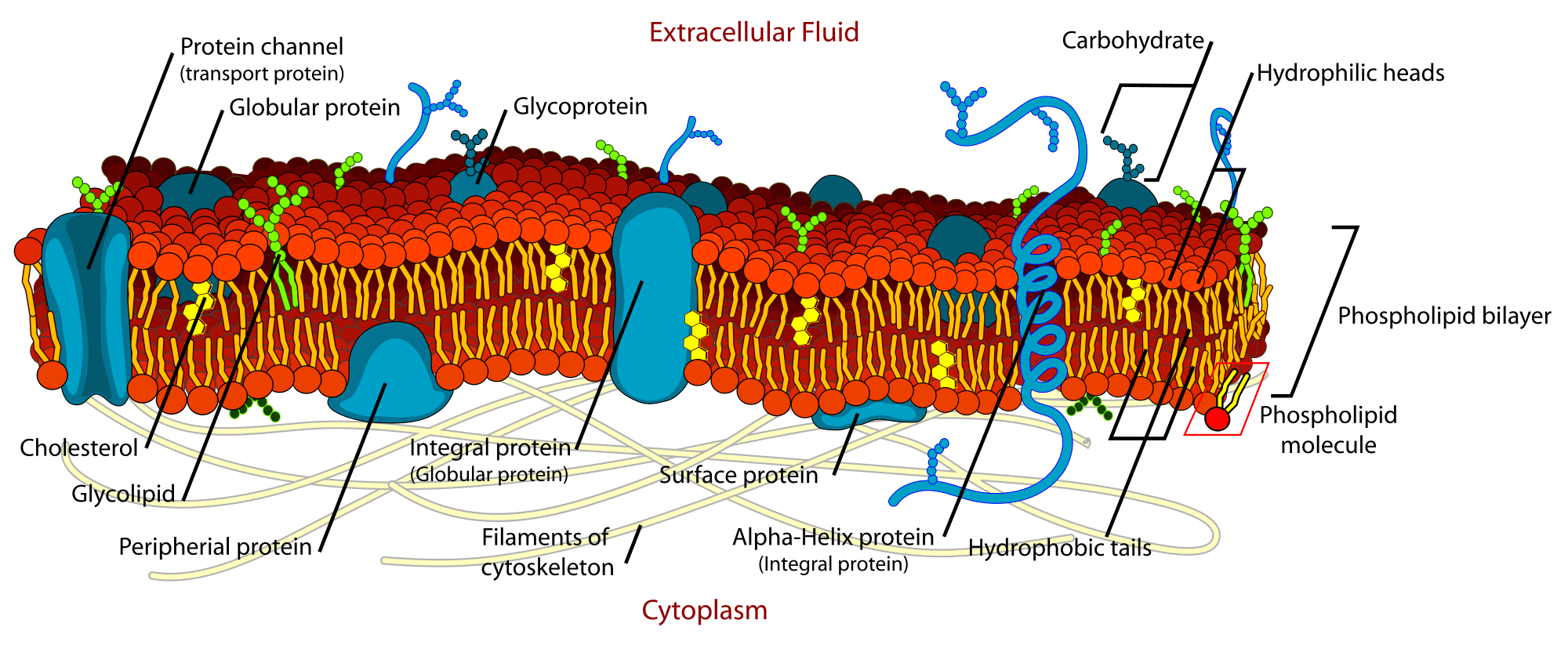
What is this image?
a)
cell membrane
b)
mitochondria
c)
golgi apparatus
d)
endoplasmic reticulum
30.

When something is 'water fearing' it is....
a)
Hydrophobic
b)
Hydrophilic
c)
Hydroelectric
d)
Hydrochloric
31.

In which direction will these molecules diffuse?
a)
from right to left
b)
from left to right
c)
they will not move at all
d)
they will move in both directions equally
32.
The cell membrane is selectively permeable, which means...
a)
All materials can enter and leave the cell
b)
Certain things can enter while others cannot
c)
The cell manually sorts through all materials
d)
Only certain cells can interact with the cell.
33.

Which part of this phospholipid is hydrophobic?
a)
fatty lipid tails
b)
head
c)
all of it is hydrophobic
d)
none of it is hydrophobic
34.
This cellular structure helps organisms maintain homeostasis by controlling what substances may enter or leave cells.
a)
vacuole
b)
nucleus
c)
cell membrane
d)
cell wall
35.
A phospholipid has 2 parts. What are they called?
a)
Hydrophilic Head, Hydrophobic Tail
b)
Hydrophobic Head, Hydrophilic Tail
36.
Describes the arrangement of the cell membrane as bendable and made of many parts.
a)
The Fluid Mosaic Model
b)
The Major Mobility Model
c)
The Crazy Cell Model
d)
The Maze Model
37.
___________ allow cells to recognize each other and act like ID tags.
a)
Carbohydrates
b)
Proteins
c)
Phospholipids
d)
Cholesterol
38.
Something is ___________ ____________
when some molecules can cross the membrane while others cannot.
when some molecules can cross the membrane while others cannot.
a)
Selectively (or Semi) Permeable
b)
Totally Transparent
c)
Liquid Licorice
d)
Heavily Patrolled
39.
___________ strengthens and stabilizes the cell membrane.
a)
Carbohydrates
b)
Proteins
c)
Phospholipids
d)
Cholesterol
40.
When cells take in external fluid, macromolecules, large particles, and other cells, it is a type of active transport called _.
a)
exocytosis
b)
Na+/K+ pump
c)
passive transport
d)
endocytosis
41.
What process is shown in this image?
a)
endocytosis
b)
exocytosis
c)
sodium-potassium pump
d)
diffusion
42.
What will happen to an animal cell if it is placed in a hypotonic solution?
a)
It will shrink.
b)
It will remain the same size.
c)
It will swell, and possibly burst (lyse).
d)
It will swell, but will not burst open.
43.
What is the term for the internal water pressure in a plant cell?
a)
turgor pressure
b)
barometric pressure
44.
Which of the following would MOST likely move a substance in active transport?
a)
carrier protein
b)
phospholipid
c)
lipoprotein
d)
marker protein
45.
The cell membrane is primarily made of
a)
phospholipids
b)
proteins
c)
carbohydrates
d)
nucleic acids
46.
All of the following require ATP energy EXCEPT
a)
facilitated diffusion
b)
pinocytosis
c)
exocytosis
d)
Na+/K+ pump
47.
Select the response that correctly completes the sentence.
Passive transport...
Passive transport...
a)
requires energy
b)
moves things up the concentration gradient
c)
is passive aggressive
d)
requires no energy and moves things down the concentration gradient
48.
Select the response that correctly completes the sentence.
Active transport..
Active transport..
a)
requires energy and moves things against the concentration gradient
b)
requires energy and moves things down the concentration gradient
c)
requires no energy
d)
is very active
49.
True or False: Facilitated diffusion moves things from high concentration to low concentration with the help of proteins.
a)
True
b)
False
50.
Osmosis is the movement of _____ across a membrane.
a)
food
b)
energy
c)
oxygen
d)
water
51.
This picture represents what type of cell transport?
a)
endocytosis
b)
exocytosis
c)
osmosis
d)
passive transport
52.
In a _ solution, the concentrations of dissolved solutes are the same as those inside the cell. There is no overall movement or change in cell size.
a)
hypertonic
b)
hypotonic
c)
isotonic
53.
A solution with a higher concentration of solutes than that of the cell.
a)
hypotonic
b)
isotonic
c)
hypertonic
d)
equilibrium
54.
Continuous and random movement of particles with no further change in concentration.
a)
dynamic equilibrium
b)
active transport
c)
passive transport
d)
diffusion
55.
Movement of particles across the plasma membrane against a concentration gradient, using energy
a)
active transport
b)
passive transport
c)
facilitated diffusion
d)
osmosis
56.
A solution that has a lower concentration of solutes than that of the cell.
a)
hypotonic
b)
hypertonic
c)
equilibrium
d)
isotonic
57.
This image shows blood cells that have been placed in a(n) _____ solution.
a)
isotonic
b)
hypertonic
c)
hypotonic
58.
This image shows animal blood cells that have been placed in a(n) _____ solution.
a)
hypotonic
b)
hypertonic
c)
isotonic
59.
This image shows red blood cells that have been placed in a(n) ______ solution.
a)
hypertonic
b)
hypotonic
c)
isotonic
60.
The movement of a substance across the membrane without any energy from the cell is
a)
passive transport
b)
endocytosis
c)
exocytosis
d)
active transport
61.
The difference in the concentration of molecules across a space is called the _.
a)
concentration
b)
concentration gradient
c)
diffusion
d)
equilibrium
62.
What will happen to a plant cell if it is placed in a hypertonic solution?
a)
It will burst open (cytolysis).
b)
It will undergo plasmolysis (cell will shrivel).
c)
It will become turgid.
d)
It will not change.
63.
Which organelle helps to offset (reduce) the effects of osmosis in protists (like the paramecium)?
a)
vacuole
b)
cilia
c)
contractile vacuole
d)
flagella
64.
This cellular structure helps organisms maintain homeostasis by controlling what substances may enter or leave cells.
a)
vacuole
b)
nucleus
c)
cell membrane
d)
cell wall
65.
What type of transport is this?
a)
facilitated diffusion
b)
active transport
c)
diffusion
d)
osmosis
66.
What are two types of passive transport?
a)
endo and exocytosis
b)
in a minute and later
c)
hydrophobic and hydrophillic
d)
osmosis and diffusion
67.
Special proteins help move particles, but NO energy is needed. This is..
a)
facilitated diffusion
b)
exocytosis
c)
active transport
d)
equilibrium
68.
What is this image?
a)
cell membrane
b)
mitochondria
c)
golgi apparatus
d)
endoplasmic reticulum
69.
When something is 'water fearing' it is....
a)
Hydrophobic
b)
Hydrophilic
c)
Hydroelectric
d)
Hydrochloric
70.
In which direction will these molecules diffuse?
a)
from right to left
b)
from left to right
c)
they will not move at all
d)
they will move in both directions equally
71.
The cell membrane is selectively permeable, which means...
a)
All materials can enter and leave the cell
b)
Certain things can enter while others cannot
c)
The cell manually sorts through all materials
d)
Only certain cells can interact with the cell.
72.
Which part of this phospholipid is hydrophobic?
a)
fatty lipid tails
b)
head
c)
all of it is hydrophobic
d)
none of it is hydrophobic
73.
This cellular structure helps organisms maintain homeostasis by controlling what substances may enter or leave cells.
a)
vacuole
b)
nucleus
c)
cell membrane
d)
cell wall
74.
A phospholipid has 2 parts. What are they called?
a)
Hydrophilic Head, Hydrophobic Tail
b)
Hydrophobic Head, Hydrophilic Tail
75.
Describes the arrangement of the cell membrane as bendable and made of many parts.
a)
The Fluid Mosaic Model
b)
The Major Mobility Model
c)
The Crazy Cell Model
d)
The Maze Model
76.
___________ allow cells to recognize each other and act like ID tags.
a)
Carbohydrates
b)
Proteins
c)
Phospholipids
d)
Cholesterol
77.
Something is ___________ ____________
when some molecules can cross the membrane while others cannot.
when some molecules can cross the membrane while others cannot.
a)
Selectively (or Semi) Permeable
b)
Totally Transparent
c)
Liquid Licorice
d)
Heavily Patrolled
78.
___________ strengthens and stabilizes the cell membrane.
a)
Carbohydrates
b)
Proteins
c)
Phospholipids
d)
Cholesterol
100 %

