
 Worksheets
CA #5 Review
Total questions: 63
Worksheet time: 2hrs 5mins

One of the key biological characteristics of SARS-CoV-2, as well as several other viruses, is the presence of spike proteins. These protein spikes are important because they
send signals to other viruses.
maintain their structure.
allow the virus to attach and penetrate the host cell.
produce more virus particles.
When a virus attaches to a host, what does it inject into the host
protein coat
Capsid
DNA/ RNA
Envelope
Which of the following might be used to prevent or treat a virus?
Antibiotic
Antifungal
Vaccine
Antiviral
Viracid

When a virus takes over a cell, it can cause the cell to create many more copies of the virus until the cell bursts open and releases them. What part of the virus's lifecycle is this?
Lytic
Lysogenic
Mouse over and click on the part of the flower where pollen needs to land in order for fertilization to take place.

A bacteriophage is a virus that is specific to bacteria. One example of a bacteriophage is the λ (lambda) virus. This virus infects the E. coli bacterium, although the bacteria may not show signs of infections for long periods. The λ virus is characteristic of a virus with which type of replication?
Lysogenic
Lytic
Chronic
Acute

What is the first step to both viral reproduction cycles?
The virus attaches to a host
The virus injects genetic material
The host gets sick
The cell is destroyed
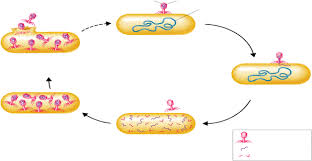


One characteristic that both prokaryotes and eukaryotes share with viruses.
Reproductive cycles
Plasma membrane
DNA
Ribosomes
Choose the description that fits the lysogenic cycle.
the virus remains dormant (inactive) for a long time
symptoms occur quickly (within 2 days)
the virus does not need a host cell
the virus only infects bacteria

Group of tissues with similar functions.
Organelles
Cells
Tissues
Organs

Group of organs with similar functions.
Organism
Cell
Organ
System

Structures in a cell that have specialized jobs.
Tissue
Molecule
Atom
Organelles

Groups of cells with similar functions.
Organs
Molecules
Tissues
Organelles

The digestive and respiratory systems pair together to ...
bring carbon dioxide and wastes to cells for diffusion.
bring oxygen and wastes to cells for diffusion.
bring oxygen and nutrients to cells for cellular respiration.
bring carbon dioxide and nutrients to cells for cellular respiration.
The digestive and respiratory rely on the ___ systems to transport needed materials to the cells.
circlatory and excretory
circulatory and muscular
nervous and digestive
nervous and skeletal
Why are the lungs, the major organ of the respiratory system, also considered an excretory organ?
They get rid of carbon dioxide, a cellular waste
They get rid of oxygen, a cellular waste
They get rid of urea, a cellular waste
They get rid of salt, a cellular waste
What systems do neurons depend on to be able to conduct cellular respiration (a process that has the key ingredients of oxygen and glucose)?
excretory, digestive, circulatory
musculoskeletal, nervous, respiratory
nervous, excretory, digestive
respiratory, digestive, circulatory
One way the skeletal and circulatory systems interact with each other is because bone marrow produces (a) ( lower case)
Reorder the following steps in a human's immune response.
Barriers such as skin and cilia.
Swelling at the site of infection.
Antibody creation by white blood cells. in the immune system.
Destruction of foreign invader (pathogen).

Which two systems work together to protect the body from pathogens?
integumentary & immune
circulatory & endocrine
endocrine & integumentary
excretory and immune

The abundance of specific types of white blood cells indicate if an infection is caused by a virus or a bacteria. This is important for your doctor to know because
both respond to antibiotics.
neither respond to antibiotics.
viral diseases respond to antibiotics; bacterial diseases do not.
bacterial diseases respond to antibiotics; viral diseases do not.
What is the function of the endocrine system?
to filter and eliminate the waste from the blood
to secrete hormones into the bloodstream to regulate body activities
to provide structure and support for the body
to defend the body against pathogens
Which of the following are in the correct order?
organ system, cell, organ, tissue, organism
cell, organ, tissue, organ system, organism
cell, tissue, organelle, organ system, organism
cell, tissue, organ, organ system, organism
This feedback system amplifies a change until a desired outcome is reached. An example of this is childbirth.
Positive feedback system
Negative feedback system
Neutral feedback system
Self-monitoring feedback system

The feedback system that returns the body back to the normal set point.
positive
negative
neutral
returnable
What type of digestion takes place in the stomach?
mechanical
chemical
both mechanical and chemical
Match the organ system to its' function.
circulatory
circulates blood throughout the body
endocrine
produces hormones
immune
fights infection
integumentary
first line of defense against pathogens
respiratory
gas exchange
Which of the following is NOT a function of the Circulatory system?
to distribute heat throughout the body
carries disease fighting white blood cells
transports oxygen and nutrients
produces new RED blood cells
These structures are surrounded by guard cells that allow carbon dioxide to enter and oxygen & water to leave.
Stomata
Roots
Vacuole
Chloroplast
What direction does water and minerals in solution travel in the xylem?
From roots to leaves
From leaves to roots
Materials can move in either direction
Why are root hairs important?
They decrease the surface area of the roots to keep in water
They increase the surface area of the roots to decrease absorption
They increase the surface area of the roots to increase absorption
What process does transpiration help the plant do?
transport glucose and amino acids from roots to leaves
transport water from leaves to roots
transport water from roots to leaves
What are modified leaves that attract pollinators? (Typically very colorful)
Petals
Sepals
Stem
Pistil
What is the vascular tissue that carries sugar and organic substances from the leaves down to the rest of the plant?
Xylem
Phloem
Cambium
Roots
What part of the flower is sticky to grab pollen?
Filament
Style
Stigma
Anther
Plants responding to light is called ?
phototropism
thigmotropism
gravitropism
hydrotropism
Which statement is true?
A. Leaves are the sites where oxygen is released and carbon dioxide is taken in.
B. Roots are the sites where oxygen is taken in and oxygen is released.
C. Leaves are the sites where oxygen is taken in and carbon dioxide is released.
D. Roots are the sites where oxygen is released and carbon dioxide is taken in.
A.
B.
C.
D.
A response that results in plant growth toward or away from a stimulus is a?
Stimulus
Tropism
Photoperiodism
Plant Hormone
Substances that act as chemical messengers within plants are called?
Tropisms
Stimuli
Plant Hormones
Nerves

In order to make seeds, the pollen needs to move form the stamen to the _________
petals
stamen
pistil

Match the parts of a flower.
stigma
part of the pistol where pollen lands
anther
part of the stamen where pollen is produced
ovary
contains ovules
petals
attract pollinators

The process of getting the pollen to the egg cell is called...
pollination
pollen
stamenation

The diffusion of water vapor out of a leaf
transportation
transformation
transpiration
translocation

The main function of stomata is to
capture sunlight
protect leaves from insects
allow gases to move rapidly in/out of leaves
release sugars into the atmosphere
What happens to the guard cells when water is not available within a plant?
The guard cells close.
The guard cells open.
The guard cells become double.
The guard cells increase.
.What is the relationship between stomata and photosynthesis in plants?
The stomata is dependent on photosynthesis.
The stomata are reactants of photosynthesis.
Photosynthesis is dependent on stomata.
Photosynthesis is independent of stomata.
Guard cells are specialized cells in the surface of the leaf of a green plant.
The main function of these cells is to
change the size of the stomata to regulate water loss
close the stomata to keep dust and dirt out of the leaf
close the stomata to keep dust and dirt out of the leaf
close the stomata to keep dust and dirt out of the leaf
Match the following tropisms to their stimuli.
Phototrophism
Light
Thigomotrophism
Touch
Gravitropism
gravity
Hydrotrophism
Water
cell
tissue
organ
organ system
organism
Label the virus.
Label the parts of the flower.
In 1898 Friedrich Loeffler and Paul Frosch found evidence that the cause of the highly contagious hoof-and-mouth disease in livestock was a microscopic infectious particle. It was discovered that this particle requires a host cell to reproduce.
This information indicates that this disease is caused by a (a) ( lower case)
Cacti grow slowly compared to most other plants. The fact that cacti keep their stomata closed for much of the day can help explain this growth characteristic. Which of these best explains the advantage of keeping stomata closed during the day?
It limits water loss through transpiration.
It conserves oxygen produced in photosynthesis.
It recycles carbon dioxide within plant systems
It protects the plant from predators

A chart of some plant systems and functions is shown.
Which system interactions are dependent on the plant’s ability to respond to the direction of light?
Option 1
Option 2
Option 3
Option 4

