wayground logo

Free Printable Worksheets

Font size

S
M
L
XL
Worksheets

YR 11 HB - Cells, Tissues, Metabolism & Enzymes Review Quiz

Total questions: 105

Worksheet time: 1hrs 26mins

Name
Class
Date
1.

Thin, flexible barrier that surrounds all cells; regulates what enters and leaves the cell

a)

Cell Wall

b)

Cell Membrane

c)

Nucleus

d)

Golgi apparatus

2.

Structure that contains the cell's genetic material in the form of DNA

a)

Vacuole

b)

Nucleolus

c)

Nucleus

d)

Ribosome

3.

Specialized structure that performs important cellular functions within a cell

a)

Vacuole

b)

Ribosome

c)

Organelle

d)

Nucleus

4.

Cell organelle that breaks down lipids, carbohydrates, and proteins into small molecules that can be used by the rest of the cell

a)

Vacuole

b)

Chloroplast

c)

Lysosome

d)

Golgi apparatus

5.

Structure in an animal cell that helps to organize cell division

a)

Nucleus

b)

Nucleolus

c)

Endoplasmic reticulum

d)

Centriole

6.

Cell organelle consisting of RNA and protein found throughout the cytoplasm in a cell; the site of protein synthesis

a)

Endoplasmic reticulum

b)

Ribosome

c)

Nucleus

d)

Nucleolus

7.

Internal membrane system found in eukaryotic cells; place where lipid components of the cell membrane are assembled

a)

Golgi apparatus

b)

Endoplasmic reticulum

c)

Cytoskeleton

d)

Organelle

8.

Organelle in cells that modifies, sorts, and packages proteins and other materials from the endoplasmic reticulum for storage in the cell or release outside the cell

a)

Golgi apparatus

b)

Ribosome

c)

Vacuole

d)

Lysosome

9.

Cell organelle that converts the chemical energy stored in food into compounds that are more convenient for the cell to use

a)

Chloroplast

b)

Mitochondria

c)

Golgi apparatus

d)

Endoplasmic reticulum

10.

Flexible double-layered sheet that makes up the cell membrane and forms a barrier between the cell and its surroundings

a)

Lipid bilayer

b)

Endoplasmic reticulum

c)

Cell Wall

d)

Centriole

11.

Property of biological membranes that allows some substances to pass across it while others cannot; also called semipermeable membrane

a)

Cell Membrane

b)

Cell Wall

c)

Selectively Permeable

d)

Cell Theory

12.

What structure does this organism use for locomotion?

a)

nucleus

b)

chloroplast

c)

vacuole

d)

flagella

13.
This organelle is a gel-like fluid that takes up most of the space inside the cell. 
a)
Cytoplasm
b)
Cell Membrane
c)
Vacuole
d)
Golgi Body
14.
What is the difference between rough and smooth Endoplasmic Reticulum?
a)
There is no difference.
b)
Plants have rough ER, animals have smooth ER.
c)
What type of injuries the Doctors treat.
d)
Rough has ribosomes, smooth does not.
15.
What is the structure labeled #1?
a)
Chloroplast
b)
Nucleus
c)
Cell Membrane
d)
Mitochondria
16.
What is the structure labeled #5?
a)
Vacuole
b)
Chloroplast
c)
Mitochondria
d)
Lysosome
17.
What is the structure labeled #3?
a)
Golgi body
b)
Endoplasmic reticulum
c)
Vacuole
d)
Mitochondria
18.
What is the structure labeled #6?
a)
Smooth ER
b)
Golgi Body
c)
Nucleus
d)
Rough ER
19.
What is the structure labeled #4?
a)
Vacuole
b)
Cell wall
c)
Cytoplasm
d)
Cell membrane
20.
What is the structure labeled #2?
a)
Lysosome
b)
Vesicle
c)
Ribosome
d)
Mitochondria
21.
The function of the plasma membrane is....
a)
to regulate what enters and leaves the cell.
b)
fight bacteria and viruses that enter the cell.
c)
provide rigid support and protection to the cell.
d)
make sure each cell can move
22.
What do the brown structures represent?
a)
Phospholipids
b)
Glycoproteins
c)
Channel Proteins 
d)
Cyctoskeleton Filaments
23.
A ______________ is composed of a phosphate and glycerol head and 2 fatty acid chain tails. 
a)
phospholipid 
b)
Carbohydrate
c)
Cholesterol 
d)
Protein 
24.

Which type of biological macromolecule is the main component of the plasma membrane?

a)

carbohydrate

b)

lipid

c)

protein

d)

nucleic acid

25.

What is the "big idea" of the fluid mosaic model of plasma membranes?

a)

the plasma membrane creates a specialized FLUID that looks like a MOSAIC.

b)

the plasma membrane is a MOSAIC.

c)

the fluid mosaic model is NOT related to the plasma membrane.

d)

a plasma membrane is a MOSAIC of components that move FREELY and FLUIDLY.

26.
What forms the channels and pumps in the phospholipid bilayer?
a)
carbohydrates
b)
proteins
c)
hydrophilic heads 
d)
lipids
27.
True or False: Large molecules, such as glucose, can easily pass through the cell membrane without any help...
a)
True: They pass right through.
b)
False: They need a protein channel.
28.
Osmosis is the diffusion of __________.
a)
water
b)
glucose
c)
air
d)
passive transport
29.

Describe the movement of molecules going through the proteins in the illustration.

a)

Molecules are moving from a higher concentration to a lower concentration.

b)

Molecules are moving from a lower concentration to a higher concentration.

c)

Molecules are moving from a higher concentration to a lower concentration and then from a lower to higher concentration.

d)

Molecules are moving from a lower concentration to a higher concentration and then from a higher concentration to a lower concentration.

30.
The cellular process in which materials are moved across a membrane from an area of low concentration to an area of high concentration is called
a)
Osmosis
b)
Simple Diffusion
c)
Active Transport
d)
Passive Transport 
31.
The picture is an example of...
a)
active transport
b)
passive transport
c)
diffusion
d)
osmosis
32.
This picture represents which type of cellular transport?
a)
passive transport
b)
endocytosis
c)
exocytosis
d)
osmosis
33.
This picture represents what type of cell transport?
a)
endocytosis
b)
exocytosis
c)
osmosis
d)
passive transport
34.

Which type of transport requires energy?

a)

Endocytosis

b)

Exocytosis

c)

Active Transport

d)

Diffusion

35.

Which of the following are a type of passive transport (does not require energy input)?

a)

endocytosis

b)

facilitated diffusion

c)

active transport

d)

osmosis

e)

diffusion

36.
A type of active transport that brings particles into a cell when the cell membrane encloses a particle to make a vesicle
a)
Diffusion
b)
Passive Transport
c)
Active Transport
d)
Endocytosis
37.

Passive Transport uses ____ energy

a)

no

b)

a lot of

c)

a little bit of

d)

some

38.

The type of transport that requires the use of transport proteins

a)

Passive Transport

b)

Facilitated Diffusion

c)

Active Transport

d)

Vesicular Transport

39.

The passage of a substance from an area of high concentration to an area of low concentration

a)

Active Transport

b)

Diffusion

c)

Vesicular Transport

d)

Exocytosis

40.
Which diagram best shows the end result of diffusion?
a)
F
b)
G
c)
H
d)
J
41.

What does selectively-permeable mean?

a)

Allow certain things to enter and leave the cell

b)

Nothing gets through

c)

The cell lets only large substances through

42.
Which way will the water molecules move during osmosis?
a)
Out of the cell, so the cell shrinks.
b)
Out of the cell, so the cell swells.
c)
Into the cell, so the cell shrinks.
d)
Into the cell, so the cell swells.
43.

Why would the cell need energy to move molecules across the membrane?

a)

the molecule is going against the concentration gradient

b)

the molecule is to large to pass through the membrane

c)

the lipid membrane requires energy anytime something is moving across the membrane

44.
Which form of transport is being shown in the diagram.
a)
diffusion
b)
osmosis
c)
facilitated diffusion
d)
active transport
45.
In this situation, where the solute is illustrated by red dots, predict if will WATER move into or out of the cell, and how that will affect the cell.
a)
Water will move into the cell and the cell will expand.
b)
Water will move into the cell and the cell will shrink.
c)
Water will move out of the cell and the cell will expand.
d)
Water will move out of the cell and the cell will shrink.
46.

Which of the following pictures shows a higher concentration?

a)
b)
47.
What is the primary role of enzymes inside of living cells? 
a)
organizing the translation of proteins
b)
allowing cells to be motile
c)
absorbing ultraviolet rays
d)
speeding up chemical reactions 
48.
Based on their role in the cell, enzymes can also be classified as –
a)
inhibitors
b)
catalysts
c)
 hormones
d)
vitamins
49.
Enzymes are able to speed up chemical reactions because they - 
a)
increase the temperature inside the cell
b)
reduce the friction between the reactants
c)
make the raw materials more chemically reactive
d)
lower the activation energy of the reaction
50.
What are all of the chemical reactions that occur within an
organism referred to?
a)
Enzymes
b)
Macromolecules
c)
Metabolism
d)
Activation Energy
51.
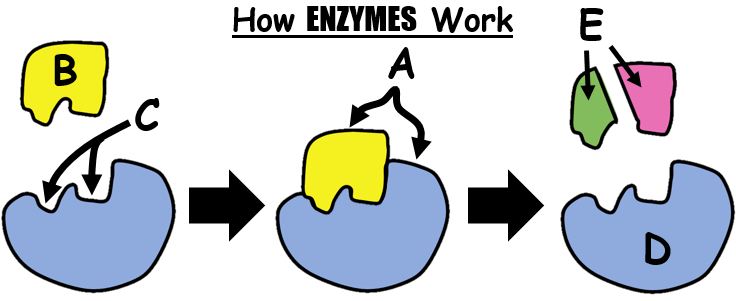
What is being represented by the letter A in the image?
a)
Substrate
b)
Enzyme
c)
Product
d)
Complex
52.
What is being represented by the letter B in the image?
a)
Substrate
b)
Enzyme
c)
Substrate
d)
Product
53.
Which substrate would this enzyme catalyze?
a)
Δ
b)
σ
c)
d)
μ
54.
In the diagram, what is letter A? 
a)
product
b)
substrate
c)
enzyme-substrate complex
d)
active site
55.
Enzymes are...
a)
nucleic acids
b)
proteins
c)
lipids
d)
carbohydrates
56.
Where do substrates bind on an enzyme?
a)
voltage-gated channels
b)
surface receptor
c)
calcium channels
d)
active site
57.
The "lock and key hypothesis" attempts to explain the mechanism of?
a)
Vacuole formation
b)
Pinocytosis
c)
Sharing of electrons
d)
Enzyme specificity 
58.
What makes an enzyme substrate specific?
a)
Size
b)
Shape
c)
Name
d)
Location it is found in
59.
Enzymes need certain environmental conditions in order to function properly.  What happens when enzymes are heated to a high temperature?
a)
they die
b)
they denature
c)
they change their amino acid sequence
d)
they work better
60.

Can a change in pH alter the active site of an enzyme?

a)

yes

b)

no

61.
Which of these is NOT true?
a)
Enzymes can denature (change shape) when the temperature gets too high.
b)
Enzymes can only be used once in a chemical reaction. 
c)
Extreme pH can denature enzymes.
d)
Enzymes speed up chemical reactions. 
62.
What happens when enzymes are heated to a high temperature?
a)
The enzymes die.
b)
The shapes of the enzyme are altered or denatured
c)
The enzymes' amino acid sequence changes.
d)
The enzymes remain the same
63.

Enzymes and substrates that match are described as

a)

matching

b)

equal

c)

complementary

d)

reciprocal

64.

Select the correct options.

The x-axis of this graph could be

a)

pH

b)

Enzymes

c)

Temp

d)

CO2

65.

Which part of the graph displays the denaturing of an enzyme?

a)

A

b)

B

c)

C

d)

D

66.

Organisms get their energy to do work from ___________ energy.

a)

solar energy

b)

chemical energy

c)

thermal energy

d)

nuclear energy

67.

A --> B + C

This equation represents which type of metabolic reaction?

a)

Anabolic

b)

Catabolic

68.

A + B --> C

This equation represents which type of metabolic reaction?

a)

Anabolic

b)

Catabolic

69.
Main cellular energy molecule
a)
ATP
b)
ADP
c)
cAMP
70.
ATP is called a cell’s “energy currency” because
a)
ATP catalyzes all metabolic reactions.
b)
most of the energy that drives metabolism is supplied by ATP.
c)
glucose is made of ATP.
d)
ATP allows one organelle to be exchanged for another between cells.
71.

Two features of anabolic reaction sequences are...

a)

Breakdown of molecules & requires energy

b)

Breakdown of molecules & Releases energy

c)

builds up molecules & releases energy

d)

builds up molecules & requires energy

72.

Two features of catabolic reaction sequences are...

a)

Breakdown of molecules & requires energy

b)

Breakdown of molecules & Releases energy

c)

builds up molecules & releases energy

d)

builds up molecules & requires energy

73.

Type of reaction involved in ATP synthesis.

a)

anabolic

b)

catabolic

74.
This process releases chemical energy from sugars and other carbon-based molecules to make ATP when oxygen is present.
a)
photosynthesis
b)
light-independent reaction
c)
cellular respiration
d)
light-dependent reaction
75.

Glucose is broken down into pyruvic acid during which process

a)
Krebs cycle
b)
Calvin cycle
c)
Glycolysis
d)
Photosynthesis
76.
Aerobic respiration is different from anaerobic respiration in that aerobic respiration needs...
a)
chlorophyll
b)
carbon dioxide
c)
glucose
d)
oxygen
77.
What is the correct equation for cellular respiration?
a)
6O2 + C6H12O6 -> 6CO2 + 6H2O + Energy
b)
6O2 + C6H12O6 + Energy -> 6CO2 + 6H2O
c)
6CO2 + 6H2O -> 6O2 + C6H12O6 + Energy
d)
6CO2 + 6H2O + Energy -> 6O2 + C6H12O6
78.
The energy in ATP is stored 
a)
in the bond between the second and third phosphate
b)
in the bond between the first and second phosphate
c)
in the bond between the adenosine and the first phosphate
d)
I like turtles
79.

Which of the following is a product of cellular respiration?

a)

Radiant Energy

b)

Oxygen

c)

Glucose

d)

Water

80.

What are the reactants (taken into) of cellular respiration? (Mark all of them!)

a)

oxygen

b)

glucose

c)

carbon dioxide

d)

water

e)

energy

81.

Each glucose produces how many pyruvic acid molecules?

a)

5

b)

2

c)

3

d)

4

82.
Where does glycolysis take place?
a)
Cytoplasm
b)
Stroma
c)
Thylakoid
d)
Mitochondria
83.
What is cellular respiration?
a)
the breakdown of glucose  to release ATP
b)
the breakdown of glucose to release NADH
c)
the breakdown of glucose to release FADH
d)
the breakdown of glucose to release carbon
84.
What molecule is broken down to provide energy for life processes?
a)
oxygen
b)
carbon dioxide
c)
glucose
d)
water
85.
Aerobic respiration produces how many ATP molecules
a)
2
b)
26
c)
36
d)
50
86.
Which statement best compares aerobic and anaerobic respiration? 
a)
Less ATP is generated during anaerobic respiration than during aerobic respiration. 
b)
More water is generated during anaerobic respiration than during aerobic respiration. 
c)
More oxygen is generated during anaerobic respiration than during aerobic respiration. 
d)
Less lactic acid is generated during anaerobic respiration than during aerobic respiration. 
87.

Which of the following structure is where cellular respiration (Kreb's Cycle and Electron Transport Chain) occurs in the cell?

a)

nucleus

b)

cytoplasm

c)

mitochondria

d)

vacuoles

88.

What are the products (what is released) of cellular respiration? (Mark all of them!)

a)

oxygen

b)

glucose

c)

carbon dioxide

d)

water

e)

ATP (energy)

89.

During which phase of cellular respiration is the most ATP harvested?

a)

Glycolysis

b)

Krebs Cycle

c)

Electron Transport Chain

d)

Citric Acid Cycle

90.

During the Krebs cycle, pyruvic acid molecules are broken down to harvest 2 ATPs. What is created and released as a byproduct of that reaction?

a)

CO2

b)

H2O

c)

Neither of these

d)

Both of these

91.

The MOST ATP is made during which step of cellular respiration

a)

Glycolysis

b)

Krebs Cycle

c)

Electron Transport Chain (ETC)

92.

Identify the main tissue types that make up the human body?

a)

Epithelial tissue, Connective tissue, Bone tissue, Blood tissue

b)

Squamous Epithelial, Dense Connective, Bone, Blood

c)

Nervous tissue, Muscle tissue, Connective tissue, Epithelial tissue

d)

Adipose Connective tissue, Muscle tissue, Epithelial tissue, Nervous neurons

e)

Neurons, Skeletal Muscle, Loose Connective, Osteons

93.
Simple columnar tissues is typically found in which of the following locations?
a)
Mucous membranes
b)
Air sacs of the lungs
c)
Lining of the trachea
d)
Walls of capillaries
94.

What kind of structures make up BONE? (all that apply)

a)

simple squamous epithelial tissue

b)

Osseous tissue

c)

Connective tissue

d)

Osteon

e)

Areolar connective tissue

95.

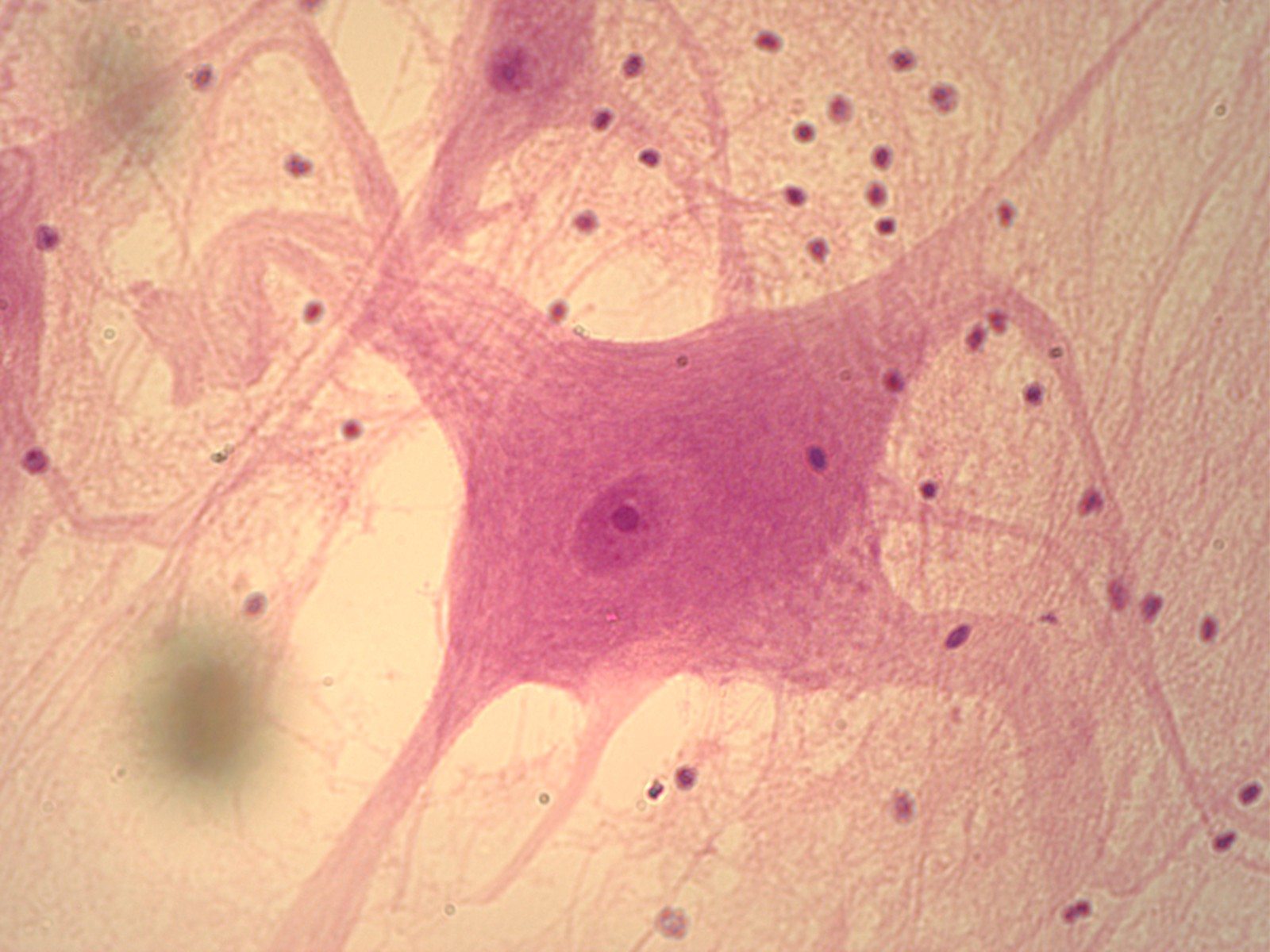
Identify the tissue type shown in the picture.

a)

Nervous tissue

b)

Connective tissue

c)

Epithelial tissue

d)

Muscle tissue

e)

Not a body tissue

96.

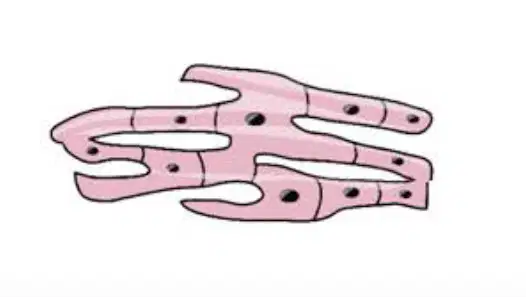
What tissue type is this

a)

dense connective

b)

smooth muscle

c)

cardiac muscle

d)

areolar tissue

97.
What tissue type is this?
a)
Nervous tissue
b)
Cardiac muscle
c)
Smooth muscle
d)
Connective tissue proper
98.
Define tissue with regards to anatomy
a)
A group of structurally and functionally related cells that come together to perform common functions
b)
Multiple sheets of thin paper used to clean your nose
c)
A series of different cells in the same area
d)
The smallest structural and functional unit of an organism
99.
Which type of muscle tissue would line the intestines?
a)
Smooth
b)
Cardiac
c)
Skeletal
d)
Transitional
100.
Which of the following tissues binds everything together?
a)
Epithelial
b)
Connective
c)
Muscle 
d)
Nervous
101.
Where is epithelial tissue found?
a)
glands
b)
covering body surfaces
c)
lines organs
d)
all of the above
102.
Which of the following is NOT a type of connective tissue?
a)
Bone
b)
Cartilage
c)
Skin
d)
Blood
103.

Which type of CONNECTIVE TISSUE supports, cushions and protects organs from the external environment.

a)

cartilage

b)

proper

c)

bone

d)

blood

104.

Which type of CONNECTIVE tissue transports substances throughout the body?

a)

cartilage

b)

proper

c)

bone

d)

blood

105.

The picture shows an example of which type of tissue?

a)

smooth

b)

skeletal

c)

cardiac

d)

connective