
Font size
 Worksheets
Electromagnetic Spectrum and Sound waves
Total questions: 52
Worksheet time: 31mins
Which of the following are NOT properties of light waves?
frequency
timbre
amplitude
wavelength
resonance

Which EM waves are invisible? (more than one correct answer)
radio
visible
ultraviolet
gamma rays


Which electromagnetic waves have the highest frequencies and the shortest wavelengths?
microwaves
visible light
gamma rays
x-rays
Which color waves have the shortest wavelength?
red
yellow
green
violet

Which of the following is not in the electromagnetic spectrum?
Light waves
Sound waves
Radio Waves
X-rays

Electromagnetic waves that help your body produce vitamin D are called?
Ultraviolet rays
X-rays
Radio waves
Gamma rays
What is a medium?
Any solid, liquid, or gas that a wave can travel through
The resting point of a wave
The middle of a crest
The center of a longitudinal wave

What do all mechanical waves require?
A medium
High temperatures
Air
Sound waves

Scientists observed a celestial object emitting a wavelength of 3 x 10³m. What type of telescope did the scientists have to use to view this?
Radio wave
Infrared ray
X-ray
Gamma Ray


Increasing the amplitude of a wave ______ the wave’s energy.
Increases
Decreases
Does not change

Mr. Lyall, the band director at Plano High School noticed one of his trumpet players had a change in pitch during a football game. After the game, Mr. Lyall asked the student to play for him and realized the pitch was still not quite right. The student then explained he had borrowed the trumpet from a neighbor because his was being repaired. Trumpet A, the student’s trumpet is the correct pitch for the sound Mr. Lyall expected to hear. However, Trumpet B is what was being played from the neighbor’s trumpet.
Choose a word for each blank to complete the sentence below.
Mr. Lyall was expecting to hear a ______ with a lower amplitude sound and instead, the student was playing a ______ and a higher amplitude.
higher frequency, lower frequency
higher frequency, higher pitch
lower frequency, higher frequency
lower frequency, lower pitch
Mrs. Brandon's class was experimenting with different forms of waves. She had one student go outside of her classroom, shine a light on the wooden classroom door, and then scream towards the door.
What behavior of waves is Mrs. Brandon trying to explain?
Lightwaves can be seen through mediums.
Mediums cause waves to behave differently.
Sound waves cannot be heard through a medium.
Mediums have no effect on waves. Each wave behaves independently of the medium.
Which color waves have the lowest frequency?
red
yellow
green
violet

If a student playing the drums hits the drums with greater force, the amplitude of the sound would...
decrease
increase
nothing
stay the same

Increasing the amplitude of a wave ______ the wave’s energy.
Increases
Decreases
Does not change
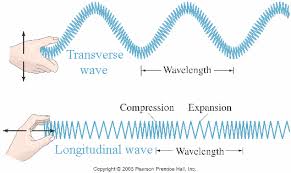
Empty space is also known as what?
cleaner
vacuum
oven
school
In a vacuum/empty space, the speed of light...
can vary
is always 300,000 km/s
is slower than the speed of light through a medium
is slow
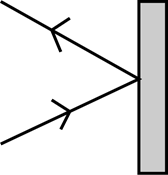
In the illustration, the light ray striking the object is-

If the angle of incidence in the diagram is 50 degrees, which statement is true?
The angle of reflection is 40 degrees because is is measured from the normal line, which is 90 degrees
The angle of reflection is 50 degrees because it is equal to the angle of incidence.
The angle of reflection is 60 degrees, because it is greater than the angle of incidence.
The angle of refraction is 50 degrees, because it is equal to the angle of incidence.
A student looks at a paper and sees that it is white.
What color(s) is being reflected by the white paper?
All colors
No colors
A student looks at a shirt and sees that it is green.
What color is being reflected by the green shirt?
All others except green
Green

What color is an object that absorbs all the colors in the light spectrum?
A rainbow
White
Black
Invisible

What happens when light hits a shiny or smooth surface?
It disappears.
It is refracted.
It is absorbed.
It is reflected.
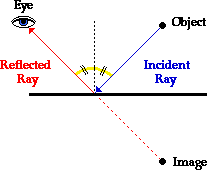
What is the angle of reflection equal to?
The angle of refraction
The angle of incidence
The angle of absorption
The angle of light

What is the angle of incidence?
The angle at which light bends in water.
The angle at which light hits a surface.
The angle at which light is absorbed by an object.
The angle at which light bounces off a surface.
Law of reflection state that - The angle of incidence is .................. to the angle of reflection.
equal
double
half
Opaque objects are....
materials that allow light to pass through.
light made by nature.
materials that allow no light to pass through.
If the angle of incidence is 45 degree, what is the angle between the incident ray and reflecting surface
45
90
180
Soft materials like cushions and sofa will
Reflect sound only
Absorb sound only
Absorb most of the sound but reflect some
Reflect most of the sound but absorb some
When designing a recording studio, the following is the best design
a spacious room made of concrete with no curtains or carpeting
a spacious room with curtains, carpeting, chairs covered in cloth and foam tiles covering the wall
Sound is carried to the brain as a
nerve signal
vibration
sound
Hard surfaces, such as ceramic tile, gypsum board, or wood, tend to _______ sound waves, causing ‘echo’.
transmit
diffract
refract
reflect
What happens when light hits rough surface?
It disappears.
It is refracted.
It is absorbed.
It is scattered
Which of the following would a light wave SLOW down?
Solid to air
liquid to air
air to liquid
It never changes speed

