wayground logo

Free Printable Worksheets

Font size

S
M
L
XL
Worksheets

Year 7-8

Total questions: 101

Worksheet time: 1hrs 20mins

Name
Class
Date
1.
K20 - name?
a)
potassium dioxide
b)
potassium oxide
c)
potassium oxygen
d)
dipotassium dioxide
2.

CaF2- name?

a)

calcium fluorate

b)

calcium fluoride

c)

fluoride calcite

d)

fluorine calciumate

3.

Na2SO4- name?

a)

sulfur sulfate

b)

sodium sulfide

c)

sodium sulfate

d)

sodium oxygenate

4.

HCl- name?

a)

hydrogen chloride

b)

chlorine hydrogen

c)

hydrogen chlorine

d)

hydrogen chlorate

5.

LiNO3- name?

a)

lithium oxygenate

b)

nitrogen lithate

c)

lithium nitride

d)

lithium nitrate

6.

MgO- name?

a)

oxygen magnesium

b)

magnesium oxide

c)

magnesium oxate

d)

magnesium oxygenate

7.

BaClO3- name?

a)

barium chlorate

b)

barium chloride

c)

chlorine bariate

d)

chlorine baride

8.

KH- name?

a)

potassium hydrate

b)

potassium hydrogen

c)

potassium hydride

d)

hydrogen potassiate

9.

LiOH- name?

a)

hydrogen lithium

b)

lithium oxyhydride

c)

lithium oxide

d)

lithium hydroxide

10.

HI

a)

-ide

b)

-ate

11.

HI - name?

a)

iodine hydrogenide

b)

hydrogen iodine

c)

hydrogen iodide

d)

hydrogen iodate

12.

H2SO4

a)

-ide

b)

-ate

13.

H2SO4- name?

a)

hydrogen sulfate

b)

hydrogen sulfide

c)

sulfur hydrogen

d)

sulfide hydrogen

14.

Which formula shows potassium iodide?

a)

KI

b)

Ki

c)

KIO3

d)

KIO2

15.

KOH

a)

Carbon oxide

b)

potassium oxide

c)

potassium hydride

d)

potassium hydroxide

16.
What is the correct name of the compound with the formula MgO?
a)
magnesium oxygen
b)
magnesium oxide
c)
manganese oxygen
d)
manganese oxide
17.
What is the correct name of the compound with the formula KH?
a)
potassium hydrogen
b)
potassium peroxide
c)
potassium hydride
d)
potassium monohydride
18.
What is the correct name of the compound with the formula CaO?
a)
calcium oxide
b)
calcium oxygen
c)
calcium monoxide
d)
monocalcium monoxide
19.
What is the correct name of the compound with the formula KCl?
a)
potassium chloride
b)
potassium chlorine
c)
potassium monochloride
d)
potassium monochlorine
20.
What is the formula for magnesium chloride?
a)
MgCl
b)
Mg2Cl
c)
MgCl2
d)
Mg(ClO3)2
21.

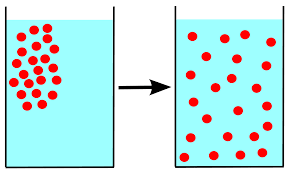
The picture below is an example of _________________.

a)

osmosis

b)

isotonic

c)

diffusion

d)

active transport

22.
What is diffusion?
a)
when molecules move 
b)
when molecules move from a high concentration to a low concentration.
c)
no movement 
d)
molecules move everywhere
23.
Where is there a low concentration of dye?
a)
at the bottom of cup
b)
in the color
c)
at the top of cup 
d)
no concenteraion gradient
24.
Where is there a low concentration of perfume?
a)
in the bottle
b)
on the hand
c)
in the room
d)
in the top
25.

What is DIFFUSION?

a)
b)
c)
d)
26.
The picture  is an example of _________________.
a)
isotonic
b)
diffusion
c)
osmosis
d)
active transport
27.

Diffusion occurs only in solids

a)

True

b)

False

28.

Diffusion is the free movement of particles from an area of __________ concentration to an area of ________ concentration.

a)

High to high

b)

High to low

c)

Low to low

d)

Low to high

29.

An increase in temperature does what to diffusion?

a)

Speeds it up

b)

Slows it down

c)

Stops it

d)

No effect

30.

When does diffusion stop?

a)

After a day and a night

b)

When the particles are evenly spread out

c)

When there are no particles left

d)

When all the particles leave the system

31.

Select the 4 correct answers. A particle _____.

a)

can be a solid.

b)

can be a liquid.

c)

can be a gas.

d)

has random motion.

e)

remains stationary.

32.
Which diagram best shows the end result of diffusion?
a)
F
b)
G
c)
H
d)
J
33.
If there is more oxygen in the blood than in an organ, which direction would the oxygen move?
a)
Out of the blood
b)
Into the blood
34.
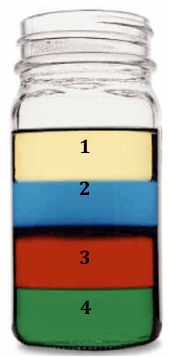
Put the liquids in order from most dense to least dense?
a)
4, 3, 2, 1
b)
1, 2, 3, 4
c)
3, 4, 2, 1, 
d)
4, 3, 1, 2
35.

Which box has a higher density?

a)

A

b)

B

c)

They are the same

36.
What is the formula for density?
a)
density = mass x volume
b)
density = mass / volume
c)
density = mass + volume
d)
density = mass - volume
37.
Frank has a paper clip. It has a mass of 9g and a volume of 3cm3. What is its density?
a)
3 g/cm3
b)
1/3 g/cm3
c)
27 g/cm3
d)
39 g/cm3
38.
A piece of copper has a mass of 89g and a volume of 10 cm3.  What would be the density of the copper?
a)
0.89 g/cm3
b)
89 g/cm3
c)
8.9 g/cm3
d)
890 g/cm3
39.

Calculate the density in the following question: A flower pot has a mass of 95 g and a volume of 92 mL.

a)

1.03 g/mL

b)

0.97 g/mL

c)

1.01 g/mL

d)

0.99 g/mL

40.

An object has a volume of 6 cm3 and a mass of 42 g. What's it's density?

a)

7 g/cm3

b)

48 g/cm3

c)

42 g/cm3

d)

6 g/cm3

41.
Jack has a rock. The rock has a mass of 14g and a volume of 2cm3. What is the density of the rock?
a)
7 mL
b)
7 g/cm3
c)
28 g/cm3
d)
1/7 g/cm3
42.
In the picture, the mass of the block is 200 g, the dimensions of the block are 6 cm by 4 cm by 5 cm.  What is its density?
a)
1.67g/cm3
b)
13.33 g/cm3
c)
0.60 g/cm3
d)
 24000 g/cm3
43.

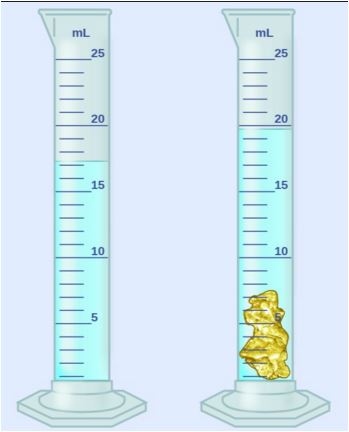
The amount of water displaced is the same as the volume of the object. What is the VOLUME of the object?

a)
40 mL
b)
65 mL
c)
20 mL
d)
25 mL
44.

An object is is placed into 45 mL of water. The water rises to 48 mL. What is the volume of the object?

a)

3 mL

b)

93mL

c)

8 mL

d)

83 mL

45.
An irregularly shaped piece of gold was lowered into a graduated cylinder holding a volume of water equal to 17 ml. The height of the water rose to 20 ml. If the mass of the gold was 27 g, what was its density?
a)
9 g/mL
b)
10.5 g/mL
c)
6.5 g/mL
d)
8 g/mL
46.
An irregularly shaped rock was lowered into a graduated cylinder holding a volume of water equal to 50 ml. The height of the water rose to 75 ml. If the mass of the stone was 250 g, what was its density?
a)
15 g/mL
b)
5 g/mL
c)
10 g/mL
d)
20 g/mL
47.

The volume of the water is 40 mL. An object was placed inside the graduated cylinder and it now reads 65 mL. The mass of the object is 125 g. What is the DENSITY of the object?

a)
40 mL
b)
65 mL
c)

25 mL

d)

5 mL

48.
An object's volume was determined through water displacement.  The starting height of the water was 58 mL and the ending height was 65 mL.  What is the density of the object if it has a mass of 47.5 g?
a)
0.39 g/cm3
b)
6.79 g/cm3
c)
67.86 g/cm3
d)
0.15 g/cm3
49.
What is the volume of 150 grams of lead if it has a density of 11.3 g/cm3?
a)
13.3 g
b)
13.3 cm3
c)
.075 g
d)
1695 cm3
50.

The density of a material is 2 g/cm3. The volume is 24 cm3 . What is the mass?

a)
12 grams
b)
48 grams
c)
12 g/cm3
d)
48 g/cm3
51.
What is the mass of a substance with a volume of 72.5 cm3 and a density of 0.94 g/cm3?
a)
68.15 g
b)
77.13 g
c)
62 g
d)
100 g
52.

There are 4 objects listed with their densities. Which of the following will float on water? (SELECT 2)

a)

Object A:

0.7 g/cm3

b)

Object B:

1.2 g/cm3

c)

Object C:

0.25 g/cm3

d)

Object D:

11.4 g/cm3

53.

If an object has a density of 6 g/mL and you put it into water, will it sink or float?  

a)
sink
b)
float
54.

Is salt (NaCI) a compound or an element?

a)

Compound

b)

element

55.

What is a substance made of two or more elements that are chemically combined called?

a)

A. element

b)

B. compound

c)

C. mixture

d)

D. solution

56.

What is the definition of a compound?

a)

The smallest part of any substance which can exist on its own

b)

Two or more atoms chemically joined together (can be the same or can be different)

c)

A simple substance in which all the atoms are identical

d)

Two or more different elements chemically joined together

57.
All matter is made of .....
a)
energy 
b)
atoms 
c)
air
d)
chemistry
58.

A substance that cannot be broken down into any other substance by ordinary chemical means is called

a)

a molecule.

b)

a mixture.

c)

an element.

d)

a compound.

59.

Two or more physically combined substances form

a)

a compound.

b)

an acid.

c)

an element.

d)

a mixture.

60.

What is an example of a mixture?

a)

Table salt

b)

Water

c)

Oxygen

d)

Air

61.

A substance that contains only one type of atom is a(n)

a)

compound

b)

element

c)

heterogeneous mixture

d)

homogeneous mixture

62.

A compound is made of ________ atoms.

a)

big

b)

similar

c)

different

63.
Carbon Dioxide is a ______ 
a)
compound 
b)
element 
c)
mixtures 
d)
Battle of Bunker Hill 
64.
Salt is a _________. 
a)
compound 
b)
element 
c)
mixture 
65.
This picture represents which of the following?
a)
element
b)
compound
c)
mixture of elements
d)
mixture of compounds
66.
This picture represents which of the following?
a)
element
b)
compound
c)
mixture
67.
This picture represents which of the following?
a)
element
b)
compound
c)
mixture
68.

The smallest unit of an element is

a)

a compound.

b)

a molecule.

c)

an atom.

d)

a mixture.

69.

The smallest unit of a compound is

a)

an element.

b)

a molecule.

c)

an atom.

d)

a mixture.

70.

True or False: All molecules are compounds.

a)

true

b)

false

71.

True or false: Air is a mixture.

a)

true

b)

false

72.

Which of the following is a mixture?

a)

oxygen

b)

gold

c)

sand

d)

water

73.
a)
Element
b)
Compound
c)
Mixture
74.
a)
Element
b)
Compound
c)
Mixture
75.
a)
Element
b)
Compound
c)
Mixture
76.
a)
Element
b)
Compound
c)
Mixture
77.
a)
Element
b)
Compound
c)
Mixture
78.
a)
Element
b)
Compound
c)
Mixture
79.
a)
Element
b)
Compound
c)
Mixture
80.

A pure substance that cannot be broken down into any other substance.

a)

Elements

b)

Compounds

c)

Mixtures

81.

Symbol for an element can be found on the

a)

Periodic Table

b)

Picnic Table

c)

Mixture Table

82.

A solid is a state of matter that has a(n)

a)

indefinite volume and indefinite shape

b)

definite volume and a definite shape

c)

definite volume and an indefinite shape

d)

indefinite volume and a definite shape

83.
In which state of matter are particles packed tightly together in fixed positions?
a)
gas 
b)
solid
c)
liquid
d)
plasma
84.
Particles of a liquid
a)
are tightly packed together and stay in a fixed position
b)
have no viscosity
c)
decrease in volume with increasing temperature
d)
are free to move in a container but are in close contact with one another
85.
In which state of matter do particles spread apart and fill all the space available to them? 
a)
crystal
b)
liquid
c)
gas
d)
solid
86.
The change from a  liquid to solid, or the reverse of melting, is called
a)
condensation
b)
boiling
c)
sublimation
d)
freezing
87.

The freezing point of water is the same as its

a)

melting point

b)

boiling point

c)

sublimation point

d)

evaporation point

88.
During the process of sublimation
a)
a solid turns directly into a gas
b)
a solid turns into a liquid
c)
a gas turns directly into a solid 
d)
 a liquid turns into a gas
89.

In a(n) (a)   , the particles are packed closely together, but they can move past each other freely.

90.

The common state of matter that does not have a definite shape or a definite volume is a(n) (a)   .

91.

The characteristic temperature at which a pure solid changes to a liquid is its (a)   point.

92.

A shrinking puddle is an example of (a)   , or vaporization that takes place only on the surface.

93.

(a)   occurs when a liquid changes to a gas below its surface as well as at the surface.

94.

In which state of matter are the particles least able to move?

a)

A

b)

B

c)

C

95.

Which of these three states represents a liquid?

a)

A

b)

B

c)

C

96.

The reaction between acid and alkali known as

a)

Titration

b)

Neutralisation

c)

Halogenation

d)

Addition

97.

Sodium hydroxide is an ..

a)

Acid

b)

Alkali

98.

Sodium hydroxide + Sulphuric acid --> X + Water


What will be the X

a)

Sodium sulphate

b)

Sodium sulphonate

c)

Sodium sulphurate

99.

Toothpaste will help to reduce acidity on tooth surface produced by bacteria.

This means toothpaste is

a)

Alkaline

b)

Acidic

c)

Amphoteric

d)

Neutral

100.

Potassium hydroxide is

a)

Alkaline

b)

Acidic

c)

Neutral

101.

Potassium hydroxide + Y -> potassium sulphate + water


What Y will be?

a)

Nitric acid

b)

Hydrochloric acid

c)

Sulphuric acid