wayground logo

Free Printable Worksheets

Font size

S
M
L
XL
Worksheets

Motion Understanding Check

Total questions: 135

Worksheet time: 3hrs 7mins

Name
Class
Date
1.

Position

a)

a specific point in space

b)

the amount of space between one point and another

c)

the change in position of an object

d)

the point or place where something begins

2.

Distance

a)

the amount of space between one point and another

b)

a specific point in space

c)

the change in position of an object

d)

the point or place where something begins

3.

speed

a)

distance traveled per unit of time

b)

a change in the position of an object compared to another object (related term: move, movement)

c)

measured period during which something occurs

d)

a change in the velocity (speed, direction, or both) of a body (related word: accelerate)

4.

motion

a)

a change in the position of an object compared to another object (related term: move, movement)

b)

a pull or push that is applied to an object

c)

the change in position of an object

d)

the amount of space between one point and another

5.

time

a)

measured period during which something occurs

b)

a change in the position of an object compared to another object (related term: move, movement)

c)

a pull or push that is applied to an object

6.

displacement

a)

the change in position of an object

b)

the amount of space between one point and another

c)

the speed and direction of moving objects

d)

the point or place where something begins

7.

velocity

a)

the speed and direction of moving objects

b)

distance traveled per unit of time

c)

a specific point in space

d)

a pull or push that is applied to an object

8.

acceleration

a)

a change in the velocity (speed, direction, or both) of a body (related word: accelerate)

b)

distance traveled per unit of time

c)

a change in the position of an object compared to another object (related term: move, movement)

d)

the change in position of an object

9.

Distance divided by time is how you find

a)

speed

b)

velocity

c)

displacement

d)

motion

10.

What is velocity?

a)

The distance an object travels per unit of time.

b)

The change in position of an object.

c)

Speed in a given direction.

d)

The state in which one objects distance from another is changing.

11.

Displacement is

a)

position of object

b)

final position minus initial position

c)

distance divided by time

d)

initial position plus final position

12.

Speed that remains the same or does not change

a)

Distance

b)

Constant Speed

c)

Mass

d)

Acceleration

13.
 Jermaine runs exactly 2 laps around a 400 meter track. What is the displacement?
a)
800
b)
400
c)
0
d)
200
14.
Bill runs 400 meters to Andy's house, turns around, and runs 400 meters back home.  What is Bill's distance?
a)
0 meters
b)
400 meters
c)
800 meters
d)
1600 meters
15.
Bill runs 400 meters to Andy's house, turns around, and runs 400 meters back home.  What is Bill's displacement?
a)
0 meters
b)
400 meters
c)
800 meters
d)
1600 meters
16.

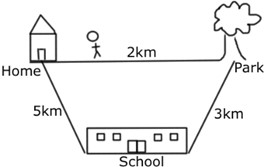
Jerry walked from home to school, then from the school to the park. What is his total distance?

a)

2 km

b)

5 km

c)

8 km

d)

10 km

17.

Jerry walked from home to school, then from the school to the park. What is his total displacement?

a)

2 km

b)

5 km

c)

8 km

d)

10 km

18.
A car drives 84 meters forward.  It's displacement and distance would be the same.
a)
True
b)
False
19.
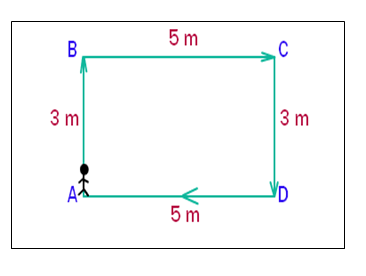
Sara walks from Point A to Point B. Which is true?
a)
Distance and displacement are EQUAL
b)
Distance is less than displacement
20.
Find the distance Sara walks from A to B,  B to C then C to D?
a)
11m
b)
3m
c)
5m
21.
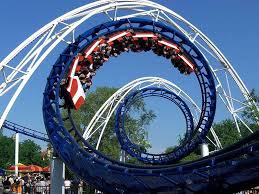
After completing one trip on a roller coaster, the roller coaster's ________ is zero.
a)
displacement
b)
reference point
c)
length
d)
distance
22.

The shortest distance between 2 points is a straight line.

a)

true

b)

false

23.

Two people walk across a parking lot. Their paths are shown in the image. Who traveled with a larger displacement?

a)

Person A

b)

Person B

c)

They both had the same displacement.

24.
David walks 3 km north, and then turns east and walks 4 km. What is the distance?
a)
7 km
b)
3 km
c)
4 km
d)
1 km
25.
Ronaldo runs across a soccer field, moving 10 meters north, then 8 meters west. His displacement would be:
a)
10.2 m, NW
b)
12.8 m, NW
c)
15.4 m, NW
d)
18.0 m, NW
26.
Because displacement has a magnitude and direction it is called a ______. 
a)
distance
b)
vector
c)
arrow
d)
length
27.
A person walks 50 meters directly north, stops, and then travels 32 meters directly south.  What is their displacement?
a)
82 meters
b)
18 meters
c)
28 meters
28.

Which of the following is correct?

a)

Initial Position = -5 m

Final Position = -5 m

Distance = 22 m

Displacement = 0 m

b)

Initial Position = -5 m

Final Position = -5 m

Distance = 0 m

Displacement = 22 m

c)

Initial Position = -5 m

Final Position = 6 m

Distance = 22 m

Displacement = 0 m

d)

Initial Position = -5 m

Final Position = 6 m

Distance = 0 m

Displacement = 22 m

29.

Which of the following is correct?

a)

Initial Position = -2 m

Final Position = 0 m

Distance = 14 m

Displacement = 2 m

b)

Initial Position = 0 m

Final Position = -2 m

Distance = 14 m

Displacement = -2 m

c)

Initial Position = -2 m

Final Position = 0 m

Distance = -2 m

Displacement = -2 m

d)

Initial Position = -2 m

Final Position = 0 m

Distance = 14 m

Displacement = 14 m

e)

None are correct.

30.

David walks 3 km north, and then turns east and walks 4 km. What is the displacement?

a)

1 km

b)

3 km

c)

4 km

d)

5 km

31.

What distance did the creature travel?

a)

23 m

b)

9 m

c)

-9 m

d)

-23 m

32.

What is the creature's final displacement?

a)

23 m

b)

9 m

c)

-9 m

d)

-23 m

33.
Object C had an initial position of 2 m and a final position of 10 m. The displacement of object C can be shown with this equation: Displacement = final position - initial position
What was the displacement of object C?
a)
+6 m
b)
+8 m
c)
-4 m
d)
-2 m
34.
Object B had an initial position of 12 m and a final position of 7 m. The displacement of object C can be shown with this equation: Displacement = final position - initial position
What was the displacement of object B?
a)
+5 m
b)
- 6 m
c)
-5 m
d)
+6 m
35.
What was the total distance traveled by object C?
a)
8 m
b)
10 m
c)
12 m
d)
14 m
36.

Which is the length of the path an object has traveled?

a)

displacement

b)

distance

c)

motion

d)

reference point

37.
What is the total displacement of the object represented in this motion graph?
a)
5 meters
b)
4 meters
c)
2 meters
d)
0 meters
38.
What is the total distance of the object represented in this motion graph?
a)
5 meters
b)
4 meters
c)
2 meters
d)
0 meters
39.
What is the total distance of the object represented in this motion graph?
a)
0 meters
b)
10 meters
c)
11 meters
d)
20 meters
40.
What is the total displacement of the object represented in this motion graph?
a)
0 meters
b)
10 meters
c)
11 meters
d)
20 meters
41.
What is the total displacement of the object represented in this motion graph?
a)
0 meters
b)
20 meters
c)
30 meters
d)
60 meters
42.
What is the total distance of the object represented in this motion graph?
a)
0 meters
b)
20 meters
c)
30 meters
d)
60 meters
43.
What is the total distance of the object represented in this motion graph? 
a)
50 meters
b)
- 50 meters
c)
150 meters
d)
100 meters
44.
What is the total displacement of the object represented in this motion graph? 
a)
0 meters
b)
- 50 meters
c)
50 meters
d)
100 meters
45.
What is the total distance of the object represented in this motion graph?
a)
0 meters
b)
300 meters
c)
450 meters
d)
600 meters
46.
What is the total displacement of the object represented in this motion graph?
a)
0 meters
b)
300 meters
c)
450 meters
d)
600 meters
47.
What is the total distance of the object represented in this motion graph?
a)
0 meters
b)
140 meters
c)
150 meters
d)
300 meters
48.
What is the total distance of the object represented in this motion graph?
a)
0 meters
b)
100 meters
c)
140 meters
d)
200 meters
49.
What is the total displacement of the object represented in this motion graph?
a)
0 meters
b)
100 meters
c)
140 meters
d)
200 meters
50.
What is the total distance of the object represented in this motion graph?
a)
0 meters
b)
2 meters
c)
6 meters
d)
39 meters
51.
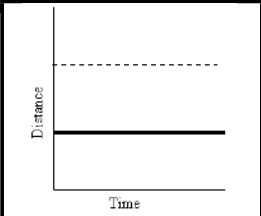
What does this graph represent?
a)
Constant Speed
b)
Acceleration
c)
Not moving
52.
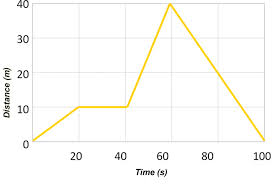
How long did it take this object to travel back to its reference/starting point?
a)
20 s
b)
30 s
c)
60 s
d)
100 s
53.
At 60 seconds, how far had this object traveled? 
a)
0 m
b)
10 m
c)
20 m
d)
40 m
54.
What does this graph represent?
a)
Constant speed
b)
Acceleration
c)
Not moving
55.
What is happening at D?
a)
Stationary
b)
Accelerating
c)
Fast steady speed; moving away from the starting position
d)
Slower steady speed; moving away from the starting position
56.
What is happening at C?
a)
Stationary
b)
Accelerating
c)
Fast steady speed; moving away from the starting position
d)
Slower steady speed; moving away from the starting position
57.
What does this graph represent?
a)
Constant speed
b)
Acceleration
c)
Not moving
58.
How long did it take this object to travel 10 m?
a)
0 s
b)
10 s
c)
15 s
d)
20 s
59.
Which runner had a head start?
a)
A
b)
B
c)
C
60.

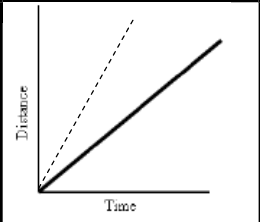
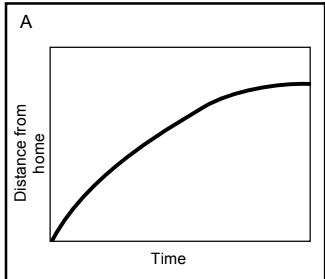
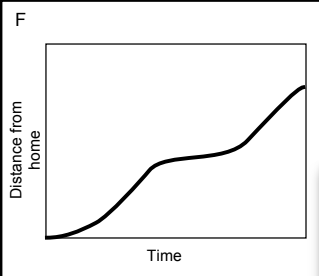
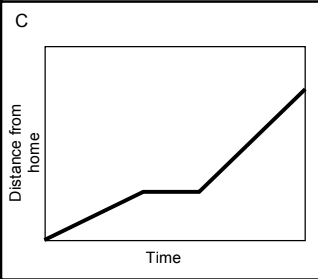
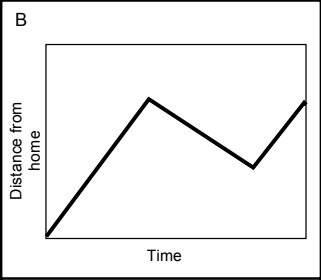
In which of the following graphs below are both runners moving at the same speed?

a)
b)
c)
d)
61.

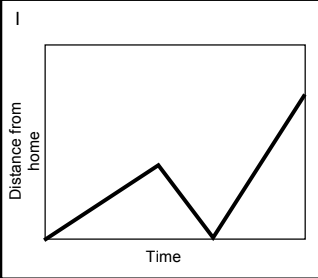
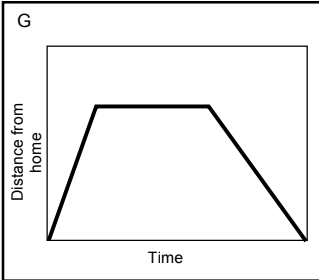
Match the description to the graph:

"The car is coming back."

a)
b)
c)
d)
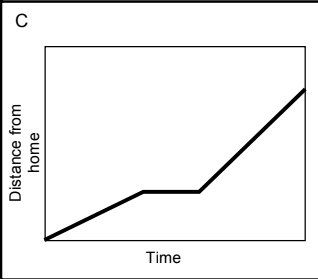
62.

Match the description to the graph:

"The car is traveling at a constant speed."

a)
b)
c)
d)
63.

Segment B-C The bus is _________________.

a)

at rest

b)

returning (to original position)

c)

moving forward

64.

Segment A-B The bus is _________________.

a)

at rest

b)

returning (to original position)

c)

moving forward

65.

Which of the graphs shows that one of runners started in the same place?

a)
b)
66.

In which of the following graphs below did one runner overtake (run past) the other?

a)
b)
c)
d)
67.

Match the description to the graph:

"The car is slowing down."

a)
b)
c)
d)
68.
The graph shows Ashley riding her bike to Maria's house. 
What was occurring from point B to point C?
a)
She was increasing her speed.
b)
She stopped for 4 minutes
c)
She was decreasing in speed
69.
a)
b)
c)
d)
70.
a)
b)
c)
d)
71.
a)
b)
c)
d)
72.
a)
b)
c)
d)
73.
a)
b)
c)
d)
74.
Which runner won the race?
a)
A
b)
B
c)
C
75.
How long did it take this object to travel 10 m?
a)
0 s
b)
10 s
c)
15 s
d)
20 s
76.
How long did it take this object to travel back to its reference/starting point?
a)
20 s
b)
30 s
c)
60 s
d)
100 s
77.
At 60 seconds, how far had this object traveled? 
a)
0 m
b)
10 m
c)
20 m
d)
40 m
78.

How can you find the velocity from a distance-time graph?

a)

Read it off the x-axis.

b)

Read it off the y-axis.

c)

Find the gradient of the line

d)

Find the area under the graph

79.

How do you calculate gradient?

a)

run / rise

b)

rise / run

c)

slip / slide

d)

hop / skip

80.

The total distance travelled in this graph is (a)   km.

81.

The speed of the object during the first 2 seconds is (a)   km/h.

82.

The speed of the object from 10 to 18 seconds is (a)   km/h.

83.

The total distance travelled is (a)   m.

84.

The speed of the object during part A of the journey is (a)   m/s.

85.

The velocity during part B of the journey is (a)   m/s.

86.

The velocity during part C of the journey is (a)   m/s.

87.

What is the speed of the object during segment B?

a)

0.5 m/s

b)

1.3 m/s

c)

2 m/s

d)

2.5 m/s

88.

Which graph shows the object moving from fast to slow?

a)

A

b)

B

c)

C

d)

D

89.

A student walks 50 meters in 100 seconds. Calculate the speed.

a)

0.5

b)

0.5 m/s

c)

500 m/s

d)

2 m/s

90.

A turtle crawls at a pace of 2 m/hr. How long does it take for the turtle to crawl 10 m?

a)

20

b)

0.2 hr

c)

200 hr

d)

5 hr

91.

A turtle crawls at a pace of 2 m/hr. How far does it move after 4 hours?

a)

8

b)

8 m

c)

2 m

d)

0.5 m

92.
What is the speed of an object that travels 60 meters in 4 seconds?
a)
240 m/s
b)
15 m/s
c)
0.067 m/s
d)
15 mph
93.
What is the speed of an object that travels 20 meters in 4 seconds?
a)
80 m/s
b)
0.2 m/s
c)
5 m/s
d)
24 m/s
94.

Jose wandered 4 km at 2 km/hr. How long did Jose wander?

a)

2 hours

b)

8 hours

c)

0.5 hours

d)

2 km

95.

A vehicle travels 2345 m in 315 s toward the evening sun. What is its speed?

a)

7.44 m/s

b)

0.13 m/s

c)

738,675 m/s

d)

7.44m

96.

What distance will a car traveling 65 km/hr travel in 180 min?

a)

11,700 m

b)

195 m

c)

21.7 m

d)

2.77 m

97.

Which of the following is an acceptable velocity measurement?

a)

25 m/s North

b)

25 m/s

c)

25 m

d)

25 m North

98.

An object travels 100 m North then 50 m South. What total distance did it travel?

a)

150 m

b)

50 m North

c)

50 m South

d)

150 m North

99.

An object travels 100 m North then 50 m South. What is its total displacement?

a)

150 m

b)

50 m North

c)

50 m South

d)

150 m North

100.
A girl is pedaling her bicycle at a speed of 0.10 km/min.  How far will she travel in two hours? (pay attention to units) 
a)
20 km 
b)
.2 km
c)
3 km 
d)
12 km 
101.

How far does a lorry move if it is travelling at 12m/s for 180s?

a)

2160 m

b)

0.06 m

c)

15 m

d)

21.6 m

102.

A team of rowers are training on the River Lagan. The captain gets there early and warms up. It takes him 30 s to row 100m in the direction of the water flow. What is his speed?

a)

3000 m/s

b)

0.3 m/s

c)

3.33 m/s

d)

0 m/s

103.

How far does a truck move if it's travelling at 15m/s for 20 min?

a)

18000 m

b)

300 m

c)

0.75 m

d)

180 km

104.

Select the description of motion from A - B.

a)

Slowing down away from the origin

b)

Speeding up away from the origin

c)

Constant velocity away from the origin

d)

Constant velocity towards the origin

105.

What segment of the graph shows no motion, or standing still?

a)

A - B

b)

B - C

c)

C - D

d)

None

106.

True or False: this graph shows several segments ALL with constant velocity.

a)

True

b)

False

107.

Describe the motion from B - C.

a)

Standing still

b)

Constant velocity of 60 m/min

c)

Constant velocity of 0 m/min

d)

Accelerating

108.

What kind of line on a P-T graph would create the segment B - C on this V-T graph?

a)

Straight, linear line

b)

Horizontal line

c)

Curved line

d)

Wouldn't happen

109.

Segment D - E would have come from what type of P-T graph line?

a)

Straight, linear

b)

Horizontal

c)

Curved

d)

Wouldn't happen

110.

What does a horizontal line (not on the x-axis) mean on a V-T graph?

a)

No movement

b)

Constant velocity

c)

Changing velocity

d)

Change in direction

111.

Which segment shows an object speeding up towards the origin?

a)

A - B above the x-axis

b)

C - D below the x-axis

c)

C-D above the x-axis

d)

D - E

112.
Which section of the graph shows decreasing velocity?
a)
CD
b)
DE
c)
EF
d)
GH
113.
What is happening from point D to E?
a)
The object is moving SLOWLY
b)
The object is moving FAST
c)
The object is decelerating
d)
The object is NOT moving
114.
What is happening in the graph from point O to A?
a)
The object is moving SLOWLY
b)
The object is moving FAST
c)
The object is NOT moving
d)
The object is accelerating
115.

Calculate the distance travelled in section B.

(a)  

116.

During section A of the graph (between 0s and 25s), the object is accelerating.

Change in velocity in this time = 3 - 0 = 3m/s

Time taken = 25 - 0 = 25s

What is its acceleration?

a)

Acceleration = Change in velocity x time = 3 x 25 = 75m/s2

b)

Acceleration = Change in velocity / time = 3/25 = 0.12m/s2

117.

the unit of acceleration is

a)

(m/s2)

b)

jouls

c)

m

d)

s

118.

A bus starts from rest and accelerates to 14 m/s in 4 s. What is the average acceleration of the bus?

a)

3.5 m/s2

b)

5.9 m/s2

c)

10.5 m/s2

d)

24 m/s2

119.
Calculate the average speed (in meter/sec) if a cheetah runs 180 meters in 10 seconds.
a)
198 m/sec
b)
170 m/sec
c)
12 m/sec
d)
18 m/sec
120.
A roller coasters accelerates from an initial velocity of 6.0 m/s to a final velocity of 70 m/s over 4 seconds.  What's the acceleration?
a)
24 m/s2
b)
18 m/s2
c)
16 m/s2
d)
16 m/s
121.
A dog runs with an initial speed of 7.5 m/s on a waxed floor.  It slides to a stop in 15 seconds.  What is the acceleration?
a)
-7.5 m/s
b)
-7.5 m/s2
c)
-0.5 m/s2
d)
7.5 mi//hr
122.
A drag racer accelerated from 0 m/s to 200 m/s in 5 s.  What was the acceleration?
a)
0 m/s
b)
40 m/s2
c)
-40 m/s2
d)
40 m/s
123.
A golf ball accelerates off a tee at 15m/s2, changing its velocity from 0m/s to 50 m/s down the fairway. How long did it take the golf ball to accelerate?
a)
750 seconds
b)
35 seconds
c)
0.3 seconds
d)
3.3 seconds
124.
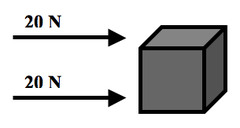
You and your dad are moving the couch from one side to another. Your dad pushes with a force of 35 N to the right and you push with a force of 25 N right. What is the net force on the couch?
a)
60 N right
b)
10 N left
c)
60 n right
d)
50 N left
125.
What is the net force?
a)
40 N left
b)
0 N Balalnced
c)
400 N right
d)
40 N right
126.
What is the net force?
a)
400 N Up
b)
400 N Down
c)
- 400 N Down
d)
800 N Down
127.

Which of the following is an example of an unbalanced force?

a)
b)
c)
d)
128.

Calculate the resultant force.

a)

40N, Left

b)

40N, Right

c)

0N, Balanced

d)

75N, Right

129.
The unit for force is a called a: 
a)
Galileo
b)
Newton
c)
Aristotle
130.
The overall force acting on an object after all the forces are combined is called a 
a)
net force
b)
unbalanced force
c)
balanced force
131.
If there are two forces going in the same direction how would you find the net force?
a)
Subtract
b)
Add
c)
Neither
d)
Multiply
132.
You push on a tree with 20 N of Force. If the tree doesn't move, the tree is pushing back on you with _____of Force.
a)
20 N 
b)
40 N 
c)
10 N 
d)
0 N
133.
What is 'drag' another name for?
a)
dressing up
b)
air resistance
c)
friction
d)
weight
134.
What are balanced forces?
a)
forces of the same size, in opposite directions
b)
the same size in the same direction
c)
forces in opposite directions
d)
forces at right angles to each other
135.
What is the net force?
a)
17 N Right
b)
3 N Right
c)
3 N Left
d)
17 N Left