
Font size
 Worksheets
Study Guide for Plate tectonic and radioactive decay test
Total questions: 45
Worksheet time: 11hrs 15mins
Which type of plate boundary would cause mountains to form?
Transform
Convergent
Divergent
Reform
The Great Rift Valley in Africa and the Mid-Ocean Ridge were all created by this boundary
Divergent
Convergent
Reform
Transform

Scientists think that convection currents that move the plates flow in Earth's
Continental crust
Oceanic crust
Asthenosphere
Lithosphere
Which of the following occurs because of convection currents?
Tectonic plates on the crust move.
The mantle increases in size.
Pressure in the crust increases.
Pressure in the crust decreases.

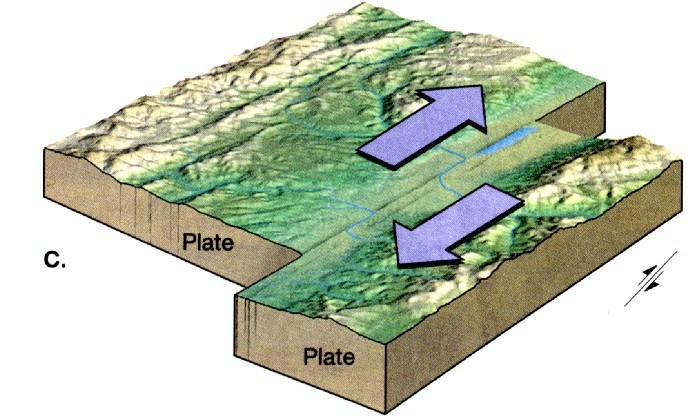
What type of plate boundary is this?
Plate
Divergent
Convergent
Transform
What type of plate boundary is this?
Transform
Convergent
Divergent
Plate
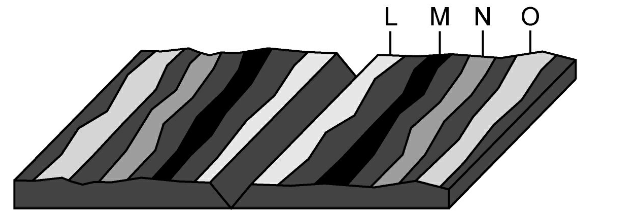
Where would the oldest rock be found?
L
M
N
O
Mountains are created when....
Two continental plates collide
Two oceanic plates pull apart
An Oceanic plate subducts under a Continental Plate
Two continental plates pull apart
Oceanic Trenches are formed by _______ plate boundaries
Convergent
Transform
Plate
Divergent
Which type of Crustal Features below are created from a Convergent boundary? (Select more than one)
Ocean Trench
Mountain
Volcano
Rit Valley
Fault Line
Which of the options below was created from a Divergent Plate Boundary? (Hint: Pick more than one)
Rift Valley
Mid-Ocean Ridge
Seafloor Spreading
Mountain
Faultine
Alfred Wegener is credited with discovering which of the following?
Plate Tectonic Theory
Pangea
Divergent Boundaries
Convergent Boundaries
Transform Boundaries


Isotopes of an element have a different number of...
Protons
Neutrons
Electrons
Mass
How do you calculate mass number?
Mass x percent
Protons + Electrons
Protons + Neutrons
Neutrons + Protons + Electrons

In an atom, there are three types of subatomic particles. ______ are positively charged, ______ are negatively charged, and ______ are neutral.
Protons, Electrons, Neutrons
Electrons, Protons, Neutrons
Neutrons, Protons, Electrons
Electrons, Neutrons, Protons
The atomic number tells the number of ______ in an atom, which never changes.
Protons
Neutrons
Electrons
An atom of an element with a different number of neutrons and therefore a different atomic mass
Isotope
Ion
Atom
Particle

What is the ATOMIC MASS of the isotope Carbon-14?
14
6
12
20
Isotopes of the same element have the same number of ________ but a different number of _______.
protons, neutrons
neutrons, protons
protons, electrons
electrons, neutrons
The identity of a chemical element is always determined by which of the following?
the number of protons it has
the number of neutrons it has
the number of electrons it has

By studying the picture, you can determine that Carbon-13 has ____ protons.
6
13
12
14
Which statement about radioactive isotopes is TRUE?
All radioactive isotopes decay at the same rate.
All radioactive isotopes release beta particles.
Scientists in labs create all radioactive isotopes.
All radioactive isotopes decay because their nucleus is unstable.
Half-life refers to the
Process by which an unstable nucleus turns into a stable nucleus
Amount of time for half of a radioactive sample to decay.
Number of radioactive nuclei that remain after 500 days.
Average mass of an element's isotope.
If the half-life of a radioactive substance is 4 days, how much of a 200-g radioactive sample is left after 16 days?
800g
50g
25g
12.5g
Radioactive decay results in the emission of _______ and _______
matter and atoms
matter and energy
helium and energy
energy and mass
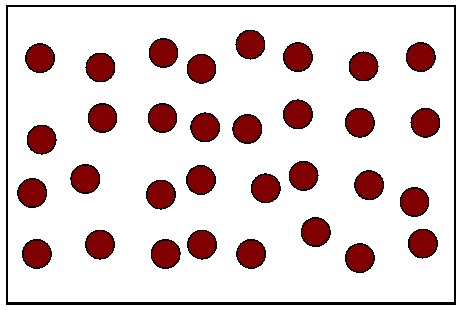
The diagram shows 32 atoms
32 of the Red are the parent isotope
0 of the atoms are daughter isotopes
How many half-lives have occurred?
0
1
2
3
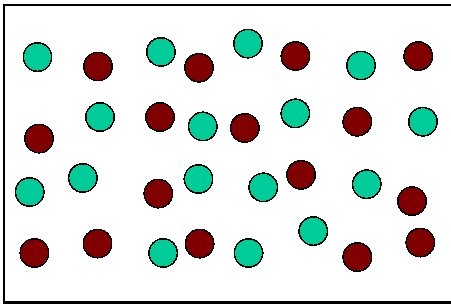
The diagram shows 32 atoms.
16 of the Red are parent isotopes
16 of the Green are daughter isotopes
How many half-lives have occurred?
0
1
2
3

