wayground logo

Free Printable Worksheets

Font size

S
M
L
XL
Worksheets

Unit 6: Gene Regulation & Expression

Total questions: 144

Worksheet time: 3hrs 14mins

Name
Class
Date
1.
In the lac operon model the genes within the operon will be expressed if:
a)
lactose is absent in the cell
b)
glucose is present in the cell
c)
lactose is present in the cell
2.
How can a person's muscle cells have the same exact DNA sequences as their nerve cells even though the look and perform completely different?
a)
The two different cells become mutated
b)
The proteins expressed in each cell are different
c)
They actually have different DNA in the two types of cells.
d)
The genome of the different cells changes
3.
All of the following are true about histone acetylation EXCEPT
a)
takes place on the histone
b)
enzymes add a acetyl group
c)
when it occurs, transcription is more likely to occur
d)
chromatin becomes more tightly packed
4.

In eukaryotes, a cluster of proteins (RNA polymerase II, mediator proteins, etc.) that assemble on the promoter is called the

a)

transcription initiation complex

b)

control element

c)

activator

d)

protein blobby thing

5.

A distal control region that activators bind to. The region is then bent by the DNA-bending protein to join mediator proteins and form the transcription initiation complex.

a)

enhancers

b)

promoters

c)

repressors

d)

transcription factors

6.

All the genes in both a prokaryotic cell and a eukaryotic cell are expressed at the same time.

a)

True

b)

False

7.

In eukaryotes, DNA is tightly coiled around ____ in chromatin

a)

Histones

b)

Whey

c)

Casein

d)

Hemoglobin

8.
The production of mature mRNA in eukaryotes involves
a)
cutting introns out and spicing exons together
b)
adding the 5' cap
c)
adding the 3' poly A tail
d)
all of these are correct
9.

In an operon, a sequence of DNA where RNA polymerase binds prior to transcription.

a)

operator

b)

promoter

c)

initiator

d)

repressor

10.

In an operon, the sequence of DNA that serves as a binding site for a repressor, and thereby regulates the expression of structural genes.

a)

promoter

b)

inducer

c)

operator

d)

repressor

11.
In eukaryotes, proteins that help the RNA polymerase bind to the regulatory region for transcription are called ____________.
a)
transcription factors
b)
topoisomerase
c)
regulatory genes
d)
activators
12.
What type of operon is the trp (tryptophan) operon?
a)
inducible
b)
repressible
c)
positive control
d)
promoible
13.

The repressor is the protein product of a(n)

a)

operator

b)

regulatory gene

c)

lac gene

d)

corepressor

14.

An operon is

a)

a genetic on/off switch in prokaryotes

b)

a genetic on/off switch in eukaryotes

c)

a group of related genes and the associated gene switches in prokaryotes

d)

a group of related genes and the associated gene switches in eukaryotes

15.

In the trp operon, __ acts as a __ and helps the repressor bind to the operator.

a)

tryptophan, corepressor

b)

tryptophan, inducer

c)

lactose, corepressor

d)

lactose, inducer

16.

True or False: All of your body cells contain the same genes.

a)

True

b)

False

17.

In the top picture the operon is

a)

on

b)

off

18.

What is 1 (the YELLOW molecule) in the diagram?

a)

RNA polymerase

b)

Inducer

c)

Repressor

d)

Operator

19.

All the genes in both a prokaryotic cell and a eukaryotic cell are expressed at the same time.

a)

True

b)

False

20.

In order for a gene to be expressed, ___ must bind to the gene's ___, a specific sequence of nucleotides at one end of the gene, thus initiating transcription.

a)

DNA polymerase, promotor

b)

DNA polymerase, operator

c)

RNA polymerase, promotor

d)

RNA polymerase, operator

21.

An operon is

a)

a genetic on/off switch in prokaryotes

b)

a genetic on/off switch in eukaryotes

c)

a group of related genes and the associated gene switches in prokaryotes

d)

a group of related genes and the associated gene switches in eukaryotes

22.

Genes can be shut off (not expressed) when a ___ binds to the ____.

a)

activator, operator

b)

repressor, operator

c)

corepressor, operator

d)

repressor, promotor

23.

What is the inducer in the lac operon?

a)

cAMP

b)

glucose

c)

lactose

d)

CRP

24.

Negative control of gene expression is mediated by __ and results in a(n) __ in the frequency of transcription.

a)

activators, increase

b)

activators, decrease

c)

repressors, increase

d)

repressors, decrease

25.
In eukaryotes, proteins that help the RNA polymerase bind to the regulatory region for transcription are called ____________.
a)
transcription factors
b)
topoisomerase
c)
regulatory genes
d)
activators
26.
What is the name given to part of a DNA molecule that codes for a protein?
a)
Glucose
b)
Chromosome
c)
Gene
d)
Phosphate
27.
How can a person's muscle cells have the same exact DNA sequences as their nerve cells even though the look and perform completely different?
a)
The two different cells become mutated
b)
The proteins expressed in each cell are different
c)
They actually have different DNA in the two types of cells.
d)
The genome of the different cells changes
28.
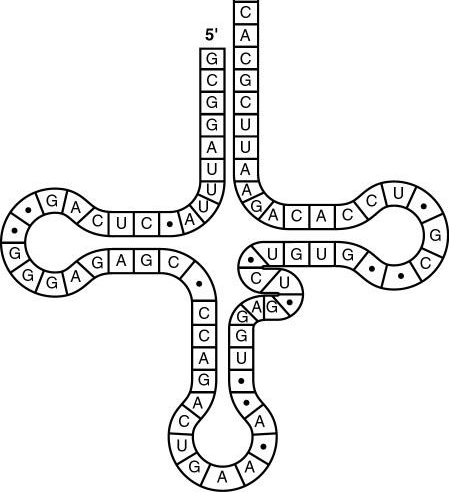
What structure of this molecule binds with the mRNA molecule?
a)
Amino Acid
b)
tRNA
c)
Anticodon
d)
Codon
29.

In an operon, the sequence of DNA that serves as a binding site for a repressor, and thereby regulates the expression of structural genes.

a)

promoter

b)

inducer

c)

operator

d)

repressor

30.
What type of operon is the trp (tryptophan) operon?
a)
inducible
b)
repressible
c)
positive control
d)
promoible
31.

In the top picture the operon is

a)

on

b)

off

32.

What is 1 (the YELLOW molecule) in the diagram?

a)

RNA polymerase

b)

Inducer

c)

Repressor

d)

Operator

33.
The "on/off" switch for an operon is called the
a)
promoter
b)
repressor
c)
operator
d)
gene
34.
An operon consists of all the the following EXCEPT
a)
operator
b)
promoter
c)
regulatory gene
d)
genes of the operon
35.

In eukaryotes, DNA is tightly coiled around ____ in chromatin

a)

Histones

b)

Whey

c)

Casein

d)

Hemoglobin

36.
Where does transcription occur in eukaryotic cells?
a)
Nucleus
b)
Ribosome
c)
Cytoplasm
d)
Rough E.R.
37.

Gene regulation is the process that is used to:

a)

help make sugars for cells in plants.

b)

make glycosomes in cells.

c)

turn genes on and off.

d)

Not sure, need help.

38.

Operons are found in the cells of which of the following types of organisms?

a)

prokaryotes

b)

eukaryotes

c)

animals only

d)

viruses

39.
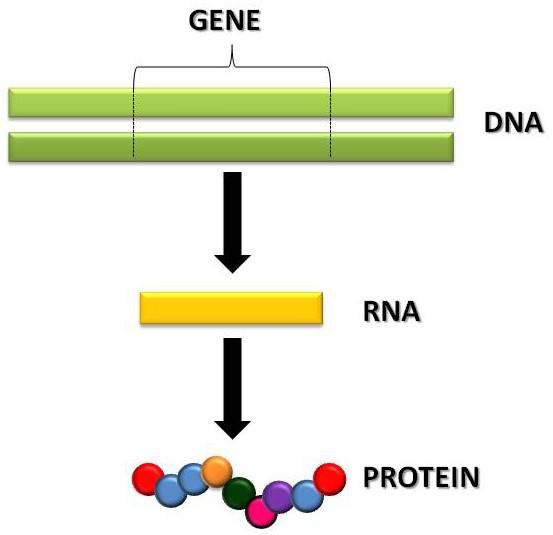
What is the flow of genetic information in cells from DNA to protein? (Central Dogma)
a)
RNA to DNA to protein
b)
DNA to RNA to protein
c)
protein to DNA to RNA
d)
RNA to protein to DNA
40.
What is the term for making an RNA copy of DNA?
a)
Transription
b)
Translation
c)
Folding
d)
Coding
41.
Which RNA bases would pair with TACGAA in transcription
a)
AUGCUU
b)
ATGCTT
c)
GCATCC
d)
GCAUCC
42.

How can a person's muscle cells have the same exact DNA sequences as their nerve cells even though they look and perform completely different?

a)

The two different cells become mutated

b)

The proteins expressed in each cell are different

c)

They actually have different DNA in the two types of cells.

d)

The genome of the different cells changes

43.

In eukaryotes, DNA is tightly coiled around ____ in chromatin

a)

Histones

b)

Whey

c)

Casein

d)

Hemoglobin

44.
Where does transcription occur in eukaryotic cells?
a)
Nucleus
b)
Ribosome
c)
Cytoplasm
d)
Rough E.R.
45.

In eukaryotic cells, transcription cannot begin until

a)

the two DNA strands have completely separated and exposed the promoter.

b)

transcription factors have bound to the promoter.

c)

the 5' caps are removed from the mRNA.

d)

the DNA introns are removed from the template.

46.
Which of the follwoing best describes the significance of the TATA box in eukaryotic promoters?
a)
it is the recognition site for a specific transcription factor
b)
it sets the reading frame of the mRNA
c)
it is the recognition site for ribosomal binding
d)
it signals the end of the nucleotide sequence of the gene
47.
RNA polymerase moves in which direction along the DNA?
a)
5' to 3' 
b)
3' to 5' along the template strand
c)
3' to 5' along nontemplate(coding) strand
d)
5' to 3' along the template strand
48.
A chemical modification of DNA that does not affect the nucleotide sequence of a gene but makes that gene less likely to be expressed.
a)
methylation
b)
acetylation
c)
transcription
d)
translation
49.
Which of the following is an example of post-transcriptional control of gene expression?
a)
the addition of methyl groups to cytosine bases of DNA
b)
the binding of transcription factors to a promoter
c)
the removal of introns and splicing together of exons
d)
gene amplification contributing to cancer
50.
The parts of a gene that do NOT code for amino acids in a protein are called
a)
introns
b)
exons
c)
codons
d)
anticodons
51.
The production of mature mRNA in eukaryotes involves
a)
cutting introns out and spicing exons together
b)
adding the 5' cap
c)
adding the 3' poly A tail
d)
all of these are correct
52.
What is the function of the poly-A tail in mRNA?
a)
to add modified guanin to the 3' end of the mRNA
b)
to indicate the site of translational termination
c)
to code for the binding of RNA polymerase to the DNA
d)
to help protect the mRNA from degradation by hydrolytic enzymes 
53.
A protein that binds to the operator and blocks the RNA polymerase
a)
regulator
b)
repressor
c)
activator
d)
corepressor
54.
Which of the following events in translation is the first to occur in eukaryotes?
a)
elongation of the polypeptide
b)
base pairing of activated methionine-tRNA to AUG of the messenger RNA
c)
binding of the larger ribosomal subunit to smaller ribosomal subunits
d)
the small subunit of the ribosome recognizing and attaching to the 5'cap
55.
What must happen to a newly made polypeptide before it can be secreted from a cell?
a)
it must be translated by a ribosome that remains free of attachment to the ER
b)
its signal sequence must target it to the ER, after which it goes to the Golgi
c)
Its signal sequence must be cleaved off
d)
Its signal sequence must target it to the plasma membrane
56.
What amino acid sequence will be produced based on the mRNA codon sequence
5'-AUG-UCU-UCG-UUA-UCC-UUG-3'
a)
met-ser-leu-ser-leu-ser
b)
met-ser-ser-leu-ser-leu
c)
met-leu-phe-arg-glu-glu
d)
met-glu-arg-arg-glu-leu
57.
Translation occurs:
a)
Outside of the Nucleus
b)
Inside of the Nucleus
58.
Translation is crucial to the process of making proteins. Which statement best describes what takes place during translation? 
a)
A copy of chromosomal DNA is created 
b)
Information in mRNA is converted into a sequence of amino acids in a protein 
c)
A RNA copy of a DNA strand is made.
d)
Instructions from DNA in the nucleus are brought to the cytoplasm 
59.

What is the correct description of eukaryotic chromosomes?

a)

many linear pieces of DNA in the cytoplasm

b)

many linear pieces of DNA in the nucleus

c)

one circular piece of DNA in the cytoplasm

d)

many circular pieces of DNA in the nucleus

60.
The anticodon is located on 
a)
DNA
b)
mRNA
c)
tRNA
d)
rRNA
61.

Group of structural and regulating genes that function as a single unit.

a)

operon

b)

promoter

c)

activator

d)

inducer

62.

In an operon, a sequence of DNA where RNA polymerase binds prior to transcription.

a)

operator

b)

promoter

c)

initiator

d)

repressor

63.

In an operon, the sequence of DNA that serves as a binding site for a repressor, and thereby regulates the expression of structural genes.

a)

promoter

b)

inducer

c)

operator

d)

repressor

64.

In an operon, protein molecule that binds to an operator, preventing transcription of structural genes.

a)

operator

b)

inducer

c)

promoter

d)

repressor

65.

Gene that codes for an enzyme in a metabolic pathway.

a)

regulator gene

b)

structural gene

c)

operon

d)

intron

66.

In an operon, a gene that codes for a protein that regulates the expression of other genes.

a)

structural gene

b)

regulator gene

c)

intron

d)

exon

67.

Operon that is normally active because the repressor is normally inactive.

a)

Intron

b)

Exon

c)

repressible operon

d)

expressible operon

68.

Molecule that binds to a repressor, allowing the repressor to bind to an operator in a repressible operon.

a)

inducer

b)

corepressor

c)

intron

d)

exon

69.

Molecule that brings about activity of an operon by joining with a repressor and preventing it from binding with the operator.

a)

promoter

b)

operator

c)

inducer

d)

intron

70.

In a catabolic pathway, an operon causes transcription of the genes controlling a group of enzymes.

a)

inducible operon

b)

repressible operon

c)

intron

d)

exon

71.

An inheritance pattern in which a nuclear gene has been modified but the changed expression of the gene is not permanent over many generations.

a)

dominance

b)

recessiveness

c)

polygenic

d)

epigenetic inheritance

72.

In eukaryotes , protein required for the initiation of transcription by RNA polymerase.

a)

promoter

b)

transcription activator

c)

transcription factors

73.

Altered gene whose sequence of bases differs from the previous sequence.

a)

exon

b)

intron

c)

mutation

d)

transcription error

74.

Mutation that arises as a result of anomalies in normal biological processes, such as mistakes made during DNA replication.

a)

Induced mutation

b)

spontaneous mutation

75.

Environmental agent that causes mutations leading to the development of cancer.

a)

carcinogens

b)

activators

c)

mutagens

76.

Change of one base only in the sequence of bases in a gene.

a)

substitution

b)

point mutation

c)

frameshift mutation

d)

deletion

77.

Insertion or deletion of at least one base so that the reading frame of the corresponding mRNA changes.

a)

substitution

b)

point mutation

c)

deletion

d)

frameshift mutation

78.
In his work with pneumonia-causing bacteria & mice, Griffith found that 
a)
the protein coat from pathogenic cells was able to transform nonpathogenic cells.
b)
heat-killed pathogenic cells caused pneumonia.
c)
some substance from pathogenic cells was transferred to nonpathogenic cells, making them pathogenic.
d)
the polysaccharide coat of bacteria caused pneumonia.
79.
The elongation of the leading strand during DNA synthesis 
a)
progresses away from the replication fork.
b)
occurs in the 3' to 5' direction.
c)
produces Okazaki fragments
d)
depends on the action of DNA polymerase
80.
E. coli cells grown on N-15 medium are transferred to N-14 medium and allowed to grow for 2 more generations.  DNA extracted from these cells is centrifuged.  What density distribution of DNA would you expect in this experiment?
a)
one high-density and one low-density band
b)
One intermediate-density band
c)
one high-density and one intermediate-density band
d)
one low-density and one intermediate-density band
81.
Which of the following mutations would be MOST likely to have a harmful effect on an organism?
a)
a deletion of three nucleotides near the middle of a gene.
b)
a single nucleotide deletion in the middle of an intron.
c)
a single nucleotide deletion near the end of a coding sequence.
d)
a single nucleotide insertion downstream of, and close to, the start of the coding sequence.
82.
What is the basis for the difference in how the leading and lagging strands of DNA molecules are synthesized?
a)
DNA polymerase can join new nucleotides to the 3' end of the preexisting strand.
b)
Helicases and single-strand binding proteins work at the 5' end.
c)
The origins of replication occur only at the 5' end.
d)
DNA ligase works only in the 3' to 5' direction
83.
Seals the Okazaki fragments together
a)
DNA Polymerase
b)
ligase
c)
helicase
d)
primase
84.

How do the leading and the lagging strands differ?

a)

The leading strand is synthesized in the same direction as the movement of the replication fork, and the lagging strand is synthesized in the opposite direction.

b)

The leading strand is synthesized at twice the rate of the lagging strand.

c)

The leading strand is synthesized in short fragments that are ultimately stitched together, whereas the lagging strand is synthesized continuously.

d)

The leading strand is synthesized by adding nucleotides to the 3' end of the growing strand, and the lagging strand is synthesized by adding nucleotides to the 5? end.

85.
Which enzyme is needed to start DNA replication?
a)
DNA Polymerase
b)
Topoisomerase
c)
Ligase
d)
Primase
86.
What is meant by the description "antiparallel" regarding the strands that make up DNA?
a)
The twisting nature of DNA creates nonparallel strands.
b)
One strand is positively charged and the other is negatively charged.
c)
The 5' to 3' direction of one strand runs counter to the 5' to 3' direction of the other strand.
d)
Base pairings create unequal spacing between the two DNA strands
87.
What is meant that DNA replication follows a “semi-conservative” model?
a)
After DNA replication, each strand contains one side that is a parental strand and the other side is a daughter strand.
b)
After DNA replication, one completed strand contains only parental DNA while the other contains only daughter DNA.
c)
None of these identify the “semi-conservative” model.
d)
After DNA replication, one completed strand contains a mixture of both parental DNA and daughter DNA dispersed throughout the strand.
88.
Suppose a double-stranded DNA molecule was shown to have 15% adenine bases. What would be the expected percentage of guanine bases in that molecule?
a)
15%
b)
35%
c)
85%
d)
Not enough information
89.
The two strands of a DNA molecule are held together by ________ bonds between their base pairs.
a)
covalent
b)
hydrogen
c)
ionic
d)
peptide
90.
What does mRNA do?
a)
provides information from DNA to ribosomes
b)
transfers amino acids to the ribosomes
c)
makes up ribosomes
d)
builds proteins
91.
What does rRNA do?
a)
provides information from DNA to ribosomes
b)
transfers amino acids to the ribosomes
c)
makes up ribosomes
d)
builds proteins
92.
What does tRNA do?
a)
provides information from DNA to ribosomes
b)
transfers amino acids to the ribosomes
c)
makes up ribosomes
d)
builds proteins
93.
A protein that binds to the operator and blocks the RNA polymerase
a)
regulator
b)
repressor
c)
activator
d)
corepressor
94.
What is the name of the stretch of DNA where RNA polymerase binds?
a)
operator
b)
promoter
c)
enhancer
d)
origin
95.
What is the role of operons in prokaryote gene expression?
a)
It makes the genes prokaryotes be turned on
b)
It accounts for the regulation of gene activity in response to the needs of the cells
c)
To make DNA for the gene
d)
To make the gene turn of and off
96.
The lac operon genes only become expressed if:
a)
lactose binds to the repressor
b)
glucose binds to the repressor
c)
lactose binds to the operator
d)
the repressor binds to the operator
97.
Inducible negative control is when when the gene is transcribed by the ____ of a specific molecule
a)
presence
b)
absence
98.
What type of operon is the trp (tryptophan) operon?
a)
inducible
b)
repressible
c)
positive control
d)
promoible
99.

What is the inducer in the lac operon?

a)

cAMP

b)

glucose

c)

lactose

d)

CRP

100.
Which of the following statements regarding mRNA is correct?
a)
Exons are included in the protein sequence, while introns are left out
b)
Introns are included in the protein sequence, while exons are left out
c)
Exons and Introns can both be included or left out depending on the protein
d)
Exons and Introns are both part of the mRNA sequence, but only exons are part of the rRNA and tRNA
101.

How does active CAP induce expression of the genes of the lactose operon?

a)

It terminates production of repressor molecules.

b)

It degrades the substrate allolactose.

c)

It stimulates splicing of the encoded genes.

d)

It stimulates the binding of RNA polymerase to the promoter.

102.

The DNA is tightly wrapped around the histone proteins and the gene is methylated.

a)

The gene is silenced.

b)

The gene is active.

c)

It is impossible to tell.

d)

The gene is on and off at various times.

103.
How can a person's muscle cells have the same exact DNA sequences as their nerve cells even though the look and perform completely different?
a)
The two different cells become mutated
b)
The proteins expressed in each cell are different
c)
They actually have different DNA in the two types of cells.
d)
The genome of the different cells changes
104.
Which of the following methods of gene regulation do eukaryotes and prokaryotes have in common?
a)
Elaborate packing of DNA in chromosomes
b)
Activator and repressor proteins, which bind to DNA
c)
The addition of a cap and tail to mRNA after transcription
d)
The removal of noncoding portions of RNA
105.
What is the relationship between a protein, the cell, and DNA?
a)
DNA is produced by protein which is produced in the cell
b)
Protein is composed of DNA which is produced in the cell
c)
DNA controls the production of protein in the cell
d)
A cell is composed of DNA and protein
106.
tRNA is involved in
a)
carrying amino acids 
b)
carrying ribosomes
c)
carrying glucose
d)
carrying lipids
107.
A distal control region that activators bind to are bent to contact mediator proteins and form the transcription initiation complex
a)
enhancers
b)
promoters
c)
repressors
d)
transcription factors
108.
Carries the genetic code to the ribosome
a)
mRNA
b)
tRNA
c)
rRNA
d)
DNA
109.
A mutation that does NOT alter the protein production is called a 
a)
deletion mutation
b)
inversion mutation
c)
silent mutation
d)
transverse mutation
110.
DNA molecule segment is : TTACGCAAG
The mutated DNA segment is TTATCGCAAG. This is an example of ___ mutation.
a)
Deletion
b)
Substitution
c)
Insertion
d)
Inversion
111.
In eukaryotes, proteins that help the RNA polymerase bind to the promoter for transcription
a)
transcription factors
b)
topoisomerase
c)
regulatory genes
d)
activators
112.
The "on/off" switch for an operon is called the
a)
promoter
b)
repressor
c)
operator
d)
gene
113.
How can a person's muscle cells have the same exact DNA sequences as their nerve cells even though the look and perform completely different?
a)
The two different cells become mutated
b)
The proteins expressed in each cell are different
c)
They actually have different DNA in the two types of cells.
d)
The genome of the different cells changes
114.
_______ is to transcription as ________ is to translation.
a)
mRNA / Amino Acid Chain
b)
Amino Acid Chain / mRNA
c)
Ribosome / Nucleus
d)
mRNA / tRNA
115.
What is occurring in this picture?
a)
Translation
b)
Replication
c)
Translocation
d)
Transcription
116.
What does the inducer molecule do in an inducable operon?
a)
it binds to the repressor protein allowing transcription to occur
b)
it binds to the promoter allowing transcription to occur
c)
it binds to the operator and stops transcription
d)
it binds to the repressor and stops transcription
117.
In the lac operon, the genes within the operon will be expressed if:
a)
lactose is absent in the cell
b)
galactose is present in the cell
c)
lactose is present in the cell
d)
glucose is absent in the cell
118.
What type of operon is the lac (lactose) operon?
a)
inducible
b)
repressible
c)
positive control
d)
promoible
119.
Transcription begins at sequences called
a)
Start Codons
b)
Promoters
c)
Origins
d)
Introns
120.
Translation is a process in eurkaryotic cells takes place in the:
a)
Cytoplasm
b)
Nucleus
c)
Nucleolus
d)
Golgi Bodies
121.
When the Ribosome reaches ________________ the process of translation stops
a)
Stop Codon
b)
Okazaki Fragment
c)
Terminator
d)
taq Polymerase
122.
Which of the following is an example of post-transcriptional control of gene expression?
a)
the addition of methyl groups to cytosine bases of DNA
b)
the binding of transcription factors to a promoter
c)
the removal of introns and splicing together of exons
d)
gene amplification contributing to cancer
123.
The process by which a cell becomes specialized for a specific structure or function.
a)
cell multiplication
b)
cell division
c)
mitosis
d)
cell differentiation
124.
Which process is happening in this picture?
a)
Transcription
b)
Translation
c)
Replication
125.
Why are insertion and deletion (frameshift) mutations so harmful?
a)
They change all of the codons from the mutation on down the line, which changes the amino acid sequence
b)
They insert things that an organism doesn't need.
c)
They often delete things that organisms need.
d)
Insertion and deletions are not any more harmful than substitution mutations.
126.
Genetic variation can arise from a random change in the DNA of a gene.  The change is called a(n)
a)
mutation
b)
gene flow
c)
gene pool
d)
allele
127.
Which sections of mRNA are cut out and discarded before the mRNA leaves the nucleus?
a)
Exons
b)
Introns
c)
Genes
d)
Amino acids
128.
What makes up a spliceosome and what does a spliceosome do?
a)
proteins & snRNPs, cuts out DNA pieces
b)
proteins & snRNPs, cuts out exons & reconnects introns
c)
proteins & snRNPs, cuts out introns & reconnects exons
d)
many nucleosomes, cuts the cheese
129.
Which RNA bases would pair with TACGAA in transcription
a)
AUGCUU
b)
ATGCTT
c)
GCATCC
d)
GCAUCC
130.
Translation happens in the
a)
Nucleus
b)
Ribosome
c)
Chloroplast
d)
Smooth Endoplasmic Reticulum
131.

Which of the following polypeptides is coded for by the mRNA sequence 5' AUGGUUAAA 3'?

a)

Val, Lys, Phe, Gly

b)

Met, Asp, Phe

c)

Met, Val, Phe

d)

Ile, Gln, Leu, Ser

132.
What type of frameshift mutation happens when the mRNA codes for a stop too soon?
a)
Extensive Missense
b)
Immediate Nonsense
c)
Limited Effect
d)
Silent
133.
A chemical modification of DNA that does not affect the nucleotide sequence of a gene but makes that gene less likely to be expressed.
a)
methylation
b)
acetylation
c)
alternative splicing
d)
snRPs
134.
What are 2  ways gene expression is controlled in prokaryotes?
a)
Through inducible and repressible operons
b)
Through introns and exons
c)
Through methylation and acetylation
d)
Through enhancers and distal control elements
135.
During DNA methylation
a)
mRNA molecules are prohibited from being translated
b)
a methyl cap is added to the 5' end to prevent DNA degredation
c)
transcription factor proteins recruit RNA polymerase initiating transcription
d)
chromatin becomes more tightly packed
136.
What are the components of a nucleotide?
a)
nitrogen base, phosphate group, and sugar
b)
sugar, purine, and pyrimidine
c)
nitrogen base and a phosphate group
d)
DNA, phosphate group, monosaccharide
137.

DNA consists of two strands of nucleotides held together by ____ bonds between complimentary bases.

a)

Covalent

b)

Hydrogen

c)

Ionic

d)

Hydrophobic

138.
Cytosine makes up 42% of the nucleotides in a sample of DNA from an organism. Approximately what percentage of the nucleotides in this sample will be thymine?
a)
8%
b)
16%
c)
42%
d)
58%
139.

This enzyme is capable of breaking Hydrogen bonds found between the bases of DNA

a)

Topoisomerase

b)

DNA Helicase

c)

DNA Polymerase

d)

Exonuclease

140.
Which enzyme is responsible for adding nucleotides?
a)
Topoisomerase
b)
DNA Polymerase
c)
Ligase
d)
Primase
141.

This enzyme helps helicase unzip DNA by relieving supercoiling

a)

Topoisomerase

b)

Exonuclease

c)

DNA Primase

d)

DNA Polymerase

142.
What is the purpose of gel electrophoresis?
a)
helps cut DNA
b)
count the genes in DNA
c)
separates DNA based on size
d)
allows for an exact replicated organism
143.

Operons are only found in

a)

prokaryotes

b)

eukaryotes

144.

Transcribes genes.

a)

DNA polymerase

b)

RNA polymerase