
 Worksheets
Ex Testing Test 2
Total questions: 109
Worksheet time: 2hrs 18mins
each muscle group should be targeted ____ a week, aerobic exercise should add up to at least ___ minutes a week
(a)
what is the first thing you should ask your client?
how much time do you have available?
what resistance exercises are you comfortable with?
what intensity do you usually work at?
what types of exercise do you like?
which of the following are ways to measure intensity in aerobic prescriptions?
%HRR and %HRmax
RPE
speed & time
%1-RM
describe each statement as frequency, intensity, type, or time
training sessions/week
mode of activity
duration of session
%HRR
equipment for activity
RPE
(a)
how would you incorporate a warm up in a prescription?
gradually transition the HR to required level of intensity
dynamic movements at lower intensities
5-10 minutes
add static stretching for flexibility
which of the following is not a reason to include cool-downs in a prescription
to clear metabolic byproducts
allow variables like HR to safely return to normal levels
makes recovery safer
because its fun
what are some considerations when choosing what type of exercise to give a client?
what is the equation for age-predicted HRmax
(a)
what is the equation for finding training % intensity using %HRR
(a)
what is the equation for VO2R
(a)
what is the equation for finding training intensity % using VO2R
(a)
label the following intensities as light, moderate, or vigorous
20-39%HRR, 60-89% HRR, RPE 12-13, talk test - short sentences, RPE 9-11, jogging, gardening
(a)
what are some pros and cons of high/low intensity aerobic exercise?
low intensity doesn't improve CV health
@ low intensity, have to exercise longer for the same benefits (time-intensity trade off)
pros of both - can improve fitness & overall health
high intensity is greater risk of injury & DOMS
what were the findings of the "exercise snacks" studies shown in class
classify the following as continuous, interval, or circuit training:
- sustaining a single intensity for duration of the session
- using a series stations w/ brief breaks between each, keep HR elevated near target intensity
- alternating periods of more intense effort and recovery within session
(a)
T or F: HIIT is typically characterized by on and off max effort exercises, i.e. 95-100% HRmax
True
False
what are pros and cons of HIIT?
what are some considerations when designing a HIIT workout?
T or F: increasing PA decreases the health risks associated with sedentary behaviour
True
False
in which population will you likely see the most change in response to an exercise program?
younger people
new to exercise and not close to their ceiling
relatively healthy and uncompromised
keeps a healthy diet and sleeps regularly
when progressing an exercise program, what do you change first?
intensity
frequency or time
type of exercise
total training volume
don't increase intensity until the client can perform at that intensity consistently for (a) minutes
when progressing an aerobic prescription, increase one F.I.T. variable by (a) % per week (range)
what are some benefits of MSK prescriptions? (physiological, psychological, health, etc)
what is false about skeletal muscle adaptations to MSK training
increase in # of oxidative proteins, decrease in MPS, increase in MPB
increase in # of muscle fibres and CSA of muscle fibres
fast-twitch fibres respond the most to a strength stimulus
res exercise stimulates production of collagen, improving strength of CT
why do we see improvements in strength in first couple weeks without seeing hypertrophy? (2 words)
(a)
describe neural adaptations to MSK training (briefly)
what is true about skeletal muscle sex differences?
females & males build the same relative % change in muscle protein & hypertrophy
absolute values are different bc females dont start with the as many fibres
males see less of a change in absolute hypertrophy due to testosterone
males see larger absolute adaptations but not relative
how soon should you progress someone in an MSK prescription?
older adults should progress every 2-4 weeks
younger adults can progress weekly
older adults should progress weekly
younger adults should progress every month
what should you consider when designing a resistance training program
multi-joint exercises are good for those short on time & for overall health benefits
order is important to avoid fatigue
overload - when their muscles adapt & they are able to do more reps, inc # of reps or weight to ensure they're reaching failure
what is the purpose - goals, what they have available, what time they have
what are some movement patterns to consider in MSK prescriptions?
horizontal & vertical push and pull
quad vs ham dominant
elbow flexion & extension
diagonal push & pull
which of the following approaches are cognitive-based (the other 2 are stage-based)
social cognitive theory
self-determination theory
trans-theoretical model
health action process approach
what are the 4 constructs of the SCT
(a)
list and describe the 4 ways to increase SE (SCT areas of action)
list & briefly describe the 6 kinds of motivation according to the SDT
what are the 5 TTM areas of action in order
(a)
what are the 2 phases of the HAPA
motivational
intenders
volitional
actors
list & briefly describe the 3 areas of action of the HAPA
what are the FITT variables (for resistance) & describe
which of the following does not seem reasonable
30% of 1-RM is very effort
85% of 1-RM is very hard effort
70-84% 1-RM is moderate effort
30-49% 1-RM is light effort
T or F: when training until failure, lifting heavier gives increased strength changes compared to lifting lighter weights, but they both give the same hypertrophy changes
True
False
when training with low weights, its important to:
include heavy weights once in a while to build neural adaptations for strength
make sure the client has enough time for excessive reps
consider that you might have to do more reps to get to failure
understand that the client won't be getting the same hypertrophy gains that they would if they were lifting heavier
which of the following rest periods seem reasonable?
multi-joint exercise with heavy loads: 2-3 mins
lifting with a smaller muscle mass: 3-4 mins
power lifting: 4-5 mins
muscle endurance with lighter weights: 1-2 mins
what should you consider when ordering exercises (MSK)?
recommended that large muscle group multi-joint exercises go last
alternate upper & lower body movements to max recovery
alternate agonist/antagonist movements to max recovery
alternate aerobic and resistance movements within the same prescription
what are some considerations around equipment for MSK prescriptions
machines lock a client's form in place & have weight increments, but you have to have access to a gym to use them
free weights can be used at home but the freedom increases risk of injury if the client doesn't have great form (esp w muscle imbalances)
resistance bands are simple, portable, user friendly, and lock a client's form in place
body weight is convenient and easy to adapt to make easier or harder
T or F: you can include aerobic and resistance exercise in the same circuit
True
False
considerations for someone who is new to exercise:
they should start with moderate exercise 3x a week
don't start them with going to failure bc DOMS will be too high
include some high intensity lifts for neural adaptations
start small to build SE
briefly describe how you would progress someone from their first week of the MSK prescription to the coming weeks
what are some ways to adapt balance training?
switch to 1 leg and add limb movement
sensory challenges - close your eyes
unstable surfaces i.e. balance pads
add height dimension i.e. walking beams, slacklines
what are some examples of resistance based balance training
resistance exercises that challenge balance i.e. lunges, step ups, split stance
unilateral regular resistance exercises i.e. 1 arm shoulder press
adding weights to balance exercises
standing still on 1 leg on balance ball holding kettlebell
how often should you include balance exercises in a prescription?
2-3x per week for 10-15 mins
only warm up and cool down
only in body of training and not in warm up and cool down
only safe to incorporate resistance balance for elite athletes
why is exercise alone not enough to make someone lose weight
exercising more usually means you're eating more (stimulates appetite)
body adapts to new expenditure to try and maintain weight
sedentary behaviour plays a bigger role than diet and exercise in making someone lose weight
exercise can change overall body comp (sub and visc fat %) without affecting weight
what are some concerns of the keto diet?
what is wrong with just dieting & no exercise?
catabolic hormones don't differentiate b/w fats, carbs, and proteins
losing fat mass and muscle/bone mass and only gaining back fat mass (exercise maintains the muscle/bone mass)
yo-yo: lose weight fast and gain it back fast, bad for SE
rapid weight loss can release toxins from adipose tissue and make people sick
what is the max weight loss (kg) per week before reaching starvation mode?
what is the healthy range of weight loss (kg) per week?
(a)
why might weight loss not occur as quickly as the client hopes?
FFM weighs more than FM
FFM is probably increasing with resistance exercise
adaptive responses in the body to maintain weight
genetics vary from person to person
what happens when the body is in severe energy restriction
significant increase in BMR
hibernation mode - body metabolizes kcals very slowly to conserve energy (efficient)
become lethargic to conserve energy, stops you from doing PA
end up holding on to kcals even stronger, resulting in very minimal (if any) weight loss
benefits of exercise in weight management?
- METs x ___ = VO2
- units for VO2 = ___
(a)
1 lb of fat = ~ (a) kcal
what is the equation to find kcals burned based on METs of an activity
Pauly D weighs 65 kg and he is doing an activity with an EE of 0.048 kcal/min/kg for 30 mins a day. how many weeks would it take him to lose 15 lbs of body fat? (round to nearest whole #, don't include units in answer)
(a)
Mike the Situation is 65 kg and he is gardening outside expending 0.091 kcal/min/kg. If Mike rakes for 6 hours, what is his energy expenditure (kcals) for this activity? (round to whole #, don't include units in answer)
(a)
Snooki is 200 lbs and has 30% BF. calculate a target weight (lbs) for her if she would like to be 20% BF in 1 year. (don't include units in answer)
(a)
Vinny weighs 70 kg. assuming he is in equal caloric balance, how long (weeks) will it take him to lose 20 lbs if he exercises 4 days a week for 60 minutes at an intensity of 7 METs?
(a)
when targeting flexibility, which of the following do we want to change?
joint capsule
muscle & its fascia
tendons and ligaments
skin
which of the following tools are matched properly to their target measurements
ROM at elbow using double-inclinometer technique
measuring lumbosacral flexion using skin distraction test
measuring knee ROM using a leighton flexometer
measuring lumbosacral flexion using double-inclinometer
in which case will stretching before exercise be detrimental
if your sport requires a large ROM
high power and high impact sports
static stretching for >60 sec immediately before activity
if the athlete has poor posture
list & briefly describe the 4 types of stretching
what is the GTO reflex also called
(a)
what are benefits of the weekly log
increases adherence to the program
helps give the feedback to the exercise professional in the next meeting
builds SE using mastery experience
helps clients hold themselves accountable
why should you schedule a time to demo the resistance training exercises
gives opportunity to give advice about posture, breathing, and control
exercise pro can correct improper technique
prevents the client from making mistakes and hurting themselves
even if a client has been exercising for years they can still be doing things wrong
what is the difference b/w meeting with a client and reassessing
in a reassessment we are expecting to see improvements/results
in a meeting, we are working on behaviour change and giving feedback to the exercise prof
reassessing too early is bad for SE but meeting early is good for SE
for clients who have been inactive, you should reassess more often than you should meet
what are some child-adult differences in CR fitness
children have a higher HR at rest but lower HR during exercise
children have a faster HR recovery b/c of greater parasympathetic input
children have lower absolute VO2 but higher relative VO2 (bc of body size)
children have a higher respiratory rate bc VE threshold decreases with age
resistance training in kids usually shows increase in muscle ___ over muscle ___
(a)
what are the changes in skeletal & MSK systems with aging:
decrease in bone density & elasticity of CT (muscle fibres shorten)
increase in amount of synovial fluid b/w joints
decrease in # and size of muscle fibres, decrease in lean mass
decrease in intramuscular fat
what are the changes in respiratory and CV system with aging
decrease in max voluntary VE, increase in residual volume
breathing will not be an exercise limitation
VO2 decline, decrease in contractility and oxidative capacity of mitochondria
decrease in vascular stiffness
what are the changes in nervous system & brain funciton with aging
decline in agility, coordination, mobility, gait
increase in vestibular function - i.e. improved balance & hearing
decrease in size of brain & speed of APs
increase in short-term memory and decreased time to solve problems
which of the following concern secondary aging
alzheimer's & dementia
mental health i.e. depression and delerium
cognitive impairments
muscle strength decline
what are the 3 most prevalent diseases for individuals 65+
high blood pressure
arthritis
heart disease
osteoporosis
what can be used to assess the fitness older adults
submaximal aerobic tests i.e. 6 minute walk
seniors fitness test
vo2max tests
short physical performance battery (lower body)
how do you keep older adults active?
make environment safe to reduce risk of falls
plan exercises at night b/c that's when vision is the least impaired
motivation - older adults report greater concerns for health & mobility
plan for lapses so SE isn't destroyed if a lapse happens
what are the 24h movement guidelines for 5-17 year olds?
at least 75 minutes of moderate-vigorous PA a day
several hours of unstructured/structured activities
no more than 4 hours of recreational screen time
sleep - lower age range 9-11 hours per night, older age 8-10 hours
what are the 24h movement guidelines for 0-4 year olds
no screen time before 2 years old
consistent bed times are not important once they hit toddler years
2-4 years old = +180 mins of MVPA per day
PA is not important for infants bc they can't walk/run
what are benefits of PA in early years and children & youth
children often fail to demo a VO2___, so VO2 ___ should be used instead
(a)
what are some things to consider when fitness testing a child?
what does the Long-Term Development in Sport and Physical Activity tell us?
majority of people track along the podium pathway rather than the active for life category
4 principles: quality, optimal programming, inclusion, and collaboration
suggests multi-sport & PA to avoid injury, burnout, and boredom
transitions between stages are based on age, not development of skill
what are the 4 domains of physical literacy?
(a)
what are some characteristics of a resistance training program for a child
using appropriately sized equipment
low to moderate intensity, 1-2 sets, 8-12 exercises
progression in intensity is prioritized over proper form and technique
include balance & coordination exercises
who is the YMCA suitable for?
people 15-69 years old
people 20-69 years old
people with balance or coordination issues
people with pain in stepping exercises i.e knee pain
when do you stop the YMCA test?
ssHR is within 10 bpm of 85% HRmax (complete the stage then stop)
client exhibits signs of intolerance
client is unable to maintain 50 rpm
client reaches 10 bpm of HRmax
what is formula 1 of YMCA (don't include units or brackets)
VO2 =
(a)
what are SM1 and SM2 (just answer separated w comma)
(a)
what is formula 2 of YMCA (dont include units or brackets)
b =
(a)
what are HR1 and HR2? (just answer separated w a comma) *say heart rate instead of HR
(a)
what is formula 3 for YMCA (include brackets)
estimated VO2max =
(a)
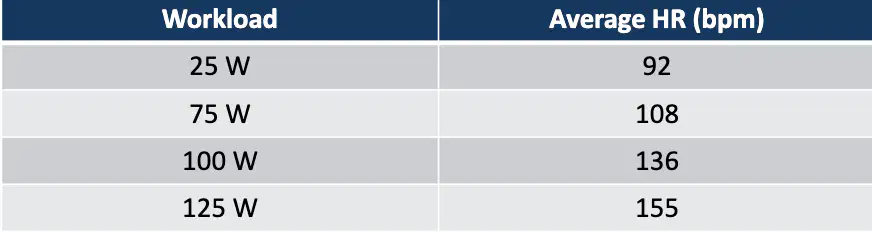
Angelina weighs 68 kg and is 52 years old. this is her YMCA data. what is her HBR for her estimated VO2max (have to look at HBR tables)
(a)
which of the following is NOT part of the YMCA test protocol
the second workload is based on the HR from the last minute of workload 1
goal = to increase HR bw 110bpm - 85%HRmax for 2 consecutive stages
measure HR within final 15 sec of each minute of each stage
ask client for RPE at the end of each minute of each stage
what must happen before increasing client to the next workload in a YMCA test
they must be in ssHR, values ± 5 bpm, within in the last 2 mins
no signs of intolerance
must complete at least 3 mins of each stage
ask for their RPE
which of the following MSK protocols test muscular endurance
push-ups
back extension
forearm plank
vertical jump
what is NOT part of predicted 1-RM testing procedure
warm up with ~5 reps of ~40-60% 1-RM
if client completes +10 reps, add weights and repeat until only 6-10 reps can be completed
allow 3-5 mins of rest between sets
if client completes 3 sets of +10 reps, let them rest for 20 minutes then keep trying
what factors affect the validity and reliability of MSK tests?
name 3 of the 7 skills for motivational interviewing
things to keep in mind when talking to a client
eye contact
vocal tone & rate of speech
body language & physical space
avoid expert trap
what are the 3 core questions of BAP?
what are the 5 core skills of BAP?
J WOWW is overweight and her Dr encouraged her to start exercising. She denies having a problem and does not intend on changing her habits. using TTM, what stage is J WOWW in? what are 2 strategies you would use in a counselling session with her?
Sammi is a 25 year old recent college graduate with a BMI of 25. her Dr advised her to spend less time sitting, she wants to start making changes this month but doesn't know how. she enjoys the eliptical and watching TV. how would you characterize Sammi in the HAPA? list 3 constructs that should be targeted to help her be more consistent in her routine.

