
 Worksheets
Unit 4: Temperature and Molecular Motion
Total questions: 106
Worksheet time: 54mins
What is the scientific definition of temperature?
The average kinetic energy of molecules in a substance
The amount of heat in a substance
The color of a substance
The size of a substance
According to the text, what happens to molecules in a liquid, solid, or vapor?
They are always in motion and bump into each other
They stay still and do not move
They change color
They disappear
If you compare the molecules in a cup of hot cocoa to those in a glass of cold chocolate milk, what would you observe?
The hot cocoa molecules move much faster than the cold chocolate milk molecules
The cold chocolate milk molecules move faster than the hot cocoa molecules
Both move at the same speed
The molecules in hot cocoa do not move
Why do molecules have kinetic energy?
Because they are moving
Because they are colored
Because they are large
Because they are cold
Explain how the movement of molecules relates to the temperature of a substance. Use evidence from the text to support your answer.
The faster the molecules move, the higher the temperature because they have more kinetic energy
The slower the molecules move, the higher the temperature
The movement of molecules does not affect temperature
Temperature is only affected by the color of the substance
What happens to most materials when they are heated?
They contract
They expand
They freeze
They evaporate
Which temperature scale is considered the metric scale?
Fahrenheit
Kelvin
Celsius
Rankine
What is the boiling point of water in Fahrenheit?
100°F
212°F
32°F
98.6°F
At what temperature do molecules stop moving, known as absolute zero, in Celsius?
0°C
-273.15°C
100°C
25°C
Why does the liquid in a thermometer rise when the temperature increases?
The liquid contracts
The liquid evaporates
The liquid expands
The liquid freezes
If the room temperature is 25°C, what is the equivalent temperature in Kelvin?
273.15 K
298.15 K
310.15 K
373.15 K
Explain why molecules cannot get colder than absolute zero.
Because molecules evaporate at absolute zero
Because molecules freeze at absolute zero
Because molecules stop moving at absolute zero
Because molecules expand at absolute zero
Which of the following is the correct formula to convert Celsius (°C) to Fahrenheit (°F)?
T(°F) = (T(°C) × 9/5) + 32
T(°F) = (T(°C) × 5/9) + 32
T(°F) = (T(°C) - 32) × 5/9
T(°F) = (T(°C) + 273.5)
What is the SI unit for temperature that scientists frequently use?
Kelvin (K)
Celsius (°C)
Fahrenheit (°F)
Joule (J)
Which formula is used to convert Celsius (°C) to Kelvin (K)?
T(K) = T(°C) + 273.5
T(K) = T(°C) × 9/5 + 32
T(K) = T(°C) - 273.5
T(K) = T(°C) × 5/9
What is the definition of thermal energy?
The sum of the kinetic and potential energies of all molecules in a substance
The average kinetic energy of molecules in a substance
The transfer of energy from warmer to cooler objects
The amount of energy needed to raise the temperature of 1 gram of water by 1°C
How does thermal energy differ from temperature?
Thermal energy is the sum of kinetic and potential energy, while temperature is the average kinetic energy
Thermal energy is the average kinetic energy, while temperature is the sum of kinetic and potential energy
Thermal energy and temperature are the same
Thermal energy is only potential energy, while temperature is only kinetic energy
If a single brick and a stack of bricks are at the same temperature, why does the stack have more thermal energy?
Because the stack has more molecules, so the sum of their kinetic and potential energy is greater
Because the stack is hotter
Because the single brick has more potential energy
Because temperature increases with the number of bricks
What is the technical definition of heat?
The transfer of thermal energy from warmer to cooler objects
The sum of kinetic and potential energy in a substance
The average kinetic energy of molecules
The amount of energy needed to change state
Which direction does thermal energy always move?
From warmer to cooler objects
From cooler to warmer objects
In both directions equally
It does not move
What happens to thermal energy transfer between two substances when they reach the same temperature?
It stops
It increases
It reverses direction
It doubles
Which of the following is the transfer of heat from a warmer object to a cooler object through direct contact?
Conduction
Radiation
Convection
Insulation
What is the process called when heat is transferred through electromagnetic rays, such as the sun heating the earth?
Conduction
Radiation
Convection
Evaporation
Which method of thermal transfer involves the movement of a fluid, such as air or water?
Conduction
Radiation
Convection
Absorption
What is a convection current?
A current in a solid that moves heat around
A current in a fluid that moves heat around
A current in a gas that prevents heat transfer
A current in a vacuum that transfers heat
If you touch a hot stove with your hand and feel heat, which type of thermal transfer is occurring?
Conduction
Radiation
Convection
Reflection
How can you enhance the flow of air (convection) in your home?
By opening windows
By using a ceiling fan
By turning off the heater
By closing all doors
A student sits next to a campfire and feels warmth. Which type of heat transfer is responsible for this sensation?
Conduction
Radiation
Convection
Insulation
Explain how convection currents work in a room heated by a heater. Use reasoning and evidence from what you know about heat transfer.
Warm air from the heater rises, cools down, then sinks back to the floor, creating a cycle that moves heat around the room.
Warm air from the heater stays at the bottom of the room and does not move.
Cool air from outside enters the room and immediately heats up without moving.
Heat is transferred only by direct contact with the heater.
What's the difference between temperature and thermal energy?
Temperature is a measure of how hot or cold something is, while thermal energy is the total energy of all the particles in an object.
Temperature is the total energy of all the particles, while thermal energy is just how hot or cold something is.
Temperature and thermal energy are exactly the same thing.
Temperature is only found in liquids, while thermal energy is only found in solids.
If you have a large and a small glass of juice, both at room temperature, which one has more thermal energy?
The large glass of juice
The small glass of juice
Both have the same thermal energy
Neither has any thermal energy
__________ is the transfer of heat through the movement of a fluid such as water or air.
Convection
Conduction
Radiation
Insulation
What kind of heat transfer happens in a microwave?
Radiation
Conduction
Convection
Evaporation
When you lick a Popsicle, how does the thermal energy travel between the Popsicle and your tongue? What kind of heat transfer is that?
Conduction
Convection
Radiation
Evaporation
What is the formula to convert Celsius to Kelvin?
K = °C + 273
K = °C - 273
K = °C × 273
K = °C ÷ 273
Thermal energy always moves from ____ to ____ energy.
High, low
Low, high
Cold, colder
Solid, liquid
When an object heats up, it ________. When an object cools down, it ___________.
Expands, contracts
Contracts, expands
Melts, freezes
Freezes, melts
What is the difference between temperature and thermal energy?
Temperature is the sum of kinetic and potential energies, while thermal energy is the average kinetic energy of molecules.
Temperature is the average kinetic energy of molecules, while thermal energy is the sum of kinetic and potential energies of all the molecules in a substance.
Temperature and thermal energy are the same thing.
Temperature is only related to potential energy, while thermal energy is only related to kinetic energy.
Why does a larger glass of juice have more thermal energy than a smaller one?
Because it is colder.
Because it has more molecules, which means more kinetic and potential energy.
Because it is in a bigger container.
Because it is a different color.
Which type of heat transfer occurs mainly through fluids like air and water?
Conduction
Radiation
Convection
Reflection
What is the main method of heat transfer from the Sun to the Earth?
Conduction
Convection
Radiation
Evaporation
When you touch a Popsicle and it melts, what kind of heat transfer is occurring?
Convection
Radiation
Conduction
Insulation
What is the correct formula to convert temperature from Kelvin to Celsius?
T(°C) = T(K) + 273.5
T(°C) = T(K) - 273.5
T(°C) = T(K) × 273.5
T(°C) = T(K) ÷ 273.5
Heat always travels from areas of ______ temperature to areas of ______ temperature.
Low, high
High, low
Medium, high
Low, medium
When most substances are heated, they ______; when cooled, they ______.
Expand, contract
Contract, expand
Melt, freeze
Freeze, melt
What is an oscillation?
An up-and-down or back-and-forth motion
A straight line movement
A circular motion
A stationary position
What do waves carry?
Energy
Water
Air
Light only
What is a vacuum?
Space that has no matter in it
Space filled with air
Space filled with water
Space filled with light
Waves that move through matter are called:
Mechanical waves
Electromagnetic waves
Sound waves
Light waves
Waves that move through vacuums are called:
Electromagnetic waves
Mechanical waves
Sound waves
Water waves
Explain the difference between mechanical waves and electromagnetic waves using examples.
Mechanical waves require matter to travel, like sound waves; electromagnetic waves can travel through vacuums, like light waves.
Mechanical waves travel only in vacuums, like light; electromagnetic waves travel only in matter, like sound.
Both mechanical and electromagnetic waves require matter to travel.
Mechanical waves and electromagnetic waves are the same and travel through both matter and vacuums.
Which of the following is an example of a mechanical wave?
Light waves
X-rays
Waves in water created from the back of a speedboat
Radio waves
What do mechanical waves require to travel?
A vacuum
Matter
Light
Energy only
Which of the following is NOT an example of an electromagnetic wave?
Light waves
X-rays
Radio waves
Sound waves
What is amplitude in the context of waves?
The speed of a wave
One-half the distance between a wave's crest and trough
The length of a wave
The frequency of a wave
Why do waves in the ocean with more energy have larger amplitudes?
They move slower
They are taller and farther displaced from the regular waterline
They have shorter wavelengths
They have lower frequency
If you were in outer space, why wouldn't you hear any sounds?
There is too much light
There is no air for the waves to travel through
The temperature is too low
Sound waves travel faster in space
Explain how talking creates sound waves and how these waves travel from mouth to ear.
By transferring vibrations from molecule to molecule
By emitting light waves
By creating electromagnetic waves
By producing radio waves
Describe the difference between mechanical waves and electromagnetic waves in terms of their ability to travel through matter.
Both require matter to travel
Only electromagnetic waves can travel in a vacuum
Only mechanical waves can travel in a vacuum
Neither can travel in a vacuum
What is the term for the highest point of a wave?
Crest
Trough
Amplitude
Frequency
How is wavelength measured on a wave?
From crest to trough
From crest to crest or trough to trough
From amplitude to resting point
From frequency to amplitude
Which Greek letter is used to represent wavelength?
Alpha (α)
Lambda (λ)
Omega (ω)
Sigma (σ)
If red light has a longer wavelength than blue light, what can you infer about their frequencies if both travel at the same speed?
Red light has a higher frequency than blue light
Red light has a lower frequency than blue light
Both have the same frequency
Frequency does not depend on wavelength
What is the unit for frequency?
Meter (m)
Second (s)
Hertz (Hz)
Newton (N)
If the frequency of a wave increases and the speed stays the same, what happens to the wavelength?
It increases
It decreases
It stays the same
It doubles
What is the equation for wave speed?
wave speed = frequency × wavelength
wave speed = wavelength ÷ frequency
wave speed = frequency + wavelength
wave speed = frequency - wavelength
Which unit is used to measure wave speed?
Meters per second (m/s)
Hertz (Hz)
Meters (m)
Seconds (s)
If ten waves pass a dock in 10 seconds, what can you say about the frequency of the waves compared to two waves passing in 10 seconds?
The frequency is higher.
The frequency is lower.
The frequency is the same.
The frequency cannot be determined.
What happens to the wavelength when the frequency of waves increases, assuming the speed is constant?
The wavelength becomes shorter.
The wavelength becomes longer.
The wavelength stays the same.
The wavelength doubles.
Which of the following is the correct abbreviation for the wave speed equation?
v = f × λ
v = λ ÷ f
v = f + λ
v = λ - f
Frequency is measured in which unit?
Hertz (Hz)
Meters per second (m/s)
Meters (m)
Seconds (s)
Wavelength is measured in which unit?
Meters (m)
Hertz (Hz)
Meters per second (m/s)
Seconds (s)
Why must ten waves be closer together than two waves if both pass a dock in the same amount of time and travel at the same speed?
Because higher frequency waves have shorter wavelengths.
Because lower frequency waves have shorter wavelengths.
Because the speed of the waves is different.
Because the dock is moving.
What is reflection?
When a wave bounces off a surface
When a wave passes through a surface
When a wave is absorbed by a surface
When a wave disappears
Which law explains that a wave reflects at the same angle as the angle it moved toward the barrier?
Law of Refraction
Law of Reflection
Law of Diffraction
Law of Absorption
If a wave moves toward a wall at 90 degrees, at what angle will it bounce off?
45 degrees
180 degrees
90 degrees
60 degrees
What is refraction?
The bouncing of waves off a surface
The bending of waves as they travel through different mediums
The absorption of waves by a surface
The disappearance of waves in a medium
Why does a pencil look distorted when placed in a glass of water?
Because the pencil is broken
Because light waves travel faster in water than in air
Because light waves reflecting off the pencil travel faster in air than underwater
Because the water absorbs all the light
An echo is an example of which phenomenon?
Refraction of a sound wave
Absorption of a sound wave
Reflection of a sound wave
Diffraction of a sound wave
What causes refraction?
Waves traveling at the same speed in all mediums
Waves bouncing off a surface
Waves traveling at different speeds in different mediums
Waves being absorbed by a medium
Why do your legs sometimes look short when you’re standing in a pool?
Because of the law of reflection
Because of refraction of light waves
Because of absorption of light waves
Because of diffraction of light waves
What is the name given to the ray that moves toward the barrier before reflection?
Reflected ray
Incident ray
Absorbed ray
Refracted ray
What is the name given to the ray that bounces off the barrier after reflection?
Incident ray
Reflected ray
Absorbed ray
Refracted ray
What is diffraction?
The bending of waves around a barrier or the spreading of waves past small openings.
The reflection of waves off a surface.
The absorption of waves by a material.
The increase in speed of waves as they travel.
What is the result called when waves collide with each other?
Interference
Reflection
Refraction
Absorption
Which of the following best describes constructive interference?
Waves combine to form a larger wave.
Waves are absorbed by a surface.
Waves pass through each other without any effect.
Waves slow down as they enter a new medium.
What happens during destructive interference?
Waves interfere and cancel each other out.
Waves combine to form a larger wave.
Waves reflect off a surface.
Waves increase in frequency.
When jumping on a trampoline with friends, what real-life phenomenon do you experience that is similar to wave interference?
Constructive and destructive interference
Refraction and reflection
Diffraction and absorption
Polarization and resonance
If two waves meet and the result is a wave with a smaller amplitude or no wave at all, what type of interference has occurred?
Destructive interference
Constructive interference
Diffraction
Reflection
Explain, using reasoning, why sometimes when you jump on a trampoline with friends, you get launched into the air, and other times you hardly move.
Because of constructive and destructive interference of the forces from each jumper.
Because the trampoline is broken.
Because of the temperature of the air.
Because of the color of the trampoline.
What is absorption?
The transfer of energy from a wave to matter as the wave passes through it.
The bouncing of a wave off a surface.
The spreading out of a wave as it passes through an opening.
The bending of a wave as it enters a new medium.
Why does the ocean appear darker the deeper you swim?
Because more light waves are absorbed as they travel down.
Because the water reflects all the light.
Because the water is colder at deeper levels.
Because there are more fish at deeper levels.
How do recording studios use absorption?
By using sound insulation to absorb sound waves.
By reflecting sound waves off the walls.
By amplifying sound waves.
By letting all sound waves pass through.
When we see a red apple, why does it appear red?
Because every other color except red is absorbed and red is reflected.
Because all colors are reflected.
Because red is absorbed and all other colors are reflected.
Because no colors are absorbed.
What happens to the energy of light rays when they are absorbed?
They are transformed into a different form of energy, such as heat.
They disappear completely.
They are reflected back into the air.
They pass through without any change.
Why do dark colors heat up more in the light compared to light colors?
Because dark colors absorb more light rays.
Because dark colors reflect more light rays.
Because dark colors let all light pass through.
Because dark colors are made of different materials.
A student notices that a black pavement gets very hot on a sunny day. Using your understanding of absorption, explain why this happens.
Black pavement absorbs more light rays, transforming the energy into heat.
Black pavement reflects all light rays, keeping it cool.
Black pavement allows all light rays to pass through.
Black pavement is naturally hot, regardless of sunlight.
What type of waves are electromagnetic waves?
Longitudinal waves
Surface waves
Transverse waves
Standing waves
What does the term "electromagnetic" in electromagnetic waves refer to?
The combination of sound and light fields
The combination of electric and magnetic fields oscillating at 90-degree angles to each other
The combination of water and air waves
The combination of heat and light fields
Which part of the electromagnetic spectrum can humans see with their bare eyes?
Infrared waves
Ultraviolet waves
Visible light
Radio waves
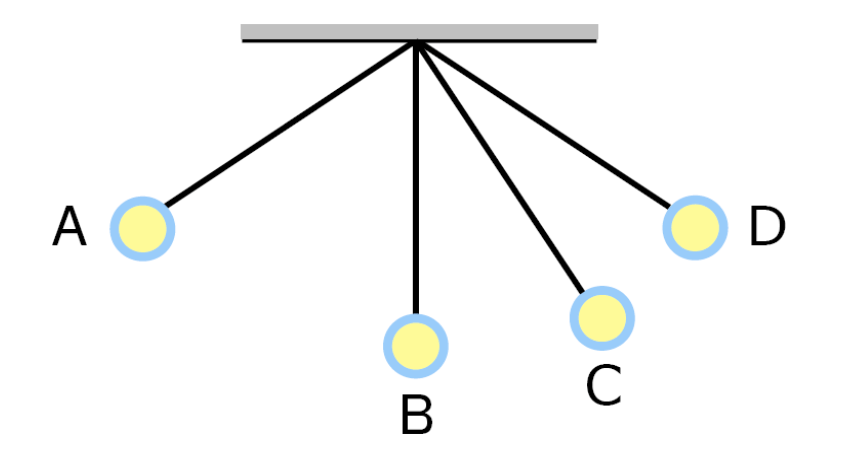
Maximum gravitational potential energy (choose all that apply)
A
B
C
D
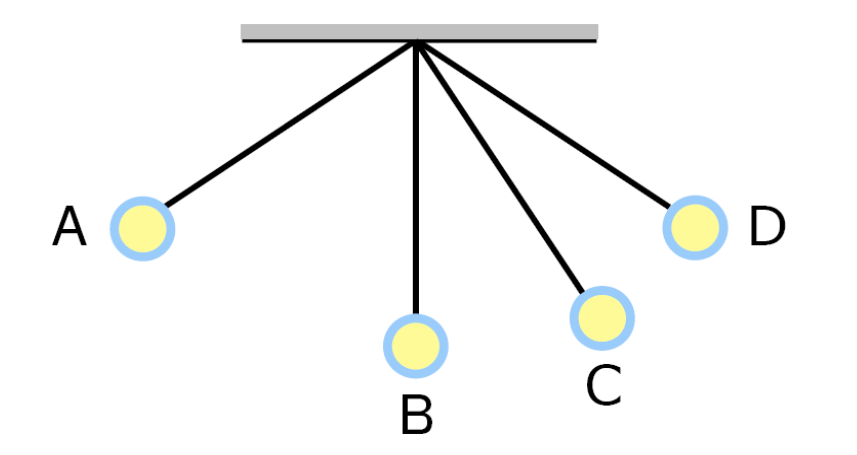
Maximum kinetic energy
A
B
C
D
True or False: Energy can be created or destroyed
True
False
Your body transforms ___ energy into ____ energy to maintain body temperature
nuclear;electromagnetic
electromagnetic;chemical
chemical;thermal
chemical;kinetic
At the top of the roller coaster the cart has ____ energy
potential
kinetic
Energy can neither be destroyed nor ...
created
transformed
changed
transferred

