
 Worksheets
BIO Chapter 2.1 Test Review
Total questions: 55
Worksheet time: 28mins
What sugar is found in RNA?
deoxyribose
nucleic acid
ribose
none of the above
What is the structure of RNA
Double Stranded
Single Stranded
Triple Stranded
Nucleotide
Where in the cell does translation occur?
Nucleus
Cytoplasm
Ribosome
Cell Wall
What is the job of mRNA?
Transcribe the DNA into RNA
Pick up amino acids and transport them to the ribosome
make of the ribosome
make protein
A codon consists of
3 consecutive nucleotides that specify for a single amino acid
1 nucleotide that specify for a protein
3 consecutive nucleotides that specify for an anticodon
a nucleotide that specify for a sugar and phosphate
Which of the following is NOT a similarity between DNA and RNA?
its composed of a nucleotide that consists of a sugar, phosphate group and nitrogenous base
Contains adenine, guanine, and cytosine
Contains uracil
all of the above
the "reading" frame of the genetic message by inserting or deleting a nucleotide is
A frameshift mutation
A point mutation
An anticodon
A genetic message
_________ takes places in the nucleus using DNA in the nucleus as a template for the formation of proteins.
Translation
Transcription
Genetic message
Codon
_______ is an expressed sequence of DNA; does code for a protein
Exon
Introns
RNA polymerase
Genetic code
How many amino acids does one codon code for?
1
2
3
4
DNA replication is described as ____________ because each new molecule contains one old strand and one new strand.
redundant
Detailed
Conservative
Semi conservative
What would the mRNA sequence for this DNA molecule be?
TAC GCT
ATG CGA
AUC GCA
AUG CGA
AUG GGU
Which of the following is attached to the transfer RNA (tRNA)?
Nucleus
Mitochondion
Chloroplast
Ribosome
What are the parts of protein synthesis?
Transcription and Replication
Translation and Replication
Transcription and Translation
None of the above
What type of RNA is associated with a codon?
mRNA
rRNA
tRNA
sRNA
What nitrogenous base is found in place of thymine in RNA?
Guanine
Adenine
Cytosine
Uracil
What is produced during transcription?
tRNA
ATP
Oxygen
mRNA
What is the actual site of protein synthesis?
Nucleus
Mitochondrion
Chloroplast
Ribosome
How many codons are needed to specify four amino acids?
2
4
8
12
If a portion of a mRNA molecule contains the base sequence AUA, the corresponding tRNA base sequence is
TAT
AUA
UAU
UUA
What is the role of tRNA during translation?
Bond to open DNA strand
Carry ribosomes to the site of protein synthesis
break apart mRNA and send it back to the nucleus
Carry amino acids to the mRNA to form a polypeptide chain
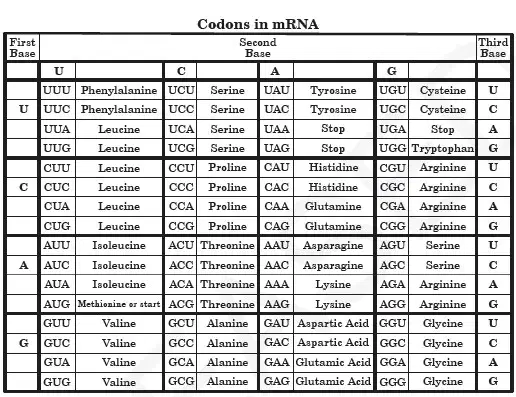
Which of the following changes would be expected if GUA AAC sequences of bases mutated to GAA AAC
The amino acids sequence would be shorter than expected
The identity of one amino acid would change
The identity of more than one amino acids would change
The amino acid sequence would remain unchanged
______________ does not always results in a change to the amino acid sequence of a protein.
Duplication
Framshift Mutation
Inversion
Point Mutation
Together with proteins, rRNA
Provides a site for polypeptide synthesis
Transports amino acids to the ribosome
Travels to the ribosome to direct the assembly of polypeptides
Translate DNA
What is the direct result of translation?
A duplicate DNA molecule
A protein
mRNA
tRNA
What is the direct result of transcription?
A duplicate DNA molecule
mRNA
tRNA
A protein
Which type of mutation is most likely to produce a nonfunctional protein?
Silent Mutaiton
Frameshift Mutation
Substitution Mutation
Point Mutation
Which is NOT external or environmental factors of mutations?
Sunlight
Radiation
Smoking
Cancer
What carries the amino acid?
mRNA
rRNA
tRNA
DNA
_________ is the process of decoding mRNA into an amino acid sequence
Transcription
Translation
Protein Synthesis
None of the above
_________ are changes in the genetic material
Mutation
Transcription
Translation
Genetic code
AUG is the _______ codon
Stop
Start
Skip
Jump
Which of the following is NOT a nitrogenous base in RNA?
Adenine
Guanine
Thymine
Uracil
Each tRNA molecule has three unpaired bases called__________
Codon
Anticodon
Exon
Inron
What type of RNA carries an anticodon?
mRNA
rRNA
tRNA
DNA
In DNA, what nitrogenous base pairs with Thymine?
Adenine
Cytosine
Guanine
Uracil
In DNA, what nitrogenous base pairs with Cytosine
Adenine
Thymine
Guanine
Uracil
Which scientist grew strains of pneumonia bacteria and injected them into mice as well as discovered transformation?
Watson and Crick
Hersey and Chase
Avery
Griffith
Which scientist discovered the structure of DNA?
Watson and Crick
Hershey and Chase
Avery
Griffith
The DNA nucleotide is composed of:
A phosphate group
5 carbon sugar
nitrogenous base
All of the above
What is the structure of DNA?
Single helix
Double helix
Twisted ladder
Double sugar phosphate
What are the chemical bond(s) that hold together the structure of DNA?
Carbon bond
Hydrogen bond
Covalent bond
Ionic bond
What scientist repeated Griffith's work to determine whether DNA, RNA, Lipids, or Proteins caused transformation?
Griffith
Avery
Watson and Crick
Hershey and Chase
________ is the principle that bonds in DNA can form only between adenine and thymine and between guanine and cytosine.
DNA polymerase
Bacteriophage
Transformation
Base Pairing
_________ is the process in which one strain of bacteria is changed by a gene or genes from another strain of bacteria
Transformation
Replication
Replication fork
DNA polyermase
A substitution mutation changes one base in a gene. Which of the following is possible?
Silent Mutation
A missense mutation
Nonsense Mutation
All of the above
__________ is the enzyme that "proofreads" the new strand of DNA, helping to ensure that each molecule is a nearly perfect copy of the original DNA.
Viruses
Replication
Transformation
DNA polymerase
________ is the sites where separation and replication occur.
Replication
Replication fork
Histone
Bacteriophage
Deoxyribonucleic acid
Phosphate
Nitrogenous base
RNA
DNA
In DNA, the sugar and phosphate come together for form
The backbone
A base
A bond
None of the above
Which of the following mutations would have the LEAST effect on a protein?
A deletion of one base near the start
An insertion of one base near the middle
A substitution in the third base of a codon
A frameshift mutation
What enzyme is responsible for unwinding DNA before replication?
Ligase
Polymerase
Helicase
Ribosome
Why is DNA replication critical before a cell divides?
Without replication, daughter cells would not have the full set of genetic instructions
Replication creates proteins directly, ensuring cell survival
It prevents transcription from occurring in the cytoplasm
Replication changes the genetic code to adapt to new environments
If DNA replication were to occur incorrectly duing cell division, which of the following outcomes would MOST likely happen to the daughter cells?
The cells would fail to produce proteins because transcription could not occur
The daughter cells could inherit mutations that may affect protein function
Translation would happen twice in each daughter cell to correct the mistake
The sugar phosphate backbone would be replaced by ribose and uracil
Which of the following is an example of a mutation
Water
Oxygen
Glucose
UV Radiation

