
 Worksheets
Unit 9 Test Review (Ecology)
Total questions: 152
Worksheet time: 2hrs 20mins


97% of the Earth's water is located in....
ground water
the ocean
lakes, rivers, and streams
glaciers

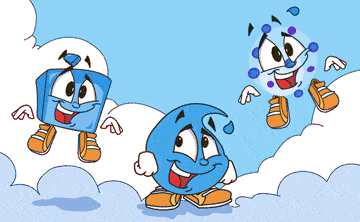
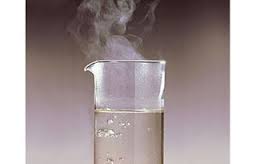
What is liquid water doing when it is changed to water vapor?
evaporating
condensing
precipitating
runoff
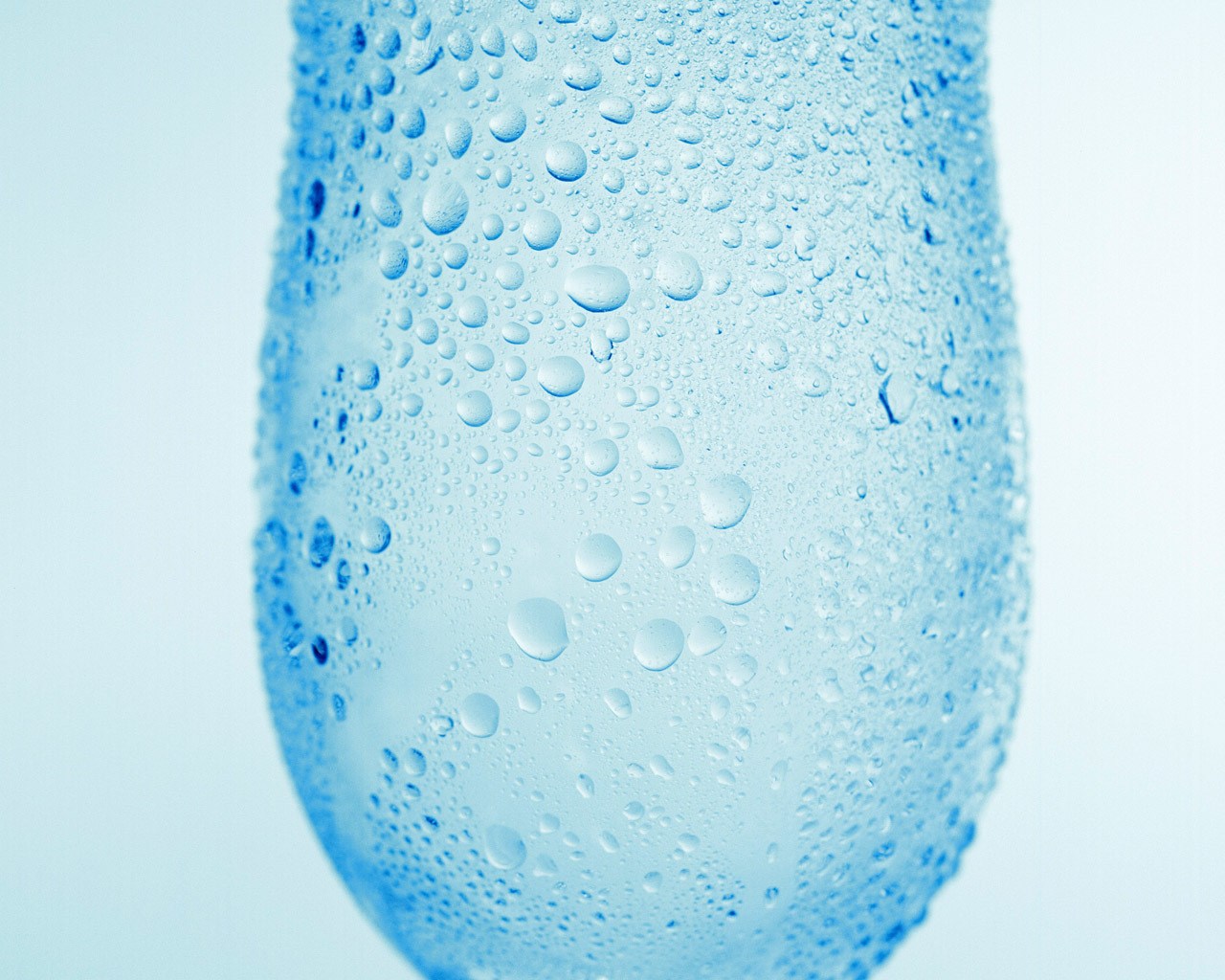
What is water vapor doing when it changes to liquid water?
evaporating
condensing
precipitating
runoff
Carbon dioxide is a gas produced by ___.
precipitation
photosynthesis
decomposition
cellular respiration
Plants use ____________ to make their own food
Water
Sunlight
Carbon dioxide
All of these
Through the process of photosynthesis, plants pull CO2 from the air to make plant food for themselves.
True
False
How do animals get carbon?
By eating plants and or other animals.
They absorb it from the atmosphere.
From the ground
They do not get carbon from anywhere.
When humans EXHALE, we release __________________.
Oxygen
Carbon Dioxide
Nitrogen
Water
Which of the following are fossil fuels?
Coal, water, oil
Oxygen, coal, oil
Coal, Oil, Natural Gas
None of the above
Where can you find carbon?
Only in Earth's atmosphere
Inside all water molecules
Inside the sun
Inside every living thing on Earth
What organisms in the ocean absorb the most carbon dioxide?
Algae and marine plants
Ocean mammals, like whales and dolphins
Fish
Coral
If the plant population decreased, the amount of carbon in the atmosphere would ____________________.
Increase
Decrease
Stay the same
When humans burn fossil fuels, most of the carbon quickly enters the _______________________ as carbon dioxide.
Water
Atmosphere
Sun
Ground
Carbon enters the soil through dead plant or animal matter through what process?
Decomposition
Respiration
Photosynthesis
Diffusion
The circulation of the element Carbon among Earth's atmosphere, land, oceans, and organisms is called _____________.
the Carbon Cycle
the Oxygen Cycle
the Carbon dioxide Cycle
the Water Cycle
How do plants affect the air that animals and people breathe?
Plants use oxygen from the air to make their own food
Plants release pollution into the air
Plants take in carbon dioxide and release oxygen
Plants take in oxygen and release carbon dioxide
What converts nitrogen gas into a usable form for plants and animals?
bacteria
rain
fungi
car exhaust
The process in which nitrogen circulates and is recycled is called
The nitrogen cycle
The carbon cycle
The water cycle
The phosphorus cycle
Organisms that need nitrogen to survive.
only plants
only animals
only bacteria
all living things
How is nitrogen "fixed" into a usable form for plants?
Through action of bacteria only
Through lightning only
Through action of bacteria and lightning
Through photosynthesis
How do animals get the nitrogen they need?
From the air they breathe
From the water they drink
From the food they eat
From the sun
Gas that makes up 78% of our atmosphere.
Oxygen
Nitrogen
Hydrogen
Carbon Dioxide
What is the process of combining nitrogen gas with other elements to make nitrogen into usable compounds?
nitrogen composition
nitrogen fixation
ammonia
denitrification
What is the formula for atmospheric nitrogen?
N
N2
NH3
NO3
What process occurs when dead plant and animal matter decomposes and nitrogen is released back into the atmosphere?
Assimilation
Fixation
Ammonification
Denitrification
Plants and animals cannot use nitrogen directly from the air.
True
False
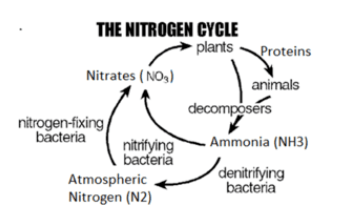
According to this diagram, plants use nitrogen to make _________________________
bacteria
animals
proteins
decomposers
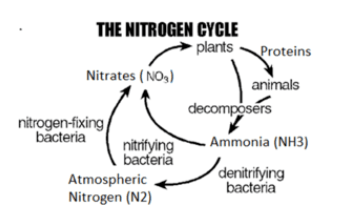
According to this diagram, plants absorb
nitrates
nitrogen fixing bacteria
animals
decomposers
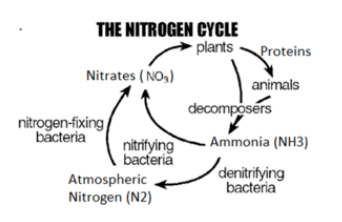
According to this diagram, animals get proteins from eating ________________________
decomposers
bacteria
plants
sunlight
The process that allows organisms to use nitrogen
assimilation
denitrification
fixation
ammonification
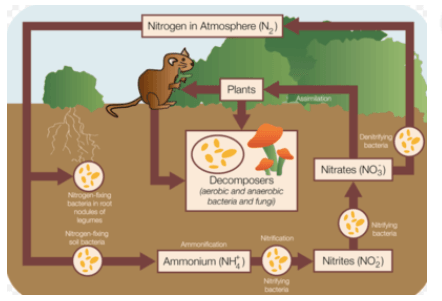
A correct path that nitrogen could take would be
air -> animals -> plants -> bacteria
animals -> air -> bacteria -> plants
bacteria -> air -> plants -> animals
air -> bacteria -> plants -> animals
Bacteria fix nitrogen from the atmosphere into a form plants can use.
True
False
Bacteria create a form of nitrogen that animals can use directly.
True
False
What do free living bacteria in the soil do?
Make clouds
Turn atmospheric nitrogen into nitrates
Make carbon dioxide for plants to go through photosynthesis
Help plants take in water
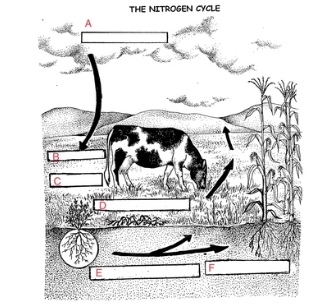
In the nitrogen cycle, what does label A in the diagram represent?
Gas
Clouds
Carbon dioxide in the atmosphere
Nitrogen in the atmosphere
All plants have nitrogen fixing bacteria in their roots.
True
False
This is NOT a part of the phosphorus cycle.
Phosphate is incorporated into sedimentary rocks
Phosphate bound to soil
Atmospheric phosphate
Phosphate is absorbed from the soil by plants
Too much phosphorus in waterways (rivers, lakes) can lead to___________.
eutrophication
Nothing
Death
diseases
An algal bloom is the rapid growth of a population of
fungi
protozoans
algae
Which of the following is NOT true of phosphorus and the phosphorus cycle?
Phosphorus is mined from phosphorus rich rock, which is processed and then added to commercial inorganic fertilizers as well as detergents.
Phosphorus tends to be more localized compared with other biogeochemical cycles that can move more freely in the global system.
Phosphorus is generally found in rocks, sediments, and soil.
Phosphorus does not exist in the atmosphere as a gas.
Living organisms do not need phosphorus.
Phosphorus is mainly found (stored) in the atmosphere.
True
False


If the amount of food or resources available increases, the carrying capacity for an animal.....
Stays the same
Increases
Decreases
Fluctuates

This is the largest number of individuals of a population that the environment can support...
carrying capacity
population crash
lag phase
mutualism

Which type of growth is best illustrated by this rabbit population?
exponential
logistic
S-shaped
predator-prey

What point on the graph represents the carrying capacity?
A
B
C
D

When a population grows past the ecosystem's carrying capacity, what happens to the population?
Continues to grow
The population starts to die off to return to carrying capcity
The population will go extinct due to lack of resources
The population grows then finds a new carrying capacity


In a forest ecosystem, which of the following is the best example of a limiting factor for a rabbit population?
The squirrel population
The amount of sunlight
Amount of grass available
Rabbits have no limiting factors

Water, sunlight, shelter, and space are resources that are often........
abiotic limiting factors
biotic limiting factors
non-limiting factors
exponetial factors

Logistic growth is representative of a population in an environment with .................... resources.
limited
plenty of
no resources
biotic


According to the graph, what is causing the deer population to decrease
They got sick
The wolf population is decreasing
The wolf population increased
They ran out of food

Predator population lags behind prey population because......
Increase in predators leads to decrease in prey
Increase in predators leads to increase in prey
Increase in predators leads to decrease in producers
Increase in producers leads to increase in prey


What is typically the limiting factor for population growth of phytoplankton? (hint: with Eutrophication there is an abundance of this.)
Water
Nutrients
Sunlight
Predation

What is Hypoxia?
High Oxygen
Low Nitrogen
Low Oxygen
High Carbon

What is a cause of eutrophication?
Too much Nitrogen and Oxygen
Too much Nitrogen and Phosphorus
Too much Nitrogen and Carbon
Too much Nitrogen and Aluminum

Reorder the following
Excess Nutrients
Algae Bloom
Decomposition
Hypoxia
Dead Animals

Why would hypoxia be bad for animals?
It is poisonous to their livers
They will get more mutations in their DNA
It can stop them from reproducing.
Animals need Oxygen for Cellular Respiration

Nitrogen is found in...
Carbohydrates
Lipids
Proteins
Sugars

Phosphorus is found in...
Carbohydrates
Nucleic Acids
Lipids
Proteins

Eutrophication
Excess nutrients causing algal growth and hypoxia
Hypoxia
Low Oxygen
Nitrogen & Phosphorus
Nutrients
Algae & Phytoplankton
Photosynthetic Organisms
Decomposition
Breaking down of substances by microorganisms

This map shows a...
Dead Zone
Hurricane
Red Tide
Tidal Current

What happens to plants at the bottom of a lake that has a dense algal bloom?
They die because they lack oxygen
They thrive
They die because they cannot recieve sunlight.
They produce excess nitrogen and phosphorus

What is Ecology?
Study of Life
Study of relationships between organisms and the environment
Study of Plants and their anatomy, physiology, and purpose in life
Study of Human Society and the connections between groups/ cultures
Which is a population?

Which biome do we live in according to this map?
Desert
Tropical Rain Forest
Temperate Deciduous Forest
Tundra
Label the Diagram
Which two are Autotrophs?

Photosynthetic organisms produce glucose from CO2 with energy from where?
More Glucose
The Sun
Eating Plants
Deep underwater thermal vents
Which three are heterotrophs?

Herbivore
Rabbit
Carnivore
Lion
Omnivore
Human
Scavenger
Vulture
Detritivore
Mushroom

Two Redbud Trees compete for water.
Intraspecific Competition
An Alligator and Cheetah both want to eat a baby Zebra
Interspecific Competition
Monopoly
No Competition
In a predator-prey relationship... If the population of prey declines, the population of predators will likely (a) . If the population of predators declines, the population of prey will likely (b) . If the population of prey increases, we expect the number of predators to (c) . If the number of predators increases, we expect the population of prey to (d) .

Ecosystem Services
Positive benefit that wildlife or ecosystems provide to people.
Provisioning
Benefit to people. can be extracted from nature.
Regulating
Benefit from ecosystem processes that moderate natural phenomenon.
Eutrophication
Excess nutrients cause an increase in plant growth but kills animals.
Ecology
Study of the relationship between organisms and their environment.

What could provide an ecosystem service? (a)

What ecosystem services do Mangrove trees provide?
Protection from rising sea levels
Firewood, Charcoal
Increase biodiversity, which is beneficial for fisherman
All of the Above

Provisioning Service
Firewood
Supporting Service
Soil creation
Cultural Service
National Parks
Regulating
Water purification

Provisioning
Extracted resources from nature
Supporting
Supports basic life and all other services
Cultural
non-material benefits from ecosystems
Regulating
benefits from natural processes and phenomena

Which is NOT an ecosystem service
Mangroves protecting the coastline
Plants purifying drinking water
Mountains that are used for snowboarding or skiing
Concrete barrier that stops the tornaders

Provisioning Service
Hemp Clothes
Supporting Service
Photosynthesis
Cultural Service
Paintings of nature
Regulating
Pollination

Provisioning Service
Oil/ Fuel
Supporting Service
Nutrient Cycling
Cultural Service
Eco-Tourism
Regulating
Erosion Control

Provisioning Service
Seafood
Supporting Service
Primary Productivity
Cultural Service
Folklore about nature
Regulating
Climate Control

Which service is necessary for all other services to exist?
Provisioning
Cultural
Supporting
Regulating


Primary succession

pioneer species

abiotic factor

secondary sucession

climax community
___ are the first organisms to colonize an area and begin the process of ecological succession.
foundational organisms
introductory organisms
primary organisms
pioneer species
Primary succession occurs in an area that has:
Has Soil
Has No Soil
Has Some Soil
none of these
What is the main difference between primary and secondary ecological succession?
Primary begins WITHOUT soil; Secondary begins WITH soil
Primary is the first state and secondary is the second stage
Primary builds plant community; secondary builds animal community.
Primary begins WITH soil; Secondary begins WITHOUT soil
What is an example of an area that is likely to undergo primary succession?
Glaciers melt and leave exposed rock
Plants die from drought and decompose
Land is bulldozed and soil remains


After a volcanic eruption, volcanic rock is present (but no soil). Which of the following states the most likely order of succession that would be seen?
Lichens → Shrubs → Grasses → Trees
Lichens → tree → shrubs→Grasses
Grasses → Lichens → Shrubs → Trees
Lichens → Grasses → Shrubs → Trees

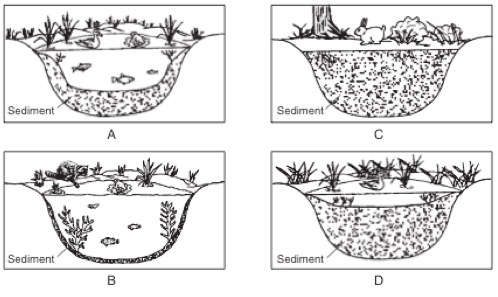
Primary or secondary ecological succession?


What is the process of combining nitrogen gas with other elements to make nitrogen into usable compounds?
nitrogen composition
nitrogen fixation
ammonia
denitrification
What process occurs when dead plant and animal matter decomposes and nitrogen is released back into the atmosphere?
Assimilation
Fixation
Ammonification
Denitrification
Why is combustion an important process in the carbon cycle?
It turns fossil fuels into carbon dioxide.
It turns once living things and organic matter into fossil fuels.
It turns carbon dioxide into glucose, so animals can eat the carbon.
It turns glucose into carbon dioxide, which gets released into the air.
What is true about nutrients in the ecosystem (such as water, carbon, and nitrogen)?
They are not affected by humans in the ecosystem.
They cannot be recovered if they are lost in the ecosystem.
They cycle through the ecosystem in different forms to support life.
They are usually only found in one form in the ecosystem to support life.
Why is decomposition an important process in the carbon cycle?
It turns fossil fuels into carbon dioxide.
It turns once living things and organic matter into fossil fuels.
It turns carbon dioxide into glucose, so animals can eat the carbon.
It turns glucose into carbon dioxide, which gets released into the air.
Why is respiration an important process in the carbon cycle?
It turns fossil fuels into carbon dioxide.
It turns once living things and organic matter into fossil fuels.
It turns carbon dioxide into glucose, so animals can eat the carbon.
It turns glucose into carbon dioxide, which gets released into the air.
Why is photosynthesis an important process in the carbon cycle?
It turns fossil fuels into carbon dioxide.
It turns once living things and organic matter into fossil fuels.
It turns carbon dioxide into glucose, so animals can eat the carbon.
How does a lion obtain the carbon it needs from a grass plant?
The lion breathes in carbon given off by the grass.
The lion cannot obtain the carbon in a grass plant.
The lion absorbs the carbon given off by transpiration.
The lion eats the antelope that ate the grass.
Within the carbon cycle, anything that absorbs more carbon from the atmosphere than it releases.
carbon sink
carbon source
Within the carbon cycle, anything that releases more carbon into the atmosphere than it absorbs.
carbon sink
carbon source
What converts nitrogen gas into a usable form for plants and animals?
bacteria
rain
fungi
car exhaust

