
Font size
 Worksheets
Mr. Bradley's Water Distribution
Total questions: 88
Worksheet time: 3570secs

Water underground is stored in ____________.
aquifers
reservoirs
wells
depositories
Approximately _____ percent of Earth's water is freshwater.
97
1
3
10
What percent of Earth's freshwater is available for humans to use?
3
less than 1
97
10
How does most of the water in the water cycle move from lakes and rivers directly back into the atmosphere?
precipitation
respiration
evaporation
condensation
Which step in the water cycle involves returning of fresh water to the Earth?
precipitation
evaporation
respiration
condensation
What occurs during the process of condensation in the water cycle?
a change in state from solid to liquid
a change in state from liquid to gas
a change in state from gas to liquid
a change in state from liquid to solid
In general, surface water always flows
from south to north
toward the equator
from north to south
downhill
How are evaporation and transpiration similar?
Both processes occur immediately before precipitation in the water cycle.
They are both processes in which liquid water is changed into water vapor.
They both occur in the biosphere.
They both process water in its solid state.
Evaporation and transpiration are two processes included in the water cycle. The energy source that drives these processes is
the burning of fossil fuels.
the Sun.
convection within Earth's mantle.
nuclear fission.
The Sun heats the Earth's water. This warm water turns into a vapor, and rises into the atmosphere, where it cools off. What happens to this water vapor?
The water vapor evaporates and escapes into space. New water is formed by precipitation.
The water vapor only rises for a very short time, then settles back into the ocean unnoticed.
The water vapor pushes clouds out of the way as it rises. This causes overcast conditions to clear.
The water vapor condenses as it cools, then it forms clouds. It later returns to the Earth as precipitation.
Clouds are formed when water vapor
rises and heats up.
rises and cools down.
falls and cools down.
falls and heats up.

What do you call the process, after precipitation occurs, in which water flows downhill?
surface runoff
accumulation
condensation
transpiration
What are four steps to the water cycle?
precipitation, evaporation, rain, and sunlight
condensation, cloud formation, rain and sunlight
evaporation, condensation, precipitation, and surface runoff
sun light, rain, surface runoff, and precipitation
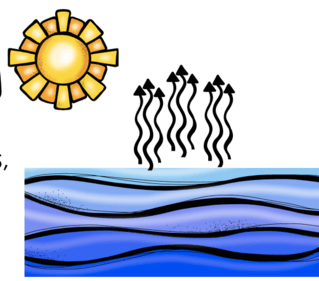

Which part of the ocean would have the lowest salinity?
in areas near melting glaciers
in areas near the equator
in areas with the highest temperatures
in areas where there is little rainfall
Only 3% of the water on Earth is freshwater. About 60% of that water is not available for man's use. Why is this?
It is frozen
It is polluted
It is too salty
It is in aquifers
Which step in the water cycle involves returning of fresh water to the Earth?
precipitation
evaporation
respiration
condensation
How does most of the water in the water cycle move from lakes and rivers directly back into the atmosphere?
precipitation
respiration
evaporation
condensation
What occurs during the process of condensation in the water cycle?
a change in state from solid to liquid
a change in state from liquid to gas
a change in state from gas to liquid
a change in state from liquid to solid
Water moves from Earth's surface to the atmosphere and back to Earth's surface again in a process known as the water cycle.Which of the following is the major form of energy driving the water cycle?
solar energy
nuclear energy
geothermal energy
chemical energy

Humans, like all other organisms, need fresh water to survive. Of all the water found on Earth, how much of it is fresh water?
about 3%
less than 1%
about 30%
more than 70%
In general, surface water always flows
from south to north
toward the equator
from north to south
downhill

The diagram shows the distribution of water on the Earth. Which source is the most abundant supply of liquid surface water that is not salty?
groundwater
oceans
lakes
rivers
How are evaporation and transpiration similar?
Both processes occur immediately before precipitation in the water cycle.
They are both processes in which liquid water is changed into water vapor.
They both occur in the biosphere.
They both process water in its solid state.
Evaporation and transpiration are two processes included in the water cycle. The energy source that drives these processes is
the burning of fossil fuels.
the Sun.
convection within Earth's mantle.
nuclear fission.
The Sun heats the Earth's water. This warm water turns into a vapor, and rises into the atmosphere, where it cools off. What happens to this water vapor?
The water vapor evaporates and escapes into space. New water is formed by precipitation.
The water vapor only rises for a very short time, then settles back into the ocean unnoticed.
The water vapor pushes clouds out of the way as it rises. This causes overcast conditions to clear.
The water vapor condenses as it cools, then it forms clouds. It later returns to the Earth as precipitation.
Clouds are formed when water vapor
rises and heats up.
rises and cools down.
falls and cools down.
falls and heats up.

The graphic shows that 97% of Earth's water is contained in a single reservoir. The remaining 3% is made up of many other reservoirs. What reservoir contains 97% of Earth's water?
a freshwater lake
a glacier
groundwater
the ocean
What is the main source of groundwater?
morning dew collecting on the surface of shrubs and grasses
saltwater flowing into fault lines at the ocean floor
precipitation seeping through pores and cracks in the ground
precipitation falling into man-made wells

The graphic shows that only 3% of the Earth's water is fresh water. The graphic also shows that of this 3%, almost all of it is contained in two reservoirs. What are the two reservoirs that contain almost all of Earth's fresh water?
glaciers and groundwater
streams and estuaries
marshes and swamps
lakes and rivers

The diagram shows the distribution of water on the Earth. Based on the diagram, which is true?
Most of Earth's water is fresh water.
Most of Earth's fresh water is contained in glaciers and ground water.
Most of Earth's water is contained in glaciers.
Most of Earth's fresh water is contained in the oceans.
What do you call the process, after precipitation occurs, in which water flows downhill?
surface runoff
accumulation
condensation
transpiration
Which of the following is an example of condensation in the water cycle?
the formation of water vapor
the formation of clouds
the formation of icebergs
the formation of ground water
Niko was hiking in the mountains when he found a spring, or a place where water naturally flows out of the ground. Where did the water in the spring come from?
It is water that was squeezed out of an igneous rock when the rock changed.
It is water that was produced by organisms living underground.
It is precipitation that fell on the ground and seeped down to a layer of rock.
It is water that condensed underground when the soil became colder during the winter.
Rain, freezing rain, sleet, snow, and hail are all examples of
condensation.
infiltration.
evaporation.
precipitation.
What are four steps to the water cycle?
precipitation, evaporation, rain, and sunlight
condensation, cloud formation, rain and sunlight
evaporation, condensation, precipitation, and surface runoff
sun light, rain, surface runoff, and precipitation

The image shows the stages in the water cycle. Which letter shows the stage when water flows back to bodies of water as runoff?
W
X
Y
Z
What is precipitation?
Sweat from our bodies on hot days
Warm rain but not cold snow or sleet
Gas that we use in furnaces or ovens
Any form of water that falls from the sky

What is the energy source that drives the water cycle?
The moon
The heat from our home
The sun
The heat from the core of the earth
Water in its gas form is called ____________________,
water vapor
precipitation
ice
air
The image shows the stages in the water cycle. Which letter shows the stage when water is heated and turns into water vapor as evaporation?
W
X
Y
Z
The image shows the stages in the water cycle. Which letter shows the stage when water vapor cools and turns back into liquid water drops in the clouds as condensation?
W
X
Y
Z
The image shows the stages in the water cycle. Which letter shows the stage when water falls from the sky in different forms of precipitation?
W
X
Y
Z
The Earth is covered with about 97% salt water.
true
false
About 3% of the water on Earth is freshwater.
True
False
The _______________ is known as the continuous movement or cycle of water on Earth that never ends.
weather cycle
storm cycle
water cycle
all of the above
Which one of the following answer choices does this scenerio describe? Large clouds begin to form over the oceans.
transpiration
evaporation
condensation
precipitation
Which one of the following answer choices does this scenerio describe? The rain began pouring very heavy on the ground.
precipitation
condensation
evaporation
transpiration
Which one of the following answer choices does this scenerio describe? When you boil water in a pot, steam rises from it.
condensation
evaporation
transpiration
precipitation
Where does runoff end up?
ponds in meadows
streams in the mountains
rivers in valleys
all of the above because they're bodies of water
What makes water change forms in the water cycle?
the air
the rain
the sun
the ground
Where is most of Earth's Freshwater found?
Ice caps and glaciers
Rivers, lakes, and streams
In the atmosphere
In the groundwater
Which one of the following answer choices does this scenario describe? After a thunderstorm, rain water runs off down the hillside.
evaporation
condensation
precipitation
runoff

