Wayground logo

Free Printable Worksheets

Font size

S
M
L
XL
Worksheets

Bio 1201 - Gregg - SI 4/3

Total questions: 57

Worksheet time: 57mins

Name
Class
Date
1.

Which of the following are true of meiosis? Select all that apply!

a)

It results in four cells

b)

It results in two cells

c)

The daughter cells are genetically identical

d)

The daughter cells are genetically unique

e)

The daughter cells are haploid

2.

Crossing over occurs between _________.

a)

Sister chromatids

b)

Non-sister chromatids from different homologous pairs

c)

Non-sister chromatids from the same homologous pair

d)

Homologous chromosome pairs

3.

_____ are separated during Meiosis I, and _____ are separated during Meiosis II.

a)

Chromosomes; spindle fibers

b)

Non-sister chromatids; sister chromatids

c)

Sister chromatids; homologous pairs

d)

Homologous pairs; sister chromatids

4.

When does crossing over occur?

a)

Metaphase I

b)

Metaphase II

c)

Anaphase I

d)

Prophase I

e)

Anaphase II

5.
What is one of two forms of a gene that can be two forms, dominate or recessive?
a)
Genotype
b)
Phil Swift
c)
Gene
d)
Allele
6.
What law is it when the alleles of each gene separate to make new genes?
a)
Law of segregation
b)
Law of independent assortment
7.
What is it when both alleles are dominate and heterozygous?
a)
A big oof
b)
Just a normal thing
c)
Codominance
d)
Incomplete dominance
8.
What law states that allele pairs in offspring will be different from the parents?
a)
Law of segregation
b)
Law of independent assortment
9.

Mendel discover:

a)

traits of offspring were simply blends of their parents’ traits.

b)

traits of offspring were simply cause by the environment.

c)

traits are passed on from parents to their children.

d)

the storks bring the babies to the parent with random traits

10.
What are the possible genotypes for this cross?
a)
TT = 25% Tt= 50% tt=25%
b)
all tall
c)
TT= 75% tt = 25%
d)
Tt = 100%
11.
Heredity is the passing of traits from _____________________ to _____________________
a)
predators to prey
b)
water to rain
c)
parents to offspring
d)
fungi to protists
12.
Offspring receives two sets of _____________ (one from each parent)
a)
blue jeans
b)
genes
c)
machines
d)
pedigree
13.
What is a dominant allele?
a)
A trait that is always shown (capital letter)
b)
A trait that can be hidden (lower case letter)
c)
Alleles that are the same
d)
Alleles that are different
14.
What is a recessive allele?
a)
A trait that is always shown (capital letter)
b)
A trait that can be hidden (lower case letter)
c)
Alleles that are the same
d)
Alleles that are different
15.
What are the two genotypes that show the DOMINANT Phenotype
a)
GG, gg
b)
GG, Gg
c)
Gg, gg
16.
What is the only Genotype that shows the RECESSIVE Phenotype?
a)
GG
b)
Gg
c)
gg
17.

What is transformation?

a)

The use of viruses to transform or genetically


engineer cells.

b)

The measure of how well cells are transformed in a new phenotype.

c)

The insertion of a foreign plasmid into a bacterial cell which results in new acquired traits.

d)

Genetic engineering or transformation of mammalian cells.

18.
In eukaryotes, functional messenger RNA molecules are made from
a)
exons spliced together after introns are removed
b)
introns spliced together after eons are removed
c)
exons spliced together with introns
d)
long pieces of RNA shortened by the Dicer enzyme
19.
Promoters are
a)
genes that code for individual proteins
b)
proteins that bind with DNA and prevent transcription
c)
DNA sequences near operons that regulate transcription
d)
small molecules that bind with repressor proteins
20.
The process by which the genetic code of DNA is copied into a strand of RNA is called
a)
translation
b)
transcription
c)
transformation
d)
replication
21.
Which of the following describes RNA?
a)
RNA is usually double-stranded and contains the base thymine
b)
RNA is usually single-stranded and contains the base uracil
c)
RNA is longer than DNA and uses five bases to encode information
d)
RNA is made in the nucleus of eukaryotic cells and stays there to carry out its functions
22.
In messenger RNA, each codon specifies a particular
a)
nucleotide
b)
enzyme
c)
amino acid
d)
promoter
23.
Which of the following statements about the genetic code is true?
a)
A codon can specify more than one amino acid
b)
Every codon specifies a different amino acid
c)
Some codons specify the same amino acid
d)
Some codons have no function at all
24.
The process of making proteins on the ribosome based on instructions from messenger RNA is called
a)
transcription
b)
transformation
c)
translation
d)
molecular biology
25.
Changes is DNA sequences that affect genetic information are known as
a)
replications
b)
mutations
c)
transformations
d)
translations
26.
A substance that can cause a change in the DNA code of an organism is called a 
a)
toxin
b)
mutagen
c)
nitrogenous base
d)
nucleotide
27.
A group of genes that are regulated together is called a(n)
a)
promoter
b)
operon
c)
intron
d)
allele
28.
Facial dimples and free earlobes are both considered dominant human traits. What are the expected phenotypes of the offspring of a female with dimples and free earlobes (DDFf) and a male with no dimples and attached earlobes (ddff)?
a)
50% with dimples and free earlobes and 50% with dimples and attached earlobes
b)
50% with dimples and free earlobes and 50% with no dimples and attached earlobes
c)
75% with dimples and free earlobes and 25% with no dimples and attached earlobes
d)
75% with dimples and attached earlobes and 25% with no dimples and free earlobes
29.
Normal fruit flies have brownish-yellow bodies, and this body color is dominant. A mutation in the gene for body color can produce flies with an ebony body color. A homozygous normal fruit fly (etet) is crossed with a homozygous ebony fruit fly (ee). What is the predicted outcome of this genetic cross?
a)
All the offspring will have ebony bodies
b)
Of the offspring, 75% will have brownish-yellow bodies and 25% will have ebony bodies
c)
All the offspring will have brownish-yellow bodies
d)
Of the offspring, 75% will have ebony bodies and 25% will have brownish-yellow bodies
30.
In the 1860s Gregor Mendel performed numerous dihybrid crosses between pea plants. Dihybrid crosses involve the study of the inheritance patterns related to two different traits. In guinea pigs the allele for black fur (B) is dominant over the allele for brown fur (b), and the allele for short fur (F) is dominant over the allele for long fur (f). What percentage of the offspring from a BbFf x bbff cross would be expected to be heterozygous for both traits?
a)
0%
b)
25%
c)
50%
d)
100%
31.
What type of inheritance do two alleles have if their traits blend together? 
a)
Incomplete Dominance
b)
Co-Dominance
c)
Mendelian Inheritance
d)
Homozygous Inheritance
32.
This is an example of ___________?
a)
Incomplete dominance
b)
Co-Dominance
33.

Which of the following is not Mendel's reason of choosing pea plants?

a)

Grown easily

b)

Short life cycle

c)

Small plants

d)

Pollination can be controlled

e)

Observable characters

34.

If all F1 generation is Aa, then the expected crossing between parents' genotypes are

a)

AA x Aa

b)

AA x aa

c)

Aa x Aa

35.

The A in both chromosomes represent

a)

phenotype

b)

gene

c)

genotype

d)

locus

36.

In guinea pigs, the allele for short hair (H) is dominant and the allele for long hair (h) is recessive. When a dominant homozygous male and a heterozygous female are bred together, what is the predicted phenotypic ratio for the offspring?

a)

1:1 short hair to long hair

b)

All have short hair

c)

1:3 short hair to long hair

d)

1:3 long hair to short hair

37.

Mating an individual expressing a dominant phenotype, but whose genotype is unknown, with an individual expressing the corresponding recessive phenotype is an example of:

a)

a heterozygous cross

b)

an F1 cross

c)

a parental cross

d)

a test cross

38.

The Law of Independent Assortment is not applicable for

a)

dihybrid inheritance

b)

heterozygous genotype

c)

true breed individuals

d)

linked genes

39.
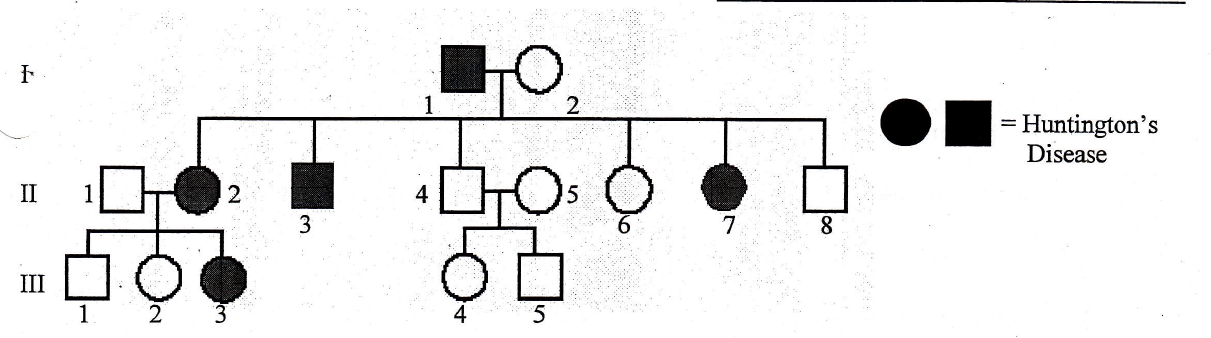
How many generations are shown in this pedigree?
a)
1
b)
2
c)
3
d)
4
40.
How many kids did the mother and father from the first generation have?
a)
2
b)
4
c)
5
d)
6
41.
In the second generation-how many people are carriers of the trait?
a)
2
b)
3
c)
5
d)
6
42.
There are no carriers for Huntington's Disease- you either have it or you don't. Is Huntington's disease caused by a dominant or recessive trait?
a)
Dominant
b)
Recessive
43.

The pedigree below tracks the presence of attached earlobes through a family's generation. Having attached earlobes is an autosomal recessive trait.

What is the genotype of individual I-1?

a)

XeY

b)

ee

c)

EE

d)

Ee

e)

XEY

44.
A mutation that does NOT alter the protein production is called a 
a)
deletion mutation
b)
inversion mutation
c)
silent mutation
d)
transverse mutation
45.
Original: ATC CAT
Mutation: ATC GCAT
What mutation occurred?
a)
deletion
b)
insertion
c)
silent
d)
transverse
46.

What strand is made of Okazaki fragments?

a)

Lagging

b)

Leading

47.

What enzyme joins Okazaki fragments together?

a)

Primase

b)

Topoisomerase

c)

Ligase

d)

Helicase

48.

DNA polymerase III elongates the leading strand in what direction?

a)

3' --> 5'

b)

5' --> 3'

49.

How might a plasmid contribute to a selective advantage for a bacterial cell?

a)

Make the cell competent.

b)

Could provide a selective advantage for that cell.

c)

Make the cell wall stronger.

d)

Does not contribute

50.
The building block of nucleic acids are nucleotides.  Nucleotides are composed of a sugar, a phosphate group, and a _________________ base.
a)
oxygen
b)
hydrogen
c)
nitrogen
d)
carbon
51.

DNA makes a copy of itself in a process called ________________________________?

a)

translation

b)

replication

c)

transcription

d)

division

52.
What are the building blocks for DNA?
a)
carbohydrates
b)
nucleotides
c)
lipids
d)
proteins
53.

The two strands of a DNA molecule are connected by

a)

hydrogen bonds between the codons and anticodons

b)

hydrogen bonds between the bases of one strand and the bases of another strand

c)

hydrogen bonds between deoxyribose sugar molecules of one strand and deoxyribose molecules of the second strand

d)

covalent bonds between phosphate groups

e)

covalent bonds between the nitrogen bases

54.

All of the following enzymes are involved in DNA replication EXCEPT

a)

helicase

b)

DNA ligase

c)

DNA polymerase

d)

RNA polymerase

e)

RNA primase

55.

The end products of translation are

a)

polypeptides

b)

amino acids

c)

lipids

d)

RNA

e)

DNA

56.

Which of the following contains the code for a protein?

a)

DNA polymerase

b)

RNA polymerase

c)

rRNA

d)

tRNA

e)

mRNA

57.

The mRNA actively being translated in the cytoplasm would have all of the following EXCEPT

a)

a poly-A-tail

b)

a 5' cap

c)

exons

d)

introns

e)

RNA nucleotides