

wayground logo

Free Printable Worksheets

Font size

S
M
L
XL
Worksheets

Physical Geology Exam 3

Total questions: 77

Worksheet time: 28mins

Name
Class
Date
1.
The primary factor that determines whether water moves by turbulent or laminar flow is ___.
a)
discharge
b)
gradient
c)
velocity
d)
area
e)
infiltration capacity
2.
Index, or guide, fossils are most useful because they
a)
are found in all types of rock
b)
occur over small geographic region
c)
rarely occur
d)
lived over a long period of geologic time
e)
lived during a brief period of geologic time
3.
If a radioactive element has a half-life of 32 million years, how much of the original amount of parent material will remain after 64 million years?
a)
32 million
b)
one quarter
c)
one half
d)
all of it
e)
none of it
4.
Rock units can be correlated best by examining ___.
a)
fossil data, rock type, and the presence of oil
b)
fossil data, rock types, and key beds
c)
key beds, rock type, and the current environment
d)
rock type, rock sequence, and the current environment
e)
The presence of oil, rock sequence, and key beds
5.
In hilly county, the groundwater table's highest elevation occurs in stream valleys and around lakes.
a)
true
b)
false
6.
The amount of water that passes a particular point in a river over a given time period is called the ____.
a)
velocity
b)
channel flow
c)
discharge
d)
channel capacity
e)
channel load
7.
Which of the following is an erosional feature of glaciers?
a)
glacial erratics
b)
terminal moraines
c)
drumlins
d)
cirques
e)
eskers
8.
Caverns usually form in ___.
a)
granite
b)
limestone
c)
fractured schist
d)
conglomerate
e)
shale
9.
Ice Ages ___.
a)
have occurred regularly through Earth’s history.
b)
have glacial episodes separated by very short interglacial stages.
c)
result from declines in sea level
d)
are the result of variations in solar energy output
e)
occur whenever accumulation of snow exceeds wastage
10.
The ___ of a glacier is where snow cover is year-round.
a)
zone of wastage
b)
plastic flow
c)
firn limit
d)
zone of sublimation
e)
zone of accumulation
11.
Which of these is created by wind deposition?
a)
butte
b)
ventifact
c)
loess
d)
yardang
e)
inselberg
12.
What happens to the wavelength and amplitude of an ocean wave as it approaches the coast?
a)
Wavelength and amplitude decrease
b)
Wavelength decreases, amplitude increases
c)
Wavelength increases, amplitude decreases
d)
Wavelength and amplitude increase
13.
Spring tides only occur in spring.
a)
true
b)
false
14.
When water is removed faster than it can be recharged, sediments may become compacted in a process called ___.
a)
intrusion
b)
demarcation
c)
desalinization
d)
subduction
e)
subsidence
15.
Finely laminated, alternating light and dark layers of sediment deposited in a glacial lake are known as glacial ___.
a)
rock flour
b)
glacial striations
c)
glacial till
d)
varves
e)
moraines
16.
How long does it take for one layer of the light, and one layer of the dark, glacial lake sediments to be deposited?
a)
a month
b)
a year
c)
10 years
d)
1000 years
e)
one glacial and one interglacial period
17.
What term describes the straight scratches on rock surfaces created by glacial abrasion?
a)
rock flour
b)
varves
c)
glacial till
d)
glacial striations
e)
moraines
18.
Flow in which there is no mixing between parallel layers in the water is known as ___.
a)
turbulent flow
b)
outflow
c)
intermittent flow
d)
laminar flow
e)
stream flow
19.
A glacier forms when ___.
a)
snow accumulates on land to form ice, and the ice mass begins to flow under its own weight
b)
temperatures do not go above freezing
c)
snow moves downslope under the influence of gravity
d)
meltwater at the base of snow mass contributes to downslope flow
e)
a thick layer of ice is present
20.
Which moon phase will result in a neap tide?
a)
New moon
b)
Full moon
c)
Blue moon
d)
Crescent moon
e)
Quarter moon
21.
Mountain valleys subjected to glaciation are typically shaped like____.
a)
the letter “S”
b)
the letter “V”
c)
the letter “U”
d)
one half of rectangle
e)
an inverted letter “V”
22.
What makes Earth unique from other planets and moons in our Solar System?
a)
It did not form by accretion.
b)
It is the only planet known to have any form of water.
c)
It is the only planet known to currently have liquid water.
d)
It is the only planet with water vapor in its atmosphere.
e)
It formed much later than other planets, allowing for the presence of liquid water.
23.
Barrier islands migrate landward.
a)
true
b)
false
24.
___ is a measure of how much water a material can hold, and ___ measures how easily the material transports fluids.
a)
Porosity; permeability
b)
Sorting; permeability
c)
Infiltration capacity; permeability
d)
Permeability; porosity
e)
Infiltration capacity; porosity
25.
When an atom undergoes alpha or beta decay, it____.
a)
becomes an ion of the same element
b)
becomes permanently stable
c)
forms a black hole
d)
becomes a completely different element
e)
becomes an isotope of the same element
26.
What is the general term for a gap in the geologic rock record that represents a period of non-deposition, erosion, or both?
a)
Nonconformity
b)
Disconformity
c)
Angular unconformity
d)
Anticonformity
e)
Unconformity
27.
What conditions are needed for the development of karst topography?
a)
Humid climate
b)
Arid climate
c)
Carbonate bedrock at shallow depth
d)
Humid climate and carbonate bedrock at shallow depth
e)
Acid rain
28.
The Coriolis effect causes ___.
a)
wind to be deflected clockwise in the northern hemisphere and counterclockwise in the southern hemisophere
b)
wind to be deflected counterclockwise in the northern hemisphere and clockwise in the southern hemisphere.
c)
high tides
d)
low tides
e)
ice ages
29.
Which of the following is most permeable?
a)
sand
b)
soil
c)
gravel
d)
silt
e)
clay
30.
What principle states that in an undisturbed succession of sedimentary rocks, the oldest layer is at the bottom and the youngest is at the top?
a)
The principle of inclusions
b)
The principle of fossil succession
c)
The principle of cross-cutting relationships
d)
The principle of uniformitarianism
e)
The principle of superposition
31.
Boulders, cobbles, and sand are carried by a stream as ___.
a)
abrasion load
b)
suspended load
c)
bed load
d)
dissolved load
e)
turbulent load
32.
Sinkholes form by ___.
a)
magma heating the subsurface, causing an explosion of rock and sediment, leaving large holes
b)
landslides
c)
extreme droughts drying out the suface sediment
d)
dissolution of underlying soluble rocks or the collapse of a cave roof
e)
dams
33.
What is the average rate of groundwater flow?
a)
few kilometers day
b)
few meters day
c)
few centimeters day
d)
few millimeters day
e)
imperceptible
34.
Where does groundwater discharge naturally?
a)
only in the ocean
b)
only in springs
c)
only in streams
d)
only in aquifers
e)
wherever the groundwater table intersects the ground surface
35.
Small particles that do not settle to the bottom of a stream are called the ___.
a)
saltation load
b)
bed load
c)
dissolved load
d)
free load
e)
suspended load
36.
Which of the following statements about radiocarbon dating is not true?
a)
The ratio of carbon-14 to carbon-12 in the atmosphere is constant.
b)
Carbon-14 is constantly being formed in the upper atmosphere.
c)
Living organisms selectively use carbon-14
d)
Organisms stop accumulating carbon-14 when they die
e)
Carbon-14 decays to nitrogen.
37.
Which statement about caves is false?
a)
They form underwater
b)
They are formed by deposition of calcium carbonate
c)
They form naturally and are open to the surface.
d)
The majority of caves are small.
e)
They are commonly found in regions with karst topography.
38.
Which statement about the stream cross-sectional velocity is true?
a)
Velocity is lowest in the center where friction is highest.
b)
Velocity is highest in the center where friction is lowest.
c)
Velocity is lowest in the center where friction is lowest.
d)
Velocity is highest in the center where friction is highest.
39.
A clast of granite found in a conglomerate is determined to be one hundred million years old. What does this information suggest about the conglomerate?
a)
The conglomerate is older than 100 million years.
b)
The conglomerate is younger than 100 million years.
c)
The conglomerate was exposed to volcanic processes 100 million years ago.
d)
The conglomerate experienced volcanic processes more than 100 million years ago.
e)
We cannot determine anything about the age of the conglomerate from this information.
40.
Wetlands help to minimize the effects of flooding.
a)
true
b)
false
41.
If accumulation is greater than wastage, a glacier is said to be ___.
a)
advancing
b)
melting
c)
surging
d)
retreating
e)
stable
42.
A cone of depression forms when ___.
a)
groundwater is pumped out of the ground faster than it can be replenished
b)
one plate subducts beneath another
c)
a cave collapses
d)
salty groundwater infiltrates fresh groundwater along coastlines
43.
Worldwide,the majority of glaciers are ___.
a)
advancing
b)
retreating
c)
approaching the firn limit
d)
flowing faster
e)
flowing slower
44.
According to the Milankovitch theory, variations in Earth’s orbit and axial tilt can trigger long-term climactic changes and prompt the start and end of ice ages.
a)
true
b)
false
45.
___ won the Nobel Prize for discovering radioactivity.
a)
James Hutton
b)
Charles Lyell
c)
Marie Curie
d)
Alfred Wegener
e)
Milutin Milankovitch
46.
The process of ice breaking off of the front of a glacier into the ocean is called ___.
a)
halving
b)
cutting
c)
cleaving
d)
calving
e)
fracturing
47.
Ancient peoples made petroglyphs by scraping away ___.
a)

loess

b)

desert pavement

c)

desert varnish

d)

abrasion

e)

yardangs

48.
Groundwater will move through any rock/sediment or soil that is porous.
a)
true
b)
false
49.
Predict what would happen to the direction of the circular pattens if the Earth were spinning in the opposite direction it spins now.
a)

Pattern would be reversed.

b)

Pattens would be the same.

c)

Pattens would cease to exist

d)

It would be too complicated to predict what would happen to the circular pattens

50.
What causes these circular patterns?
a)

Winds

b)

Ocean thermal effects

c)

Ocean salinity effects

d)

Ocean thermal and salinity effects

51.
What is the heat source for hydrothemal activity on land?
a)
earthquake faults only
b)
recent or current volcanic activity only
c)
deep heat in Earth's interior only
d)
earthquake faults and recent or current volcanic activity
e)
earthquake faults and deep heat in Earth’s interior
52.
The region of the crust above the water table that is moist, but unsaturated is the ___.
a)
asthenosphere
b)
mesosphere
c)
zone of ablation
d)
zone of saturation
e)
zone of aeration
53.
A(n) ___ forms when a river flows into a standing body of water.
a)
natural levee
b)
delta
c)
scarp
d)
alluvial plain
e)
underwater canyon
54.
There is good evidence that variation in solar energy is responsible for short-term climatic variations, like the Little Ice Age.
a)
true
b)
false
55.
How are oil and gas extracted in the hydraulic fracturing process?
a)
Injection of high-pressure fracking fluids increases the permeability of the rock and allows previously trapped oil and gas to be extracted.
b)
Injection of high-pressure fracking fluids forces low-pressure oil and gas to the suface.
c)
Horizontal wells are drilled, and the oil and gas is erupts out.
d)
Injections of fracking fluid are used to generate small earthquakes, which shake oil and gas to the surface.
56.
What do you call the location in a solar system where a planet’s orbit is at the right distance from its parent star to allow for liquid water?
a)

The Hospitable Region

b)

The Hibernation Orbit

c)

The Bear Distance

d)

The Habitable Zone

e)

Earth

57.

Which Milankovitch cycle is depicted here?

a)

obsession

b)

obliquity

c)

wobbliness

d)

eccentricity

e)

precession

58.

What effect does it have on Earth's climate?

a)

The greater Earth’s axial tilt angle, the more extreme the seasons

b)

Makes seasonal contrasts more extreme in one hemisphere and less extreme in the other due to direction of tilt at perihelion.

c)

Changes the length of the seasons; when orbit is more circular, length of seasons are more even.

59.

Which Milankovitch cycle is depicted here?

a)

obsession

b)

obliquity

c)

wobbliness

d)

eccentricity

e)

precession

60.

What effect does it have on Earth's climate?

a)

The greater Earth’s axial tilt angle, the more extreme the seasons

b)

Makes seasonal contrasts more extreme in one hemisphere and less extreme in the other due to direction of tilt at perihelion.

c)

Changes the length of the seasons; when orbit is more circular, length of seasons are more even.

61.

Which Milankovitch cycle is depicted here?

a)

obsession

b)

obliquity

c)

wobbliness

d)

eccentricity

e)

precession

62.

What effect does it have on Earth's climate?

a)

The greater Earth’s axial tilt angle, the more extreme the seasons

b)

Makes seasonal contrasts more extreme in one hemisphere and less extreme in the other due to direction of tilt at perihelion.

c)

Changes the length of the seasons; when orbit is more circular, length of seasons are more even.

63.
The red arrow is point at ___, where ___ occurs.
a)

spit bar, erosion

b)

cut bank, erosion

c)

cut bar, deposition

d)

cliff bar, deposition

e)

spit bank, erosion

64.
The white arrow is point at ___, where ___ occurs.
a)

point bar, deposition

b)

cut bank, deposition

c)

cut bar, erosion

d)

sand beach, deposition

e)

barrier, erosion

65.

What is this diagram depicting?

(a)  

66.

What cave feature are the arrows pointing at?

(a)  

67.

What cave feature are the arrows pointing at?

(a)  

68.

What cave feature is the arrow pointing at?

(a)  

69.

And what about this cave feature?

(a)  

70.

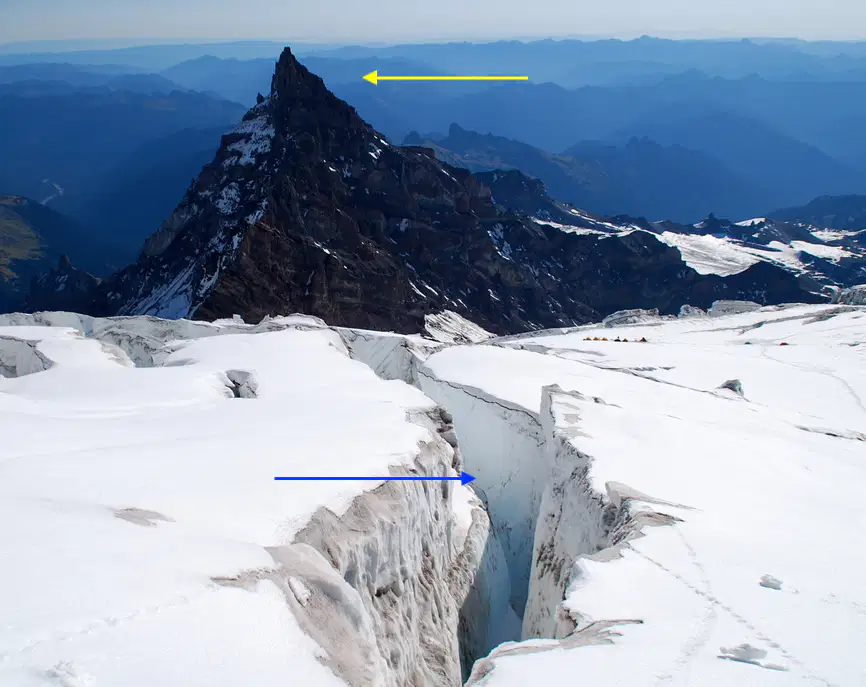
What is the blue arrow pointing at?

(a)  
71.

What glacially-carved feature is the yellow arrow pointing at?

(a)  

72.

What glacially-carved feature is shown here?

(a)  

73.

What type of dune is this?

(a)  

74.

What type of dune is this?

(a)  

75.

What type of dune is this?

(a)  

76.

What type of dune is this?

(a)  

77.

What type of dune is this?

(a)
