
 Worksheets
The Earth, Moon, and Sun
Total questions: 77
Worksheet time: 6hrs 25mins
What are seasons?
A) Changes in the local environment that occur at about the same time each year
B) Changes in weather from one day to the next
C) Changes in the world's average temperature over many years or decades
What motion explains why seasons are repeated each year?
The Earth orbiting the Sun
The Earth spinning on its axis
The Sun spinning on its axis
The Moon orbiting the Earth
The tilt of the Earth is responsible for which of the following?
The occurrence of seasons on Earth
The presence of gravity on Earth
The existence of oceans on Earth
The rotation of the Earth on its axis
What percentage of Earth is covered in sunlight at any given time.
25%
50%
75%
100%
In January, the northern hemisphere is tilted away from the Sun. Identify how many daylight hours a city in the northern hemisphere experiences at this time of year.
Less than 12 hours
Exactly 12 hours
More than 12 hours
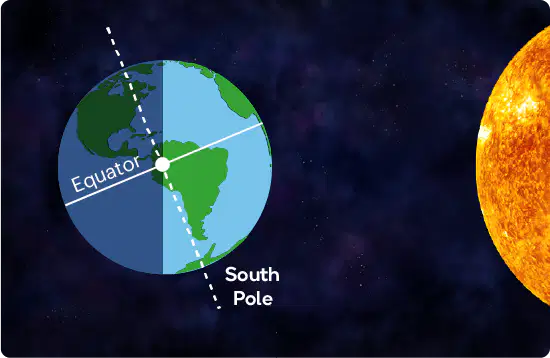
Which two statements are true for the South Pole when the southern hemisphere is tilted towards the Sun.
It has 18 hours of daylight
The Sun doesn't set
It is winter there
It is summer there

The diagram shows three locations at a particular time of year. Determine which location experiences the most daylight hours.
A
B
C
Describe the relationship between the number of daylight hours and temperature.
An increase in daylight hours generally leads to higher temperatures.
A decrease in daylight hours generally leads to higher temperatures.
There is no relationship between daylight hours and temperature.
An increase in daylight hours generally leads to lower temperatures.
The phases of the Moon are caused by the motion of the Moon around Earth and what we observe from Earth. Which statement best explains this?
The phases are caused by the Moon's orbit around Earth and the changing amount of sunlight we see reflected from its surface.
The phases are caused by the Moon changing its shape as it moves around Earth.
The phases are caused by clouds covering parts of the Moon as it orbits Earth.
The phases are caused by the Moon moving closer and farther away from Earth during its orbit.
Lunar eclipses do not occur during every full moon because:
the Moon's orbit is tilted relative to Earth's orbit, so the Moon often misses Earth's shadow
the Moon is always in Earth's shadow during a full moon
the Sun is not always aligned with the Earth and Moon during a full moon
lunar eclipses only happen during a new moon
A solar eclipse can only be seen during the daytime because:
the Sun is only visible during the day
the Moon is only visible during the day
solar eclipses happen at night
the Earth blocks the Sun during the day
Identify the main cause of tides on Earth.
The Earth orbiting around the Sun
The gravitational pull of the Moon
The gravitational pull of the Sun
The gravitational pull of the Earth
There are two high tides each day because of the cause of tides and the motion of the Earth. Which of the following best explains this phenomenon?
The gravitational pull of the Moon creates two bulges of water on opposite sides of the Earth as it rotates, resulting in two high tides daily.
The Sun's heat causes water to expand, creating two high tides each day.
Earth's rotation causes water to move only once around the planet, resulting in a single high tide.
The Moon's gravity only affects one side of the Earth, causing one high tide per day.
Seasons are used to describe:
the different periods of weather changes throughout the year
the phases of the moon
the types of soil
the stages of plant growth
The northern and southern hemispheres experience seasons at different times because:
the tilt of Earth's axis causes different parts of the planet to receive varying amounts of sunlight throughout the year.
the northern hemisphere is closer to the sun than the southern hemisphere.
the southern hemisphere rotates faster than the northern hemisphere.
the Earth's orbit changes direction every six months.
Which of the following may indicate a change of seasons.
Trees losing their leaves (Many types of trees lose their leaves before the cold winter months.)
The number of daylight hours (Changes in daylight hours influence which season it is.)
Changes in weather patterns (A change in seasons means that the weather also changes.)
How close the Earth is to the Sun
Which season is most commonly associated with hot weather and more daylight hours.
Spring
Fall
Summer
Winter
Identify the season that the northern hemisphere experiences when it is tilted away from the Sun.
Winter
Summer
Spring
Fall

The diagram shows the Earth at one point in its orbit around the Sun.
Determine which of the following statements are true.
The southern hemisphere is tilted away from the Sun, so is experiencing fall
The southern hemisphere is tilted away from the Sun, so is experiencing winter
The northern hemisphere is tilted toward the Sun, so is experiencing spring
The northern hemisphere is tilted toward the Sun, so is experiencing summer
Your location on Earth affects the number of daylight hours you experience because:
The tilt of Earth's axis causes different locations to receive varying amounts of sunlight throughout the year.
The distance from the Moon changes the amount of daylight.
The Earth's rotation speed is different at each location.
The number of daylight hours is the same everywhere on Earth.
Summer has longer daylight hours than winter because:
the tilt of the Earth's axis causes one hemisphere to receive more direct sunlight
the Earth is closer to the Sun during summer
the Sun moves faster in the sky during summer
the Moon blocks less sunlight in summer
The relationship between the number of daylight hours and temperature is:
As the number of daylight hours increases, the temperature generally rises.
As the number of daylight hours increases, the temperature generally falls.
There is no relationship between daylight hours and temperature.
Temperature decreases as daylight hours increase.
A location on the Equator spends:
less time in daylight during winter than summer
more time in daylight during summer than winter
half of the time in daylight and half of the time in darkness
If a location on Earth is tilted towards the Sun, it experiences:
more than 12 hours of daylight
less than 12 hours of daylight
exactly 12 hours of daylight
Determine which two statements are true for the South Pole when the southern hemisphere is tilted towards the Sun.
It is winter there
It is summer there
It has 18 hours of daylight
The Sun doesn't set
Determine which two statements describe the North Pole when the northern hemisphere is tilted away from the Sun.
A) It is winter there
B) It is summer there
During winter at the North Pole, the Sun doesn't rise because that part of Earth is constantly facing away from the Sun.
It has 24 hours of darkness
It has 24 hours of daylight
In North America, summer has longer daylight hours than winter. Select the correct explanation for this.
In summer the northern hemisphere is tilted towards the Sun, while in winter it's tilted away from the Sun
During summer the northern hemisphere is closer to the Sun, while during winter it's further away
In summer the northern hemisphere is further away from the Sun, while in winter it's closer
In summer the northern hemisphere is tilted away from the Sun, while in winter it's tilted towards the Sun
As daylight hours increase, average temperatures are likely to:
stay the same
increase
decrease
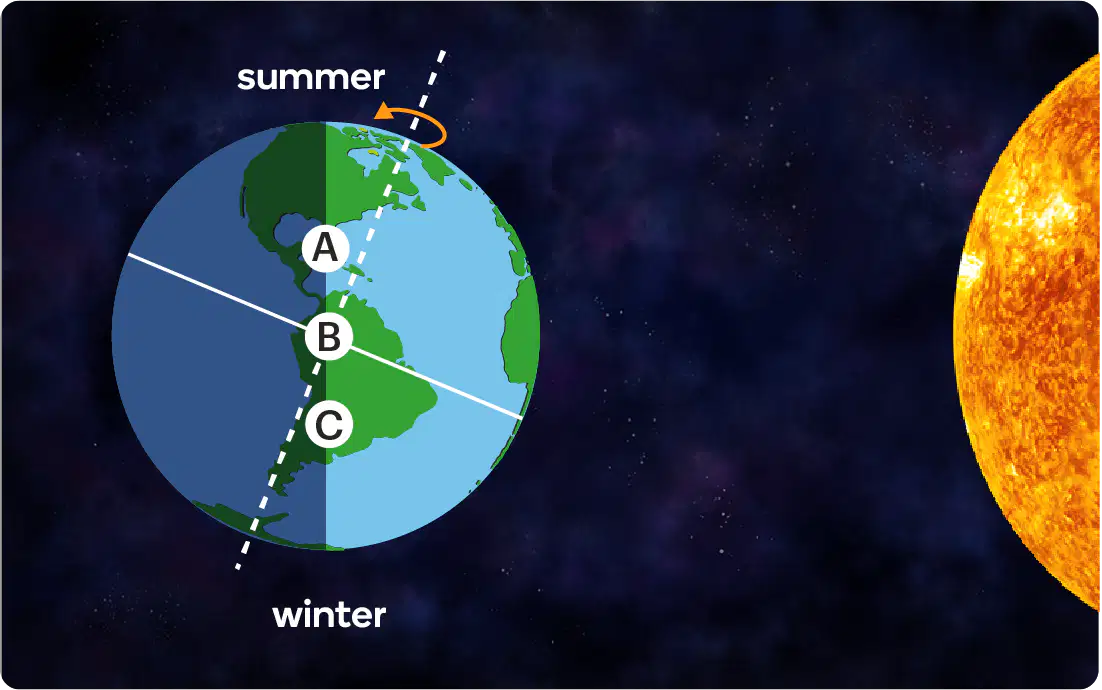
Determine which statement describes Location C.
It has fewer daylight hours so is likely to be cold
It has fewer daylight hours so is likely to be hot
It has more daylight hours so is likely to be hot
It has more daylight hours so is likely to be cold
Describe what causes the phases of the Moon to change each month.
The Moon's phases change due to its position relative to the Earth and Sun.
The Moon's phases change because the Moon emits its own light.
The Moon's phases change due to the Earth's rotation.
The Moon's phases change because of solar flares.
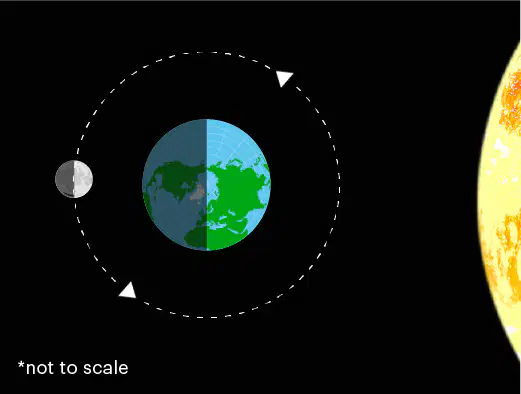
This diagram shows the positions of the Sun, Earth, and Moon at a particular time. Select the phase of the Moon that we see from Earth.
New moon
First quarter
Full moon
Third quarter
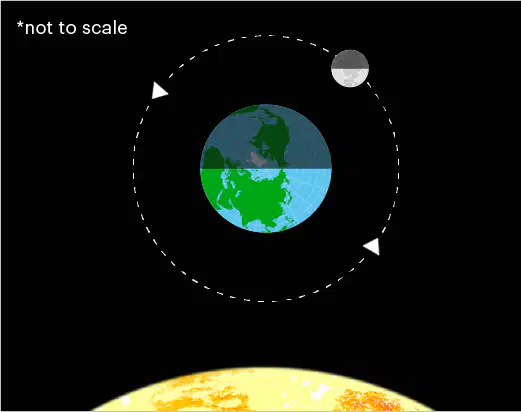
This diagram shows the positions of the Sun, Earth, and Moon at a particular time. Select the phase of the Moon that we see from Earth.
Waxing crescent moon
Waning gibbous moon
What is the phase of the Moon when it is positioned between the Sun and the Earth?
new moon
full moon
first quarter
last quarter
What is the phase of the Moon when it is a thin crescent shape after the new moon?
waxing crescent
waning crescent
full moon
first quarter
What is the phase of the Moon when half of the Moon is illuminated and it is increasing?
first quarter
last quarter
new moon
full moon
What is the phase of the Moon when more than half is illuminated and it is increasing?
waxing gibbous
waning gibbous
first quarter
new moon
What is the phase of the Moon when the entire face is illuminated?
full moon
new moon
crescent moon
quarter moon
What is the phase of the Moon when more than half is illuminated and it is decreasing?
waning gibbous
waxing gibbous
full moon
first quarter
What is the phase of the Moon when half of the Moon is illuminated and it is decreasing?
third quarter
first quarter
full moon
new moon
What is the phase of the Moon when it is a thin crescent shape before the new moon?
waning crescent
waxing crescent
full moon
first quarter
Which of the following is the reason why the Moon has phases?
The Earth's shadow falls on the Moon differently at different times of the month
The Moon reflects different amounts of sunlight as it orbits the Earth
The Moon's orbit is not a perfect circle
We see different amounts of the sunlit side of the Moon as it orbits the Earth
During a new moon phase we can see:
all of the sunlit side of the Moon
none of the sunlit side of the Moon
one quarter of the sunlit side of the Moon
half of the sunlit side of the Moon
Identify which two statements are true for a waxing gibbous moon.
More than half of the sunlit side of the Moon is visible
Less than half of the sunlit side of the Moon is visible
The amount of the sunlit side of the Moon you can see is increasing
The amount of the sunlit side of the Moon you can see is decreasing
Determine which two statements are true for a first quarter moon.
From Earth, we can see one quarter of the sunlit side of the Moon
From Earth, we can see one half of the sunlit side of the Moon
The Moon has traveled half of the way around its orbit since the new moon
The Moon has traveled a quarter of the way around its orbit since the new moon
Solar eclipses occur when:
the Moon passes between the Earth and the Sun, blocking the Sun's light
the Earth passes between the Moon and the Sun, blocking the Sun's light
the Sun passes between the Earth and the Moon, blocking the Moon's light
the Moon moves behind the Earth, away from the Sun
Lunar eclipses occur when:
the Earth comes between the Sun and the Moon, casting a shadow on the Moon.
the Moon comes between the Earth and the Sun, casting a shadow on the Earth.
the Sun comes between the Earth and the Moon, blocking the Moon's light.
the Earth and Moon are on opposite sides of the Sun.
Compare the positions of the Sun, Earth, and Moon during solar and lunar eclipses.
During a solar eclipse, the Moon is between the Sun and Earth; during a lunar eclipse, the Earth is between the Sun and Moon.
During a solar eclipse, the Earth is between the Sun and Moon; during a lunar eclipse, the Moon is between the Sun and Earth.
During both solar and lunar eclipses, the Sun is between the Earth and Moon.
During both solar and lunar eclipses, the Earth is between the Sun and Moon.
Select which statement is true during a solar eclipse.
The Earth is positioned between the Sun and the Moon
Part of the Earth falls into the Moon's shadow
The Moon falls into the Earth's shadow
The Sun is positioned between the Earth and the Moon
During which phase of the Moon can a solar eclipse occur?
Third quarter moon
Full moon
First quarter moon
New moon
Select which statement is true during a lunar eclipse.
The Sun is positioned between the Earth and the Moon
The Moon falls into the Earth's shadow
Part of the Earth falls into the Moon's shadow
The Moon is positioned between the Earth and the Sun
Determine the phase of the Moon in which a lunar eclipse can occur.
Third quarter moon
First quarter moon
New moon
Full moon
Determine which of the following are true during a lunar eclipse.
The Moon is between the Earth and the Sun
The Earth is between the Moon and the Sun
The Moon falls into the Earth's shadow
The Earth falls into the Moon's shadow
Determine which of the following are true during a solar eclipse.
The Moon is between the Earth and the Sun
The Earth is between the Moon and the Sun
The Moon falls into the Earth's shadow
The Earth falls into the Moon's shadow
The Moon produces tides on Earth by:
pulling on Earth's oceans with its gravity, causing water to rise and fall
reflecting sunlight onto Earth's oceans, causing water to move
blocking the Sun's rays, which changes ocean currents
creating wind patterns that push ocean water
There are two high tides every day because:
the gravitational pull of the Moon and the Sun causes two bulges of water on opposite sides of the Earth.
the Earth's rotation creates two waves that circle the planet daily.
the wind patterns push ocean water to create two high tides.
the temperature differences in the ocean cause water to expand twice a day.
What is the main cause of tides on Earth?
The gravitational pull of the Earth
The gravitational pull of the Sun
The Earth orbiting around the Sun
The gravitational pull of the Moon
Identify the two factors that affect how much gravitational pull one object has on another.
A) Mass and speed
B) Mass and composition
C) Mass and distance
D) Distance and speed
Identify the approximate time between two low tides on Earth.
6 hours
12 hours
18 hours
24 hours
Select the motion that best explains why there are two high tides each day.
The Earth spinning on its axis
The Moon orbiting the Earth
The Earth orbiting the Sun
An island experiences high tide at 3 am on a particular day. Determine when the next low tide is likely to occur.
9 am
Midday
3 pm
3 am on the following day
Determine why the Sun's influence on tides is weaker than the Moon's influence.
The Sun is closer than the Moon
The Sun is further away than the Moon
The Sun has less mass than the Moon
The Sun has more mass than the Moon
Fill in the blank:
During the new moon, the relationship between Earth, Moon, and Sun is _______.
aligned
random
opposite
perpendicular
Fill in the blank:
During the first quarter, the relationship between Earth, Moon, and Sun is _______.
at right angles
in a straight line
parallel
opposite
Fill in the blank:
During the full moon, the relationship between Earth, Moon, and Sun is _______.
aligned
random
perpendicular
scattered
Fill in the blank:
During the new moon, the relationship between the two tidal bulges is _______.
add together
cancel out
remain unchanged
move apart
Fill in the blank:
During the first quarter, the relationship between the two tidal bulges is _______.
partly cancel each other out
completely reinforce each other
move in opposite directions
remain unchanged
Fill in the blank:
During the full moon, the relationship between the two tidal bulges is _______.
add together
cancel each other
remain unchanged
move apart
Fill in the blank:
During the new moon, high tides will be _______.
higher
lower
unchanged
less frequent
Fill in the blank:
During the first quarter, high tides will be _______.
lower
higher
unchanged
more frequent
Fill in the blank:
During the full moon, high tides will be _______.
higher
lower
unchanged
less frequent
Fill in the blank:
During the new moon, low tides will be _______.
lower
higher
unchanged
stronger
Fill in the blank:
During the first quarter, low tides will be _______.
higher
lower
unchanged
more frequent
Fill in the blank:
During the full moon, low tides will be _______.
lower
higher
unchanged
stronger
Fill in the blank:
The phase of the Moon that comes after the first quarter is called the _________.
Third quarter
New Moon
Full Moon
Waning crescent
Fill in the blank:
When two lines meet at 90 degrees, they are said to be ____________.
at right angles
parallel
intersecting
skew
Fill in the blank:
When two forces act in opposite directions, they can _____________.
partly cancel each other out
combine to form a larger force
move in the same direction
increase the speed of an object

