wayground logo

Free Printable Worksheets

Font size

S
M
L
XL
Worksheets

Physical Science Review

Total questions: 133

Worksheet time: 3hrs 0mins

Name
Class
Date
1.

The layer of gases that surrounds the Earth is known as its (a)  

Choose from the below words
atmosphere
lithosphere
hydrosphere
biosphere
2.

Which gas is most abundant in Earth's atmosphere? (a)  

Choose from the below words
oxygen
nitrogen
carbon dioxide
ozone
3.
What are greenhouse gases?
a)
gases that cause climate change
b)
gases that emit green smoke
c)
gases that are used to make green colored glass
4.

Which of the following have been linked to climate change?   (a)  

Choose from the below words
droughts
flooding
melting of polar ice caps
all of the above
5.

The main human activity that releases greenhouse gases is (a)  

Choose from the below words
using bottled water
burning fossil fuels
texting on cellphones
eating meat
6.

Some greenhouse gases are naturally present in the Earth's atmosphere (a)  

Choose from the below words
True
False
7.
Carbon is stored in
a)
Trees and other living things
b)
Oceans
c)
underground in soil and fossil fuels
d)
All are correct
8.

Visible light reaches Earth’s surface while infrared light is trapped as heat. Which characteristic of Earth’s atmosphere causes this to happen? (a)  

Choose from the below words
the hole in the ozone
the greenhouse effect
atmospheric pressure
the inversion layer
9.

In the pie chart, the pink section represents which gas in Earth's atmosphere? (a)  

Choose from the below words
Carbon dioxide
Oxygen
Nitrogen
Hydrogen
10.

The substances listed on the right side of a chemical equation are the (a)  

Choose from the below words
Yields
Reactants
Products
Precipitates
11.

CaCO3 represents a chemical (a)  

Choose from the below words
Formula
Symbol
Subscript
Reaction
12.

The substances listed on the left side of a chemical equation are the (a)  

Choose from the below words
Products
Coefficients
Precipitates
Reactants
13.
In chemical reactions, what does the principle of conservation of mass mean?
a)
Matter is not created or destroyed.
b)
The total mass of the reactants is greater than the total mass of the products.
c)
The total mass of the reactants is less than the total mass of the products.
d)
Matter is not changed.
14.

A molecule is smaller than an atom. (a)  

Choose from the below words
True
False
15.
How many Oxygen (O) atoms are in 2C2HO8Cl2
a)
2
b)
16
c)
8
d)
5
16.
A molecule is________
a)
a glob of gelatinous goo
b)
smaller than an atom
c)
filled with raisons
d)
more than one atom bonded together
17.
How many elements are in C6H12O6?
a)
1
b)
2
c)
3
d)
4
18.
Which of the following shows the correct way to balance the chemical equation?
Fe + O2 -> Fe2O3
a)
4Fe + 3O2 -> 2Fe2O3
b)
2 Fe + 3O2 -> Fe2O6
c)
4 Fe + O6 -> 2Fe2O3
d)
None of the options are correctly balanced.
19.
In a closed system, a chemical reaction takes place.  The mass of the reactants in the beginning of the reaction is 25g.  What does the mass have to be in the end of the reaction in order to follow the law of conservation of mass?
a)
25g
b)
You can't tell with the given information.
c)
30g
d)
15g
20.
There are two reactants in a chemical equation, and one product.  The mass of the product is 30g.  The mass of the first reactant is 17g.  What must the mass of the second reactant be, if the equation is to follow the law of conservation of mass?
a)
47g
b)
13g
c)
23g 
d)
You cant tell with the given information
21.
Students react baking soda & vinegar.
Which of the following would provide the evidence that the number of atoms present before a chemical reaction is equal to the number of atoms present after the chemical reaction?
a)
The mass of the plastic bag, baking soda, and vinegar before the reaction was equal to the mass after the reaction.
b)
Bubbles were produced during the reaction, which meant that a gas was being produced.
c)
The plastic bag did not change in any way, indicating that it was not involved in the reaction.
d)
The mass of the baking soda was exactly equal to the mass of the vinegar used to create the chemical reaction.
22.

How many IRON (Fe) atoms are in this chemical formula? (a)  

Choose from the below words
4 iron atoms
2 iron atoms
8 iron atoms
3 iron atoms
23.

What kind of properties can only be observed when a substance changes into a different substance? (a)  

Choose from the below words
physical properties
chemical properties
24.

Which type of property is the ability to conduct electricity? (a)  

Choose from the below words
physical property
chemical property
25.

Properties that can be observed without changing the identity of the substance. (a)  

Choose from the below words
Physical
Chemical
26.
Example for physical property
a)
odor
b)
burns in air
c)
reacts with water to create hydrogen gas
d)
rust
27.

Which of the following is a sign that a chemical reaction has occurred? (a)  

Choose from the below words
change in shape
melting
formation of a gas
dissolving
28.

Which of the following is NOT an example of a physical change? (a)  

Choose from the below words
crumpled paper
pencil sharpening
shrunken clothing
rust
29.

A change where one or more new substances are created. (a)  

Choose from the below words
Physical Change 
Chemical Change 
30.

Fizzing, foaming, and burning are all examples of (a)  

Choose from the below words
Chemical change
Physical change
31.

Change in density is a physical change. (a)  

Choose from the below words
True
False
32.

Rust on an iron bar is an example of chemical change. (a)  

Choose from the below words
True 
False
33.

Flammability is an example of what property? (a)  

Choose from the below words
Chemical property
Physical property
34.
Physical properties are
a)
properties that can be observed without changing the identity of the substance
b)
properties that describe how a substance changes into a completely different substance
35.

Which of the following atomic symbols is written correctly? (a)  

Choose from the below words
ee
hE
C
CL
36.

Which statement best describes an element? (a)  

Choose from the below words
made from mixture 
thousands in the world
pure, made of only one atom
can be separated 
37.

Carbon is considered an element while carbon dioxide is considered a compound. This is because carbon dioxide is – (a)  

Choose from the below words
a gas at room temperature.
made of two different elements.
given off by green plants.
38.

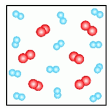
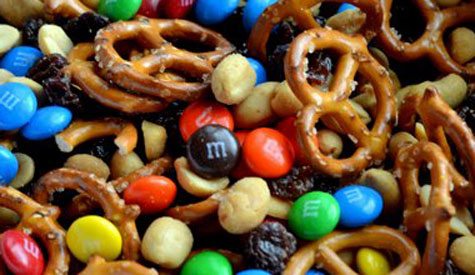
This picture represents which of the following? (a)  

Choose from the below words
element
compound
mixture
39.

This picture represents which of the following? (a)  

Choose from the below words
element
compound
mixture
40.

What is the tiniest particle in the entire universe? (a)  

Choose from the below words
cells
gases
atoms
liquids
41.

What is the name of a single type of atom? (a)  

Choose from the below words
cell
proton
element
atom
42.

What is the term for combining 2 or more atoms together? (a)  

Choose from the below words
atoms
elements
molecules
compounds
43.

What is the term for combining 2 or more DIFFERENT atoms together? (a)  

Choose from the below words
atoms
elements
molecules
compounds
44.

Are these molecules also compounds? (a)  

Choose from the below words
YES
NO
45.

Are these molecules also compounds? (a)  

Choose from the below words
YES
NO
46.

A pure substance that cannot be broken down into other substances by chemical or physical means.  (a)  

Choose from the below words
compound          
atom
mixture 
element
47.

This diagram represents a (a)   .

Choose from the below words
pure substance that is a compound
mixture of elements
pure substance that is an element
mixture of compounds
48.

This diagram represents a (a)   .

Choose from the below words
Pure substance
Homogeneous mixture
Heterogeneous mixture
49.

Can a mixture be separated?  (a)  

Choose from the below words
No
Yes
Only sometimes
50.

The basic unit of matter is (a)  

Choose from the below words
a mixture
a substance
an atom
a compound
51.

A substance that contains only one type of atom is a(n) (a)  

Choose from the below words
compound
element
heterogeneous mixture
homogeneous mixture
52.

This picture represents which of the following? (a)  
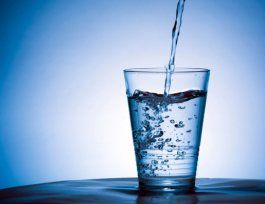
Choose from the below words
Element
Compound
Mixture
53.

A pure substance (a)  

Choose from the below words
is an element or a compound
is an element or a mixture
is a compound or a mixture
is a mixture
54.

NaHCO3 is an example of (a)  

Choose from the below words
a compound
an abbreviation
a mixture
an element
55.
At higher temperatures
a)
particles in an object have less energy
b)
particles in an object move faster
c)
a gas contracts
56.

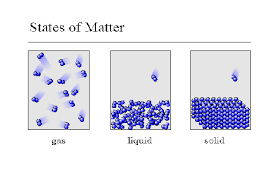
Particles (molecules) in a (a)   have more energy than the other states of matter.
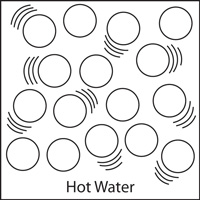
Choose from the below words
gas
solid
liquid
57.
Particles of a liquid
a)
are tightly packed together and stay in a fixed position.
b)
have no viscosity.
c)
decrease in volume with increasing temperature.
d)
are free to move around one another but still touch.
58.

The speed of the molecules determines the (a)   .

Choose from the below words
volume
density
pressure
temperature
59.

The slower the particles in a substance move, (a)  

Choose from the below words
the colder it is.
the warmer it is.
the more energy it has.
the less energy it has.
60.

Thermal energy is...

(a)  

61.

Which subatomic particles contribute the most to the mass of an atom? (a)  

Choose from the below words
Protons, Neutrons, Electrons
Protons only
Protons and Electrons
Protons and Neutrons
62.
What is the number of protons that the element in this image contain?
a)
14
b)
7
c)
15
d)
18
63.
An element with a mass number of 11 and an atomic number of 5 has how many neutrons?
a)
11
b)
5
c)
6
d)
16
64.

Which letter represents a proton? (a)  

Choose from the below words
A
B
C
D
65.

Which letter represents a neutron? (a)  

Choose from the below words
A
B
C
D
66.

Which letter represents an electron? (a)  

Choose from the below words
A
B
C
D
67.

Which letter represents the nucleus? (a)  

Choose from the below words
A
B
D
E
68.

Which subatomic particle has a positive (+) charge? (a)  

Choose from the below words
Neutron
Proton
Electron
69.

Which subatomic particle has a negative (-) charge? (a)  

Choose from the below words
Proton
Electron
Neutron
70.

Which subatomic particle has a neutral or no charge? (a)  

Choose from the below words
Proton
Electron
Neutron
71.

How did Mendeleev arrange the elements? (a)  
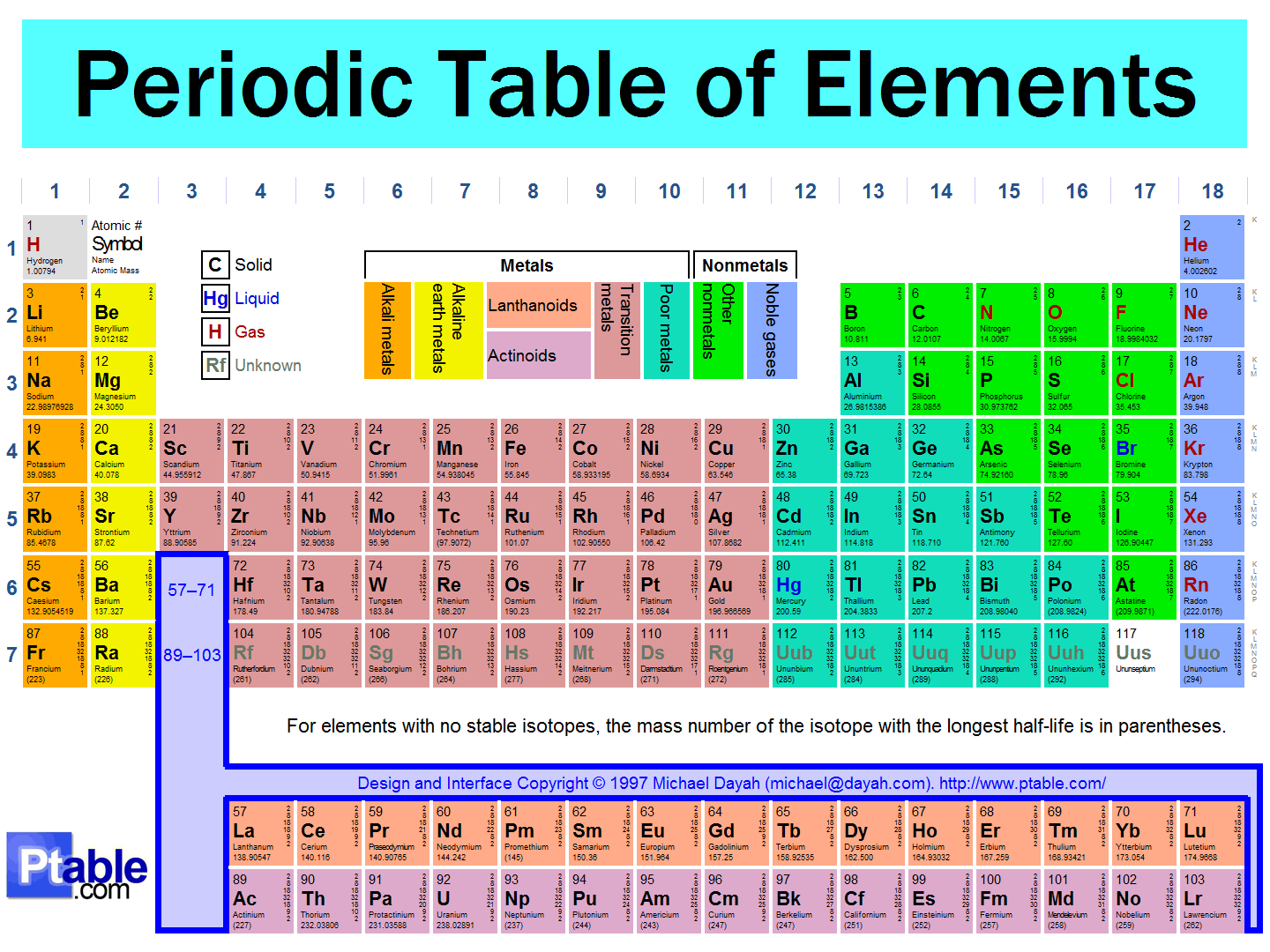
Choose from the below words
alphabetical 
density
melting point
atomic mass
72.

The horizontal row on the periodic table is called a (a)  
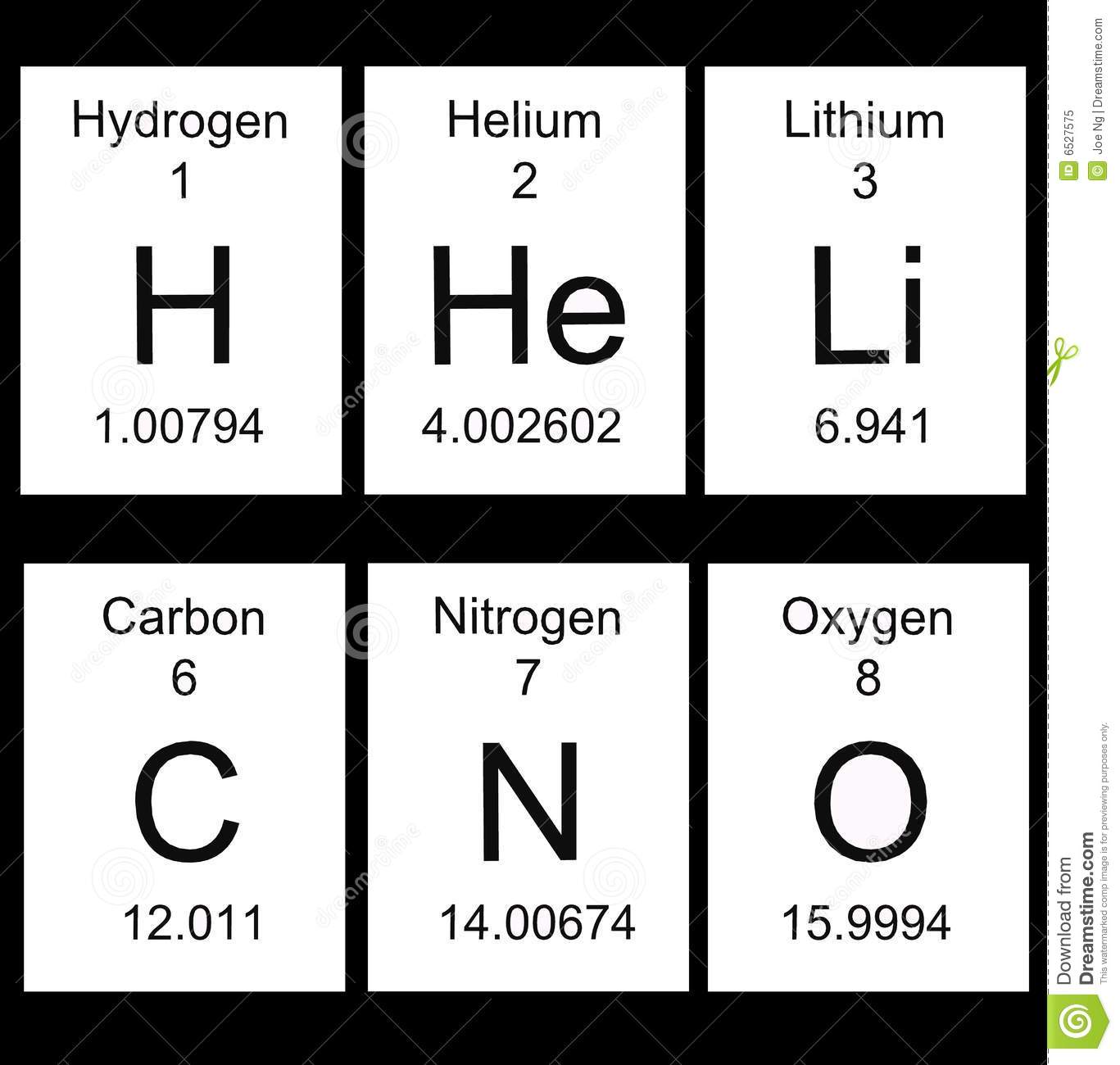
Choose from the below words
group
family
period
atomic number
73.

The number at the bottom of each square on the periodic table is the (a)  
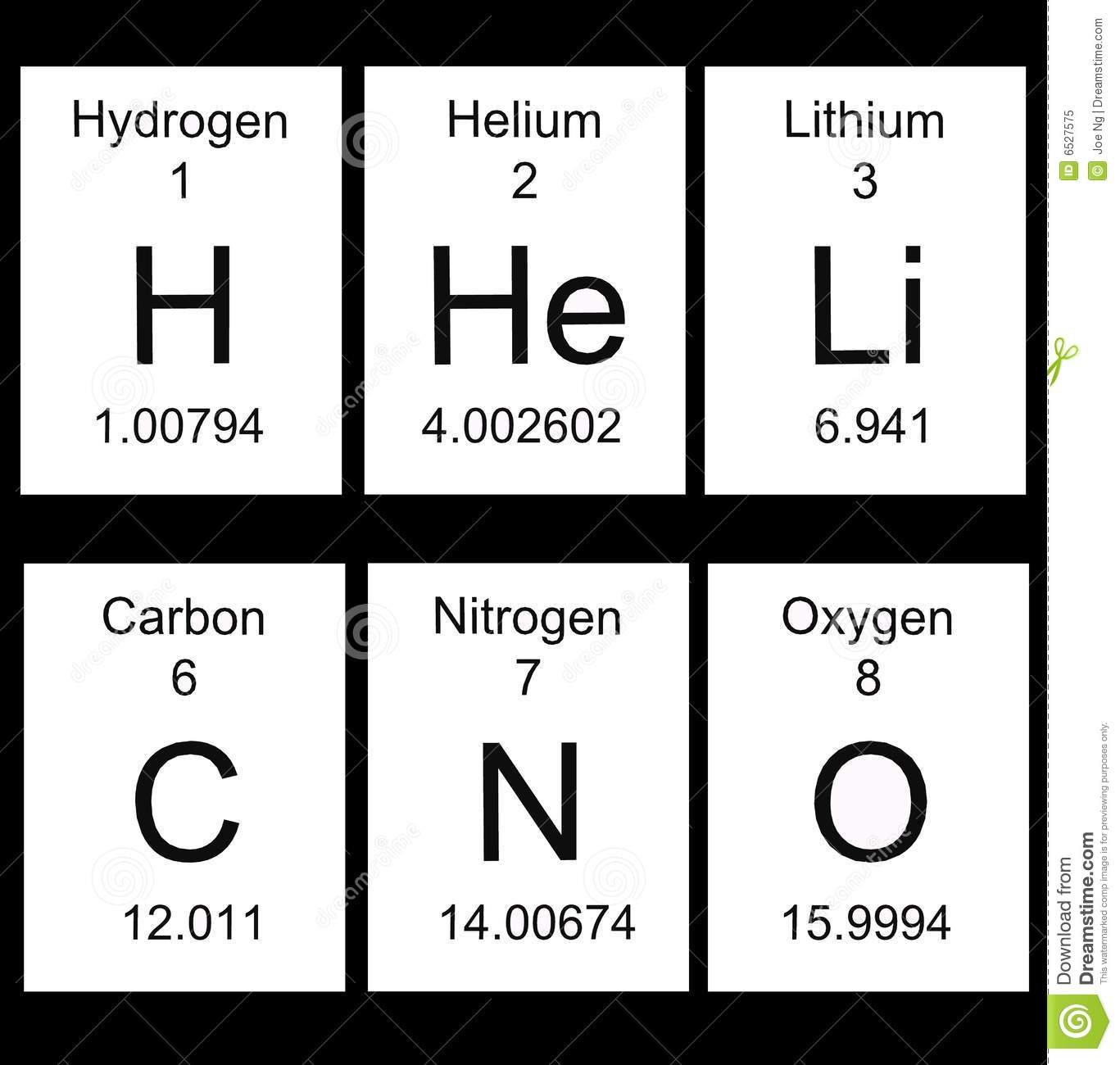
Choose from the below words
atomic number
atomic mass
chemical symbol
element name
74.

The number at the top of each square on the periodic table is the (a)  

Choose from the below words
atomic number
atomic mass
Chemical Symbol
Element Name
75.

Most of the elements on the periodic table are classified as (a)   .
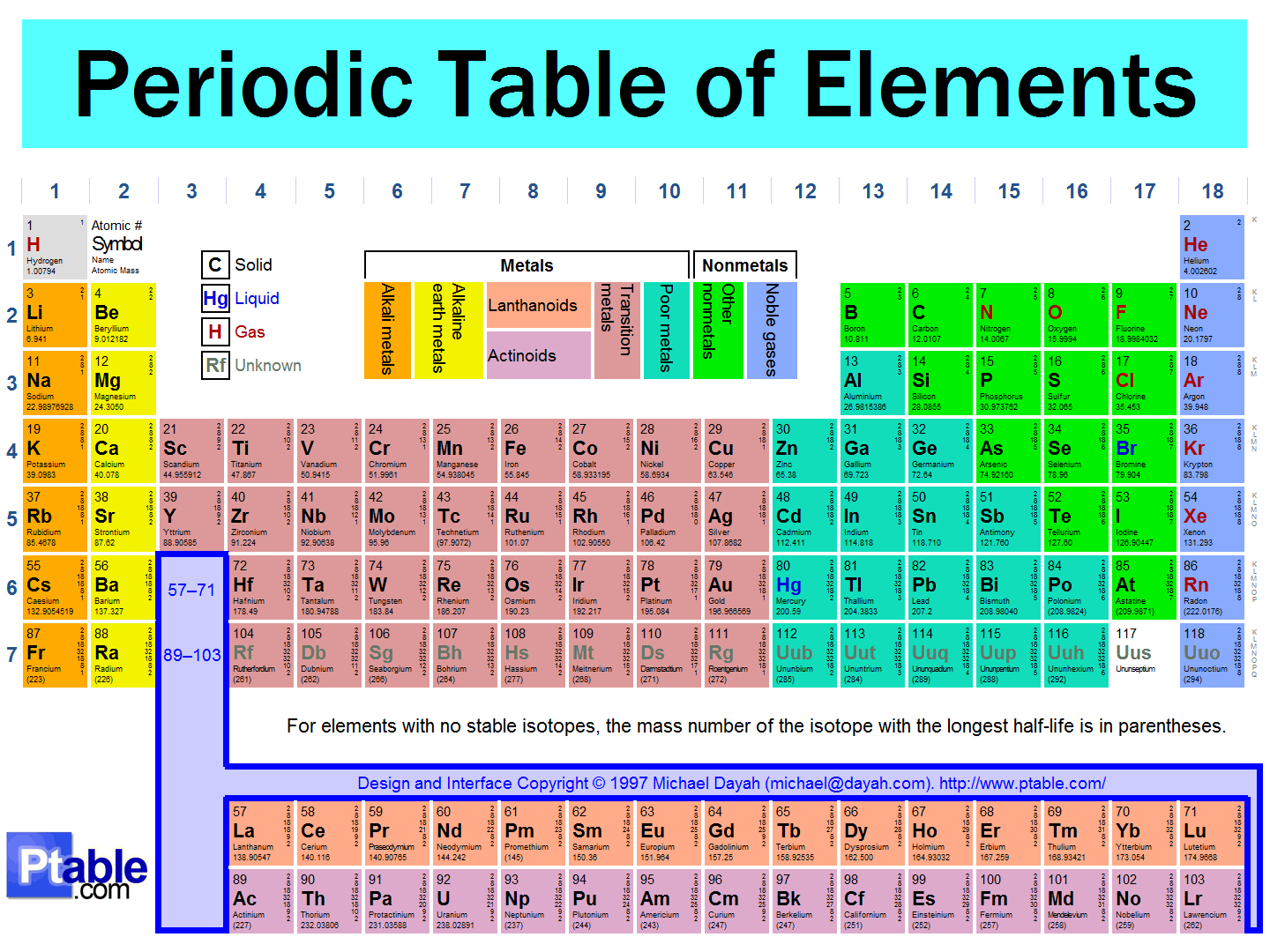
Choose from the below words
Metals
Nonmetals
Metalloids
Periods
76.

This class of elements are sometimes called "semiconductors." (a)  

Choose from the below words
Metals
Nonmetals
Metalloids
Groups
77.

Which group of the periodic table is composed of inert (not reactive)  gases? (a)  

Choose from the below words
alkali metals
alkaline earth metals
halogens
noble gases
78.

Elements which are shiny, conduct electricity and heat are called (a)  

Choose from the below words
metal
nonmetal
metalloid
nonexistent
79.

The atoms along the staircase are called  (a)  

Choose from the below words
metals
nonmetals
metalloids
noble gases
80.

Vertical columns of elements (these are also known as a "family") - they also have the same number of valence electrons and are known as (a)   .

Choose from the below words
groups
periods
quadrants
rows
81.

Most noble gases have _______ valence electrons.

a)

1

b)

2

c)

7

d)

8

82.

In what section would Noble Gases be found? (a)  

Choose from the below words
white
yellow
blue
red
83.

All elements found on the left side of the Periodic Table of the Elements have what properties in common? (a)  

Choose from the below words
They conduct heat and electricity 
They are all gases 
They are brittle and dull
They are radioactive
84.

What line segment represents only the solid state? (Diagram F) (a)  
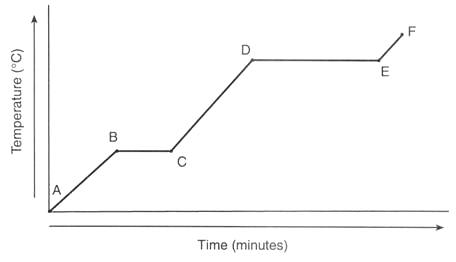
Choose from the below words
A-B
B-C
C-D
D-E
85.

Between which points is the temperature of the substance remaining constant? (Diagram F) (a)  

Choose from the below words
A-B only.
A-B, C-D, E-F
B-C only.
B-C, D-E
86.

True or false: melting and freezing occur at the same temperature! (a)  

Choose from the below words
True
False
I don't know
87.

A substance's heating curve is shown in the graph. What is its boiling point? (Diagram B) (a)  
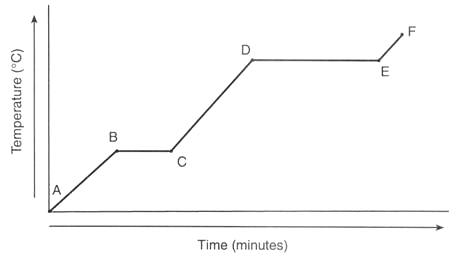
Choose from the below words
100 C
60 C
80 C
20 C
88.

Are the particles moving faster or slower as time goes on? (Diagram F) (a)  

Choose from the below words
Faster
Slower
89.

Is the substance gaining or losing energy? (Diagram D) (a)  

Choose from the below words
Gaining
Losing
90.

Which line segment demonstrates vaporization occurring? (Diagram E) (a)  

Choose from the below words
B-C
C-D
D-E
E-F
91.

What phase change is occurring at line segment B-C if the graph is exothermic? (Diagram E) (a)  

Choose from the below words
melting
freezing
boiling
condensation
92.

How long does it take this substance to change from a liquid to a gas? (Diagram E) (a)  

Choose from the below words
1 minute
2 minutes
10 minutes
15 minutes
93.

What will occur when the substance transitions from B to A? (Diagram A) (a)  

Choose from the below words
condensation
evaporation
melting
freezing
94.

What will occur when the substance changes from 1 atm to 30 at a constant temperature of -15oC? (Diagram A) (a)  

Choose from the below words
condensation
deposition
melting
sublimation
95.

What will occur when the substance changes from 0o C to 100oC at a constant pressure of 30 atm? (Diagram A) (a)  

Choose from the below words
condensation
evaporation
melting
freezing
96.
What happens when thermal energy is taken away from particles?
a)
They move faster and farther apart
b)
They move slower and closer together
97.

During a phase change, the temperature (a)  

Choose from the below words
increases
decreases
fluctuates
stays the same
98.

What is the normal boiling point of this substance? (Diagram C) (a)  

Choose from the below words
150 °C
100 °C
-50 °C
0 °C
99.

What is the normal melting point of this substance? (Diagram C) (a)  

Choose from the below words
150 °C
100 °C
-50 °C
0 °C
100.

What is point A? (Diagram C) (a)  

Choose from the below words
triple point
critical point
equilibrium point
normal melting point
101.

**An ice cube feels cold when we hold it. Which of the following best explains why?

a)

Heat moves from our hands into the ice cube.

b)

Cold moves from our hands into the ice cube.

c)

Heat moves from the ice cube into our hands.

d)

Cold moves from the ice cube into our hands.

102.

What type of process is happening as one moves along line segment B toward the right? (Diagram F) (a)  

Choose from the below words
An endothermic Process
An exothermic Process
The calorimetry process
Nuclear fusion
103.
At higher temperatures
a)
particles in an object have less energy
b)
particles in an object move faster
c)
a gas contracts
104.

What is the atomic number? (a)  

Choose from the below words
the number of protons
the number of protons and neutrons
the number of neutrons
the number of protons and electrons
105.

Elements which are shiny, conduct electricity and heat are called (a)  

Choose from the below words
metal
nonmetal
metalloid
nonexistent
106.

What are the electrons of the "outer shell" of an element called? (a)  

Choose from the below words
VALENCE ELECTRONS
COMPOUND
ELEMENT
107.

If an element does NOT conduct electricity and is NOT shiny or malleable, it is a: (a)  

Choose from the below words
Metal
Nonmetal
Gas
Liquid
108.

A substance that is generally shiny, can be bent, and often conducts heat and electricity is: (a)  

Choose from the below words
Gas
Nonmetal
Metal
Element
109.

What determines the properties of elements? (a)  

Choose from the below words
Nonmetal
Atomic number
Periodic Table
Electrons
110.

What do elements share or transfer to form compounds? (a)  

Choose from the below words
Electrons
Elements
Neutrons
Protons
111.
How are compounds and elements different?
a)
Elements are metals; compounds are nonmetals
b)
Elements are pure substances; compounds are not
c)
Elements exist as solids, liquids, and gases; compounds are solids
d)
Elements have one kind of atom; compounds have different kinds of atoms
112.

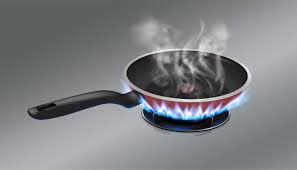
A student is given four solid substances to test.  One is a metal.  What are properties of metal that student could test for? (a)  
Choose from the below words
Malleableness
Shininess
Conducts electricity
All of the above
113.

Non-metals are (a)   conductors of heat.

Choose from the below words
Good
Poor / Bad
114.

Which words best describe NON-METALS? (a)  

Choose from the below words
ductile, shiny, brittle
malleable, dull, brittle, ductile
brittle, dull, insulators
115.

What does "malleable" mean? (a)  

Choose from the below words
Can be made into a shape.
Brittle
Ductile
Shiny
116.

The positive particles of an atom are  (a)  

Choose from the below words
electrons 
positrons 
neutrons 
protons 
117.

Particles in an atom that are neutral and have no charge are  (a)  

Choose from the below words
negatrons 
electrons 
neutrons 
protons 
118.

The subatomic particle with a negative charge is the (a)  

Choose from the below words
electron
proton
neutron
nucleus 
119.

Element or compound?H2O (a)  

Choose from the below words
element
compound
120.

In the modern periodic table elements are arranged by: (a)  

Choose from the below words
atomic mass
atomic number
valence electrons
number of isotopes
121.

Each column in the periodic table is called a  (a)  

Choose from the below words
period
group
cluster
unit
122.

What is the name of the group that never reacts--ever ever they are stable with a full outermost ring!!! (a)  

Choose from the below words
noble gases
transition
halogens
borons
123.

The horizontal row on the periodic table is called a (a)  

Choose from the below words
group
family
period
atomic number
124.

What is Atomic Mass Number ? (a)  

Choose from the below words
Number of Protons
Number of Neutrons
Number of Protons and Neutrons
Number of Protons and Electrons
125.

Ozone and Oxygen molecules are the same substance because they both are made only of oxygen atoms. (a)  

Choose from the below words
true
false
126.

This table displays (a)  

Choose from the below words
price values of the metals.
chemical properties of the metals.
physical properties of the metals.
corrosive resistance of the metals.
127.

How many atoms make up one molecule of laughing gas?

a)

1

b)

2

c)

3

d)

4

128.

How many atoms of sodium (Na) are in one molecule of baking soda?

a)

1

b)

2

c)

3

d)

4

129.

Consider the picture of the jar holding oil, syrup, and water. It would be easy to pour off the oil to separate from both the syrup and water because the liquids have different (a)  

Choose from the below words
densities
masses
temperatures
volumes
130.

What is the atomic number of this element?

a)

20

b)

60

c)

40

d)

41

131.

Which example below is a chemical reaction? (a)  
Choose from the below words
ice melting
water boiling
lighting a match
grape juice freezing
132.

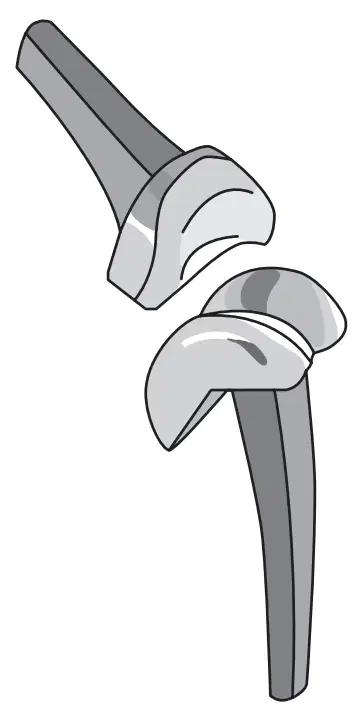
Synthetic finger joints can replace damaged joints in human hands. In the past, these joints were made out of soft plastic. They were flexible but wore down quickly and required replacement. Scientists are now making synthetic finger joints from different materials.

When choosing a material to make synthetic finger joints, which of these is the least important factor for scientists to consider?

a)

the flexibility of the material

b)

the durability of the material

c)

the ability of the material to be accepted by body systems

d)

the ability of the material to be used in other parts of the body
133.

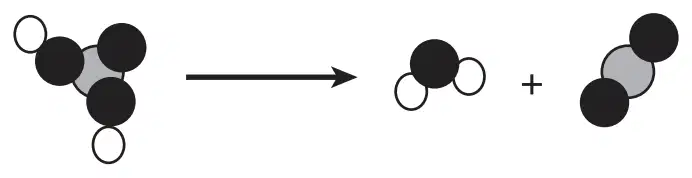
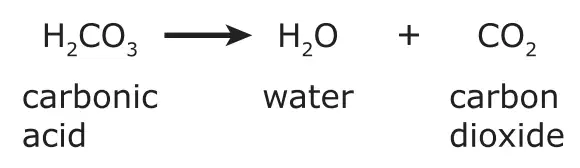
Heat causes some substances to decompose or break into smaller substances. Atoms are not created or destroyed during this process; they are only rearranged. These reactions can be written as chemical equations.

Which particle diagram best represents the conservation of atoms in this chemical reaction?

a)

b)

c)

d)