
 Worksheets
Rat Amphitheatre Questions
Total questions: 80
Worksheet time: 40mins
Deep fascia is
in your muscles
around your organs
under the skin
in bone marrow
Visceral fascia is
in your muscles
around your organs
under the skin
in bone marrow
Superficial fascia is
in your muscles
around your organs
under the skin
in bone marrow
Choose which muscle naming rules are used for (check all that apply):
Pectoralis major
Location of muscle
Direction of the muscle fibers
Relative size of the muscle
Number of origins
Location of the muscle's origin and insertion
Choose which muscle naming rules are used for (check all that apply):
Frontalis
Size of the muscle
Shape of the muscle
Action of the muscle
Location of the muscle
Direction of muscle fibers
Choose which muscle naming rules are used for (check all that apply):
Rectus abdominis
Action of the muscle
Number of origins
Location of the muscle
Size of the muscle
Direction of the muscle fibers
Choose which muscle naming rules are used for (check all that apply):
Adductor group
Relative size of the muscle
Location of the muscle
Number of origins
Action of the muscle
Shape of the muscle
Choose which muscle naming rules are used for (check all that apply):
Trapezius
Action of the muscle
Direction of the muscle fibers
Number of origins
Relative size of the muscle
Shape of the muscle
Choose which muscle naming rules are used for (check all that apply):
Sternocleidomastoid
Shape of the muscle
Number of origins
Location of muscle
Location of the muscle's origin and insertion
Direction of the muscle fibers
Choose which muscle naming rules are used for (check all that apply): Gluteus medius
Location of the muscle
Relative size of the muscle
Direction of the muscle fibers
Action of the muscle
Shape of the muscle
Choose which muscle naming rules are used for (check all that apply):
External oblique
Location of muscle
Direction of muscle fibers
Relative size of the muscle
Action of the muscle
Location of muscle's origin and insertion
The bone that does not move through it is attached to the muscle of interest is known as the
origin
insertion
prime mover
antagonist
A bone that moves when an attached muscle contracts is called a(n)
origin
insertion
prime mover
antagonist
Fascia is
connective tissue
muscle
epithelial tissue
nervous tissue


Turning the hand so that the palm is upward or facing anteriorly (in anatomical position).
supination
pronation
flexion
dorsiflexion
Harry needs to stand on his "tippy toes" to reach the cookie jar. What is the movement of his ankles?
Plantarflexion
Extension
Dorsiflexion
Rotation

When Dustin Martin kicks a football the movement of the knee joint in the back swing, before kicking the ball is......
Abduction
Flexion
Extension
Adduction

Which movement is shown in the picture?
eversion
rotation
extension
flexion


Refers to pointing the foot towards the tibia.
Plantarflexion
Eversion
Dorsiflexion
Inversion

Which shoulder motion is illustrated in the picture?
rotation
adduction
flexion
hyperextension
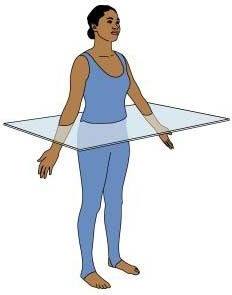
Divides body into top and bottom portions
Medial Plane
Sagittal
Proximal
Transverse Plane

The plane of the body that divides the body into anterior and posterior.
sagittal plane
frontal plane
transverse plane
median plane

How many anatomical planes are there?
three
four
six
two

Which anatomical plane divides the body into equal right and left sides?
Transverse
Horizontal
Sagittal

The blue is sticking out of the
pectoralis major
rectus abdominis
external obliques
deltoids

The blue pin is in the
latissimus dorsi
trapezius
deltoid
triceps brachii
The purple pin is in the
latissimus dorsi
trapezius
deltoid
triceps brachii

The blue is sticking out of the
rectus abdominis
external obliques
linea alba
pectoralis major
The purple is sticking out of the
rectus abdominis
external obliques
linea alba
pectoralis major
The orange is sticking out of the
rectus abdominis
external obliques
linea alba
pectoralis major

The blue is sticking out of the
rectus femoris
biceps femoris
tibialis anterior
vastus medialis

The blue is sticking out of the
extensor digitalis
biceps brachii
triceps femoris
triceps brachii
The purple is sticking out of the
extensor digitalis
flexor digitalis
gastrocnemius
tibialis anterior
The orange is sticking out of the
rectus femoris
biceps femoris
tibialis anterior
vastus lateralis


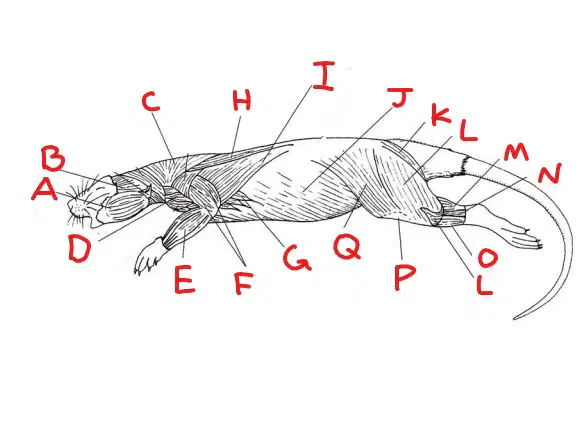
Biceps femoris
L
Q
E
M
D
Soleus
L
Q
N
M
D
Deltoid
A
E
B
C
D
Tibialis anterior
O
Q
E
M
D
Acromiotrapezius
A
B
C
D
H
Temporalis
A
B
C
D
H
Gluteus superficialis
J
Q
K
P
L
Serratus ventralis
J
G
E
I
F
Semitendinosus
Q
L
K
P
M
External obliques
Q
G
J
P
M
Gastrocnemius
Q
M
O
P
L
Spinotrapezius
C
H
B
I
F
Latissimus dorsi
C
H
B
I
F
Triceps brachii
C
H
B
E
F
Extensors digitorum
C
H
B
E
F
Masseter
A
D
B
C
E
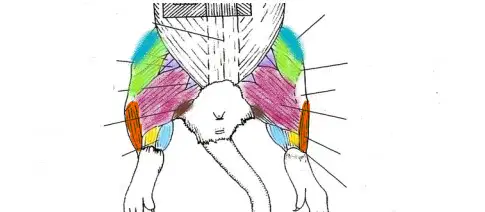
Tibialis anterior
Blue
Orange
Pink
Purple
Green
Soleus
Blue
Orange
Yellow
Purple
Green
Patellar tendon
Blue
Orange
Yellow
Purple
White
Gracilis
Blue
Orange
Yellow
Pink
White
Gastrocnemius
Blue
Orange
Yellow
Pink
White
Semitendinosus
Blue
Brown
Yellow
Pink
White
Adductors
Blue
Brown
Yellow
Purple
White
Vastus medialis
Blue
Brown
Yellow
Purple
Green
Rectus femoris
Blue
Brown
Yellow
Purple
Green
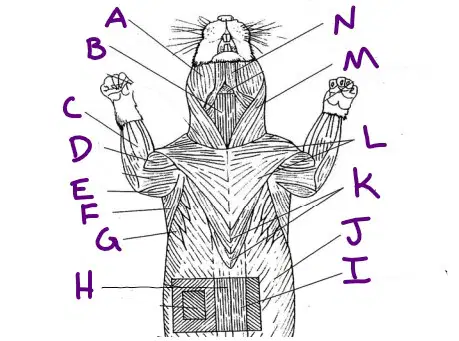
Digastric
A
B
M
N
L
Sternohyoid
A
B
M
N
L
Sternomastoid
A
B
M
N
L
Masseter
A
B
M
N
L
Flexors digitorum
C
D
E
G
L
Biceps brachii
C
D
E
G
L
Pectoralis major
H
D
K
G
L
Pectoralis minor
H
D
K
G
L
Linea alba
H
I
K
J
L
Rectus abdominus
H
I
K
J
L
Obliques
H
I
K
J
L
Latissimus dorsi
H
I
K
F
L
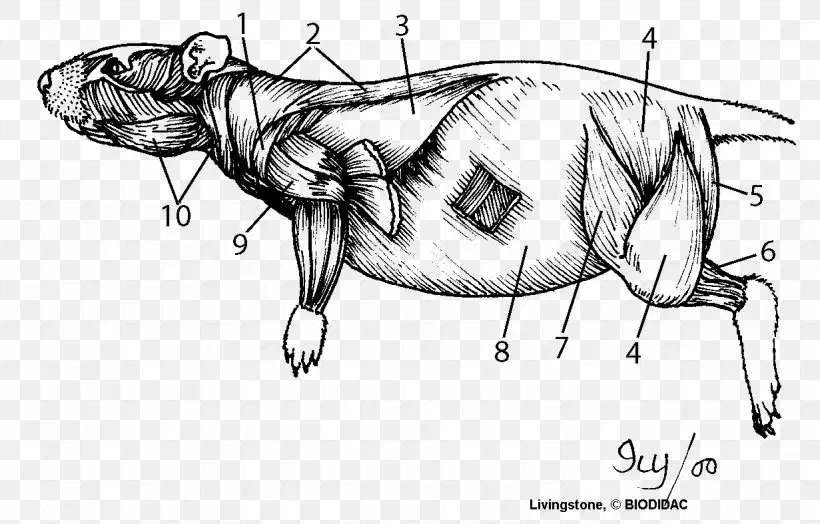
Deltoid
1
2
10
9

