
Font size
 Worksheets
Unit 6 Review
Total questions: 92
Worksheet time: 2hrs 47mins
What is an operon?
a part of a ribsome
a part of a Rna
a unit made up of linked genes that code for proteins needed to do a specific task
needed for dna replication
Operons are found in which of the following organisms?
Bacteria(prokaryotes)
plants and animals(eukaryotes)
only animals
virsuses
What does a promoter do?
binds RNA polymerase for transcription
binds DNA polymerase for replication
binds the operator
binds the repressor
The lac operon genes only become expressed if:
lactose binds to repressor
glucose binds to repressor
repressor binds to operator
lactose binds to operator
What is the name of the stretch of DNA where RNA polymerase binds?
operator
promoter
enhancer
regulatory gene
What does the lactose do to the Operon?
Blocks transcription of the lactase gene by cutting up the DNA
Binds to the repressor preventing it from attaching to the operator
The lactose binds promoter to prevent transcription
Allows for the transcription rate of lactase to slow down
Regulatory proteins (transcription factors) may
encourage transcription
prevent transcription
stop transcription once its started
either encourage or prevent transcription
In a repressible operon, the corepressor
allows transcription to progress
allow the repressor to prevent transcription
binds to the promoter and transcribes the gene
When subunits are available in the environment, a cell will use them to create necessary macromolecules. What type of operon would it most likely use for this process?
repressible operon
inducible operon
In the lac operon the inducer is
lactose
glucose
galactose
all of the above

What is 1 in the diagram?
RNA polymerase
Inducer
Repressor
Operator
What is 2 in the diagram?
RNA polymerase
Inducer
Repressor
Operator
In the top picture the operon is
on
off

What type of operon is the trp (tryptophan) operon?
inducible
repressible
positive control
promotor
What is gene expression?
a regulated process
an easy process
a quick process
a slow process

The Himalayan rabbit's habitat has cold, snowy winters and mild summers. The body is typically covered in white fur except for the nose, feet, tail, and ears, which are covered in black fur.
A scientist shaved an area of white fur on the back of a Himalayan rabbit and placed an ice pack over the shaved area . The shaved area grew black fur.
Which of these best explains why the hair that grew back where the Ice pack was placed was black and not white?
The white hair mutated to black hair as the rabbit's body temperature decreased.
The coat color changed from white to black with the age of the rabbit.
The genes for black hair were activated by specific temperatures.
White hair only grows during certain times of the year.
CRISPR-Cas9 is a genetic modification technique that edits parts of the genome of an organism . Using this technique scientists can add, remove, or modify sections of the DNA sequence.
How can scientists use this technique to control gene expression?
By determining the number of chromosomes in an organism
By identifying how closely related one individual is to another
By calculating the number of genes different organisms produce
By activating or deactivating specific genes
Negative control regulatory proteins use repressors.
True
False
sequences of DNA that code for either regulatory proteins or small regulatory RNA.
Regulatory genes:
proteins that bind to DNA to either facilitate or hinder transcription of the DNA by RNA polymerase.
Regulatory proteins:
pieces of RNA that bind to mRNA and activate or inhibit translation.
Small regulatory RNA (sRNA):
noncoding sequences of DNA that regulatory proteins bind to.
Regulatory sequences:
Gene expression is
when cells regulate to what extent they express each gene contained in their DNA
sequences of DNA that code for either regulatory proteins or small regulatory RNA
noncoding sequences of DNA that regulatory proteins bind to.
the process by which information from a gene is used to synthesize a functional gene product.
Label the regulatory proteins and processes
What is a chromosome?
a piece of DNA
DNA wrapped around protein
the complete genome of an organism
AUGCUU
ATGCTT
GCATCC
GCAUCC

anti-parallel
deoxyribosic
helical
radioactive
Polymerase
builds the complimentary DNA strand
Ligase
bonds DNA fragments together
Primase
Indicates whee DNA replication begins
Helicase
"unzips" the DNA
DNA replication is described as (a) when new DNA is composed of one strand from the parent DNA and one strand that is newly synthesized.
Pyrimidines are double ringed structure.
True
False
Purines are double ringed structure.
True
False
Place the correct label as demonstrated in the picture.
5' to 3'
3' to 5' along the template strand
3' to 5' along nontemplate(coding) strand
5' to 3' along the template strand

What is the amino acid sequence for the following mRNA strand:
UGG-ACU-CGA-GUG
(a)
What is the amino acid sequence for the following mRNA strand:
AUU-AAG-UGC-GGG
(a)
What is the amino acid sequence for the following mRNA strand:
CCA-GAG-UUU-UAG
(a)
All of the following are true EXCEPT:
Gene expression involves transcription and translation
Transcription copies DNA to RNA
Translation copies RNA to protein
All RNAs are translated into protein
The TATA box is
a promoter in eukaryotes.
an operator in prokaryotes.
an exon in prokaryotes.
a tail in eukaryotes.
Which of the following describes the process of alternative RNA splicing?
Different mRNA molecules are made from different sections of DNA
Different mRNA molecules are made from cutting out different exons from same pre-mRNA
Different mRNA molecules are absorbed from the environment for recombination
Different mRNA molecules are absorbed from the mitochondria for translation
4 base pairs that transfer to amino acids
3 base pairs that transfer to amino acids
3 base pairs that transfer to DNA
3 base pairs that transfer to mRNA
The molecule that synthesizes the mRNA inside the nucleus
DNA polymerase
Nucleotides
RNA polymerase
helicase
Who is Gregor Mendel
an Austrian Monk from the mid 1800s who contributed to the study of Genetics
The scientist who discovered the structure of DNA
a British scientist who discovered penicillin
The scientist who used X-Ray Crystallography to shed light on the structure of DNA
sugar and phosphate is bonded by
glycosidic bond
phosphoester bond
nucleotide
nucleoside
The composition of base, sugar and phosphate groups is called
glycosidic bond
phosphoester bond
nucleotide
nucleoside
Purines are double ringed structure.
True
False
Pyrimidines are double ringed structure.
True
False
What is genetic transformation?
A prokaryotic cell turning into a eukaryotic cell
Foreign DNA being inserted into a plasmid
A host organism taking in foreign DNA
A gene being mutated

Based upon the data in the table provided complete letter D (32% Thymine), determine the percentage of Cytosine present in DNA of Yeast.
20%
36%
64%
18%
Based upon the data in the table provided complete letter F (22.8% of Guanine), determine the percentage of Thymine present in DNA of Maize.
37.9% Thymine
32.8% Thymine
27.2% Thymine
22.6% Thymine
Explain how forensic scientists are able to use DNA analysis to identify individuals.
Comparison of DNA from a known source or individual with analysis of the sequence of an unknown sample of DNA allows scientists to find out if both of them are similar or not.
DNA from the unknown sample is sequenced and analyzed. The result of the analysis is then matched with any random population. The matching individual then helps in forensics.
Comparison of DNA from a known source or individual with analysis of the sequence of bases in strands of an unknown sample of RNA allows scientists to find out if both of them are similar or not.
Comparison of DNA from a known source or individual with analysis of the sugars and phosphates in strands of an unknown sample of DNA allows scientists to find out if both of them are similar or not.
Select all that are true about DNA Polymerase
Synthesize 5' to 3' direction only
Can synthesize RNA
Synthesize 3' to 5' direction only
Cannot initiate synthesis de novo
Why can't DNA Polymerase initiate synthesis de novo?
It actually can
It needs a primer
DNA strands are antiparallel
mRNA is not processed
Process when the code from the DNA is copied to mRNA
Transcription
Translation
Where does transcription occur?
(a)
What is produced by transcription?
mRNA
rRNA
tRNA
DNA
Where does translation occur?
In the cytoplasm
At a ribosome
In the cytoplasm at a ribosome
In the nucleus
What is produced by translation?
rRNA
mRNA
Proteins
Lipids
Which types of RNA are used in translation? Select all correct options
DNA
mRNA
rRNA
tRNA
What is a codon?
A set of 3 nucleotides on mRNA
A set of 3 nucleotides on DNA
A whole strand of mRNA
An amino acid
What type of RNA is responsible for bringing amino acids?
mRNA
tRNA
rRNA
DNA
What is the central dogma?
DNA to RNA to Amino Acid
DNA to RNA to Protein
RNA to DNA to Protein
RNA to DNA to Amino Acid
What binds together to create proteins?
Sugars
Nucleotides
Lipids
Amino Acids
In RNA, what base replaces Thymine?
Cytosine
Adenine
Uracil
Guanine
Determine the RNA sequence that compliments the DNA stranded:
TACGGT
TACGGT
AUGCCA
ATGCCA
UACGGU
What is the template for the RNA sequence?
(a)
How does rRNA read the mRNA strand?
In single nucleotides
In codons
All at once
Select all of the RNA types from the options below
mRNA
rRNA
pRNA
tRNA
cRNA

There are several steps in gene expression. DNA is a double helix, that unwinds into two strands. What is the next step in DNA replication as shown in diagram 2?
Process; replication; produvt tRNA
Process; Transcription; product; mRNA
Process; Transctription; product; DNA
Process; recombination; product; polymerase
What are the steps in order of protein synthesis.
Messenger RNA is produced using DNA as a template
mRNA attaches to the ribosome
a anti-codon on tRNA bonds to a specific codon on mRNA
Amino acids bond together to create a peptide chain
A protein is created
Negative control regulatory proteins use repressors.
True
False
sequences of DNA that code for either regulatory proteins or small regulatory RNA.
Regulatory genes:
proteins that bind to DNA to either facilitate or hinder transcription of the DNA by RNA polymerase.
Regulatory proteins:
pieces of RNA that bind to mRNA and activate or inhibit translation.
Small regulatory RNA (sRNA):
noncoding sequences of DNA that regulatory proteins bind to.
Regulatory sequences:
Gene expression is
when cells regulate to what extent they express each gene contained in their DNA
sequences of DNA that code for either regulatory proteins or small regulatory RNA
noncoding sequences of DNA that regulatory proteins bind to.
the process by which information from a gene is used to synthesize a functional gene product.
Label the regulatory proteins and processes
What mutation has occurred here?
T-G-A-C-C-A
T-G-A-G-C-A
Substitution
Deletion
Insertion
Frameshift
Which of the following would result in a frameshift mutation?
Insertions only
Substitution only
Deletion only
Insertions and Deletions
DNA molecule segment is : TTACGCAAG
The mutated DNA segment is TTCGCAAG. This is an example of ___ mutation.
Substitution
Deletion
Insertion
Inversion
A mutation is defined as:
A change in the cell's structure
Anything that changes in an embryo
Any change in the physical features of a human
A change in the DNA sequence
ATTTGAGCC- Original
ATTGAGCC - Mutated
The example above is an example of a
Insertion- Frameshift
Deletion- Substitution
Deletion -Frameshift
All of the above
What mutation has occurred here?
T-G-A-C-C-A
T-G-A-G-C-A
Substitution
Deletion
Insertion
Frameshift
Why are insertion and deletion (frameshift) mutations so harmful?
They change all of the codons from the mutation on down the line, which changes the amino acid sequence
They insert things that an organism doesn't need.
They often delete things that organisms need.
Insertion and deletions are not any more harmful than substitution mutations.
Identify the DELETION mutation form the following:
ATG CCA AAT
ATG TCA AAT
ATG CCT AAA T
ATC CA AT
ATG CCA AAT

Which mutation will cause translation to stop?
Mutations 1 and 3 only
Mutation 1 only
Mutation 2 only
Muations 1, 2, 3

Which type of mutation does the model demonstrate?
Deletion
Substitution
Insertion
Translocation
Mutations can be spontaneous.
True
False

What describes a change in the DNA sequence?
Transcription
Translation
DNA replication
Mutation
Apoptosis
Where would a mutation have to occur in order to be passed down to organism’s offspring?
Somatic
Germline
True or False: All mutations are Harmful
False
True
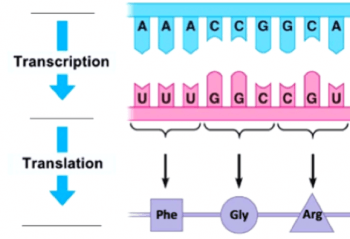
3 bases in a row on the mRNA strand, that call for a particular amino acid to be added to the polypeptide chain:
chromosome
gene
codon
anticodon

