
 Worksheets
Midterm 3 Review Questions
Total questions: 57
Worksheet time: 29mins
Name
Class
Date
1.
The process of DNA replication requires that each of the parental DNA strands be used as a __________ to produce a duplicate of the opposing strand.
a)
Catalyst
b)
Enzyme
c)
Template
d)
Copy
2.
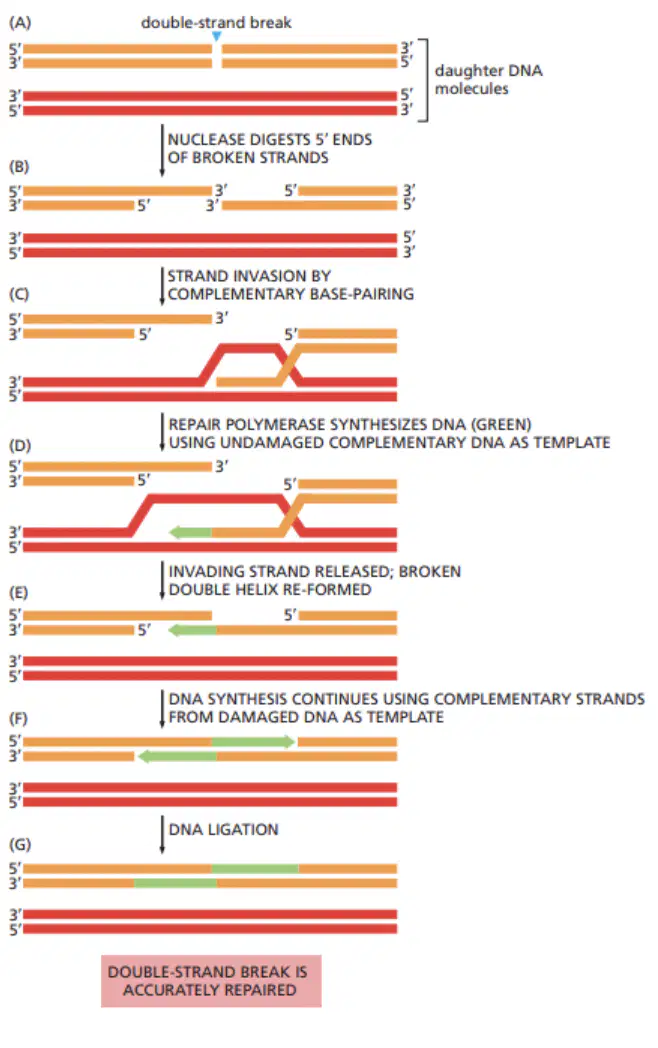
Identify which form of DNA repair this figure illustrates.
a)
Homologous Recombination
b)
Nonhomologous end joining
c)
mismatch repair
d)
excision repair
3.
What role does DNA topoisomerase play?
a)
It binds the DNA polymerase to the template stand
b)
It fuses the Okazaki fragments together in the lagging strand
c)
It relieves tension built up at the replication fork
d)
None of the above
4.
During DNA replication, the ____________ is synthesized discontinuously because it grows away from the replication fork, and the ___________ is synthesized continuously because it grows towards the replication fork.
a)
DNA, RNA
b)
RNA, DNA
c)
leading strand, lagging strand
d)
lagging strand, leading strand
5.
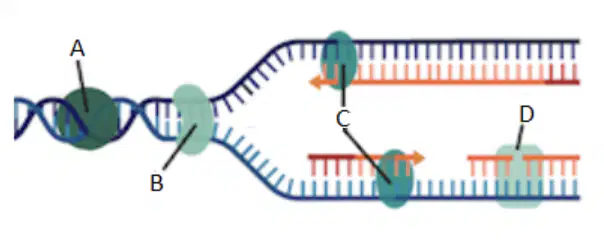
What is the name of the enzyme labeled D?
a)
topoisomerase
b)
helicase
c)
DNA polymerase
d)
ligase
6.
DNA polymerase can only add new nucleotides in one direction. Which direction is it?
a)
3' to 5"
b)
5' to 3'
7.
Which of the following facts about telomeres is/are true?
a)
Telomeres are found at the ends of chromosomes.
b)
Telomeres protect the ends of chromosomes from degradation.
c)
Telomeres are made up of coding DNA sequences that contribute to protein production.
d)
Telomeres shorten with each round of cell division due to the removal of non-coding DNA.
8.

In the image, you can see that the lagging strand ends up with gaps on the end after the RNA primers are removed. How does telomerase fix this end-replication problem?
a)
Telomerase uses its RNA template to allow repeating sequences to be added to the ends of the chromosome.
b)
Telomerase removes nucleotides on the end of the chromosome to remove overhangs.
c)
Telomeres use the other strand of DNA as a template to replicate the ends.
d)
None of the above
9.
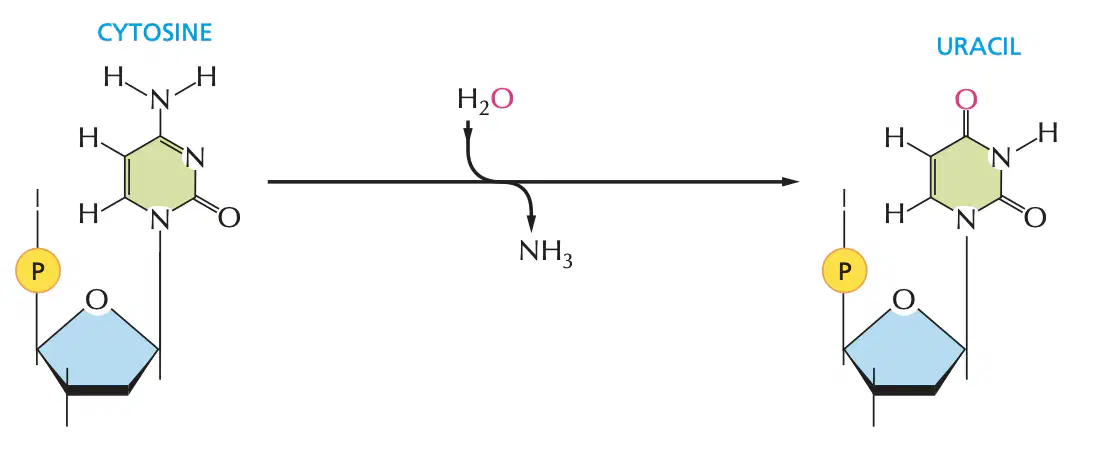
One common form of DNA damage is called ____________, it is the loss of an amino group from a cytosine in DNA to produce the base uracil
a)
Hydration synthesis
b)
Amino conversion
c)
Depurination
d)
Deamination
10.
Which of the following steps in DNA repair comes last?
1. The nick or break in the helix is sealed by DNA ligase, the same enzyme that joins the Okazaki fragments during replication of the lagging DNA strand.
2.The damaged DNA is recognized and removed by one of a variety of mechanisms.
3. A repair DNA polymerase binds to the 3ʹ-hydroxyl end of the cut DNA strand. It then fills in the gap by making a complementary copy of the information stored in the undamaged strand.
a)
1
b)
2
c)
3
11.
The chromatin structure in eukaryotic cells is much more complicated than that observed in prokaryotic cells. This is thought to be the reason why DNA replication occurs much faster in prokaryotes. How much faster is it?
a)
5x
b)
2x
c)
10x
d)
100x
12.
Replication forks are asymmetrical
a)
True
b)
False
13.
DNA replication is considered semiconservative because
a)
new DNA strands must be copied from a DNA template
b)
after many rounds of DNA replication, the original DNA double helix is still intact.
c)
each daughter DNA molecule consists of one strand from the parent DNA molecule and one new strand.
d)
each daughter DNA molecule consists of two new strands copied from the parent molecule.
14.
If the genome of the bacterium E. coli requires about 20 minutes to replicate itself, how can the genome of the fruit fly Drosophila be replicated in only 3 minutes?
a)
Drosophila DNA contains more origins of replication the E. coli DNA
b)
The Drosophila genome is smaller than the E. coli genome.
c)
Eukaryotic DNA polymerase synthesizes DNA at a much faster rate than prokaryotic DNA polymerase.
d)
The nuclear membrane keeps the Drosophila DNA concentrated in one place in the cell, which increases the rate of polymerization.
15.
For every origin of replication, how many replication forks are there?
a)
1
b)
2
c)
3
d)
4
16.
Which of the following is considered True?
a)
Primase is an example of a DNA polymerase
b)
Ligase unwinds the DNA helix
c)
The replication fork is asymmetrical
d)
Okazaki fragments proofread and correct for nucleotide mismatches
17.
What is the name for the cells back up machinery for making repairs when mistakes occur during replication?
a)
Sliding clamp
b)
Mismatch repair
c)
Depurination
d)
Deamination
18.
There are two methods for repairing double-strand breaks: Homologous Recombination and Nonhomologous End Joining. Which of the two methods results in a loss of genetic information?
a)
Homologous Recombination
b)
Nonhomologous End Joining
19.
In which direction is DNA made at the replication fork?
a)
The leading strand and the lagging strand both are synthesized in a 5' to 3' direction
b)
The leading strand is synthesized in a 5' to 3' direction and the lagging strand is synthesized in a 3' to 5' direction.
c)
The leading strand and the lagging strand are both synthesized in a 3' to 5' direction.
d)
The leading strand is synthesized in a 3' to 5' direction and the lagging strand is synthesized in a 5' to 3' direction.
20.
Base Excision Repair (BER) repairs damage caused by
a)
X-rays, hydrolysis, UV-light, chemicals, and alkylating agents
b)
X-rays, chemicals, ionizing radiation, and UV-light
c)
X-rays, hydrolysis, chemicals, ionizing radiation, and oxygen radicals
d)
X-rays, hydrolysis, alkylating agents, and oxygen radicals
21.
Which type of DNA damage completely removes a purine base from a nucleotide via hydrolysis?
a)
Depurination
b)
Deamination
c)
Formation of a thymine dimer
d)
Double-stranded breaks
22.
Which DNA repair mechanism requires another homologous chromosome or sister chromatid to be available?
a)
Homologous end joining
b)
Homologous recombination repair
c)
Mismatch repair
d)
Nucleotide excision repair
e)
None of the above
23.
When do thymine dimers form?
a)
two adjacent thymines on the same strand of DNA become covalently linked together
b)
two adjacent thymines on complementary strands of DNA become non-covalently linked together
c)
two adjacent thymines on complementary strands of DNA become covalently linked together
d)
two adjacent thymines on the same strand of DNA become non-covalently linked together
24.
What is false about RNA
a)
They are composed of adenine, guanine, cytosine, and thymine
b)
RNA is single stranded
c)
RNA is only in prokaryotes
d)
all of the above
25.
What are the different types of RNA
a)
tRNA
b)
SiRNA
c)
MiRNA
d)
mRNA
e)
TrRNA
26.
In prokaryotes, what region of RNA Polymerase recognizes the DNA promoter sequence?
a)
Recognition Signal Subunit
b)
sigma factor
c)
None of the above; Prokaryotic RNA Polymerases can't recognize promoters without the help of proteins
27.
In Eukaryotes what needs to occur before mRNA can be translated by ribosome?
a)
Addition of the 5' cap
b)
Addition of phosphate
c)
Removal of exons
d)
Addition of poly A tail
e)
Leaves the nucleus
28.
How do snRNPs recognize their cut sites?
a)
They recognize introns by the 2'OH
b)
They recognize the operators regulator binding sites
c)
they recognize exons 3' OH
d)
They splice-site due to complementary base-pairing between their RNA components
29.
RNA in cells differs from DNA in that
a)
it contains the base uracil, which pairs with cytosine
b)
it is single-stranded and cannot form base pairs
c)
it is single-stranded and can fold up into a variety of structures
d)
the sugar ribose contains fewer oxygen atoms than does deoxyribose
30.
What is the purpose of the 5' cap and poly A tail?
(a)
31.
What options describe the TATA binding protein?
a)
It is a general transcription factor
b)
it is a domain of TFIID
c)
It attracts other transcription factors
d)
it is a type of RNA
e)
it is a type of sigma factor
32.
In Eukaryotes, Transcription is similar to DNA replication in that...
a)
a mature mRNA transcript is synthesized discontinuously and the pieces are then joined together.
b)
it uses the same enzyme that is used to synthesize DNA
c)
the newly synthesized RNA remains paired to the template DNA
d)
nucleotide polymerization occurs only on the 5' side
33.
In Prokaryotes, Transcription is similar to DNA replication in that...
a)
a mature mRNA transcript is synthesized discontinuously and the pieces are then joined together.
b)
it uses the same enzyme that is used to synthesize DNA
c)
the newly synthesized RNA remains paired to the template DNA
d)
nucleotide polymerization occurs only on the 5' side
e)
None of the above
34.
Which of the following statements is false?
a)
A new RNA molecule can begin to be synthesized from a gene before the previous RNA molecule’s synthesis is completed.
b)
If two genes are to be expressed in a cell, these two genes can be transcribed with different efficiencies.
c)
RNA polymerase is responsible for both unwinding the DNA helix and catalyzing the formation of the phosphodiester bonds between ribonucleotides.
d)
Unlike DNA, RNA uses a uracil base and a deoxyribose sugar.
35.
List three ways in which the process of eukaryotic transcription differs from the process of bacterial transcription.
(a)
36.
The sigma factor...
a)
remains part of the polymerase throughout transcription
b)
recognizes promoter sites in the DNA
c)
recognizes transcription termination sites in the DNA
d)
is not needed in eukaryotic transcription
37.
Which of the following statements is true?
a)
Ribosomes are large RNA structures composed solely of rRNA.
b)
Ribosomes are synthesized entirely in the cytoplasm.
c)
rRNA components have catalytic activity that joins amino acids together.
d)
A ribosome binds one tRNA at a time.
38.
Ribozymes catalyze which of the following reactions?
a)
DNA Synthesis
b)
Formation of ribosomes
c)
RNA Splicing
d)
Protein hydolysis
39.
You are studying a disease that is caused by a virus. When you purify the virus particles, and analyze them, you find they contain no trace of DNA. Which of the following molecules are likely to contain the genetic information of the virus?
a)
high-energy phosphate groups
b)
RNA
c)
carbohydrates
d)
liposome
40.
What are all of the stop codons? what binds to stop codons? how do these change the large ribosomal subunit?
(a)
41.
In eukaryotic cells, general transcription factors are required for the activity of all promoters transcribed by RNA polymerase II. The assembly of the general transcription factors begins with the binding of the factor __________________ to DNA, causing a marked local distortion in the DNA. This factor binds at the DNA sequence called the __________________ box, which is typically located 25 nucleotides upstream from the transcription start site. Once RNA polymerase II has been brought to the promoter DNA, it must be released to begin making transcripts. This release process is facilitated by the addition of phosphate groups to the tail of RNA polymerase by the factor __________________. It must be remembered that the general transcription factors and RNA polymerase are not sufficient to initiate transcription in the cell and are affected by proteins bound thousands of nucleotides away from the promoter. Proteins that link the distantly bound transcription regulators to RNA polymerase and the general transcription factors include the large complex of proteins called the__________________. The packing of DNA into chromatin also affects transcriptional initiation, and histone __________________ is an enzyme that can render the DNA less accessible to the general transcription factors.
a)
deacetylase
b)
TATA
c)
TF||D
d)
TF||H
e)
mediator
42.
Below is the sequence from the 3' end of an mRNA.
5'-CCGUUACCAGGCCUCAUUAUUGGUAACGGAAAAAAAAAAAAAA-3'
If you were told that this sequence contains the stop codon for the protein encoded by this mRNA, what is the anticodon of the tRNA located at the P-site of the ribosome when release factor binds to the A-site?
a)
(a) 5'-CCA-3'
b)
(b) 5'-CCG-3'
c)
(c) 5'-UGG-3'
d)
(d) 5'-UUA-3'
43.
What is the spliceosome and what does it do ?
(a)
44.
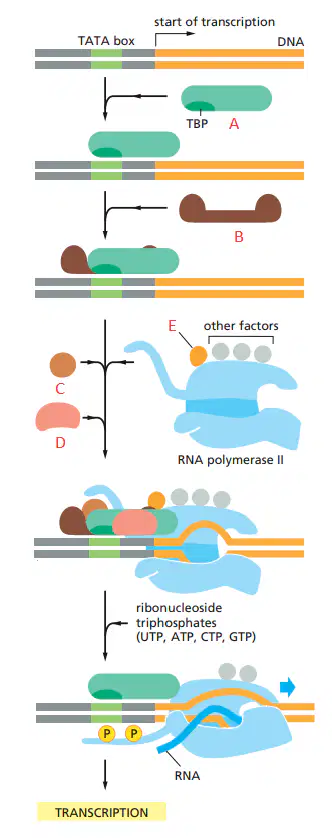
What are all of the General Transcription factors?
a)
A) TFIID, TFIIB, TFIIE, TFIIH, TFIIF
b)
A) TFIIG ,TFIIJ, TFIIZ, TFIIA, TFIIF
c)
A) TFIII, TFIIY, TFIIL, TFIIB, TFIIE
d)
A) TFIIA, TIIDQ, TFIIP, TFIIN, TFIIF
45.
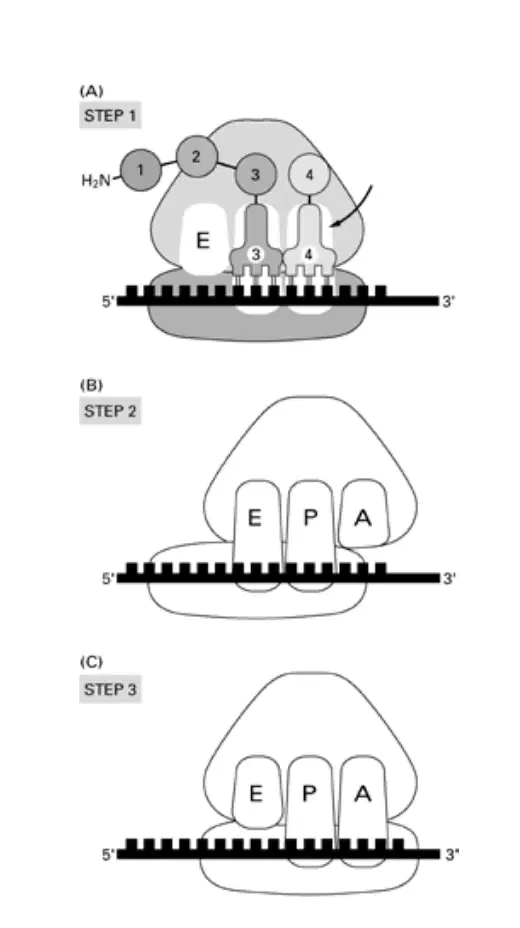
Figure A shows the stage in translation when an incoming aminoacyl-tRNA has bound to the A-site on the ribosome. Using the components shown in Figure A as a guide, describe what happens in Figure B and C to complete the addition of the new amino acid to the growing polypeptide chain.
(a)
46.
You have a segment of DNA that contains the following sequence:
5'-GGACTAGACAATAGGGACCTAGAGATTCCGAAA-3'
3'-CCTGATCTGTTATCCCTGGATCTCTAAGGCTTT-5'
If you know that the RNA transcribed from this segment contains the following sequence:
5'-GGACUAGACAAUAGGGACCUAGAGAUUCCGAAA–3'
Which of the following choices best describes how transcription occurs?
a)
(a) The top strand is the template strand; RNA polymerase moves along this strand from 5' to 3'.
b)
(b) The top strand is the template strand; RNA polymerase moves along this strand from 3' to 5'
c)
(c) The bottom strand is the template strand; RNA polymerase moves along this strand from 5' to 3'.
d)
(d) The bottom strand is the template strand; RNA polymerase moves along this strand from 3' to 5'.
47.
Say you grow E.coli in medium, but there is low lactose level. Which will occur?
a)
β-galactosidase and permease are present in small quantities, but transacetylase is present in large quantities.
b)
all the enzymes of the lactose operon are present in very small quantities.
c)
all the enzymes of the lactose operon are present in large quantities.
d)
the mRNA of the lactose operon is not present at all.
e)
no enzymes of the lactose operon are present.
48.
What are the 3 basic parts of an operon?
a)
structural genes, the mRNA, and the tRNAs.
b)
promoter, the mRNA, and the termination codons.
c)
promoter, the structural genes, and the termination codons.
d)
promoter, the operator, and two or more structural genes.
e)
None of the these are correct
49.
Which of the following blocks the transcription of the tryptophan operon by acting as a co-repressor?
a)
Lactose
b)
cAMP
c)
Tryptophan
d)
Methionine
e)
CRP
50.
To be considered active, CAP must bind what first?
a)
the activator protein.
b)
the repressor protein.
c)
the repressor molecule.
d)
the co-repressor molecule.
e)
cAMP.
51.
If the concentration of glucose is high within the environment, then there must be a low concentration of what?
a)
inducers
b)
repressors
c)
cAMP
d)
CAP
e)
None of the these are correct
52.
How does the presence of glucose affect the transcription of the lac operon?
a)
It increases the rate of transcription.
b)
It decreases the rate of transcription.
c)
It increases the cAMP concentration, which in turn causes a decreased rate of transcription.
d)
It decreases the cAMP concentration, which in turn causes an increased rate of transcription.
e)
None of the these are correct
53.
What type of operon can be turned "off" as a response to the presence of molecules in the environment of the cell?
a)
Suppressible
b)
Impressible
c)
Inducible
d)
Degraded
e)
Repressible
54.
Which description best fits the promoter?
a)
the mRNA that binds tRNAs.
b)
DNA that binds RNA polymerase.
c)
a plasmid that binds the enzymes for replication.
d)
the mRNA that binds to a ribosome.
e)
None of the these are correct
55.
Which of the following does NOT apply to the TATA box?
a)
They contain thymine–adenine base pairs.
b)
They help specify the starting point for transcription.
c)
They are found in the region of the promoter.
d)
They are part of the intron consensus sequence.
e)
They bind a specific transcription factor.
56.
What protein type determines a cell's identity, and provides a cellular memory for the next generation of daughter cells?
a)
Multipotent stem cell genes
b)
Majordomo genes
c)
"Master switch" genes
d)
Major binding factors
e)
Master transcription regulators
57.
Which proteins are responsible for recognizing regulatory DNA sequences?
a)
TATA box
b)
Transcription regulators
c)
miRNA
d)
tRNA
e)
promoter
100 %

