
 Worksheets
EMERGENCY & DISASTER NURSING ⏐ 𝙲𝙰 𝟸
Total questions: 122
Worksheet time: 2hrs 2mins
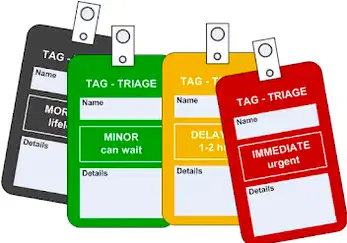
A triage tag is a tool that the first responders and medical personnel use during a disaster. With the aid of the triage tags, the first-arriving personnel are able to effectively and efficiently distribute the limited resources and provide the necessary immediate care for the victims until more help arrives. 𝙼𝚊𝚝𝚌𝚑 𝙲𝙾𝙻𝚄𝙼𝙽 𝙰 𝚠𝚒𝚝𝚑 𝙲𝙾𝙻𝚄𝙼𝙽 𝙱.
🔴 RED 𝚃𝙰𝙶
Immediate/Emergent
🟡 YELLOW 𝚃𝙰𝙶
Delayed/Urgent
🟢 GREEN 𝚃𝙰𝙶
Minor/Non-Urgent
⚫️ BLACK 𝚃𝙰𝙶
Deceased/Expectant
Simple Triage 𝚊𝚗𝚍 Rapid Treatment (START) is a strategy that the first responders and medical personnel employ to evaluate the severity of injury of each victim as quickly as possible and tag the victims in about 30–60 seconds. 𝙼𝚊𝚝𝚌𝚑 𝙲𝙾𝙻𝚄𝙼𝙽 𝙰 𝚠𝚒𝚝𝚑 𝙲𝙾𝙻𝚄𝙼𝙽 𝙱.
🔴 RED 𝚃𝙰𝙶
can't wait; needs immediate treatment; has high probability of survival
🟡 YELLOW 𝚃𝙰𝙶
can wait for 30 minutes to 2 hours
🟢 GREEN 𝚃𝙰𝙶
can wait for more than 2hrs
⚫️ BLACK 𝚃𝙰𝙶
poor prognosis regardless of treatment
Simple Triage 𝚊𝚗𝚍 Rapid Treatment (START) is is currently the most widely used triage system to know which victims are of highest priority. 𝙼𝚊𝚝𝚌𝚑 𝙲𝙾𝙻𝚄𝙼𝙽 𝙰 𝚠𝚒𝚝𝚑 𝙲𝙾𝙻𝚄𝙼𝙽 𝙱.
🔴 RED 𝚃𝙰𝙶
seen 1st
🟡 YELLOW 𝚃𝙰𝙶
seen 2nd
🟢 GREEN 𝚃𝙰𝙶
seen 3rd
⚫️ BLACK 𝚃𝙰𝙶
N/A
Triage is one of the key principles of the effective management of major emergencies. Triage is derived from the French word “trier” which means "to sort/group/rank/classify". 𝙼𝚊𝚝𝚌𝚑 𝙲𝙾𝙻𝚄𝙼𝙽 𝙰 𝚠𝚒𝚝𝚑 𝙲𝙾𝙻𝚄𝙼𝙽 𝙱.
🔴 RED 𝚃𝙰𝙶
shock, uncompromised airway, unstable wounds, 𝚊𝚗𝚍 chest trauma
🟡 YELLOW 𝚃𝙰𝙶
open fracture with palpable distal pulse 𝚊𝚗𝚍 large wounds
🟢 GREEN 𝚃𝙰𝙶
infections, minor burns or lacerations, 𝚊𝚗𝚍 closed fractures
⚫️ BLACK 𝚃𝙰𝙶
pulselessness, apnea, severe neurological trauma, 𝚊𝚗𝚍 full-thickness burn more than 60% of TBSA
OPEN FRACTURES (with palpable distal pulse) are tagged as (a) .
—
CLOSED FRACTURES are tagged as (b) .
The "walking wounded" are automatically tagged as:
🟢 GREEN 𝚃𝙰𝙶𝚂
🔴 RED 𝚃𝙰𝙶𝚂
🟡 YELLOW 𝚃𝙰𝙶𝚂
⚫️ BLACK 𝚃𝙰𝙶𝚂
Using the START Method, the "walking wounded" will automatically be tagged as 🟢 GREEN 𝚃𝙰𝙶𝚂.
—
The rest who are unable to move will be assessed with which of the following parameters for correct tagging? [𝚂𝙰𝚃𝙰]
Breathing
Circulation
Mental Status
Emotional Status
Financial Status
Using the START Method, the "walking wounded" will automatically be tagged as 🟢 GREEN 𝚃𝙰𝙶𝚂.
—
The rest who are unable to move will be assessed further for correct tagging. Which one is the first parameter?
Breathing
Circulation
Mental Status
Using the START Method, the "walking wounded" will automatically be tagged as 🟢 GREEN 𝚃𝙰𝙶𝚂.
—
The rest who are unable to move will be assessed further for correct tagging. Which one is the second parameter?
Circulation
Breathing
Mental Status
Using the START Method, the "walking wounded" will automatically be tagged as 🟢 GREEN.
—
The rest who are unable to move will be assessed further for correct tagging. Which one is the third/last parameter?
Mental Status
Breathing
Circulation
The first choice on where to attach triage tags.
Left Arm
Right Arm
Left Leg
Right Leg
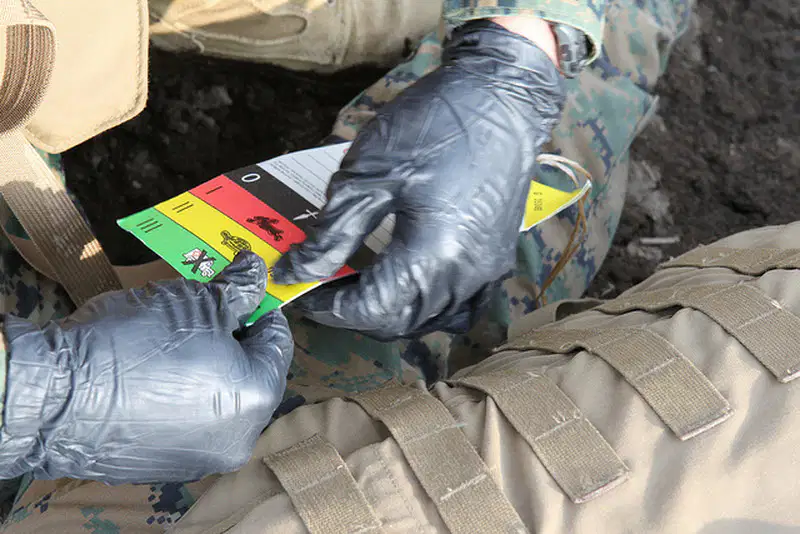
The second choice on where to attach triage tags.
Left Leg
Right Leg
Left Arm
Right Arm
The first choice on where to attach triage tags is (a) and the second choice is (b) .
The recommended time-frame of doing triage/victim.
less than 60 seconds
more than 60 secs
30-60 minutes
15-30 minutes
You're working as a triage nurse during a disaster situation. Based on the triage color code tags placed on each of the wounded, which tag color represents the wounded who have the highest priority of being treated first?
🔴 RED 𝚃𝙰𝙶𝚂
🟡 YELLOW 𝚃𝙰𝙶𝚂
🟢 GREEN 𝚃𝙰𝙶𝚂
⚫️ BLACK 𝚃𝙰𝙶𝚂
A catastrophic disaster has occurred 5 miles from the hospital you are working in.
The hospital's disaster plan is activated and the wounded are brought to the hospital.
You're helping triage the survivors. One of the wounded is able to walk around and has minor lacerations on the arms, hands, chest, and legs. You would place what color tag on this survivor?
🟢 GREEN 𝚃𝙰𝙶
🔴 RED 𝚃𝙰𝙶
🟡 YELLOW 𝚃𝙰𝙶
⚫️ BLACK 𝚃𝙰𝙶
Which statement below is incorrect about the 🟡 YELLOW 𝚃𝙰𝙶𝚂 in regards to a disaster situation?
A survivor with this tag color is seen after patients with the green tag color.
A survivor with this tag color can have treatment delayed for an hour or less.
A survivor with this tag color has serious injuries that could eventually lead to the compromise of breathing, circulation, or mental status, especially if treatment is delayed more than an hour or so.
A survivor with this tag color has second priority for treatment of injuries.
The wounded victim is unable to walk, has respiratory rate of 40, capillary refill is 6 seconds, and can't follow simple commands. The wounded victim is assigned what tag color?
🔴 RED 𝚃𝙰𝙶
🟡 YELLOW 𝚃𝙰𝙶
🟢 GREEN 𝚃𝙰𝙶
⚫️ BLACK 𝚃𝙰𝙶
While triaging the wounded from a disaster, you note that one of the wounded is not breathing, radial pulse is absent, capillary refill >2 seconds, and does not respond to your commands. What color tag is assigned?
⚫️ BLACK 𝚃𝙰𝙶
🔴 RED 𝚃𝙰𝙶
🟡 YELLOW 𝚃𝙰𝙶
🟢 GREEN 𝚃𝙰𝙶
The wounded victim is unable to walk, has respiratory rate of 12, capillary refill is 8 seconds, and is unresponsive. The wounded victim is assigned what tag color?
🔴 RED 𝚃𝙰𝙶
🟡 YELLOW 𝚃𝙰𝙶
🟢 GREEN 𝚃𝙰𝙶
⚫️ BLACK 𝚃𝙰𝙶
The wounded victim is unable to walk, has respiratory rate of 19, capillary refill of one second, and is able to obey your commands. The wounded victim is assigned what tag color?
🟡 YELLOW 𝚃𝙰𝙶
🔴 RED 𝚃𝙰𝙶
🟢 GREEN 𝚃𝙰𝙶
⚫️ BLACK 𝚃𝙰𝙶
The wounded victim is unable to walk, respiratory rate is absent but when airway is repositioned breathing is noted. The wounded victim is assigned what tag color?
🔴 RED 𝚃𝙰𝙶
🟡 YELLOW 𝚃𝙰𝙶
🟢 GREEN 𝚃𝙰𝙶
⚫️ BLACK 𝚃𝙰𝙶
The wounded victim is unable to walk, respiratory rate is absent and when airway is repositioned breathing is still absent. The wounded victim is assigned what tag color?
⚫️ BLACK 𝚃𝙰𝙶
🔴 RED 𝚃𝙰𝙶
🟡 YELLOW 𝚃𝙰𝙶
🟢 GREEN 𝚃𝙰𝙶
The wounded victim is able to walk and obey commands. The wounded victim is assigned what tag color?
🟢 GREEN 𝚃𝙰𝙶
🔴 RED 𝚃𝙰𝙶
🟡 YELLOW 𝚃𝙰𝙶
⚫️ BLACK 𝚃𝙰𝙶
Nurse Ejay is assigned to telephone triage. A client called who was stung by a honeybee and is asking for help. The client reports pain and localized swelling but has no respiratory distress or other symptoms of anaphylactic shock. What is the appropriate initial action that the nurse should direct the client to perform?
Removing the stinger by scraping it
Applying a cold compress
Taking an oral antihistamine
Calling 911
Nurse Anna is an experienced travel nurse who was recently employed and is assigned to the emergency unit. In her first week of the job, which of the following area is the most appropriate assignment for her?
Ambulatory section
Triage
Trauma team
Psychiatric care
A client arrives at the emergency department who suffered multiple injuries from a head-on car collision. Which of the following assessment should take the highest priority to take?
A deviated trachea
Unequal pupils
Irregular pulse
Ecchymosis in the flank area
Nurse Kelly, a triage nurse encountered a client who complained of mid-sternal chest pain, dizziness, and diaphoresis. Which of the following nursing action should take priority?
Administer oxygen therapy via nasal cannula
Notify the physician
Complete history taking
Put the client on ECG monitoring
A group of people arrived at the emergency unit by a private car with complaints of periorbital swelling, cough, and tightness in the throat. There is a strong odor emanating from their clothes. They report exposure to a “gas bomb” that was set off in the house. What is the priority action?
Direct the clients to the decontamination area
Instruct personnel to don personal protective equipment
Direct the clients to the cold or clean zone for immediate treatment
Immediately remove other clients and visitors from the area
When an unexpected death occurs in the emergency department, which task is the mostappropriate to delegate to a nursing assistant?
Assisting with postmortem care
Facilitate meetings between the family and the organ donor specialist
Escorting the family to a place of privacy
Help the family to collect belongings
The physician has ordered cooling measures for a child with a fever who is likely to be discharged when the temperature comes down. Which task would be appropriate to delegate to a nursing assistant?
Assist the child in removing outer clothing
Prepare and administer a tepid sponge bath
Explain the need for giving cool fluids
Advise the parent to use acetaminophen (Tylenol) instead of aspirin
You are preparing a child for IV conscious sedation before the repair of a facial laceration. What information should you report immediately to the physician?
The parent's refusal of the administration of the IV sedation
The child suddenly pulls out the IV
The parent is not sure regarding the child's tetanus immunization status
The parent wants information about the IV conscious sedation
The emergency medical service has transported a client with severe chest pain. As the client is being transferred to the emergency stretcher, you note unresponsiveness, cessation of breathing, and unpalpable pulse. Which of the following task is appropriate to delegate to the nursing assistant?
Doing chest compressions
Assisting with the intubation
Placing the defibrillator pads
Initiating bag valve mask ventilation
The nursing manager decides to form a committee to address the issue of violence against ED personnel. Which combination of employees would be best suited to fulfill this assignment?
At least one representative from each group of ED personnel
ED physicians and charge nurses
RNs, LPNs, and nursing assistants
Experienced RNs and experienced paramedics
A client suffered an amputation of the first and second digits in a chainsaw accident. Which task should be delegated to an LPN/LVN?
Wrapping the cleansed digits in saline-moistened gauze, sealing in a plastic container, and placing it in icy water
Cleansing the amputated digits and placing them directly into an ice slurry
Gently cleansing the amputated digits and the hand with povidone-iodine
Cleansing the digits with sterile normal saline and placing it in a sterile cup with sterile normal saline
A client arrives in the emergency unit and reports that a concentrated household cleaner was splashed in both eyes. Which of the following nursing actions is a priority?
Flush the eye repeatedly using sterile normal saline
Examine the client's visual acuity
Patch the eye
Use Restasis (Allergan) drops in the eye
A client was brought to the emergency department after suffering a closed head injury and lacerations around the face due to a hit-run accident. The client is unconscious and has a minimal response to noxious stimuli. Which of the following assessment findings if observed after few hours, should be reported to the physician immediately?
Drainage of a clear fluid from the client's nose
Withdrawal of the client in response to painful stimuli
Bruises and minimal edema of the eyelids
Bleeding around the lacerations
A 5-year-old client was admitted to the emergency unit due to the ingestion of an unknown amount of chewable vitamins for children at an unknown time. Upon assessment, the child is alert and with no symptoms. Which of the following information should be reported to the physician immediately?
The vitamin that was ingested contains iron
The child was nauseated and vomited once at home
The child has been treated several times for toxic substance ingestion
The child has been treated multiple times for injuries caused by accidents
The following clients are presented with signs and symptoms of heat-related illness. Which of them needs to be attended first?
A homeless person who is a poor historian; has altered mental status, poor muscle coordination, and hot, dry ashen skin; and whose duration of heat exposure is unknown.
A relatively healthy homemaker who reports that the air conditioner has been broken for days and who manifest fatigue, hypotension, tachypnea, and profuse sweating.
An elderly person who complains of dizziness and syncope after standing in the sun for several hours to view a parade.
A marathon runner who complains of severe leg cramps and nausea, and manifests weakness, pallor, diaphoresis, and tachycardia.
An anxious female client complains of chest tightness, tingling sensations, and palpitations. Deep, rapid breathing, and carpal spasms are noted. Which of the following priority action should the nurse do first?
Have the client breathe into a brown paper bag
Provide oxygen therapy
Notify the physician immediately
Administer anxiolytic medication as ordered
An intoxicated client comes into the emergency unit with uncooperative behavior, mild confusion, and slurred speech. The client is unable to provide a good history but he verbalizes that he has been drinking a lot. Which of the following is a priority action of the nurse?
Administer IV fluid incorporated with Vitamin B1 as ordered
Administer Naloxone (Narcan) 4 mg as ordered
Contact the family to get information about the client
Obtain an order for the determination of blood alcohol level
A nurse is providing discharge instructions to a woman who has been treated for contusions and bruises due to domestic violence. What is the priority intervention for this client?
Arranging transportation to a safe house
Advising the client about contacting the police
Making an appointment to follow up on the injuries
Making a referral to a counselor
In the work setting, what is the primary responsibility of the nurse in preparation for disaster management, that includes natural disasters and bioterrorism incidents?
Being aware of the agency's emergency response plan
Being aware of the signs and symptoms of potential agents of bioterrorism
Making ethical decisions regarding exposing self to potentially lethal substances
Being aware of what and how to report to the Centers for Disease Control and Prevention
In conducting a primary survey on a trauma patient, which of the following is considered one of the priority elements of the primary survey?
Brief neurologic assessment
Client's allergy history
Initiation of pulse oximetry
Complete set of vital signs
A 65-year-old patient arrived at the triage area with complaints of diaphoresis, dizziness, and left-sided chest pain. This patient should be prioritized into which category?
Emergent
Non-urgent
Urgent
Expectant
In caring for a victim of sexual assault, which task is most appropriate for an LPN/LVN?
Provide emotional support and supportive communication
Assess immediate emotional state and physical injuries
Ensure that the “chain of custody” is maintained
Collect hair samples, saliva swabs, and scrapings beneath fingernails
A 15-year-old male client arrives at the emergency department. He is conscious, coherent, and ambulatory, but his shirt and pants are covered with blood. He and his hysterical friends are yelling and trying to explain that they were goofing around and he got poked in the abdomen with a stick. Which of the following comments should be given first consideration?
“He pulled the stick out, just now, because it was hurting him.”
“The stick was really dirty and covered with mud.”
“He’s a diabetic, so he needs attention right away.”
“There was a lot of blood and we used three bandages.”
A prisoner, with a known history of alcohol abuse, has been in police custody for 48 hours. Initially, anxiety, sweating, and tremors were noted. Now, disorientation, hallucination, and hyper-reactivity are observed. The medical diagnosis is delirium tremens. What is the priority nursing diagnosis?
Risk for Injury related to seizures
Risk for Situational Low Self-esteem related to police custody
Risk for Nutritional Deficit related to chronic alcohol abuse
Risk for Other-Directed Violence related to hallucinations
In relation to submersion injuries, which task is most appropriate to delegate to an LPN/LVN?
Monitor an asymptomatic near-drowning victim
Stabilize the cervical spine for an unconscious drowning victim
Talk to a community group about water safety issues
Remove wet clothing and cover the victim with a warm blanket
You are assessing a patient who has sustained a cat bite to the left hand. The cat is up-to-date immunizations. The date of the patient’s last tetanus shot is unknown. Which of the following is the priority nursing diagnosis?
Risk for Infection related to organisms specific to cat bites
Impaired Skin Integrity related to puncture wounds
Ineffective Health Maintenance related to immunization status
Risk for Impaired Mobility related to potential tendon damage
A 33-year-old patient with a history of seizures and medication compliance of phenytoin (Dilantin) and carbamazepine (Tegretol) is brought to the ED by the MS personnel for repetitive seizure activity that started 45 minutes prior to arrival. You anticipate that the physician will order which drug for status epilepticus?
Lorazepam (Ativan) IV
Phenytoin and Carbamazepine PO
Carbamazepine (Tegretol) IV
Magnesium sulfate IV
A client arrived at the emergency department after suffering multiple physical injuries including a fractured pelvis from a vehicular accident. Upon assessment, the client is incoherent, pale, and diaphoretic. With vital signs as follows: temperature of 97°F (36.11° C), blood pressure of 60/40 mm Hg, heart rate of 143 beats/minute, and a respiratory rate of 30 breaths/minute. The client is mostly suffering from which of the following shock?
Hypovolemic
Distributive
Obstructive
Cardiogenic
Cole is an emergency nurse who encountered a patient who is a suspected carrier of a biologic agent. Which of these if found in the patient is not classified as a Category A biologic agent?
Burkholderia pseudomallei (Melioidosis)
Bacillus anthracis (anthrax)
Francisella tularensis (tularemia)
Clostridium botulinum toxin (botulism)
A 15-year-old male client was sent to the emergency unit following a small laceration on the forehead. The client says that he can’t move his legs. Upon assessment, respiratory rate of 20, strong pulses, and capillary refill time of less than 2 seconds. Which triage category would this client be assigned to?
🟡 YELLOW 𝚃𝙰𝙶
🔴 RED 𝚃𝙰𝙶
🟢 GREEN 𝚃𝙰𝙶
⚫️ BLACK 𝚃𝙰𝙶
An ER nurse is handling a 50-year-old woman complaining of dizziness and palpitations that occur from time to time. ECG confirms the diagnosis of paroxysmal supraventricular tachycardia. The client seems worried about it. Which of the following is an appropriate response of the nurse?
“We’ll need to keep you for further assessment; you may develop blood clots.”
“You can be discharged now; this is a probable sign of anxiety.”
“The physician will prescribe you blood-thinning medications to lessen the episodes of palpitations.”
"You have to stay here for a few hours to undergo blood tests to rule out myocardial infarction.”
A client was brought to the ED due to an abdominal trauma caused by a motorcycle accident. During the assessment, the client complains of epigastric pain and back pain. Which of the following is true regarding the diagnosis of pancreatic injury?
All of the above
Redness and bruising may indicate the site of the injury in blunt trauma
The client is symptom-free during the early post-injury period
Signs of peritoneal irritation may indicate pancreatic injury
A 20-year-old male client was brought to the emergency department with a gunshot wound to the chest. In obtaining a history of the incident to determine possible injuries, the nurse should ask which of the following?
"What direction did the bullet enter into the body?"
"How long ago did the incident occur?"
"What was the initial first aid done?"
"Where did the incident happen?"
When attending a client with a head and neck trauma following a vehicular accident, the nurse’s initial action is to?
Immobilize the cervical area
Provide oxygen therapy
Initiate intravenous access
Do oral and nasal suctioning
The residents and local leaders in Municipality X is mapping out potential disaster locations in the community. This period of planning and preparation is described as:
Non-disaster stage
Recovery stage
Pre-disaster stage
Impact stage
Earthquake occur, nurses need to be ready, not only in providing quality care for the victim but ensuring their own safety as well. During a mass disaster drill stimulating an earthquake, the nurse must triage numerous severely ill persons. The client who should receiver priority care is:
Gasping for breathing and are conscious
Cyanotic and not breathing
Close fracture
Apneic and has a apical rate of 50
When developing the plan of care for a toddler who has taken an acetaminophen overdose, which of the following should the nurse expect to include as part of the initial treatment?
Give N-acetylcysteine
Frequent blood level determinations
Tracheostomy
Electocardiogram
Which of the following is true response levels 1 and 2?
1. Local emergency response personnel and organizations can contain and effectively manage the disaster
2. Regional efforts and aid from surrounding communities are sufficient
3. Local and regional assets are overwhelmed
4. National assistance needed
1 and 2
1, 2 and 4
1 and 3
1, 2, 3 and 4
A client with severe chest pain has been transported by the Emergency Medical Service (EMS). Upon transferring the patient to the emergency stretcher, you observe unresponsiveness, cessation of respiration, and absence of palpable pulse. What is the responsibility of a respiratory therapist?
Assisting with oral intubation
Placing the defibrillator pads
Bag-valve mask ventillation
Chest compressions
When an unexpected death occurs in the Ed, the nursing assistant should be delegated which of the following responsibilities?
Assist with postmortem care
Go with the organ donor specialist to talk to the family
Escort the family to a place of privacy
Assist the family to collect belongings
Mrs. Ty who came to ED due to difficulty of breathing after she was stung by a bee, and the physician ordered epinephrine injection. The indications for epinephrine injection for Mrs. Ty is to:
Relieve respiration distress due to bronchial spasm
Reduce anaphylaxis
Relieve hypersensitivity to allergen
Restore client's cardiac rhythm
Several provinces in the Philippines have been devastated by an earthquake, and local and regional resources are overwhelmed. In what level of response is this?
Level 3
Level 1
Level 2
Level 4
How many LEVELS OF RESPONSE are there?
3
1
2
4
Which is true about Level 4 response?
None of the above
Local emergency response personnel and organizations can contain and effectively manage the disaster
Regional efforts and aid from surrounding communities are sufficient
National assistance needed
Client call nurse Ejay because he was stung by a honeybee and is asking for help. The client reports pain and localized swelling but has no respiratory distress or other symptoms of anaphylactic shock. What is the appropriate initial action?
Ask him if he has a card
Ask him if he has a tweezer
Ask him to scratch
Ask him to apply cold compress
The electric fan in the unit sparks occasionally but continues to function relatively well. Nurse Minda knows though that she _.
Must have it checked by maintenance department immediately
Has to ask one of the staff to preliminary check it
Will just to wait until the fan stops to function
Should alert the unit staff to closely observe the fan
In case of poisoning, the nurse is aware that the main goals in poisoning are to _.
1. Inactive the poison
2. Administer the specific antidote
3. Induce the patient to vomit
4. Support vital organ functions
1, 2 and 4
1, 2 and 3
1, 3 and 4
2, 3 and 4
The electric fan stops to work every now and then and continues to spark at interval. The BEST thing to DO NEXT is to_.
Turn off the fan immediately
Call the maintenance immediately
Let it continue to function
Request for another fan as soon as possible
To remove the ingested poisonous substance, the physician ordered a gastric lavage. What is the role of the nurse immediately prior to the procedure?
Get the right size of the nasogastric tube
Remind parents to be careful next time
Obtain and informed consent immediately
Tell the parent that they are negligent
Nurse Emma must work with the Disaster Committee fora an appropriate disaster response strategy, in order to succeed, must have physical assets which includes which of the following?
1. Increased security
2. Stockpiles of equipment
3. Numerous medications
4. Trained staff
1, 2, 3 and 4
1, 2 and 3
1, 3 and 4
1, 2 and 4
The wounded victim is able to walk and obey commands. The wounded victim is assigned what tag color?
Green
Red
Yellow
Black
A toddler is brought to the mergency room after ingesting and undetermined amount of drain cleaner. The nurse should expect to assist with which of the following first?
Performing a tracheostomy
Administering an emetic
Performing gastric lavage
Inserting an indwelling urinary (Foley) catheter.
A 3 year-old client was brought to the emergency department by his mother and was triaged due to abdominal pain, confusion and agitation The initial diagnosis is lead poisoning. Which type of management is required?
Chelation therapy
Gastric lavage
Administration of high flow oxygen
Emergency neurosurgery
A client presented to the emergency department with a marine sting and stated that they flush the affected area with tap water. What were you anticipating to observe?
Pain on the site
Difficulty of breathing
Ease pain
Itching on the site
The client's slippers are on fire, and the client has been removed from the room; what should the nurse do next?
Extinguish the fire
Fire alarm
Close the door
Rescue the client
Nurse Ejay caring client who was stung by a honeybee and ask nurse about medications. What is the best medication for this reactions?
Epinephrine
Antihistamine
Bronchodilators
Corticosteroids
Client ask nurse how to remove bee stings?
Scrape the stringer
Pull out the stinger
Cut the stringer
None of the above
Patients brought in who are responsive with penetrating head wounds are tagged by the triage nurse in which colour?
Red
Green
Black
Yellow
Client call nurse Ejay because he was stung by a honeybee and is asking for help. The client report pin and localized swelling but has no respiratory distress or other symptoms of anaphylactic shock. What is the inappropriate owner?
Ask him remove stinger using tweezer
Ask him to scrape the stinger
Ask him if he has a card
Ask him lower the affected site
The nurse is the first responder after a tornado has destroyed many homes in the community. Which victim should the nurse attend to first?
A child who is complaining, "My leg is bleeding so bad, I am afraid it is going to fall off!"
A pregnant woman who exclaims, "My baby is not moving."
A young child standing next to an adult family member who is screaming, "I want my mommy!
An older victim who is sitting next to her husband sobbing, "My husband is dead. My husband is dead."
The community health nurse is working with disaster relief after a tornado. The nurse assists in finding safe housing for survivors, providing support to families, organizing counseling, and securing physical care when needed. Which level of prevention does the nurse exercise?
Tertiary level of prevention
Primary level of prevention
Secondary level of prevention
Quaternary level of prevention
The nurse in the hospital emergency department is notified by emergency medical services that several victims who survived a plane crash will be transported to the hospital. Victims are suffering from cold exposure because the plane plummeted and was submerged in a local river. What is the initial action of the nurse?
Call the nursing supervisor to activate the agency disaster plan.
Supply the triage rooms with bottles of sterile water and normal saline.
Call the intensive care unit to request that nurses be sent to the emergency department.
Call the laundry department, and ask the department to send as many warm blankets as possible to the emergency department.
The community health nurse is preparing to teach personnel and family preparedness for disasters to a group of parents of school-age children. Which items should the nurse plan to include in disaster preparedness? [𝚂𝙰𝚃𝙰]
Flashlight
Supply of batteries
Battery-operated radio
Extra pair of eyeglasses
4-week supply of water
The nurse is the first responder at the scene of a 6-car crash on a highway. Which victim should the nurse attend to first?
A victim experiencing dyspnea
A victim experiencing confusion
A victim experiencing tachycardia
A victim experiencing intense pain
The nurse in charge of a nursing unit is asked to select the hospitalized clients who can be discharged so that hospital beds can be made available for victims of a community disaster. Which clients can be safely discharged? [𝚂𝙰𝚃𝙰]
A client with chest pain
A client with a Holter monitor
A client receiving oral antibiotics
A client experiencing sinus rhythm
A client newly diagnosed with atrial fibrillation
The nurse in charge of a nursing unit is asked to select those hospitalized clients who can be discharged so that hospital beds can be made available for victims of a community disaster. Which clients can be safely discharged? [𝚂𝙰𝚃𝙰]
The client who 24 hours earlier gave birth to her second child by caesarean delivery
The 48-hour postoperative client who has undergone an ileostomy because of ulcerative colitis
The client with peritonitis caused by a ruptured appendix who is febrile with a temperature of 102°F (38.9°C)
The 2-day postoperative client who has undergone total knee replacement and is ambulating with a walker
The client with heart failure (HF) who has bilateral rhonchi
The nurse from a medical unit is called to assist with care for clients coming into the hospital emergency department during an external disaster. Using principles of triage during a disaster, the nurse should attend to the client with which problem first?
Bright red bleeding from a neck wound
Fractured tibia
Penetrating abdominal injury
Open massive head injury in deep coma
The nurse is the first responder at the scene of a train accident. Which victim should the nurse attend to first?
A victim experiencing airway obstruction
A victim experiencing excruciating pain
A victim experiencing moderate anxiety
A victim experiencing altered level of consciousness
The nurse in charge of a nursing unit is asked to select the hospitalized clients who can be discharged so that hospital beds can be made available for victims of a community disaster. Select the clients who can be safely discharged. [𝚂𝙰𝚃𝙰]
A client with dyspnea
A client experiencing sinus rhythm
A client receiving oral anticoagulants
A client with chronic atrial fibrillation
A client experiencing third-degree heart block
The nurse is the first responder at the scene of a train accident. Which victim should the nurse attend to first?
A young woman who appears dazed and confused and is shivering
A middle-aged man with 1 foot trapped under the wreckage
A crying teenager who is holding pressure on an arm laceration
A screaming middle-aged woman looking frantically for her husband
Which client should the emergency department triage nurse classify as emergent?
A client with crushing substernal pain who is short of breath
A client with a displaced fracture who is crying
A client with a simple laceration and soft tissue injury
A client with a temperature of 101°F (38.3°C) with a productive cough
A hospital responds to a local mass casualty event. Which action should the nurse supervisor take to prevent staff post-traumatic stress disorder during a mass casualty event?
Provide water and healthy snacks for energy throughout the event.
Schedule 16-hour shifts to allow for greater rest between shifts.
Encourage counseling upon deactivation of the emergency response plan.
Assign staff to different roles and units within the medical facility.
A client who is hospitalized with burns after losing the family home in a fire becomes angry and screams at a nurse when dinner is served late. How should the nurse respond?
"You seem upset. I have time to talk if you'd like."
"Do you need something for pain right now?"
"Please stop yelling. I brought dinner as soon as I could."
"I suggest that you get control of yourself."
A nurse is field-triaging clients after an industrial accident. Which client condition should the nurse triage with a red tag?
Multiple fractured ribs and shortness of breath
Dislocated right hip and an open fracture of the right lower leg
Large contusion to the forehead and a bloody nose
Closed fracture of the right clavicle and arm numbness
An emergency department (ED) charge nurse prepares to receive clients from a mass casualty within the community. What is the role of this nurse during the event?
Direct medical-surgical and critical care nurses to assist with clients currently in the ED while emergency staff prepare to receive the mass casualty victims.
Ask ED staff to discharge clients from the medical-surgical units in order to make room for critically injured victims.
Call additional medical-surgical and critical care nursing staff to come to the hospital to assist when victims are brought in.
Inform the incident commander at the mass casualty scene about how many victims may be handled by the ED.
The hospital administration arranges for critical incident stress debriefing for the staff after a mass casualty incident. Which statement by the debriefing team leader is most appropriate for this situation?
"You are free to express your feelings; whatever is said here stays here."
"Lets evaluate what went wrong and develop policies for future incidents."
"This session is only for nursing and medical staff, not for ancillary personnel."
"Lets pass around the written policy compliance form for everyone."
A nurse is caring for a client whose wife died in a recent mass casualty accident. The client says, "I cant believe that my wife is gone and I am left to raise my children all by myself." How should the nurse respond?
"You sound anxious about being a single parent."
"Please accept my sympathies for your loss."
"I can call the hospital chaplain if you wish."
"At least your children still have you in their lives."
A nurse cares for clients during a community-wide disaster drill. Once of the clients asks, "Why are the individuals with black tags not receiving any care?" How should the nurse respond?
In a disaster, extensive resources are not used for one person at the expense of many others.
To do the greatest good for the greatest number of people, it is necessary to sacrifice some.
Not everyone will survive a disaster, so it is best to identify those people early and move on.
With black tags, volunteers can identify those who are dying and can give them comfort care.
Emergency medical services (EMS) brings a large number of clients to the emergency department following a mass casualty incident. The nurse identifies the clients with which injuries with yellow tags? [𝚂𝙰𝚃𝙰]
Partial-thickness burns covering both legs
Neck injury and numbness of both legs
Small pieces of shrapnel embedded in both eyes
Head injury and difficult to arouse
Bruising and pain in the right lower abdomen
A nurse triages clients arriving at the hospital after a mass casualty. Which clients are correctly classified? [𝚂𝙰𝚃𝙰]
A 35-year-old female with severe chest pain: red tag
A 42-year-old male with full-thickness body burns: green tag
A 55-year-old female with a scalp laceration: black tag
A 60-year-old male with an open fracture with distal pulses: yellow tag
An 88-year-old male with shortness of breath and chest bruises: green tag
The Rule of Nines is a quick and easy tool used for the initial management of resuscitation in burn patients. This method divides the body's surface area into percentages. How many percent if the anterior and posterior aspect of the following are burned? [𝙼𝚊𝚝𝚌𝚑 𝙲𝙾𝙻𝚄𝙼𝙽 𝙰 𝚠𝚒𝚝𝚑 𝙲𝙾𝙻𝚄𝙼𝙽 𝙱.]
Entire Head 𝚊𝚗𝚍 Neck
9%
Entire Right 𝚊𝚗𝚍 Left Arm
18%
Entire Right 𝚊𝚗𝚍 Left Leg
36%
Groin
1%
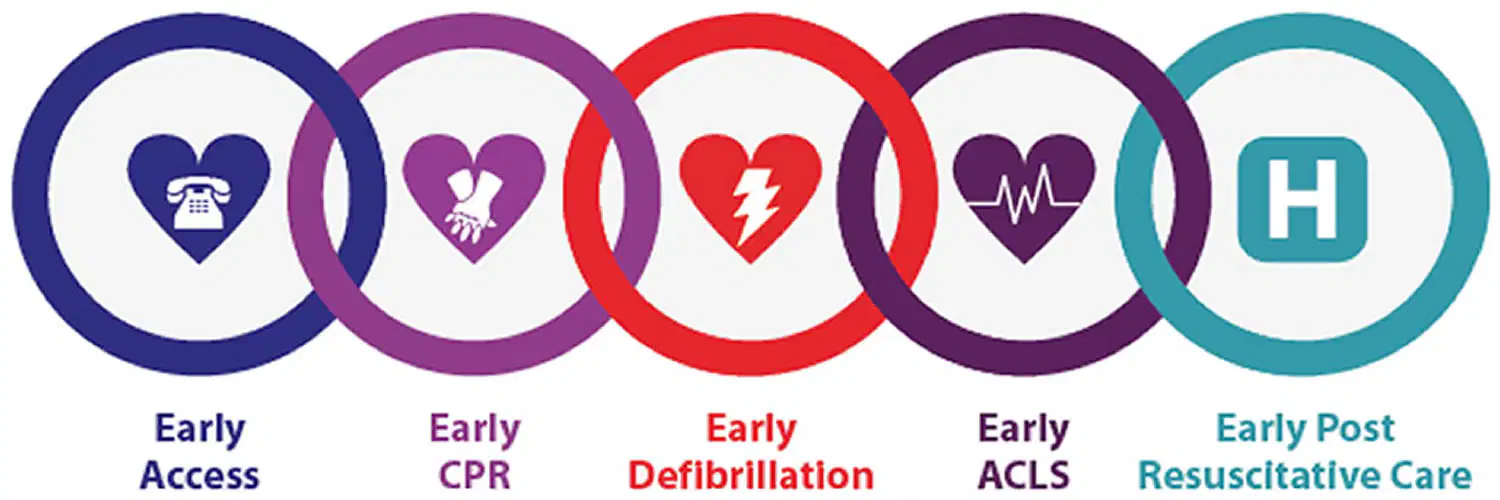
Which is considered as the most significant and most crucial link in the adult's Chain of Survival that could increase the survival rate of someone on cardiac arrest if given or rendered earlier?
Early Defibrillation
Early Access
Early CPR
Early ACLS
Early Post-Resuscitative Care
What is the compression to ventilation ratio you should use when giving CPR to any individual?
30:2
30:1
15:2
15:1
When performing two-rescuer CPR, how often should you switch roles?
After every five cycles of CPR
After every cycle of CPR
After every two cycles of CPR
After every 10 cycles of CPR
When operating an AED, what are the correct steps to follow?
Power on the AED, attach electode pads, analyze the rhythm, clear the individual, and deliver shock
Power on the AED, attach electrode pads, shock the individual, and analyze the rhythm
Attach electrode pads, check pulse, shock individual, and analyze rhythm
Check pulse, attach electrode pads, analyze rhythm, shock patient
When looking for a pulse on a child from one year to puberty, where should you check?
Carotid artery
Carotid vein
Radial artery
Radial vein
What are the vital characteristics of first-rate CPR? [𝚂𝙰𝚃𝙰]
Starting chest compressions within 10 seconds of recognition of cardiac arrest
Pushing hard and fast
Minimizing interruptions
Giving 1 rescue breaths after 30 compressions
Which step is not a part of the five steps in the Adult Chain of Survival?
Advanced airway placement
Early CPR
Rapid defibrillation
Integrated post-cardiac arrest care
What is the recommended BLS sequence for the 2020 ILCOR guidelines?
Chest compressions, Airway, Breathing
Airway, Breathing, Check pulse
Airway, Breathing, Chest compressions
None of the above
What are the signs of an obstruction of the airway? [𝚂𝙰𝚃𝙰]
Poor air exchange
High-pitched noise while inhaling
Inability to speak
Low-pitched noise while exhaling
How many breaths should be given during a two-rescuer CPR on an adult with an advanced airway in place?
Every 2 to 3 seconds (20 to 30 breaths per minute)
Every 4 to 5 seconds (12 to 15 breaths per minute)
Every 6 to 8 seconds (8 to 10 breaths per minute)
Every 10 to 12 seconds (5 to 6 breaths per minute)
Due to the essential nature of washing your hands, how much time is recommended to wash your hands?
20 seconds
10 seconds
1 minute
5 minutes
You come upon a person who has lost a significant amount of blood, has a very pale skin color, and is confused. What do you suspect the cause to be?
Shock
Seizure
Stroke
Hypoglycemia
While dining out in a restaurant you hear a mother cry out that her six-month-old child, who was given some marbles by an older child, is gagging. His mouth area is turning blue and he’s unable to take a breath or cry out. What would you do first in this scenario?
Deliver back blows and chest thrusts
Begin CPR
Attempt rescue breaths then compressions
Blind finger Sweep
While performing CPR on an infant, another rescuer appears on the scene, what do you do next?
Have the second rescuer help with CPR, to avoid and minimize fatigue
Immediately transport the patient
Wait until exhausted, then switch
Have the second rescuer begin ventilations; ratio 30:2
Where should you place the AED pads when treating an infant for pediatric cardiac arrest?
Chest and back
Do not use an AED on an infant
Upper chest and mid abdomen
Wherever they fit
How long should you check for breathing while performing CPR?
No longer than 10 seconds
2 seconds
20 seconds
Do not check for breathing, continue chest compressions
After finding an unresponsive child, yelling for help, and confirming the child isn't breathing what would be your next course of action?
Deliver chest compressions
Leave the child and search for an AED
Deliver rescue breaths as most cardiac arrest occur due to breathing problems
Begin back blows and chest thrusts

