
 Worksheets
APES Exam Review
Total questions: 150
Worksheet time: 3hrs 50mins
An ecological footprint considers
per capita resource use of a nation.
how much an individual consumes in terms of land area.
average yearly consumption of resources.
resources that an entire nation consumes in and average year.
the ratio of resources consumed in developed nations to less developed nations.

Individuals will use shared resources in their own self-interest rather than in keeping with the common good, thereby depleting the resources. This is known as
Self centeredness
Commonwealth sharing
Tragedy of the Commons
Public resource commons
Which of the following biogeochemical cycles does not have an atmospheric phase?
Hydrolic Cycle
Nitrogen Cycle
Sulfur Cycle
Carbon Cycle
Phosphorous Cycle
Select the two characteristics that determine which type of biome an ecosystem is.
Climate
Temperature
Elevation
Precipitation
In a food pyramid, which organism can be found on the bottom?
Primary Consumers
producers
Secondary Consumers
Herbivores
One species benefits and the other is not affected is an example of which symbiotic relationship?
Parasitism
Commensalism
Mutualism
Predation

In which biome would you expect to find an area with an average temperature of 10oC and 200 cm of precipitation annually?
Temperate seasonal forest
Temperate rainforest
Woodland/shrubland
Tropical seasonal forest
Based on the theory of island biogeography, which of the following is the most likely reason that an island in the ocean that is 5 kilometers from a continent would have a higher number of species than one that is 15 kilometers from a continent?
There are more species that have the ability to travel 5 kilometers than can travel 15 kilometers.
Islands that are closer to continents always have a wider range of habitats than more distant islands do.
There are smaller populations of each species on islands that are at greater distances from continents.
Islands that are closer to continents always have more ecological niches than more distant islands do.
High biodiversity is important because...
it means that the ecosystem is more able to recover from disturbances.
it means that the ecosystem is less able to recover from disturbances.
it means that organisms are healthier and have more opportunities.
it means that organisms are less healthy and have less opportunities.
Which of the following best shows the process of evolution?
A population of mosquitoes develops resistance to a pesticide.
A lizard's color becomes brown as it sits on a log.
A plant loses its leaves in a drought.
A population of foxes increases as more prey becomes available.
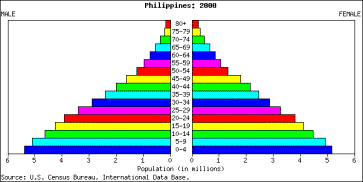
These organisms typically live in unstable, unpredictable environments & are able to reproduce rapidly (exponentially). They do not take care of their young & are subject to predation.
K-strategist
r-strategist
m-strategist
s-strategist
These organisms occupy stable environments, are larger in size and have longer life expectancies. They produce, during their life spans, fewer offspring, but place a greater investment in each.
K-strategist
r-strategist
m-strategist
s-strategist
What is the maximum number of individuals of one species that the environment can support?
overload capacity
top capacity
population
carrying capacity
Which factor would be considered density independent?
an intestinal parasite
a fatal virus
a severe drought
severe overcrowding


The Coriolis effect is responsible for
the mixing of two Hadley cells
the falling effect of warm air
the cooling effect of air as it rises and expands
the deflection of atmospheric currents
The type of plate boundary where two plates come together is a .....
Convergent Boundary
Divergent Boundary
Transform Boundary
Plate Boundary

What type of event will occur at this boundary?
Earthquake
Volcano Eruption
Tornado
Mountain Building
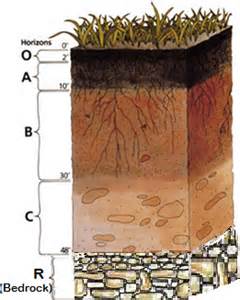

The rate at which water flows through the soil is called soil percolation or ______.
Groundwater
Permeability
Soil Pores
Porosity
What is the correct sequence of layers of the earth's atmosphere from earth's surface to space?
troposphere, stratosphere, mesosphere, thermosphere.
mesosphere, stratosphere, thermosphere, troposphere.
troposphere, mesosphere, stratosphere, thermosphere.
stratosphere, troposphere, mesosphere, thermosphere.
The practice of planting a nitrogen-using plant with a nitrogen-fixing plant is called
intercropping
contour farming
strip cropping
monoculture
Over use of farmland can cause a depletion in soil nutrients and can lead to
waterlogging
desertification
irrigation
intercropping
Reclamation is the process of
Removing coal from a subsurface seam
Extracting ore minerals from gangue minerals
Returning land to its original or better condition
Protecting the habitats of local wildlife
Which is true about aquaculturing?
The amount of aquacultured fish has decreased significantly in favor of wild-caught fish.
Aquaculturing requires the same inputs as other forms of animal agriculture, including feed and antibiotics.
Aquaculture operations do not affect the surrounding ecosystem in any adverse way.
All of the above are true.
Which of the following would be an environmental impact of high density animal farming?
bad smells
livestock can escape
water pollution due to runoff
improvement of feeding efficiency
IPM is likely to use all of the following techniques EXCEPT
intercropping.
habitat creation for pest predators.
planting herbicide-resistant crops.
increased use of traditional pesticides.
What causes a heat island?
large forested areas
deforestation
climate change
mass transit
Which of the following best describes an environmental advantage of urbanization?
Individuals living in cities have more varied employment opportunities than individuals living in rural areas.
Individuals living in cities have greater access to health care than individuals living in rural areas.
Individuals living in cities usually have greater access to fresh, local agricultural products than individuals living in rural areas.
Individuals living in cities usually have a lower transportation carbon footprint than individuals living in rural areas.
The following are advantages of which type of energy?
· Emits little to no CO2/toxins
· 2-3 million x more energy than coal
Low environmental impact
Petroleum
Coal
Natural Gas
Nuclear Energy
The following are disadvantages of which type of energy?
· Mining alters landscapes and endangers humans
· High carbon emissions during combustion
Petroleum
Coal
Natural Gas
Nuclear Energy
Colorless, odorless gas that is a naturally occurring decay product of uranium
asbestos
radon
lead
carbon monoxide
formaldehyde
The majority of atmospheric mercury is produced by
medical waste incinerators
volatilization of lead-based paint
coal-burning power plants
runoff from thermometer factories
municipal waste incinerators

High levels of industrial smog are due to
I. nitrogen dioxide
II. sulfur dioxide
III. humid weather
I only
I and II only
II and III only
I and III only
Smoke from forest fires is most likely to affect air quality over larger areas for many days when
smog is produced due to chemical reactions in the atmosphere
a persistent atmospheric inversion exists in the region
it emits primary pollutants
it emits secondary pollutants
A type of pollution found both indoors and outdoors, which includes pollen, dander, soot, carbon, and dust.
Water droplets
Allergens
Particulate matter
Combustibles
This toxic heavy metal was found in paints and gasoline in the U.S. until 1976
Lead
Mercury
CFC
VOC
A secondary pollutant such as ozone would form
early in the morning when most emissions happen
mid day- late afternoon, due to the reaction needing sunlight and car emissions
at night, the reaction takes a long time to process
What is a trophic level?
an organisms feeding level in a food chain/food web
the predator/prey relationship
symbiotic relationships
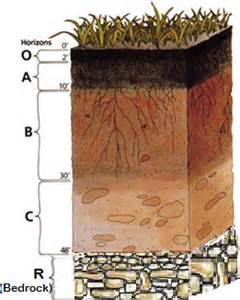
In which horizon is most of the partially decomposed material known as HUMUS?
Horizon O
Horizon B
Horizon C
Horizon D or R
Where the naturally occuring good ozone layer is located
troposphere
mesosphere
stratosphere
thermosphere
Plate movement occurs in which part of Earth's crust?
Core
Mantle
Upper mantle
lithosphere
Which of the following geographical features IS NOT associated with a convergent boundary
Deep ocean trench
Volcanic Arc (continental or island)
Crustal uplift forming mountain ranges
Mid ocean ridge
Which of the following DOES not contribute to soil erosion?
Plowing
Overgrazing
Deforestation
Composting

A plane leaves the north pole. It flies directly south towards the equator & will land ___.
to the West (deflected right of its path)
to the East (deflected left of its path)

Which of the following is true regarding solar radiation?
Radiation helps determine an area's climate
Radiation strikes at different angles depending on latitude
Radiation is concentrated over smaller surface area near the equator
All of the answers listed
The __________ cell is an atmospheric convection current occurring at the equator.
Hadley
Ferrell
Polar
Warm, moist air that rises around the equator leads to ___________ while cool, dry air that sinks at 30 degrees latitude leads to _________.
tropical rain forests / deserts
deserts / tropical rain forests

The upwelling of cool, nutrient rich ocean water is caused by
Southeast trade winds
Westerlies in southern hemisphere
Northeast trade winds
Westerlies in northern hemisphere

In ENSO conditions,
Trade winds shift and upwelling is suppressed off western coast of South America
Trade winds weaken but do not shift direction
The upwelling of cool, nutrient rich water is enhanced
Weather patterns remain the same

Which of the following describe the relationship between D.O. and B.O.D.?
When D.O. decreases, the B.O.D. decreases
When D.O. decreases, the B.O.D. increases
When B.O.D. decreases, the D.O. decreases
When B.O.D. increases, the D.O. decreases
Which of the following characteristics is common to coal and petroleum
Both were formed by the remains of ancient marine organisms
Both release significant amounts of mercury when burned.
Both are considered renewable resources.
both are forms of ancient organic matter buried deep within the earth's crust.
Both require fractional distillation
Nuclear reactors produce energy through the process of
Incineration
Transmutation
Fusion
Breeding
Fission
Which of the following is the most likely to lead to acid rain?
the release of carbon dioxide from a coal-fired power plant
the release of carbon monoxide from automobiles.
the release of sulfur dioxide from a coal-fired power plant
The release of methane from a cattle feedlot
the release of particulates from a coal-fired power plant
The surface of a layer of saturated ground.
water table
groundwater
watershed
reservoir
What would be the best definition of permeability?
Percentage of the total volume of a rock or sediment that consists of open spaces
The ability of a rock or sediment to let fluids pass through open spaces or pores
The inability of a rock or sediment to let fluids pass through open spaces or pores
The level below which the ground is saturated with water
What percent of water on earth is FRESH WATER?
97%
3%

The step of the nitrogen cycle that is in red is called...
Denitrification
Nitrification
Nitrogen Fixation
Ammonification

The step of the nitrogen cycle that is in red is called...
Denitrification
Nitrification
Nitrogen Fixation
Ammonification

The step of the nitrogen cycle that is in red is called...
Denitrification
Nitrification
Assimilation
Ammonification
Nitrogen fixation...
animals eat the plants and other animals that contain nitrogen and release it through their waste
Bacteria in the soil and lightning in the atmosphere “fix” the nitrogen
Once in the ground, bacteria in the soil also nitrify the nitrogen
plants absorb nitrogen through their roots and return it back to the atmosphere
What is "overfishing"?
Fishing out of season
Catching fish faster than they can replenish
Catching fish from the top of the food chain
Catching more fish than what people eat
What is bycatch?
Catching other sea life than what you were aiming to catch
Fish caught as the ships go by
Fish that escapes out of nets
Fish caught at the very end of the fishing season
What is an impact of fish disappearing? Select all that apply.
Global warming
Jobs and economies can disappear
A major source of protein for humans is lost
Sea levels will rise, flooding coastal areas

The greenhouse effect is a natural process
true
false

The greenhouse effect is caused by
more heat arriving at the Earth from the sun
the Earth releasing more heat at night
gases in the air trapping heat released by the Earth

The graph shows us that
the earth temperature is always increasing
the earth's temperature has steadily increased since 1900
the earth's temperature has steadily rising since the 1960s
the earth's temperature decreased during the 19th and 20th centuries

How many oxygen atoms does a molecule of ozone contain?
1
2
3
4
What is the name of the international agreement committing parties to phasing out ozone depleting substances and phasing out chlorofluorocarbons (CFCs)?
Vienna Protocol
Paris Agreement
Montreal Protocol
Antarctic Convention
The depletion in the Ozone layer is caused by:
Carbon dioxide
Nitrous oxide
Methane
Chlorofluorocarbon
A serious risk factor associated with the operation of a nuclear power plant is the production of
acid rain
helium gas
greenhouse gases, such as CO2
radioisotopes with long half-lives
What is a problem commonly associated with nuclear power facilities?
A small quantity of energy is produced.
Reaction products contribute to acid rain
It is impossible to control nuclear fission.
It is difficult to dispose of wastes.
How can wind become energy?
When a wind turbines changes the kinetic energy in wind to electric energy.
When a windmill goes fast enough
It just naturally is
The sun heats it so it becomes solar energy
Which is NOT caused by acid rain?
damage to statues
dying fish
spread of disease
weakened trees
This primary pollutant creates a reddish brown gas creating photochemical smog and tropospheric ozone.
sulfuric acid
VOC
nitrogen dioxide
particulate matter
Which of the following government agencies is responsible for the Clean Air Act?
the USGS
the USDA
the EPA
the USDOJ
Source: are released from burning fuel (fossil fuels or biomass), solvents, paints glues and other commonly used products. They include benzene, methane, formaldehyde and others
Health effects: In addition to smog (ozone) effects, some are carcinogenic
Environmental effects: affects some plants directly in addition to smog effects

The bottom image represents a _____________.
rain shadow effect
thermal inversion
Coriolis Effect
ozone layer
What effect do temperature inversions have?
traps heat and raises the temperature beneath it
traps cold air and lowers the temperature beneath it
traps emissions and can accumulate beneath it
traps the ozone layer
Can be traced back to the point of origin.
Point Source Pollution
Non-point source pollution

A ship carrying gasoline runs into shore and spills large amount of gasoline.
Point
Non-Point

The phenomenon by which toxins concentrate in the organisms at higher trophic levels within an ecosystem is known as...
Biotoxicity
Biomagnification
Eutrophication
Predation


In 2012, there were 20 births per 1,000 people and 5 deaths per 1,000 people in Peru. Calculate the approximate doubling time of Peru's populaiton.
5 years
15 years
47 years
72 years

The size of the human population began to increase exponentially after the
bubonic plague
development of plowing and irrigation
Industrial Revolution
development of the first cities.


Which wind system is closest to the equator?
Doldrums
Westerlies
Polar easterlies
Trade winds
Why does the Earth have seasons?
Tilt of the Earth on its axis
Earth's shape
Earth's rotation around the Sun
Earth's rotation on its own axis

Which month has the highest precipitation?
July
August
September
June
This phenomenon occurs when a coastal mountain range blocks the passage of precipitation to the leeward side of the mountains.
thermal inversion.
Coriolis effect.
rain shadow effect.
urban heat island effect.
ENSO.

Which of these problems could happen if we don't look after the resources we have?
Loss of animal homes
Climate change
Increase in pollution
All of the above
Which is NOT a way to decrease your ecological footprint?
Eating less meat and processed foods
Walking or biking to school
Carpool to work
Driving a Hummer (SUV) around for fun
What are considered "the commons"
Common house hold items like knifes, spoons, and forks.
A renewable resource owned by no one and available for use by anyone at little or no charge
A field where college students can sit outside in between classes
An underground layer of permeable rock or sand that collects, holds, and conducts water is a(n)...
Lake
Pond
Aquifer
River
An oyster filters water, provides habitat to many organisms and serves as food to humans. This is the oyster's...
habitat
niche
learned behavior
social behavior

What device reduces SO2 emissions in power plants?
scrubber units
electrostatic precipitators
catalytic converters
afterburners

