wayground logo

Free Printable Worksheets

Font size

S
M
L
XL
Worksheets

Study Questions for Solutions Assessment

Total questions: 150

Worksheet time: 4hrs 36mins

Name
Class
Date
1.

Water is the universal ____.

a)

solute

b)

solvent

c)

solution

2.

solute + solvent =

a)

solution

b)

equation

3.
a)

solvent

b)

solution

c)

solute

4.
a)

solvent

b)

solute

5.
a)

solute

b)

solvent

6.
a)

solvent

b)

solute

7.

Solutes dissolve quicker in _________ water.

a)

cold

b)

warm

8.

Solutes dissolve quicker if you stir them.

a)

true

b)

false

9.
a)

solute

b)

solvent

c)

solution

10.
a)

solvent

b)

solute

11.
a)

solution

b)

solute

c)

solvent

12.
The substance being dissolved in a solution.
a)
sands
b)
solute
c)
solvent
d)
alloy
13.
The substance in which a solute is dissolved
a)
sands
b)
solvent
c)
alloy
d)
negative particles
14.
Solutions are composed of __________ .
a)
salts and solutes
b)
solvents and salts
c)
solutes and alloys
d)
solutes and solvents
15.

If I dissolve carbon dioxide in water, what is the solvent?

a)

Carbon Dioxide

b)

There is no solvent

c)

Oxygen

d)

Water

16.
Solubility is defined as
a)
the ability to catch on fire
b)
the ability to be dissolved
c)
the ability to fly.
d)
the ability to get on Mrs. D's nerves.
17.
Solutions are composed of __________ .
a)
salts and solutes
b)
solvents and salts
c)
solutes and alloys
d)
solutes and solvents
18.
In a sample of salt water, NaCl would be considered the ______.
a)
Solution
b)
Solute
c)
Solvent
d)
Solvation
19.
If we are making Kool-aid with sugar, Kool-aid powder, and water, which part is the solvent?
a)
water
b)
powder
c)
sugar
d)
powder and sugar
20.
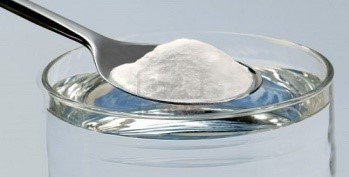
In this mixture, which of the following will be the solute?
a)
The water in the glass
b)
The glass that holds the final mixture
c)
The solution containing both powder and water
d)
The powder on the spoon
21.
Lemonade - Water, lemon juice, and sugar
Identify the solute
a)
water
b)
lemon juice
c)
sugar and lemon juice 
22.
What is a solvent?
a)
The substance that does the dissolving in a solution.
b)
The substance that is being dissolved in a solution.
c)
The mixing of different substances.
d)
The process in which neutral molecules lose or gain electrons
23.
What is a compound? 
a)
 the simplest form of a substance 
b)
a combination only of 3 elements 
c)
a combination of 2 or more elements 
d)
a place where people are held 
24.
What is the simplest form that cannot be broken down to anything simpler? 
a)
element 
b)
solution
c)
compound
25.
When materials combine to form a mixture, they
a)
A. keep their original properties.
b)
B. react to form a new substance with new properties.
c)
C. combine in a specific ratio.
d)
D. always change their physical state.
26.
If a spoonful of salt is mixed in a glass of water, what is the water called?
a)
A. solute
b)
B. solution
c)
C. solvent
d)
D. element
27.
A pure substance that cannot be separated into simpler substances by chemical or physical means.  
a)
Element
b)
Compound
c)
Mixture
d)
Chemical
28.
What pulls a ball back to earth?
a)
Gas
b)
Gravity
c)
Friction
d)
Molecules
29.
a)

solute

b)

solvent

30.
a)

solute

b)

solvent

31.
a)

solute

b)

solvent

32.
a)

solute

b)

solvent

33.
a)

solute

b)

solvent

34.
a)

solute

b)

solvent

35.
a)

solute

b)

solvent

36.
a)

solute

b)

solvent

37.
a)

solute

b)

solvent

38.
a)

solute

b)

solvent

39.

A homogeneous mixture is the same thing as...

a)

a solution

b)

a heterogeneous mixture

c)

a compound

d)

an element

40.

The prefix hetero means...

a)

same

b)

different

c)

together

d)

awesome

41.

A type of mixture that forms when one substance dissolves in another is known as a

a)

heterogeneous mixture

b)

solution

c)

solute

d)

solvent

42.
What is a solvent
a)
the liquid in which a solute is dissolved to form a solution.
b)
Another word for solution
c)
A thing that make drinks turn colors
d)
Its a metal molecole
43.
If I dissolve sugar in water, what is the solute?
a)
Water
b)
Hydrogen
c)
Sugar
d)
Carbon
44.
Which is an example of a solute?
a)
Egg whites
b)
Sugar
c)
Water
d)
Acetone
45.
Which is an example of a solvent?
a)
Salt
b)
Egg whites
c)
Water
d)
Sugar
46.

What is a solvent

a)

A liquid that will dissolve a solid solute

b)

Another word for solution

c)

A thing that make drinks change colour

d)

Usually the solid about to be dissolved

47.

The ___ is the thing being dissolved.

a)

solute

b)

solvent

c)

mixture

d)

solution

48.
Solutions are composed of __________ .
a)
salts and solutes
b)
solvents and salts
c)
solutes and alloys
d)
solutes and solvents
49.

If I dissolve carbon dioxide in water, what is the solvent?

a)

Carbon Dioxide

b)

There is no solvent

c)

Oxygen

d)

Water

50.

If I dissolve salt in water, what is the solvent?

a)

salt

b)

water

c)

salt & water

d)

none of the above

51.

If I dissolve salt in water, what is the solute?

a)

water

b)

salty water

c)

none of the above

d)

salt

52.

Define the term soluble.

a)

Can dissolve in water

b)

Cannot dissolve in water

c)

Partially dissolves in water

53.

Define the term insoluble.

a)

Can dissolve in water.

b)

Cannot dissolve in water.

c)

Partially dissolves in water.

54.

Is water the only solvent that can dissolve solutes?

a)

Yes

b)

No

55.
How does a solution become supersaturated?
a)
dissolve lots of solute in it.
b)
dissolve a little solute in it. 
c)
dissolve more solute than you should be able to. 
d)
dissolve a solvent in it. 
56.
Solution where more solute can still be dissolved at the given temperature. 
a)
Saturated
b)
Unsaturated
c)
Mixture
d)
Homogeneous solution
57.
Describe a solute.
a)
part of solution present in largest amount
b)
gets dissolved
c)
water
d)
surrounds and breaks apart
58.
__________ are made up of solutes and solvents.
a)
Solutions
b)
Suspensions
c)
Heterogeneous Mixtures
d)
Pure Substances
59.
When a solvent contains as much of the solute as it can hold, the solution is said to be
a)
supersaturated
b)
diluted
c)
saturated
d)
unsaturated
60.
What does it mean to dilute a solution?
a)
lower the concentration of solute per solvent
b)
increase the concentration of solute per solvent
61.
You can make a solution more concentrated by adding __________.
a)
solute
b)
solvent
c)
water
62.
What is able to dissolve other substances?
a)
Solute
b)
Salt
c)
Suspension
d)
Solvent
63.
If I dissolve sugar in water, what is the solute?
a)
Water
b)
Hydrogen
c)
Sugar
d)
Carbon
64.
If I dissolve carbon dioxide in water, what is my solvent?
a)
Carbon Dioxide
b)
There is no solvent
c)
Oxygen
d)
Water
65.
What is unsaturated?
a)
A solution with more solute than solvent
b)
A solution with less than the maximum amount of solutes 
c)
A solution with the  perfect balance of solutes and solvents
d)
A solution with solids at the bottom
66.
Which substance is MOST soluble at 0 ºC?
a)
KI
b)
NaNO3
c)
NaCl
d)
Ce2(SO4)3
67.
Which solute is the most soluble at 10 ⁰C?
a)
KI
b)
KClO3
c)
NH4Cl
d)
NH3
68.
Which solute is the least soluble at 90 ⁰C?
a)
SO2
b)
KClO3
c)
KI
d)
HCl
69.
Which solute does not increase in solubility as temperature rises?
a)
NH3
b)
NaNO3
c)
KNO3
d)
NaCl
70.
When 20 grams of potassium chlorate, KClO3, is dissolved in 100 grams of water at 80 ºC, the solution can be correctly described as:
a)
supersaturated
b)
saturated
c)
unsaturated
71.
When 20 grams of KNO3 is dissolved in 100 grams of water at 80 ºC, the solution can be correctly described as:
a)
supersaturated
b)
saturated
c)
unsaturated
72.
When 50 grams of KCl is dissolved in 100 grams of water at 50 ºC, the solution can be correctly described as:
a)
supersaturated
b)
unsaturated
c)
saturated
73.
which is supersaturated at 60 g and 60 degrees Celsius
a)
KCLO3
b)
KNO3
c)
NaCl
d)
NaNO3
74.
Graph that shows the amount of solute that can be dissolved in 100 g of water at a certain temperature.
a)
Solubility curve
b)
Saturation curve
c)
Concentration curve
d)
Molarity curve
75.
Solubility refers to the ____ of solute that can dissolve in a certain volume or mass of solvent, at a certain temperature.
a)
Volume
b)
Proportion
c)
Mass
d)
Particles
76.
An ______ is a compound that breaks apart in water, forming charged particles (ions) that can conduct electricity.
a)
electrolyte
b)
nonelectrolyte
c)
polar molecule
d)
non polar molecule
77.
How many more grams of KNOdissolve at 50 ⁰C compared to 0 ⁰C?
a)
85 g
b)
15 g
c)
70 g
d)
100 g
78.
How many grams of SOcan dissolve at 50 ⁰C?
a)
5 g
b)
10 g
c)
20 g
d)
39 g
79.
Describe a solute.
a)
part of solution present in largest amount
b)
the substance that gets dissolved
c)
the substance that does the dissolving
d)
surrounds and breaks apart
80.
What is a precipitate?
a)
an insoluble reactant formed during a chemical reaction
b)
an insoluble product formed during a chemical reaction
c)
a soluble solvent in a saturated solution
d)
a soluble solute in a saturated solution
81.
Solution where more solute can still be dissolved at the given temperature. 
a)
Saturated
b)
Unsaturated
c)
Supersaturated
d)
Homogeneous solution
82.
Describe a solute.
a)
part of solution present in largest amount
b)
gets dissolved
c)
water
d)
surrounds and breaks apart
83.
When two liquids mix, they are said to be....
a)
insoluble
b)
miscible
c)
soluble
d)
immiscible
84.
Define solubility
a)
how much pressure is in an object has
b)
Surface Area per Temperature
c)
how much solute can dissolve in a solvent
d)
it is a made up word
85.
Which of the following usually makes a substance dissolve faster in a solvent?
a)
agitating the solution
b)
increasing the particle size of the solute
c)
lowering the temperature
d)
decreasing the number of particles
86.
What will allow more solute to be dissolved in a solvent.
a)
adding more solute
b)
stiring
c)
cooling solution
d)
heat
87.

Which of the following does not effect how much of something dissolves?

a)

Type of solvent/solute

b)

Temperature

c)

Pressure

d)

Stirring

88.

___________ stirring _______ rate of dissolution

a)

increase ; decrease

b)

increase ; increase

89.

___________ surface area _______ rate of dissolution

a)

increase ; decrease

b)

increase ; increase

90.

___________ temperature _______ dissolution

a)

increase ; decrease

b)

increase ; increase

91.

___________ pressure _______ solubility

(for gases)

a)

increase ; decrease

b)

increase ; increase

92.

___________ temperature _______ solubility

(for solids)

a)

increase ; decrease

b)

increase ; increase

93.

Which would dissolve faster

a)

sugar cubes

b)

granular sugar

94.

Which solution would dissolve more solute?

a)

a hot one

b)

a cold one

95.

The rate by which solvent dissolves solute is called...

a)

saturation

b)

dissolution

c)

solution

d)

electrolyte

96.

What would dissolve most slowly?

a)

Large crystals in stirred water

b)

Large crystals in unstirred water

c)

Small crystals in stirred water

d)

Small crystals in unstirred water

97.

Which would dissolve fastest?

a)

sugar cubes in hot water

b)

sugar cubes in cold water

c)

granular sugar in cold water

d)

granular sugar in hot water

98.

Which of the following does not effect how fast something dissolves?

a)

Surface area

b)

Temperature

c)

Type of solute/solvent

d)

Stirring

99.
Which of the following word pairs correctly completes the sentence below?
_______ are corrosive substances characterized as having a strong smell, a sour taste, and a _______.
a)
Acids; pH less than 7
b)
Acids; pH greater than 7
c)
Bases; pH greater than 7
d)
Bases; pH less than 7
100.
The esophagus is the tube that connects the mouth to the stomach. Heartburn occurs when some of the stomach juices flow backwards up the esophagus. To help relieve heartburn, a person should take medicine that is
a)
neutral
b)
basic
c)

acidic or basic.
d)
acidic
101.
If an acid is combined with a base of equal strength, the result will most likely be
a)
a neutral solution.
b)
a stronger acid.
c)
impossible to tell without testing the pH.
d)
a stronger base
102.
Human blood has a pH between 7.35 and 7.45. Which of the following best describes human blood?
a)
strongly acidic
b)
slightly acidic
c)
strongly basic
d)
slightly basic
103.
What would be considered the weakest base? 
a)
8
b)
14
c)
7.8
d)
11.6
104.
Many cleaning solutions are bases. Which of the following is a property of most bases?
a)
feels slippery
b)
white color
c)
can only be liquid
d)
tastes sour
105.
Pure water has a pH of 7. Pure water _______.
a)
is a base
b)
is a neutral substance
c)
could be either an acid or a base
d)
is an acid
106.
A compound that changes color when it is in contact with an acid or base is called______________
a)
Acid
b)
Base 
c)
Neutral
d)
Indicator
107.
The pH scale measures...
a)
...the strength of an acid.
b)
...the strength of hydrogen ions.
c)
...the concentration of hydrogen ions.
d)
...the concentration of an acid
108.
Pollution causes the pH of rain water fall below 6. What is such type of rain called?
a)
Acid rain
b)
polluted rain
c)
low pH rain
109.
Acid + base --> ?
a)
salt + hydrogen gas + water
b)
salt + carbon dioxide + water
c)
salt + water
d)
salt only
110.
 bicarbonate of soda (pH 9) be used to treat a bee sting.
A bee sting is ________.
a)
Acidic
b)
Basic
c)
Neutral
d)
salt
111.
A wasp sting is alkaline (pH 9). What could be used to treat a wasp sting???
a)
acidic
b)
basic
c)
neutral
d)
salt
112.

What is the chemical formula for hydroxide?

a)

H3O+

b)

H3O-

c)

OH+

d)

OH-

113.

Weak acids have a lower pH than stronger acids?

a)

True

b)

False

114.

Most foods would be considered

a)

bases

b)

acids

c)

neutral

115.

Litmus is a common

a)

catalyst

b)

indicator

c)

enzyme

d)

base

116.

Which of the following values would represent the pH of a strong base?

a)

1

b)

8

c)

7

d)

13

117.

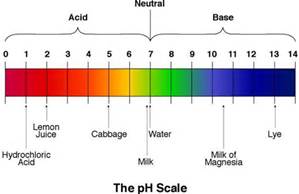
According to the pH range given in the image,which substance is more acidic than lemon juice?

a)

Hydrochloric acid

b)

Cabbage

c)

Milk

d)

Milk Of Magnesia

118.

Holly has an unknown substance in a beaker. She wants to determine the relative pH of the unknown substance. She places a piece of blue litmus paper into the substance, and the litmus paper stays blue.

The substance in the beaker

a)

is a base

b)

is an acid

c)

have neutral pH

d)

doesn't have pH

119.

Litmus paper can be used to determine the _______ of a substance

a)

relative volume

b)

relative pH

c)

temperature

d)

chemical formula

120.

Which of the following statements is correct?

a)

Blue litmus paper turns red when placed in a base.

b)

Red litmus paper turns blue when placed in a base.

c)

Blue litmus paper stays blue when placed in an acid.

d)

Red litmus paper stays red when placed in a base.

121.

The pH of a solution is tested, and it is found to be a basic solution. Of the following choices, what could the pH have been?

a)

3

b)

7

c)

9

d)

5

122.

Human blood has a pH between 7.35 and 7.45. Which of the following best describes human blood?

a)

strongly acidic

b)

slightly acidic

c)

strongly basic

d)

slightly basic

123.

Many cleaning solutions are bases. Which of the following is a property of most bases?

a)

feels slippery

b)

white color

c)

can only be liquid

d)

tastes sour

124.

Pure water has a pH of 7. Pure water _______.

a)

is a base

b)

is a neutral substance

c)

could be either an acid or a base

d)

is an acid

125.

A sour taste is a characteristic of:

a)

acid

b)

base

c)

neutral

d)

pH scale

126.

Stronger acids have a pH closer to...

a)

7

b)

14

c)

0

d)

9

127.

Weaker bases have a pH closer to...

a)

8

b)

14

c)

0

d)

4

128.

A pH level of 7 indicates

a)

acid

b)

base

c)

neutral

d)

non of the following

129.

The pH scale is a range from:

a)

1-7

b)

1-5

c)

0-14

d)

1-14

130.

Which property is not associated with acids?

a)

Sour taste

b)

strong acids can burn you

c)

turns litmus paper blue

d)

reacts with metals

131.
If an electrical current can run through a solution, it is said to contain
a)
magic
b)
nonelectrolytes
c)
electricity
d)
electrolytes
132.
A solution that can hold more solute  is called
a)
saturated
b)
supersaturated
c)
unsaturated
d)
insoluble
133.
Solvent is best defined as-
a)
a mixture in which the substances are spread out evenly between one another and cannot be told apart
b)
the ability of a substance to dissolve in another substance
c)
a substance that dissolves in another substance
d)
a substance into which another substance dissolves
134.
A solution that has more solute than it can hold is called
a)
saturated
b)
supersaturated
c)
unsaturated 
d)
suspension
135.
You can make a solution more concentrated by adding more __________.
a)
solute
b)
solvent
c)
water
136.
Contains the maximum amount of dissolved solute
a)
unsaturated solution
b)
supersaturated solution
c)
saturated solution
137.
Solutions in which electric currents cannot run through are said to be
a)
noncolloidal
b)
electrolytes
c)
nonelectrolytes
d)
conductors
138.
What is a solute?
a)
The substance that does the dissolving in a solution.
b)
The substance that is dissolved into the solution.
c)
The mixing of different substances.
d)
The process in which neutral molecules lose or gain electrons
139.
Which technique could increase or speed up the rate of dissolving?
a)
Allowing the mixture to settle
b)
Stirring the mixture
c)
Adding more powder
d)
Adding more water
140.
If we are making Kool-aid with sugar, Kool-aid powder, and water, which part is the solvent?
a)
water
b)
powder
c)
sugar
d)
powder and sugar
141.
How does a solution become supersaturated?
a)
dissolve lots of solute in it.
b)
dissolve a little solute in it. 
c)
dissolve more solute than you should be able to. 
d)
dissolve a super amount of solvent in it. 
142.
A solute that contains polar molecules will dissolve in a solvent that contains
a)
nonpolar molecules
b)
polar molecules
c)
covalent molecules
d)
equal-sized molecules
143.
Oil molecules are nonpolar. What kind of solvent is required to remove an oil stain?
a)
saturated
b)
unsaturated
c)
polar
d)
nonpolar
144.
How many moles of NaCl are present in a solution with a molarity of 8.59M and 125 mL of solution?
a)
1.07 gram
b)
62.7 mol
c)
1.07 mol
d)
62.7 grams
145.
How many liters would you need to make a 1 M solution if you have 6 mol of Sodium Hydroxide? 
a)
2
b)
3
c)
4
d)
146.

A student is preparing solutions for a laboratory experiment by dissolving solid solutes in liquid solvents. Which action will increase the rate of solubility

a)

lowering the temperature of the solvent

b)

stirring the solute in the solution

c)

increasing the pressure on the solution

d)

increasing the particle size of the solute

147.

What is the molality of a solution in which 3.0 moles of NaCl is dissolved in 1.5 Kg of water?

a)

2.0 m

b)

0.22 m

c)

135 m

148.

What is the molality of a solution when 48 g of NaCl is dissolved in 5 kg of water?

a)

557 m

b)

4.14 m

c)

.17 m

d)

6.04 m

149.

What is the percent by mass of a sugar solution where 10 grams of sugar is added to 100 grams of water?

a)

.10%

b)

0.091%

c)

9.1%

150.
What is the concentration, in percent by volume, of 15.3 mL of solute in 2.65 L of solution?
a)
0.58%
b)
0.0058%
c)
5.8%