
 Worksheets
Earth and Space Final Exam
Total questions: 145
Worksheet time: 1hrs 13mins
Most ozone is found in a region of Earth’s atmosphere between 10 and 20 miles above Earth’s surface. This temperature zone of the atmosphere is known as the
Thermosphere
Stratosphere
Mesosphere
Troposphere
Why are P-waves received, but S-waves are not received by seismic stations located on the opposite side of Earth from an earthquake epicenter?
S-waves travel slower than P-waves
S-waves travel faster than P-waves
Earth’s inner core absorbs S-waves
Earth’s outer core absorbs S-waves
0 degrees longitude starts at the imaginary line running through Greenwich, England. What is the name of this imaginary line?
Prime Meridian
Equator
Arctic Circle
North Pole
Tropic of Cancer
What are the latitude and longitude lines?
Imaginary lines that divide the Earth
Visible lines that divide the Earth
Long and short line that divide the Earth
Real lines that mark territories
None of the above
Who is closer to the Equator: Freddy, standing at 41 degrees North Latitude, or Suzanne, standing at 12 degrees North Latitude?
Freddy
Suzanne
They are the same distance from the Equator
Feddy and Suzanne are equally distant
Cannot determine
Who is closer to the Prime Meridian: Mike, standing at 72 degrees, 30 minutes East longitude, or Shirley, standing at 72 degrees, 30 minutes West longitude?
Mike
Shirley
They are the same distance
Cannot be determined
Both are equally distant
What is the main line of longitude called?
Equator
Northern Hemisphere
Prime Meridian
Tropic of Cancer
International Date Line
What is the angle between the Equator and the North Pole?
90 degrees
45 degrees
180 degrees
0 degrees
30 degrees
What is the imaginary line at 180 degrees longitude that separates one day from another called?
Prime Meridian
International Date Line
Arctic Circle
Equator
North Pole
What does the equator, an imaginary line, divide the Earth into?
Northern and Southern Hemisphere
Eastern and Western Hemisphere
Tropical and Polar Regions
Arctic and Antarctic Circles
Equatorial and Non-Equatorial Regions
What is located 90 degrees north of the Equator?
Prime Meridian
North pole
South Pole
International Date Line
Equator
What is the primary purpose of the latitude lines?
To indicate elevation
To measure time
To measure distances
To identify locations
None of the above
List the four spheres
Lithosphere Hydrosphere Biosphere Atmosphere
Lithosphere Stratosphere Biosphere Mesosphere
Lithosphere Hydrosphere Cryosphere Atmosphere
Lithosphere Hydrosphere Exosphere Atmosphere
Rank the following stellar objects from smallest to largest
Moon, planet, solar system, galaxy, and universe
Planet, moon, galaxy, solar system, and universe
Universe, galaxy, solar system, planet, and moon
Moon, planet, solar system, universe, and galaxy.
What is the approximate age of the universe?
4.5 million years old
4.5 billion years old
13.7 million years old
13.7 billions years old
Which unit of measurement describes the distance between the Earth and Sun?
Kilometer
Light Year
Parsec
Astronomical Unit
The gravitational attraction between two objects in the universe is greatest when their masses are
Small and the objects are close together
Small and the objects are far apart
Large and the objects are far apart
Large and the objects are close together
Almost everything we know about the universe is based on….
Our observations of light
Sending astronauts to outer space
Listening to cosmic background radiation
Studying impact craters on the Earth and Moon
What event is known as the beginning of the universe?
The Big Crunch
The Big Bang
Cosmic Inflation
The Steady State Theory
Which of the following statements about the Big Bang Theory is true?
It suggest the universe is contracting
It states that the universe was once in a hot, dense state
It explains the future fate of our universe
It is universally accepted without any evidence
What Phenomenon explains the change in frequency or wavelength of light from an object moving away from an observer?
Redshift
Blueshift
Doppler Effect
Gravitational Lensing
Which of the following objects gives off their own light?
Black holes
Planets
Main sequences stars
Moons
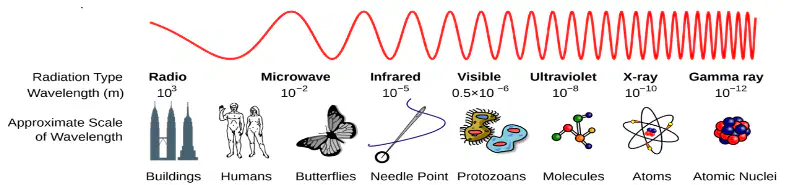
Which type of electromagnetic radiation has the longest wavelength?
Gamma rays
X-Rays
Infrared
Radio Waves
Which type of electromagnetic radiation travels the fastest?
Radio
Ultraviolet
Gamma Ray
All EM waves travel at the same speed
Stars are composed of
Solid
Liquid
Gas
Plasma
Which process occurring in the Sun produces energy by converting lighter hydrogen into heavier helium?
Radiation
Conduction
Radioactive decay
Nuclear fusion
When the star reaches the end of its life cycle, the nuclear force is overtaken by which force?
Electromagnetic Force
Gravitational Force
Rotational Force
Frictional Force
Stars fuse lighter elements into heavier elements throughout their lifetime until which element is reached?
Helium
Iron
Carbon
Silicon
Which of the following is true about the life cycle of massive stars compared to smaller stars?
Massive stars live longer than smaller stars
Massive stars do not go through a supernova
Massive stars end their life cycle as black holes or neutron stars
All stars follow the same life cycle regardless of size
What would you expect to be the relationship between the density of gas and dust in a nebula, and the rate of star formation within that nebula?
As density of gas and dust increases, the rate of star formation decreases.
As density of gas and dust increases, the rate of star formation increases.
As density of gas and dust decreases, the rate of star formation increases.
Star formation is not dependent on density of matter.
Stars with very low mass can have lifetimes of hundreds of billions of years, whereas stars with very high mass have much shorter lifetimes on the order of a billion years. How does luminosity of these stars help explain the large difference in these lifetimes?
High mass stars fuse hydrogen into helium quicker, so they burn out faster.
High mass stars fuse hydrogen into helium slower, so they live longer.
High mass stars have greater gravitational pull, so they live longer.
High mass stars have TBD
Which of the following eject stellar matter into space, allowing for the formation of new stars and planets?
Supernova
Protostar
Main sequence stars
Supergiants
When does a protostar become an “official” star?
When it reaches a temperature threshold
When planets begin orbiting
When it has gravitational pull
When fusion begins
What is located at the center of our Milky Way galaxy?
cluster of supergiant stars
black hole
dark matter
our Sun
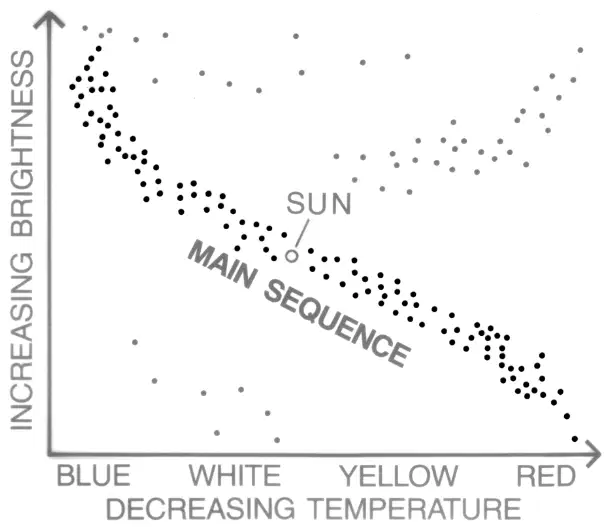
What does the x-axis of the Hertzsprung-Russell (HR) diagram represent?
Luminosity of stars
Temperature of stars
Distance of stars
Size of stars
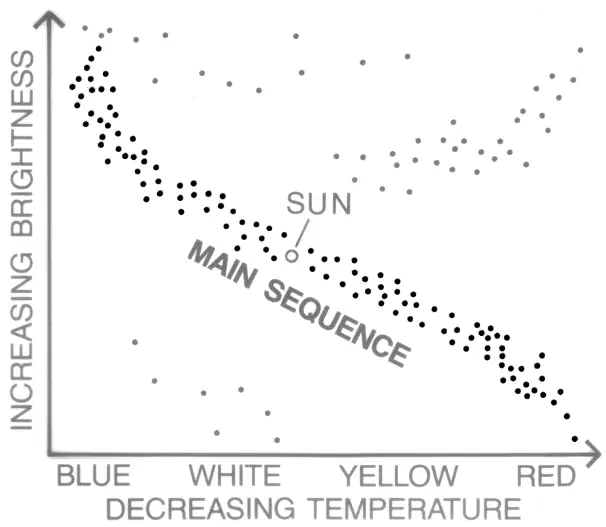
Which type of star is found in the upper right portion of the HR diagram?
Neutron stars
White dwarfs
Main sequence stars
Supergiants
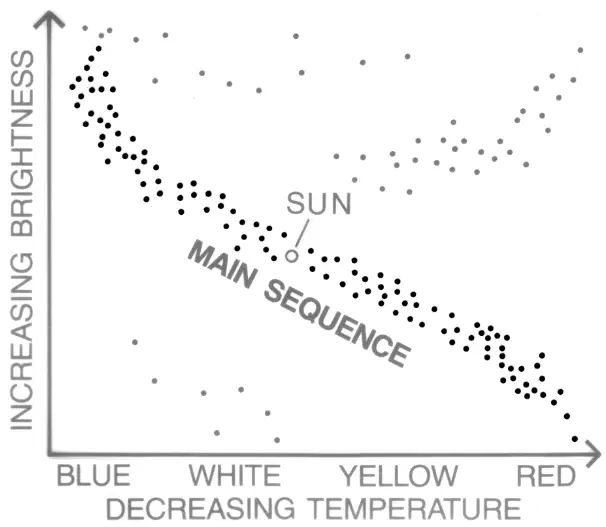
How do stars typically move on the HR diagram as they evolve?
They remain static throughout their life cycles
They move from the main sequence around to the right
They move from the main sequence around to the left
They move in random directions
What is a characteristic of red giants as seen on the HR diagram?
They have low luminosity and high temperature
They have high luminosity and low temperature
They have high luminosity and high temperature
They have low luminosity and low temperature
Which of the following statements is true regarding white dwarfs on the HR diagram?
They are very luminous and cool
They are found in the upper right corner
They are hot and have low luminosity
They form before main sequence stars
What are the compositional layers of the earth defined by?
Physical properties
Chemical properties
Magnetic properties
Biogeographic properties
What type of properties define the mechanical layers of the Earth?
Physical properties
Chemical properties
Magnetic properties
Biogeographic properties
What is the correct order (starting from the surface) of Earth’s layers?
Crust, outer core, inner core, mantle
Mantle, outer core, inner core, crust
Outer core, inner core, crust, mantle
Crust, mantle, outer core, inner core
The thin, outer layer of the lithosphere that forms the Earth’s surface is called the
Mantle
Crust
Inner Core
Outer Core
What type of metals is the inner core made mostly of?
Iron and basalt
Iron and granite
Iron and nickel
Iron and silicon
The soft layers of the mantle on which the lithosphere floats is the
Atmosphere
Outer core
Inner core
Asthenosphere
What physical property causes the Earth to have layers?
Temperature
Density
Pressure
Seismic Waves
Which is denser?
Oceanic crust
Continental crust
They have the same density
What layer of the Earth is most responsible for Earth’s magnetic field?
Lower mantle
Atmosphere
Inner core
Outer core
What does Earth’s magnetic field shield it from?
Climate change
Asteroid impacts
Solar winds
Auroras
What type of rock mostly makes up continental crust?
Granite
Obsidian
Basalt
Marble
What is thinner?
Continental crust
Oceanic crust
They have the same thickness.
Most geologists think that the movement of Earth’s plates is caused by
Conduction
Convection currents
Earthquakes
Earth’s magnetic field
Why is the Earth’s inner core solid?
Density
Pressure
Temperature
Type of rock it contains
Using data from seismic waves, geologists have learned that the Earth’s interior is made up of several
Continents
Volcanoes
Ridges
Layers
Which type of seismic waves cannot travel through liquids?
S-waves
P-waves
Love waves
Alfred Wegener is best known for what hypothesis?
Seafloor spreading
Plate tectonics
Continental drift
Subduction
What is the name of the ancient supercontinent that broke apart about 200 million years ago?
Gondwana
Eurasia
Pangaea
Panthalassa
Fossils of the Mesosaurus, a prehistoric freshwater animal, have been found on the continents of South America and Africa. The distribution of these fossils suggest that these areas were once…
Made of similar chemical elements
Covered by oceanic crust
Connected to one another
Frozen
Scientists have found fossils of tropical plants in Antarctica. How could tropical plants have grown in Antarctica?
At one time, Earth’s entire surface was a tropical rainforest.
At one time, the continent of Antarctica was located closer to the equator.
At one time, the rotation of Earth increased in speed, causing a warming of the atmosphere.
Catastrophic volcanic eruptions melted the thin ice of Antarctica and exposed the sunlight.
Which of the following is NOT evidence of continental drift?
A land bridge once connected different continents
Similar rock types on different continents
Similar fossils on different continents
Similar glacial striations and till on different continents
Which layer of the Earth is composed of tectonic plates?
Mesosphere
Lithosphere
Asthenosphere
Exosphere
What layer of the Earth does the lithosphere float on top of?
Mesosphere
Outer core
Asthenosphere
Troposphere
Which two scientists provided the supporting evidence necessary to validate the hypothesis of continental drift?
Harry Hess and Marie Tharp
Marie Curie and Alfred Wegener
Alfred Wegener and Marie Tharp
Harry Hess and Alfred Wegener
Where does seafloor spreading take place?
Continental rift alleys
Hot spots
Volcanic island arcs
Mid-ocean ridges
Where do convection currents take place?
Crust
Mantle
Outer core
Inner core
What type of plate boundary exists at a mid-ocean ridge?
Convergent plate boundary
Divergent plate boundary
Subduction plate boundary
Transform plate boundary
What type of plate boundary are subduction zones associated with?
Convergent boundary
Divergent boundary
Volcanic plate boundary
Transform plate boundary
Mountain ranges are usually associated with…
A convergent boundary between oceanic crust and continental crust
A divergent boundary between oceanic crust and continental crust
A convergent boundary between two different continental crust
A transform boundary between two different continental crusts
What type of tectonic plate boundary involves a collision between two plates?
Convergent plate boundary
Divergent plate boundary
Subduction plate boundary
Transform plate boundary
What type of tectonic plate boundary involves two plates moving away from one another in opposite directions?
Convergent plate boundary
Divergent plate boundary
Volcanic plate boundary
Transform plate boundary
What type of tectonic plate boundary involves two plates sliding and grinding past one another horizontally without destroying any crust?
Convergent plate boundary
Divergent plate boundary
Subduction plate boundary
Transform plate boundary
Which type of plate boundary is MOST associated with earthquakes?
Transform plate boundary
Divergent plate boundary
Rigid plate boundary
Convergent plate boundary
Which of the following is NOT evidence of seafloor spreading?
Magnetic pole reversals
Age of rocks on ocean floor
Mantle plumes in hot spots
Molten material at mid-ocean ridges
Which of the following does NOT occur at the convergent plate boundary?
Volcanic island arcs
Continental volcanic mountain arcs
Ocean trenches
Rift valleys
Which of the following is caused by continental divergent plate boundaries?
Volcanic island arcs
Rifts valleys
Continental mountains
Deep ocean trenches
Volcanic arcs are associated with…
Divergent boundaries
Convergent boundaries
Transform boundaries
All of the above
What is a vibration of Earth produced by the rapid release of energy within the lithosphere called?
Fault
Epicenter
Volcano
Earthquake
What is lava underneath Earth’s surface called?
Lava
Magma
Mantle
Asthenosphere
What type of volcano is tall and has the most violent and explosive eruptions?
Cinder cone
Stratovolcano (composite)
Supervolcano
Shield volcano
What is the name of the place beneath Earth’s surface where an earthquake starts?
Fault
Focus
Epicenter
Wave front
What type of wave shake particles at right angles to the wave’s direction of travel?
P waves
S waves
Surface waves
Body waves
What process occurs when an earthquake’s shaking turns loose soil into mud?
Landslide
Seismic shaking
Tsunamis
Liquefaction
What is the location on the surface of Earth where an earthquake is centered?
Fault
Focus
Epicenter
Wave front
What type of volcanoes are the largest and are produced by the accumulation or runny basaltic lava?
Cinder cone
Stratovolcano (composite)
Supervolcano
Shield volcano
What is a break in the lithosphere where movement has occurred?
Fold
Fault
Focus
Earthquake
Which type of seismic wave arrives first at a seismograph?
S wave
P wave
Surface wave
Electromagnetic waves
Which gas is the most abundant in Earth’s atmosphere?
Oxygen
Carbon Dioxide
Nitrogen
Hydrogen
What causes a front to form?
The boundary between two air masses with different temperatures and densities
A rapid drop in precipitation
Cloud formation at high altitudes
Warm air compressing
A cold front forms when:
Warm air moves over cold air
Cold air pushes under warm air
Cold and warm air meet and stop moving
Warm air gradually rises over cold air
What typically happens at a warm front?
Cold air moves quickly beneath warm air
Warm air sinks beneath cold air
Cold and warm air meet and stop moving
Warm air gradually rises over cold air
Which of the following best describes a stationary front?
Fast-moving cold air
Warm air overtakes cold air
Two air masses the meet but don’t move
Air moving in opposite directions
Warm fronts generally move:
Rapidly with turbulent air
Sideways, without lifting
With cold air overtaking warm
Slowly with gradual lifting of warm air
Why do thunderstorms often occur along cold fronts?
Cold air rapidly lifts warm, moist air, leading to condensation
Warm air quickly sinks
Air pressure drops
Cloud cannot form quickly
What type of weather might follow a cold front?
Warmer temperatures and sunshine
Strong winds and hot temperatures
Persistent rain
Cooler, drier air with clear skies
Which of the following would most likely be found in the center of a low-pressure system?
Sunny skies
High temperatures
Rising air and cloud formation
Dry, sinking air
What effect does warm air have on air pressure?
It increases air pressure
It causes lower air pressure
It makes pressure constant
It causes high-pressure systems to form
Which direction does air move in a low-pressure system in the Northern Hemisphere?
Outward and clockwise
Inward and counterclockwise
Inward and clockwise
Outward and counterclockwise
Occluded fronts often bring:
Clear and sunny weather
Complex precipitation patterns, including rain and snow
No change in weather
Drought conditions


The Oceanic crust is younger than Continental crust because
it subducts and is recycled.
The Earth Science field which studies the history, processes, and structure of the Earth is Geology
The Earth Science field which studies the atmosphere and weather is:
Evidence for the Big Bang Theory includes red shift in the spectra of galaxies
The work of scientists generally begins with making observations and asking questions.

