
Font size
S
M
L
XL
 Worksheets
Semester 2 Final
Total questions: 137
Worksheet time: 1hrs 9mins
Name
Class
Date
1.
A ___________ interprets the signal
a)
Transmitter
b)
Receiver
c)
Pitcher
d)
Radio
2.
A _________ is a disturbance that transfers energy from one place to another without transferring matter.
a)
Frequency
b)
Amplitude
c)
Wave
d)
Hertz
3.
___________ is the energy due to motion.
a)
potential
b)
kinetic
c)
gravitational
d)
thermal
4.
When you increase the speed of an object, the kinetic energy increases by _________ the factor.
a)
twice
b)
thrice
c)
the square of
d)
one half
5.
A toy car travels 10 cm east and 5 cm west. Calculate the distance the car traveled.
a)
15cm
b)
5cm
6.
A toy car travels 10 cm east and 5 cm west. Calculate the displacement.
a)
5 cm
b)
15 cm
7.
A toy car travels 10 cm west, 10 cm north, 10 cm east, and 15 cm south. Calculate the distance that the car traveled.
a)
45 cm
b)
25 cm
8.
A toy car travels 10 cm west, 10 cm north, 10 cm east, and 15 cm south. Calculate the displacement.
a)
45 cm
b)
5 cm
9.
The pitchers mound in baseball is 100 m from the plate. It takes 5 seconds for a pitch to reach the plate. How fast is the pitch?
a)
20 m/s
b)
500 m/s
10.
The energy contained in a rubber band is called ________________.
a)
gravitational potential energy
b)
kinetic energy
c)
potential energy
d)
normal energy
11.
The amount of potential energy an object has depends on the __________ of objects or particles.
a)
motion
b)
position
c)
mass
d)
speed
12.
If you drive 100 km/hr 8 hours, how far will you go?
a)
800 km
b)
800 years
13.
Billy Bob is 40 feet away from his car. It takes him 40 seconds to run to his car. How fast is Billy Bob?
a)
1 ft/s
b)
1600 ft/s
14.
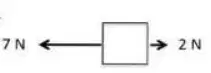
Determine the net force on the box in the free-body diagram. (Be sure to include the correct units.)
a)
7 N
b)
2 N
c)
5 N
d)
9 N
15.
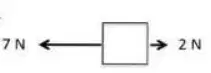
Determine if the forces are balanced or unbalanced.
a)
Balanced
b)
Unbalanced
16.
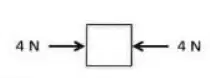
Determine the net force on the box in the free-body diagram. (Be sure to include the correct units.)
a)
4 N
b)
0 N
c)
8 N
17.
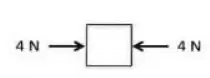
Determine whether the forces are balanced or unbalanced.
a)
Unbalanced
b)
Balanced
18.
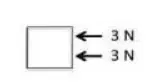
Determine the net force on the box in the free-body diagram. (Be sure to include the correct units.)
a)
3 N
b)
0 N
c)
6 N
19.
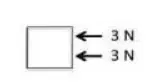
Determine whether the forces are balanced or unbalanced.
a)
Balanced
b)
Unbalanced
20.
The more you change its shape, the more ____________ energy the spring contains.
a)
potential
b)
kinetic
c)
gravitational potential
d)
electrical
21.
A _________ is a back-and-forth or an up-and-down movement of an object.
a)
Wave
b)
Amplitude
c)
Wavelength
d)
Vibration
22.
A material in which a wave travels is called a ___________.
a)
Medium
b)
Vaccuum
c)
Space
d)
Amplitude
23.
The regions of a longitudinal wave where the particles in the medium are closest together are ________.
a)
Compressions
b)
Rarefactions
24.
The regions of a longitudinal wave where the particles of the medium are farthest apart are ____________.
a)
Compressions
b)
Rarefactions
25.
For any wave, the larger the amplitude, the more ________ the wave carries.
a)
Weight
b)
Energy
c)
Crest
d)
Trough
26.
All the following are examples of potential energy due to forces in fields, except:
a)
Electric potential energy
b)
Gravitational potential energy
c)
Magnetic potential energy
d)
Elastic potential energy
27.
________ is the bouncing of a wave off a surface.
a)
Bouoyancy
b)
Reflection
c)
Absorption
d)
Diffraction
28.
_______ is the transfer of energy by a wave to the medium through which it travels.
a)
Bouyancy
b)
Reflection
c)
Absorption
d)
Diffraction
29.
Without ________ we would not hear sound waves on the other side of doors.
a)
Reflection
b)
Absorption
c)
Transmission
d)
Diffraction
30.
The speed of a sound wave depends on the material in which it travels.
a)
True
b)
False
31.
The _____ of a material also affects the speed of a sound wave.
a)
Reflectivity
b)
Solubility
c)
Temperature
d)
Softness
32.
The potential energy of an object _____________ as its height increases.
a)
decreases
b)
increases
c)
stays the same
33.
_________ is the change in direction of a wave when it travels by the edge of an object or through an opening.
a)
Reflection
b)
Transmission
c)
Refraction
d)
Diffraction
34.
All the following about diffraction are true, except: _____
a)
Causes waves to travel around the edges of an object.
b)
Causes waves to spread out after they travel through an opening.
c)
Less occurs as the size of the object or opening becomes similar in size to the wavelength of the wave.
35.
How many main parts are there in the ear?
a)
1
b)
2
c)
3
d)
4
e)
5
36.
Temperature can affect the speed of mechanical waves.
a)
True
b)
False
37.
Sound waves travel at the same speed in solids, liquids, and gases.
a)
True
b)
False
38.
A signal can be all of the following, except:
a)
Stored
b)
Encoded
c)
Convex
d)
Transmitted
39.
An advantage of transmitting information with waves is that they do not permanently move ___________.
a)
Waves
b)
Matter
c)
Light
d)
Sound
40.
A(n) ____________ is a thin strand of glass or plastic that can transmit a beam of light over long distances.
a)
Radio wave
b)
Sound wave
c)
Light wave
d)
Optical Fiber
41.
Two ways to modulate a wave are to change the wave's __________ or the wave's ___________.
a)
Amplitude (AM); Wavelength (XM)
b)
Frequency (FM); Amplitude (AM)
c)
Frequency (FM); Wavelength (XM)
d)
Amplitude (AM); Speed (SM)
42.
When a pendulum is swinging, it has mass and speed. So, it has _______________.
a)
Gravitational potential energy
b)
Kinetic energy
c)
Mechanical energy
43.
Microphone feedback happens when __________ signals interfere with each other.
a)
Microwave
b)
Digital
c)
Electronic
d)
Sound
44.
The information in signals deteriorates as noise ______________.
a)
Decreases
b)
Increases
45.
Radio signals are _________.
a)
Digital
b)
Analog
46.
A digital thermometer displays _______________ values. Each value has a specific amount and is not __________.
a)
Abstract; continuous
b)
Discrete; variable
c)
Abstract; variable
d)
Discrete; continuous
47.
A signal to or from a computer is encoded into _____________, such as the two values--on(1) or off(0).
a)
Morse code
b)
Binary numbers
c)
Braille
48.
A device that receives and translates a digital signal is only expecting one of the two values, __________________.
a)
On or Off
b)
Yes or No
c)
Right or Wrong
d)
Left or Right
49.
Your computer saves music as _____________ information.
a)
Analog
b)
Digital
c)
Sirius
50.
The thermometer calculates the temperature based on the _____________, and displays the value.
a)
Heat
b)
Moving particles
c)
Resistance
d)
Current
51.
For a signal to be understood, the information is decoded, then sent.
a)
True
b)
False
52.
Signals can be transmitted long distances by using electromagnetic waves such as radio waves, microwaves, or light waves.
a)
True
b)
False
53.
As the ball moves downward, its potential energy _____________ because its height decreases.
a)
increases
b)
decreases
c)
stays the same
54.
Almost every time you make a phone call, use a computer, or watch a television show, you are using electromagnetic technology.
a)
True
b)
False
55.
Electromagnetic waves travel slowly.
a)
True
b)
False
56.
As a wave moves closer to its source, it can mix with other signals.
a)
True
b)
False
57.
A signal that changes continuously over time, such as a clock, is a digital signal.
a)
True
b)
False
58.
Think about a radio that does not sound clear. The radio sent the signal correctly, but noise accumulated on the signal.
a)
True
b)
False
59.
The information in the signal is converted into numbers or digits.
a)
True
b)
False
60.
A digital photo holds one color value at one location called a pixel.
a)
True
b)
False
61.
Sounds and images sent by digital signals are usually less clear than those sent by analog signals.
a)
True
b)
False
62.
To retrieve digital information, the device you are using must be able to transmit the specific digital signal.
a)
True
b)
False
63.
The advancement of digital technology leads to further advancement of science.
a)
True
b)
False
64.
Ferromagnetic elements include all of the following, except:
a)
iron
b)
nickel
c)
silicon
d)
Cobalt
65.
A magnetic force is a contact force which means it can apply a force without being in direct contact with another object.
a)
True
b)
False
66.
___________ is the transfer of energy to an object by a force that makes the object move in the direction of the force.
a)
Motion
b)
Energy
c)
Work
d)
Kinetic energy
67.
All magnets have two poles – a ____ and a ____. (Choose 2)
a)
North
b)
East
c)
South
d)
West
68.
If similar poles of two magnets, such as north and north, are brought near each other, the magnets repel.
a)
True
b)
False
69.
If opposite poles of two magnets are brought near each other, the magnets repel.
a)
True
b)
False
70.
______ is stored energy that is the result of interactions of magnetic poles in a magnetic field.
a)
Magnetic potential energy
b)
Elastic potential energy
c)
Gravitational potential energy
d)
Potential energy
71.
A ______ is a region in a magnetic material in which the magnetic fields of the atoms all point in the same direction.
a)
Magnetic Field
b)
Magnetic Domain
c)
Magnetic Pole
d)
Magnetic Force
72.
Earth’s magnetic poles and geographic poles are in the same spot.
a)
True
b)
False
73.
As the distance between charged objects increases, the electric force between them increases.
a)
True
b)
False
74.
Stored energy due to interactions of charges in an electric field is called _______.
a)
Gravitational potential energy
b)
Electric potential energy
c)
Magnetic potential energy
d)
Elastic potential energy
75.
An object is _______ when it has an unbalanced amount of positive charge or negative charge.
a)
Magnetically charged
b)
Fully charged
c)
Electrically charged
d)
Chemically charged
76.
When a box falls to the floor, it ______________.
a)
breaks
b)
does nothing
c)
does work on the floor
d)
has the most potential energy
77.
An object that has gained charged particles as it comes in contact with another object has an unbalanced electric charge.
a)
True
b)
False
78.
What does a wave transfer?
a)
Matter
b)
Energy
c)
Friction
d)
Water
79.
When a wave’s energy is transferred to an object, rather than being transmitted though it or reflected by it, It is_______________.
a)
Reflected
b)
Transmitted
c)
Absorbed
d)
Refracted
80.
When a wave bounces off a surface and moves in a different direction it is called_________
a)
Refraction
b)
Reflection
c)
Absorption
d)
Transmission
81.
An optical illusion that makes a straw in water appear to be bent or broken is caused by___________?
a)
Reflection
b)
Absorption
c)
Refraction
d)
transmission
82.
Which color roof might help keep your house a little warmer?
a)
Black because it absorbs
b)
White because it absorbs
c)
The color will make no difference
83.
Light shining through a glass window to provide natural sunlight in a house is an example of ____________?
a)
Absorption
b)
Refraction
c)
Reflection
d)
transmission
84.
When you look at a lake and it looks shiny, what is this an example of?
a)
Reflection
b)
Absorption
c)
Refraction
d)
Transmission
85.
Objects or substances that absorb any wavelength of electromagnetic radiation become warmer and_______.
a)
Produce a gas
b)
convert the absorbed energy to infrared radiation (heat)
c)
Convert the absorbed energy into chemical energy
d)
Reflect back twice as much energy
86.
When light hits a red wagon, some of the energy is absorbed and___________.
a)
Red light is reflected
b)
Red light is absorbed
c)
Blue light is reflected
d)
All light is absorbed
87.
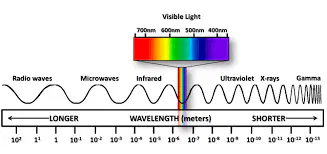
What color has a longer wavelength?
a)
Red
b)
Blue
c)
Green
d)
Violet
88.
Why do things appear green?
a)
They reflect green wavelengths of light
b)
They absorb green wavelengths of light
c)
Only green wavelengths of light hit it
89.
What is true about electromagnetic waves with a higher frequency? (Choose all that apply)
a)
They have a longer wavelength
b)
They have more energy
c)
They have less energy
d)
They have a shorter wavelength
90.
What is the absorption of light?
a)
Light hits an object and does not leave
b)
Light bounces off an object
c)
Light changes its frequency
d)
Light changes its wavelength
91.
What happens to light when its wavelength changes?
a)
It slows down
b)
It changes color
c)
Nothing else changes
92.
What property of a wave is related to the brightness of the color?
a)
wavelength
b)
frequency
c)
amplitude
93.
If the frequecy of a wave decreases, what happens to the wavelength?
a)
The wavelenght gets shorter
b)
The wavelength gets longer
c)
The wavelength stays the same
94.
What color has the highest frequency?
a)
violet
b)
red
c)
blue
d)
green
95.
What part of the electromagnetc spectrum is given off by the sun?
a)
Only visible light
b)
Visible light, Ultraviolet light, Radio waves
c)
All of the electromagnetic spectrum
96.
How does a prism affect the wavelengths of white light?
a)
White light is bent and separated into different wavelengths (color)
b)
White light is tall turned into one different wavelength (color)
c)
White light stays white
97.
Why do some objects look black?
a)
Light never hits those objects
b)
They reflect all wavelengths of visible light
c)
They absorb wavelength of visible light
d)
They absorb every wavelength of visible light except they reflect black wavelengths
98.
Why do some objects look white?
a)
They reflect all wavelengths of visible light
b)
Only white light hits the object
c)
They reflect white wavelengths of visible light
d)
The absorb all wavelengths of visible light
99.

Which angle is the angle of incidence?
a)
𝛳₂
b)
𝛳₁
100.
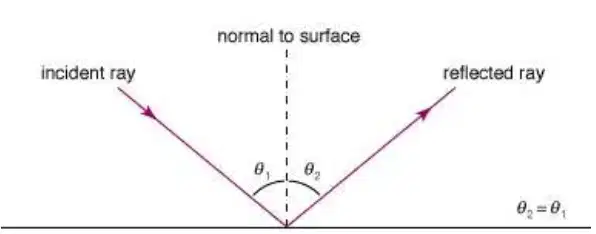
Which angle is the angle of reflection?
a)
𝛳₂
b)
𝛳₁
101.
Why is it cooler to wear white clothing on a hot, sunny day?
a)
White objects reflect all of the energy from the light.
b)
White objects absorb all of the energy from the light.
c)
White objects transmit all of the energy from the light.
d)
White objects refract all of the energy from the light.
102.
We are able to see objects because they
a)
reflect light into our eyes
b)
refract light into our eyes
c)
absorb light.
d)
diffract light into our eyes.
103.
Light does not need a medium to travel through.
a)
True
b)
False
104.
The imaginary line perpendicular to the reflecting surface is called:
a)
Focal line
b)
Normal
c)
Regular
d)
Reflection ray
105.
Reflection of light from a rough surface is called:
a)
Regular reflection
b)
Normal reflection
c)
Rough reflection
d)
Diffuse reflection
106.
When light moves into a medium with a lower index of refraction it:
a)
speeds up
b)
changes direction
c)
slows down
d)
stays the same
107.
Each of the following are primary light colors, Except:
a)
Red
b)
Green
c)
Yellow
d)
Blue
108.
When you look at a lake and it looks shiny, what is this an example of?
a)
Refraction
b)
Diffraction
c)
Reflection
109.
The distance along the optical axis between the axis and the focal point is called:
a)
Reflection ray
b)
Normal
c)
Axis length
d)
Focal length
110.
A lens that is thicker in the middle than at the edges is a:
a)
Concave mirror
b)
Concave lens
c)
Convex mirror
d)
Convex lens
111.
Alphonse is having dinner with his family. He looks at his sister through his glass of water and sees that she looks much smaller. Alphonse knows that refraction is a behavior of light that can cause this distortion.
What other light behavior must be happening for Alphonse to see this?
a)
Transmission
b)
Reflection
c)
Absorption
112.
Adella is in class wearing her favorite blue jacket. She knows that the jacket appears blue because it reflects blue light and absorbs all other colors of light.
In terms of waves, what do reflection and absorption mean?
a)
Reflection is when a wave's energy is taken in by a material
b)
Absorption is when a wave's energy is taken in by a material
c)
Absorption is when a wave's energy bounces off of a material
d)
Reflection is when a wave's energy bounces off of a material
113.
An object with equal amounts of positive charge and negative charge is ___________.
a)
Electrically Positive
b)
Electrically Negative
c)
Electrically Neutral
114.
Electrically neutral objects do not attract or repel each other.
a)
True
b)
False
115.
An electric insulator is a material in which charges cannot easily move.
a)
True
b)
False
116.
The total charge in a system CANNOT change.
a)
True
b)
False
117.
Transfer of charged particles between two conductors is ______.
a)
Conduction
b)
Induction
c)
Production
d)
Conjunction
118.
Electrically charged objects always attract each other.
a)
True
b)
False
119.
All simple circuits contain all of the following, except: _______.
a)
A source of electric energy
b)
An electric device
c)
An electric motor
d)
An electric conductor
120.
When a circuit is complete and energy flows through the circuit, it is called an open circuit.
a)
True
b)
False
121.
Electric energy does not flow through a(n) _______.
a)
Closed System
b)
Open System
c)
Simple Circuit
d)
Complex Circuit
122.
The measure of the potential energy difference is made in _______.
a)
Amps
b)
Ohms
c)
Volts
d)
Joules
123.
The 3 V battery has a potential energy difference of 6 V between the positive and negative side.
a)
True
b)
False
124.
When electric energy is transferred to a light bulb, the electric energy becomes ____ and ____ energy. (Choose 2)
a)
Light
b)
Thermal
c)
Kinetic
d)
Potential
125.
The voltage measured across a portion of a circuit indicates how much energy is transferred in that portion of the circuit.
a)
True
b)
False
126.
Resistance is measured in ____________.
a)
Amps
b)
Volts
c)
Ohms
127.
Voltage is measured in ____________.
a)
Amps
b)
Volts
c)
Ohms
128.
A magnetic field surrounds all moving charged particles.
a)
True
b)
False
129.
The strength of the magnetic field around a current-carrying wire decreases when the wire is wound into a coil.
a)
True
b)
False
130.
A temporary magnet made with a current-carrying wire coil wrapped around a magnetic core is called a(n) ______.
a)
permanent magnet
b)
magnetic current
c)
electromagnet
d)
electric motor
131.
A(n) _______ is a device that uses an electric current to produce motion.
a)
Electric current
b)
Electromagnet
c)
Electric motor
d)
Permanent magnet
132.
An electric motor includes all the following, except: _________
a)
A wire coil connected to a rotating shaft
b)
A permanent magnet
c)
A temporary magnet
d)
An electric energy source
133.
Almost any device that needs to produce motion uses a(n) electric motor.
a)
True
b)
False
134.
To produce an electric current, a magnet is moved through a wire coil that is part of a(n) ______ electric circuit.
a)
Open
b)
Closed
135.
A(n) __________ is a device that uses a magnetic field to transfer mechanical energy to electric energy.
a)
Electric generator
b)
Electric motor
c)
Magnetic motor
d)
Magnetic generator
136.
The rotating coils transfer _________.
a)
Electric energy to mechanical energy
b)
Mechanical energy to electric energy
c)
Kinetic energy to potential energy
d)
Thermal energy to mechanical energy
137.
An electric current that flows in one direction is ________.
a)
Direct Current
b)
Alternating Current
Reset

