
 Worksheets
1.4-8 HBIO
Total questions: 54
Worksheet time: 1hrs 21mins
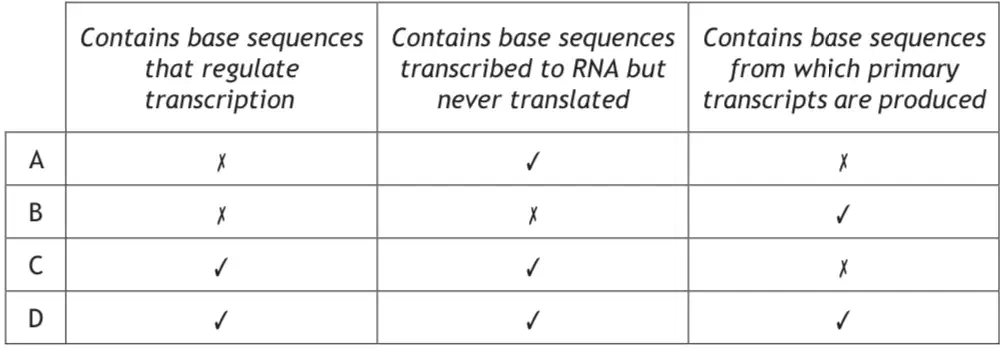
Which line in the table below shows features of the human genome?
A
B
C
D
The following are events in the evolution of life on Earth.
1 Animals appear
2 Vertebrates appear
3 Land plants appear
In which order are these events thought to have occurred?
1 2 3
1 3 2
3 1 2
3 2 1
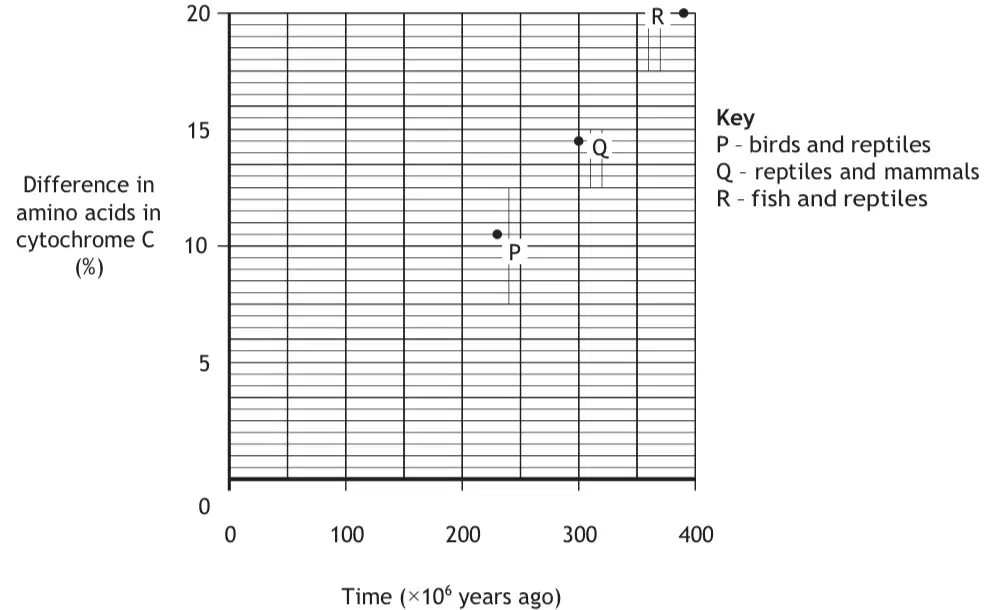
The graph below shows a molecular clock which compares the amino acid sequences in the protein cytochrome C in various vertebrate groups.From the information in the graph, which vertebrate groups shared a common ancestor most recently?
fish and reptiles
Birds and mammals
Reptiles and mammals
Birds and reptiles
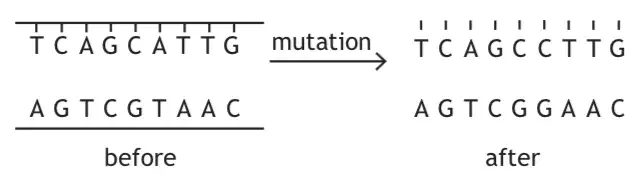
The type of mutation shown is…
Deletion
Substitution
Insertion
Inversion
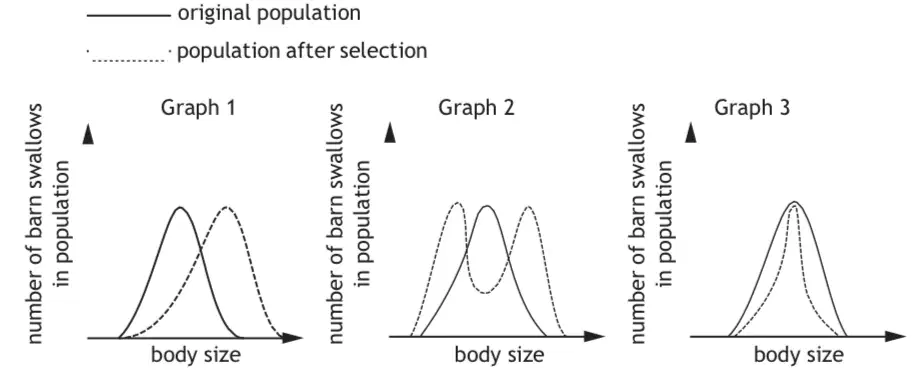
The graphs below show possible changes in the body size of a population of barn swallows, Hirudino rusticana, in response to a selection pressure.Which row in the table below matches each graph with the type of selection taking place?
1-disruptive
2-directional
3-stabilising
1-directional
2-disruptive
3-stabilising
1-stabilising
2-disruptive
3-directional
1-directional
2-stabilising
3-disruptive
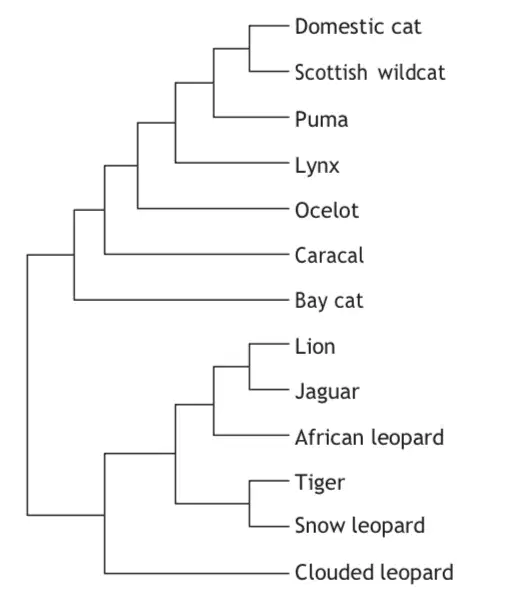
With how many species does the African leopard share a common ancestor in this phylogenetic tree?
2
5
12
13
New species have evolved when two populations
have become
isolated by a behavioural barrier
unable to interbreed to produce fertile offspring
very different due to directional selection
very different due to disruptive selection.
Each type of human cell has a different structure and function because
only some of their genes are expressed
they contain different genes
some genes are lost during differentiation
some genes are gained during differentiation.
The list describes some uses of stem cells.
1 Studying how cells differentiate
2 Researching the development of Parkinson’s disease
3 Producing skin for skin grafts
4 Bone marrow transplants
Which of these uses are not therapeutic?
1 only
1 and 2 only
2 and 4 only
3 and 4 only
The analysis of DNA sequences from different organisms is used in the production of molecular clocks.
This analysis is based on the assumption that over time DNA sequences undergo mutations
Randomly
Spontaneously
At a varying rate
At a constant rate
Embryonic stem cells can be used therapeutically to differentiate and replace any damaged or diseased tissue.
This is because they are
multipotent and specific genes are switched on
pluripotent and all genes are switched on
multipotent and specific genes can be switched on
pluripotent and all genes can be switched on.
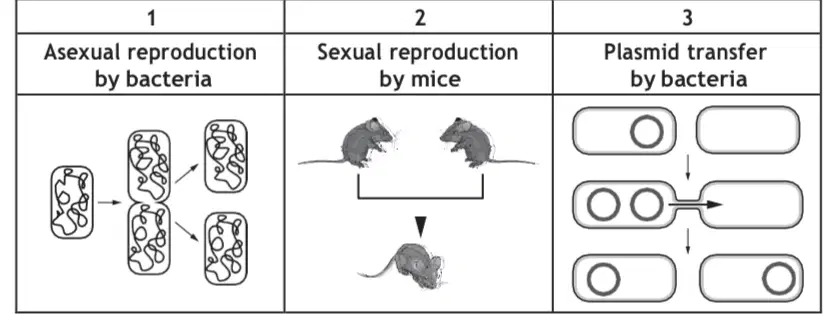
The table shows three examples of gene transfer. Which of these examples illustrate horizontal gene transfer?
2 only
3 only
1 and 2 only
1 and 3 only
Sickle cell anaemia is a human condition that affects haemoglobin, reducing the blood’s ability to carry oxygen. It is caused by a mutation that changes one adenine base to thymine. This results in one amino acid in haemoglobin being changed. The mutation that causes sickle cell anaemia is
Deletion
Insertion
Substitution
Translocation
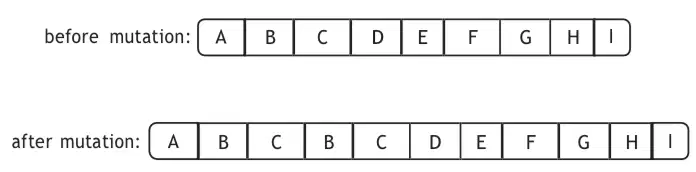
The diagram shows the arrangement of genes on a chromosome before and after a mutation.Which type of mutation has taken place?
Inversion
Insertion
Duplication
translocation
he protein dystrophin contains 3684 amino acids. A mutation in the dystrophin gene causes cells to produce a protein with 2428 amino acids.
Which type of mutation could have caused this?
Nonsense
Duplication
Missense
Inversion
Define cellular differentiation
(a)
What does cellular differentiation allow
(a)
Regions of unspecialised cells in animals
(Adult) Stem cells
Embryonic stem cells
Meristems
Cells in the very early embryo can differentiate into all the cell types that make up the organism and so are..
Pluripotent
Multipotent
Multicellular
Singular
Tissue stem cells are involved in the growth, repair and renewal of the cells found in that tissue. They are..
Pluripotent
Multipotent
Multicellular
Singular
All the genes in embryonic stem cells can be switched ___
On
Off
Tissue stem cells are multipotent as they can differentiate into ..
(a)
involve the repair of damaged or diseased organs or tissues.
Therapeutic uses
Research uses
involve stem cells being used as model cells to study how diseases develop or being used for drug testing.
Therapeutic uses
Research uses
The genome of a organisms is its..
(a)
Most of the eukaryotic genome consists of
Non-coding sequences
Coding sequences
DNA sequences that code for protein are defined as
(a)
Which of these are DNA sequences that do NOT code for proteins
Genes
Regulate
Transcribed but never translated
Non-translated forms of RNA
tRNA
rRNA
mRNA
Missense mutations
result in one amino acid being changed for another. This may result in a non-functional protein or have little effect on the protein.
result in a premature stop codon being produced which results in a shorter protein.
result in some introns being retained and/or some exons not being included in the mature transcript.
cause all of the codons and all of the amino acids after the mutation to be changed. This has a major effect on the structure of the protein produced.
Nonsense mutations
result in one amino acid being changed for another. This may result in a non-functional protein or have little effect on the protein.
result in a premature stop codon being produced which results in a shorter protein.
result in some introns being retained and/or some exons not being included in the mature transcript.
cause all of the codons and all of the amino acids after the mutation to be changed. This has a major effect on the structure of the protein produced.
Splice-site mutations
result in one amino acid being changed for another. This may result in a non-functional protein or have little effect on the protein.
result in a premature stop codon being produced which results in a shorter protein.
result in some introns being retained and/or some exons not being included in the mature transcript.
cause all of the codons and all of the amino acids after the mutation to be changed. This has a major effect on the structure of the protein produced.
Frame-shift mutations
result in one amino acid being changed for another. This may result in a non-functional protein or have little effect on the protein.
result in a premature stop codon being produced which results in a shorter protein.
result in some introns being retained and/or some exons not being included in the mature transcript.
cause all of the codons and all of the amino acids after the mutation to be changed. This has a major effect on the structure of the protein produced.
What nucleotide mutation relates in frame-shift mutations
Insertion
Deletion
Substitution
where a section of a chromosome is added from its homologous partner.
Duplication
Deletion
Inversion
Translocation
where a section of a chromosome is removed.
Duplication
Deletion
Inversion
Translocation
where a section of chromosome is reversed.
Duplication
Deletion
Inversion
Translocation
where a section of a chromosome is added to a chromosome, not its homologous partner.
Duplication
Deletion
Inversion
Translocation
Define evolution
(a)
Define natural selection
(a)
an average phenotype is selected for and extremes of the phenotype range are selected against.
Stabilising selection
Directional selection
Disruptive selection
one extreme of the phenotype range is selected for.
Stabilising selection
Directional selection
Disruptive selection
two or more phenotypes are selected for.
Stabilising selection
Directional selection
Disruptive selection
is where genes are transferred between individuals in the same generation.
Horizontal gene transfer
Vertical gene transfer
is where genes are transferred from parent to offspring as a result of sexual or asexual reproduction.
Horizontal gene transfer
Vertical gene transfer
Natural selection is more rapid in
Prokaryotes
Eukaryotes
importance of isolation barriers
(a)
What barriers lead to allopatric speciation
Geographical
Behavioural
Ecological
What barriers lead to sympatric speciation
Geographical
Behavioural
Ecological
What barriers lead to allopatric speciation
Geographical
Behavioural
Ecological
To compare sequence data, computer and statistical analyses
Bioinformatics
Phylogenetics
the study of evolutionary history and relationships.
Bioinformatics
Phylogenetics
3 domains of life
Bacteria
Archaea
Eukaryotes
Yeast
An individual’s genome can be analysed to predict the likelihood of developing ..
(a)

