
 Worksheets
Physics Review (ULOG, Momentum, Energy, Coulomb's Law)
Total questions: 88
Worksheet time: 54mins
A bicycle rider is traveling up a hill. When the rider reaches the top of the hill, she stops to rest. Then she travels down the hill. Which statement correctly describes the potential energy and the kinetic energy of the bicycle rider?
As the rider moves up the hill, her kinetic energy increases, and her potential energy decreases.
As the rider reaches the bottom of the hill, her kinetic energy and her potential energy decrease.
When the rider is at the top of the hill, her potential energy is the greatest, and her kinetic energy is the least.
When the rider goes down the hill, her potential energy increases, and her kinetic energy decreases.
Conservation of energy means that
energy can be created but not destroyed
energy can be destroyed but not created
energy can be both created and destroyed
energy can be neither created nor destroyed
Which is the best example of an object with only potential energy?
water being poured out of a pitcher
a ball being thrown across a field
a boulder resting on top of a cliff
a boat sailing through the water
As a boulder rolls from the top of a hill to the bottom, how does its potential and kinetic energy change?
Potential and kinetic energy both increase.
Potential energy increases and kinetic energy decreases.
Potential energy decreases and kinetic energy increases.
Potential and kinetic energy both increase.

Students are investigating changes from potential to kinetic energy by rolling a marble down a ramp made by propping up a plastic ruler on a book and letting it roll down.
Which of the following will change the potential energy the marble starts with?
Adding more books beneath the ruler to increase its height
Pushing the marble down the ramp
Switching the plastic ruler with a wooden one
Replacing the marble with a rock
A bicycle and passenger car are both moving at a velocity of 15 miles per hour. Which has more kinetic energy?
the bicycle because it has less mass
They are both moving at the same velocity, therefore they have equal kinetic energy.
It is impossible to know as both are moving at the same velocity
the car because it has more mass

The illustration shows a roller coaster and indicates four different positions the car might be at as it moves along the track.
At which point in the roller coaster's journey is its potential energy the greatest?
W
X
Y
Z
Which of the following changes will increase the kinetic energy of a snowball at the top of a hill?
melting the snowball with the sun
moving the snowball to a lower hill
pushing the snowball as it rolls down the hill, increasing its velocity
all of the above
If a green golf ball is dropped from a height of 7 feet and a yellow golf ball is dropped from a height of 12 feet, which ball has greater potential energy before it is released?
yellow
green
Both have the same amount of potential energy.
Neither will have more potential energy than the other.
When a roller coaster reaches the bottom of a steep slope, it has-
low PE and high KE
high PE and low KE
low PE and low KE
high PE and high KE
Energy is measured in
Kilograms
Joules
Liters
Centimeters
All energy, potential and kinetic, within a specific system is called
total energy
radiant energy
light energy
recyclable energy

What would the force between them be if the distance between them were doubled?

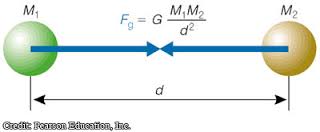
Complete the following statement: The farther away two planets are the _______ the gravitational force between them.
more
same
doesn't matter
less
Which configuration will result in the greatest gravitational force?
small masses far apart
large masses far apart
small masses close together
large masses close together

What happens to the force between two charged objects when you double the distance between them?
it doubles
it is cut in half
it quadruples
it is cut by 1/4

If one of the charges doubles, what happens to the force?
it doubles
it gets cut in half
it quadruples
it is cut by 1/4
What is the unit for electrostatic charge?
Coulombs
Newtons
Meters
Joules

What would a negative value for Fe mean?
The particles are moving away from each other
The particles have the same charge
The particles have opposite charges
The particles are moving towards each other
What does "r" measure?
the distance between the two charged objects
the amount of charge carried by the objects
the amount of force between two charged objects
the constant value for forces between the objects
What will be the units of F (or Fe)?
Newtons
Meters
Coulombs
Joules

As the value of r increases, what happens to the value of F?
F increases
F decreases
F never changes, q does
Cannot know from the information
What does q measure?
the distance between the two charged objects
the amount of charge carried by the object
the amount of force between two charged objects
What can you do to increase the value of k?
change the force
change the distance
change the charge
nothing can be done to change the value of k; it is a constant
Which of the following charges will attract each other?
-4 μC & -5 μC
4 μC & 5 μC
4 C & 5 C
-4 μC & 5 μC
What is the value of Coulomb's Constant?
9 x 10⁹ Nm2/C-2
8.987 Nm2/C-2
8.987 x 10¹¹ Nm2/C-2
7.1 x 104.5 Nm2/C-2


The image shows two charged particles with a force of 2.4 N. What would you predict the force of interaction would be when the magnitude of charge on q2 doubles?
9.6 N
4.8 N
1.2 N
.6 N

The image shows two charged particles with a force of 2.4 N. What would you predict the force of interaction would be when the distance doubles?
4.8 N
1.2 N
.6 N
.3 N

What direction will the charge in the middle move?
to the right
to the left
stay still
it's a mystery

What direction will the charge in the middle move?
to the right
to the left
stay still
it's a mystery

What direction will the charge in the middle move?
to the right
to the left
stay still
it's a mystery

What direction will the charge in the middle move?
to the right
to the left
stay still
it's a mystery

What direction will the charge in the middle move?
to the right
to the left
stay still
it's a mystery

What direction will the charge in the middle move?
to the right
to the left
stay still
it's a mystery

What direction will the charge in the middle move?
to the right
to the left
stay still
it's a mystery

What direction will the charge in the middle move?
to the right
to the left
stay still
it's a mystery

The graph shows the relationship between the force of interaction and the magnitude of charge. What type of relationship is this?
Direct
Indirect
Inverse
Reverse
What will happen to two positive charges placed near each other?
They will attract.
They will repel.
They will not do anything.
They will go out for lunch.
If the amount of charge increases, the force...
stays the same
gets weaker
gets stonger
turns into soup
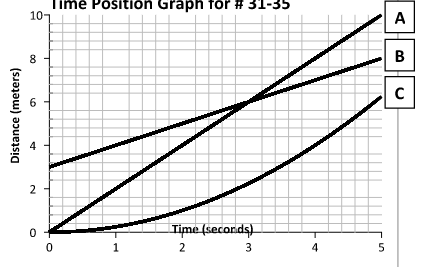
Who among the following sprinters got a cheeky head start in the race?
Sprinter A
Sprinter B
Sprinter C

From the 3rd second to the 5th second of your journey, what is the object doing?
Is it cruising at a steady pace?
Is it accelerating, eager to reach its destination?
Is it taking a break and not moving at all?
Or is it slowing down, taking in the sights?

Can you guess what this intriguing graph is trying to tell us?
Is it showing constant speed?
Could it be representing acceleration?
Or is it indicating that nothing is moving?
Imagine you're in a high-speed race! On a distance vs. time graph, what does a steeper slope indicate?
Does it mean you're slowing down?
Or does it mean you're speeding up?
Does it indicate less acceleration?
Or does it mean greater acceleration?

Can you guess what's happening at point E?
Is it stationary?
Or, is it accelerating?
Could it be moving at a fast steady speed, away from the starting position?
Or, is it returning to the start position at a steady speed?
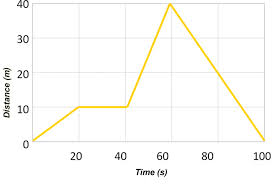
Imagine you're a time traveler! How long did it take for you to zip back to your starting point in your time machine?
20 s
30 s
60 s
100 s
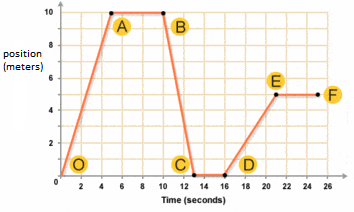
Imagine you're on a rollercoaster ride! Can you tell what's happening from point B to C on this thrilling graph?
You're zooming down a steep hill.
You're making your way back to the starting point.
You're slowing down to enjoy the view.
You're at a standstill, taking a breather.
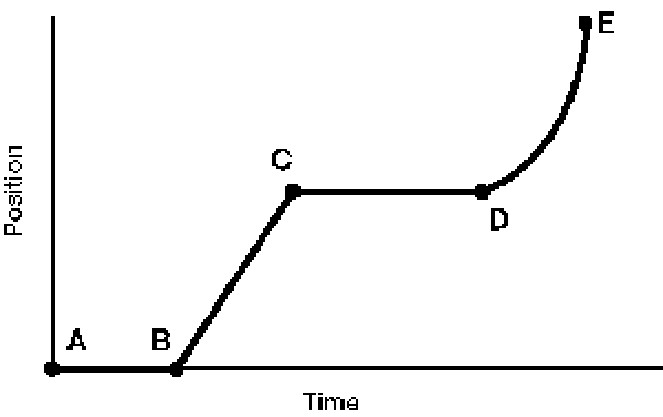
Let's play a fun game! Can you tell me when the speed of our imaginary object is changing? Is it during interval:
A-B
B-C
C-D
D-E
From t=1.0 second to t=3.0 seconds, what do you think the object is doing?
Is it moving at a constant speed, just like a time machine?
Is it speeding up, like a rocket?
Is it not moving, like a statue?
Or is it slowing down, like a snail?
Imagine you're a scientist plotting a position-time graph. On which axis would you plot the position (distance)?
x
y
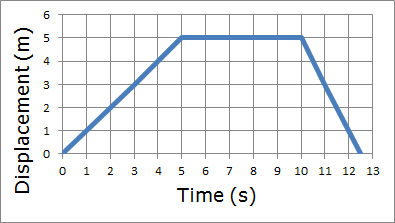
Imagine you're watching a person on a graph. Can you tell how far they've travelled in the first 5 seconds?
2 m
10 m
0 m
5 m
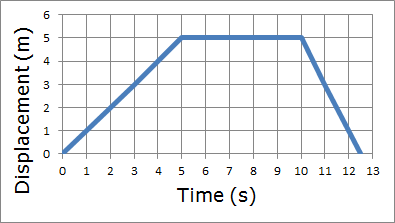
Can you guess what the person was up to between the 5th and 10th second? It's a fun challenge!
Was he leisurely strolling?
Or maybe he was running?
Could he be standing still?
Or was he walking briskly?
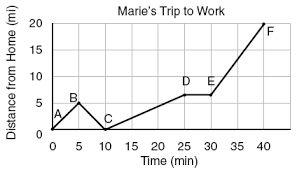
Can you guess when Marie was zooming her car the fastest?
Was it from C to D?
Or maybe D to E?
Could it be E to F?
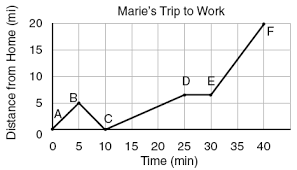
Can you guess why Marie suddenly stopped moving at the 27-minute mark?
Did she decide to become a speedster because she was running late?
Did she remember she left her favorite book at home and dashed back to retrieve it?
Was she patiently waiting for a red light to change?
Was she carefully navigating across the peak of a hill?
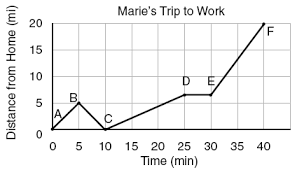
Marie usually zooms to work in 30 minutes. Did her journey today take...
The usual time.
Longer than the usual time.
Shorter than the usual time.
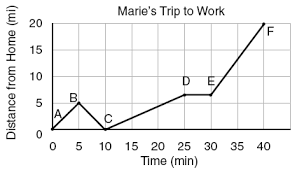
Guess how far Marie's workplace is from her cozy little house?
40 mi
25 mi
20 mi
5 mi
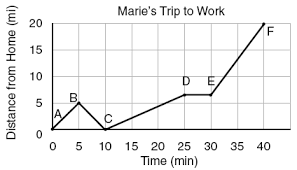
Can you guess how far Marie traveled before she decided to turn back?
20 mi
5 mi
10 mi
25 mi
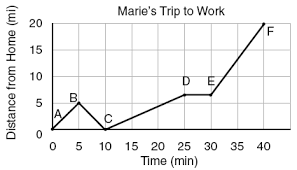
Can you guess when Marie took a break from her journey?
Was it within the first 5 minutes?
Or did she stop between 5-10 minutes?
Maybe she paused at 10-25 minutes?
Or was it later, between 25-30 minutes?
Imagine you're a superhero flying through the sky! What would the slope of your position-time graph represent as you soar?
The distance you've flown
Your displacement in the sky
Your velocity or speed
Your acceleration or how fast you're speeding up
Imagine you're a scientist studying motion and you're looking at a velocity-time graph. Can you tell what the slope of this graph represents?
The total distance travelled
The displacement from the starting point
The speed at which you're moving
The rate at which your speed is changing, also known as acceleration

