
 Worksheets
last chapterrr :)))
Total questions: 122
Worksheet time: 31hrs 30mins
Left atria to left ventricle thru what?
Tricuspid
Bicuspid or mitral valve
In an activated lymphocyte, it produces two types of daughter cells which one has long-lived cells that retain the ability to start dividing on short notice if antigen is presented to immune cells again at a later date
Effector cells
memory cells
Clonal deletion
clonal selection
In an activated lymphocyte it produces two types of daughter cells, which one carrys out the attack on the antigen bearing pathogen (B cells produce antibody, T cells release cytokines and destroy antigen bearing cells)
Clonal deletion
clonal selection
effector cells
memory cells
method by which self-reactive T or B cells are removed during immune system development so that they cannot damage self tissues is what ?
Clonal deletion
clonal selection
effector cells
memory cells
antigen binding will select for and cause proliferation of T and B cells specific to antigens that are recognized during infection is what?
Clonal selection
Clonal deletion
Effector cells
memory cells
Out of the 4 key traits of the specific immune system, which one has :
* immune system can remember a pathogen after encountering it once
* Will allow for a faster response time in subsequent exposures
*The basis for vaccines
Diversity
Immunologic memory
distinguish self from non-self
specificity
Out of the 4 key traits of the specific immune system, which one has antigenic determinants from pathogens or foreign substances will activate specific immune cells
Diversity
Immunologic memory
Specificity
Distinguish self from non-self
Out of the 4 key traits of the immune system, which one has the immune system to know what is self and not attack or become activated by these determinants
Specificity
Distinguish self from non-self
Diversity
Immunologic memory
out of the 4 key traits of specific immune system, which one has :
* T cells and B cells will develop reactivity to specific proteins and pathogenic components during every infection - antigens
* T cells and antibodies produced by B cells recognize antigens – cellular determinants on the pathogen of foreign substance
Specificity
Distinguish self from non-self
Diversity
Immunologic memory
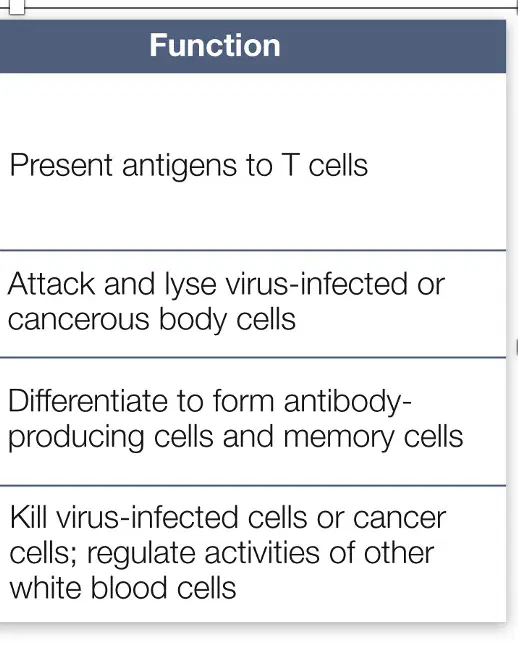
(Adaptive (specific) Immune cells)
Put them in order from top to bottom
1.Dendritic cells
2.
B Lymphocytes
3.Natural killer cells
4.
T Lymphocytes
1. Dendritic cells
2. Natural killer cells
3.
B Lymphocytes
4.
T Lymphocytes
1. Natural killer cells
2.
B Lymphocytes
3.
T Lymphocytes
4. Dendritic cells
1.Natural killer cell
2. B Lymphocytes
3.Dendritic cells
4. T lymphocytes
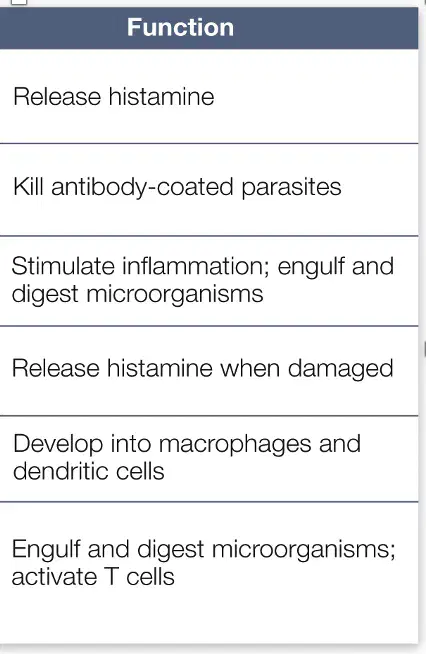
(Innate (Granulocytes) Immune cells)
Put the type of cell that correlates to each function ( from top to bottom)
Basophils
Eosinophils
Neutrophils
Mast cells
Monocytes
Macrophages
Eosinophils
Basophils
Mast cells
Monocytes
Neutrophils
Macrophages
Eosinophils
Mast cells
Basophils
Monocytes
Neutrophils
Macrophages
Basophils
Eosinophils
Mast cells
Monocytes
Neutrophils
Macrophages
In lymphocytes, this cell differentiate and mature in the bone marrow, and makes antibodies which enter the blood and bind non-self proteins
B cells
T cells
Lymphocytes
Granular cells
In white blood cells, a type of lymphocytes mature in the thymus, have killing ability, secrete many inflammatory chemicals is what?
T cells
B cells
Granular cells
RBC
In white blood cells, what participate in specific defenses against non-self or altered cells and can kill and rid body of virus infected cells or tumor cells
Granular cells
T cells
B cells
Lymphocytes
In white blood cells, what is the histamine producing cells and phagocytes
Granular cells
Lymphocytes
T cells
B cells
Have nuclei and can leave closed circulatory system and enter tissues where injury may have occurred or pathogens have gained entrance
White blood cells
RBC
T cells
B cells
In the non-specific defenses, what has low pH no suitable for survival of many bacteria
Gastric Juice of the stomach
Defensins
Mucus
Lysozyme
In the non-specific defenses, what provides peptides produced by the mucous membranes and is also toxic to a wide range of pathogens (bacteria and viruses)
Mucus
Skin
Gastric juice of the stomach
Defensins
In the non-specific defenses, what has enzyme produced in mucus, tears, saliva and Can attack walls of many bacteria
Mucus
Skin
Lycozyme
Defensins
In the non-specific defenses, what causes secretion found on mucus membranes. Traps microorganisms.
Skin
Mucus
Lysozyme
Defensins
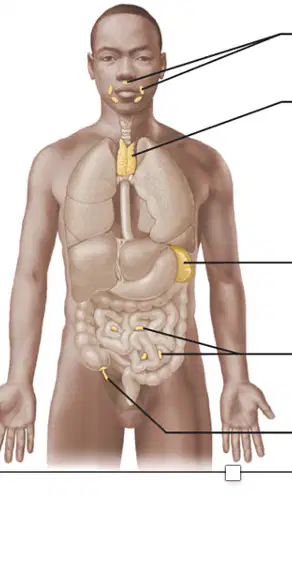
In the secondary lymphoid organs, what is the third arrow pointing to? ( From top to bottom)
Tonsils
Thymus
Spleen
Appendic
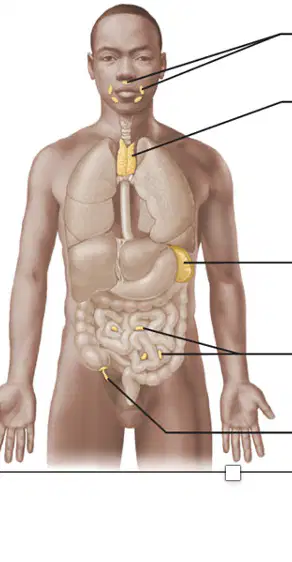
In the secondary lymphoid organs, what is the second arrow pointing to? ( from top to bottom)
Spleen
Tonsils
Appendix
Thymus
In non-specific defenses, what prevents entry of pathogens and foreign substances
Skin
Mucus
Lysozyme
Defensins
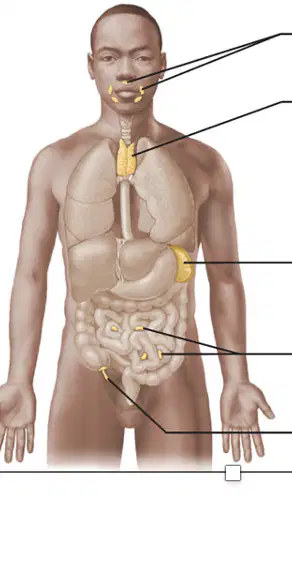
In this secondary lymphoid organs, what is the first top arrow pointed to?
Tonsils
Thmus
Spleen
Appendix
areas of immune cell activation when pathogens reach the blood
Spleen
Thymus
Tonsils
Site of T cell maturation
Tonsils
Thymus
Spleen
immune cells can be activated after exposure to pathogens in our upper respiratory tract
Tonsils
Thymus
Spleen
*fluid component of the blood
* Contains ions, soluble proteins,
molecules
* Red and white blood cells
suspended in plasma
These are characteristics of what?
Blood plasma
Lymph
Lymph nodes
Spleen
*fluid derived from tissues and blood
* Accumulates in extracellular spaces
* Lymph moves through the lymphatic
system for filtration
These are characteristics of what?
Blood plasma
Lymph
Lymph nodes
spleen
In the defense system against pathogens, which phase has mobilized cells and molecules they generate destroys the invader
recognition Phase
Activation phase
Effector Phase
In the defense system agasint pathogens, which phase "recognition leads to mobilization of cells capable of fighting off foreign invader"
Recognition Phase
Activation Phase
Effector Phase
In the defense system against pathogens, which phase has the ability to discriminate self from non-self?
Recognition Phase
Activation Phase
Effector Phase
harmful organisms and viruses that can cause disease are called what?
Viruses
mobilized cells
RBC
pathogens
In the Bicarbonate buffer sytem, the mixture of what two compounds to maintain blood pH levels?
Carbonic acid, and Sodium bicarbonate
Carbonic acid, and fatty acid
Sodium bicarbonate and HCI
Carbonic acid and NaCI
In a blood buffer, when pH rises, H+ does what?
Releases
Binds up
In a blood buffer, when pH drops, H+ does what?
Binds up
releases
Blood pH must be maintained between what?
7.35-8.45
7.35-7.45
6.89-7.21
what regulates sodium ion concentration in extracellular fluid
Anti-diuretic hormone
thirst mechanism
Aldosterone
Edema
what prevents excessive water loss in kidney?
Aldosterone
Anti-diuretic hormone
Thirst mechanism
Edema
Reabsorption of water and electrolytes by kidney is regulated primarily by what?
Nerves
Hormones
RBC
Tubular filtration
driving force for water intake
Thirst mechanism
Aldosterone
Anti-diuretic hormone
urine
Out of the 3 processes for urine formation, which one has H+, K+, creatinine, and drugs that are removed from peritubular blood and secreted by the tubule cells into the filtrate
Tubular secretion
Tubular reabsorption
Glomerular filtration
Out of the 3 processes for urine formation, which one has water, glucose, amino acids, and has needed ions are transported out of the filtrate into the tubule cells and enter the capillary blood
Glomerular filttration
Tubular Reabsorption
Tubular Secretion
Out of the 3 processes of urine formation, which one has water and solutes smaller than proteins that are forced through the capillary walls and pores of the glomerular capsule into the renal tubule
Glomerular filtration
Tubular reabsorption
Tubular secretion
In urine formation, choose the correct order of the processes?
1. Glomerular filtration
2.Tubular reabsorption
3.Tubular secretion
1. Tubular reabsorption
2.Glomerular filtration
3.Tubular secretion
1. Tubular secretion
2. Glomerular filtration
3. Tubular reabsorption
in a nephron, it has two capillary beds, which one arises from the efferent arteriole that drains the glomerulus
Glomerular capillary bed
peritubular capillaries
in the nephron, there are two capillary beds, which one is the afferent arteriole which is the feeder vessel
Glomerular capillary bed
peritubular capillaries
the structural and functional units of the kidney thats also responsible for forming urine
nephrons
Glomerulus
uric acid
feces
what is highly toxic and must be excreted continuously or detoxified (is a nitrogenous waste)
NH3
CO2
NO2
H2O
End products of protein and nucleic acid metabolism are?
Water and CO2
CO2
Water
Nitrogenous wastes
semi-solid product contains undigested food, mucus, bacteria, water
villi
goblet cells
feces
microvilli
End products of carbohydrate metabolism and fats ( that are easy to eliminate) are?
Water and CO2
Water and O2
nitrogenous wastes along with water and CO2
nitrogenous watse
what does the large intestine NOT have?
Villi
Microvilli
circular folds
feces
what does the large intestine do compared to small intestine
large intestine helps digest food while small helps with water absorption and elimination
large intestine helps with water absorption and elimination while small digests food
what is the difference in the processes of
1. glycogenesis
2.glycogenolysis
3.gluconeogenesis
1.glycogen formation
2.glycogen splitting
3. formation of new sugar
1.glycogen splitting
2.glycogen formation
3.formation of new sugar
1. glycogen splitting
2.formation of new sugar
3. glycogen formation
what stores glucose from the blood in large polysaccharide molecule called glycogen
liver
kidney
pancreas
small intestine
what stores bile until needed for emulsifying fats
Bile salts
Gall bladder
pancreas
liver
what emulsify fats
Bile salts
Gall bladder
liver
pancreas
what produces bile which is yellow-green watery solution containing bile salts, pigments, cholesterol, phospholipids, and electrolytes
Liver
Kidney
Gallbladder
small intestine
What is the largest gland in the body
Kidney
Liver
heart
large intestine
What pancreatic juice digests nucleic acids
Trypsin
Lipases
Nuclease
Pancreatic amylase
What pancreatic juice is the only source of enzyme capable of fat digestion
Lipases
Nuclease
Pancreatic amylase
Trypsin
what pancreatic juice completes about half of protein digestion
Pancreatic amylase
Trypsin
Lipases
Nuclease
what pancreatic juice completes digestion of starch?
Pancreatic amylase
Trypsin
Lipases
Nuclease
* Triangular gland of the abdomen
* Produces enzymes that bread down digestible food
* Alkaline fluid neutralized acidic chyme coming from stomach
These characteristic describe what?
Pancreas
Liver
Small Intestine
Large Intestine
transport cholesterol around the body for use in biosynthesis and storage – “bad cholesterol”
HDLs
LDLs
remove cholesterol from tissue and carry it to the liver where it can be used to synthesize bile – “good cholesterol”
HDLs
LDLs
which one has a lower density than the other?
fat
protein
particle made up of a core of hydrophobic fat and cholesterol with a covering of hydrophilic protein that allows it to be suspended in water
Lipoproteins
Chylomicrons
Micelles
Villi
particles of fat
Chylomicrons
micelles
nutrients
fatty acid
what are lipid soluble, pass through the plasma membranes of microvilli in
small intestine
Micelles
Chylomicrons
Nutrients
Villi
deep folds of mucosa and submucosa layers in the structure in the wall of the intestine that increase absorptive surface.
Villi
Circular folds
microvilli
fingerlike projections of the mucosa, rich with capillary beds for absorption in the structure thats in the intestine wall to increase absorptive surface.
Villi
Circular folds
microvilli
tiny projections of plasma membrane of mucosa cells in the structure of the intestine wall that increase absorptive surface.
Microvilli
Villi
circular folds
body’s major digestive organ, extends from stomach to large intestine
small intestine
large intestine
pancreas
liver
produce local hormones (Gastrin) important in digestion
Cheif cells
parietal cells
enterendocrine cells
produce hydrocloric acid, makes stomach contents acidic and activates other enzymes – pepsinogen to pepsin
chief cells
parietal cells
enteroendocrine cells
produce protein digesting enzymes (pepsinogens)
chief cells
parietal cells
enteroendocrine cells
small vessel connecting the pulmonary artery with the descending thoracic aorta – allows detour of blood around the lungs and directly into the system
Foramen ovale
Ductus Arteriosus
opening in the septum between the left and right atria – blood bypasses the fetal lungs
Foramen Ovale
Ductus Arteriosus
its waves of smooth muscle contractions and
Occurs in esophagus, small intestine, large intestine, urinary tract
Baroreceptors
Defecation
Peristalsis
Ingestion
Deficiency in such vitamin results in fatigue, skin disorder, mental disorders, and anemia
A
D
K
B
Deficiency in such vitamin result in blood clotting problems
A
B
K
C
Deficiency in such vitamin results in rickets
A
B
C
D
Deficiency in such vitamin results in Anemia, and oxidative damage to cells
D
B
E
A
Deficiency in such vitamin results in night blindness
A
C
K
B
Deficiency in this vitamin results in scurvy and slow healing
C
A
B
E
Elements needed in tiny amounts such as (copper, iron, iodine, zinc)
Micronutrient
Macronutrient
Elements required in large amounts such as(calcium, chlorine, phosphorus, sodium, potassium)
Macronutrient
Micronutrient
What are the building blocks for all proteins
Amino acids
fatty acid
ascorbic acid
Hydrochloric acid
Vitamins and minerals
Major nutrients
Minor nutrients
carbonhydrates, lipids, protiens, water
Major nutrients
minor nutrients
Rids the body of indigestible remains
defecation
absorption
digestion
ingestion
Nutrients enter the bloodstream
Defecation
Absorption
Digestion
Ingestion
Breaks food down physically and chemically
digestion
ingestion
Absorption
defecation
Taking in food
ingestion
digestion
absorption
defecation
drains the digestive organs, spleen, and pancreas and deliver blood to liver through the Hepatic Portal Vein
Hepatic portal vein
Just look at it :)
chemoreceptors in large arteries signal rise of ___ levels
CO2
O2
glucose
blood pressure
changes in pressure or stretch in blood vessels within the aortic arch and carotid sinus.
baroreceptors
mechanoreceptors
chemical-receptors
nocicreceptor
Nervous system activity that controls heart rate and vessel constriction originates in the what?
Medulla
pons
spinal cord
blood is returned to the heart via what?
Veins
RBC
arteries
tissue
travel of gases (O2, CO2) and small solutes along concentration gradient
Diffusion
osmotic pressure
Filtration
determined by large protein molecules in vessle and
When blood pressure falls, fluid travels back into vessels
Filtration
osmotic pressure
Diffusion
Blood enters capillary beds through high pressure arterioles that causes some fluid from blood to leave the arterioles and enter the interstitial space
Filtration
osmosis
Diffusion
prevent or stop bleeding
platelets
RBC
White blood cell
cell fragments broken off of large cells called Megakaryocytes
and are packed with enzymes and chemicals necessary for clotting
platelets
RBC
white blood cells
Bundle of His
what reservoir for blood and helps filter out and eliminate dead and dying RBCs
spleen
platelets
kidney
liver
life span of an RBC is how many days?
100 days
90 days
95 days
99 days
at a normal condition, bone marrow produces how many RBC every second?
2 million
3 million
1 million
4 million
RBC are controlled by the hormone erythropoietin released by the ___ in response to insufficient oxygen
Kidney
stomach
liver
heart
Help fight off infections or diseases
red blood cell
white blood cell
transport respiratory gases (O2 and CO2)
Red blood cell
white blood cell
most of blood cells are erythrocytes, which are?
Red blood cells
white blood cells
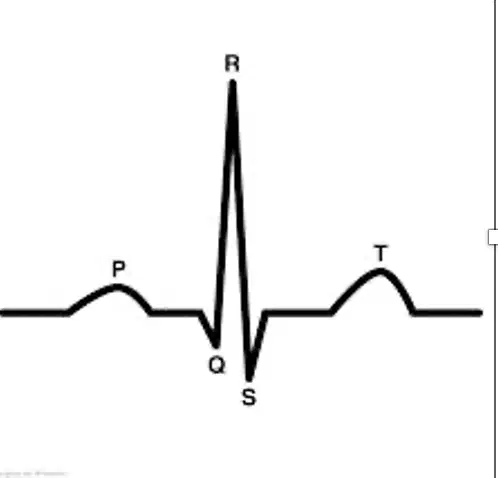
which letter represents the relaxation and repolarization of the ventricles?
P
Q,R,S
T
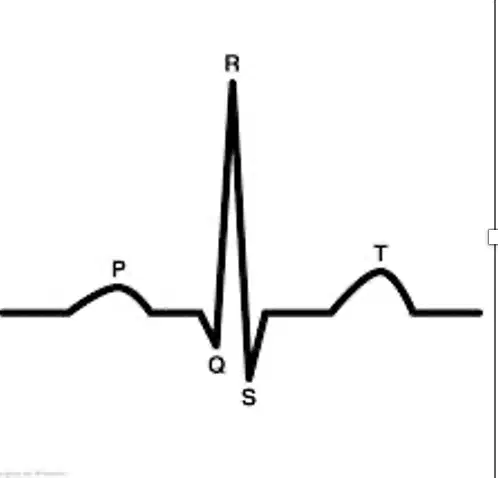
which letter represents the depolarization and contraction of ventricles?
P
Q,R,S
T
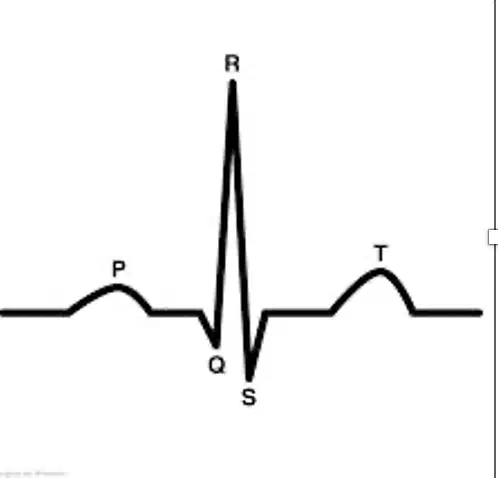
which letter represents the depolarization of the atrial muscle
P
Q,R,S
T
Electrical events in the cardiac muscle during the cardiac cycle can be recorded by electrodes on the skin, what is the recording?
ECG
ECB
ECD
ECC
activates conduction fibers ( Bundle of His )
sinoatrial node
atrioventricular node
purkinje fibers
atria
what is the pacemaker of the heart?
sinoatrial node
atrioventricular node
Bundle of His
Purkinje fibers
relaxation of the ventricles
diastole
systole
contraction of the ventricles
systole
diastole
contraction of the two atria followed by the two ventricles and then relaxation
cardiac cycle
Pulmonary valve and aortic valve
atrioventricular valves
systemic system

